MP1000

Search documents
精锋医疗-手术机器人先行者商业化进展提速;首次覆盖,给予超配评级
2026-02-25 04:08
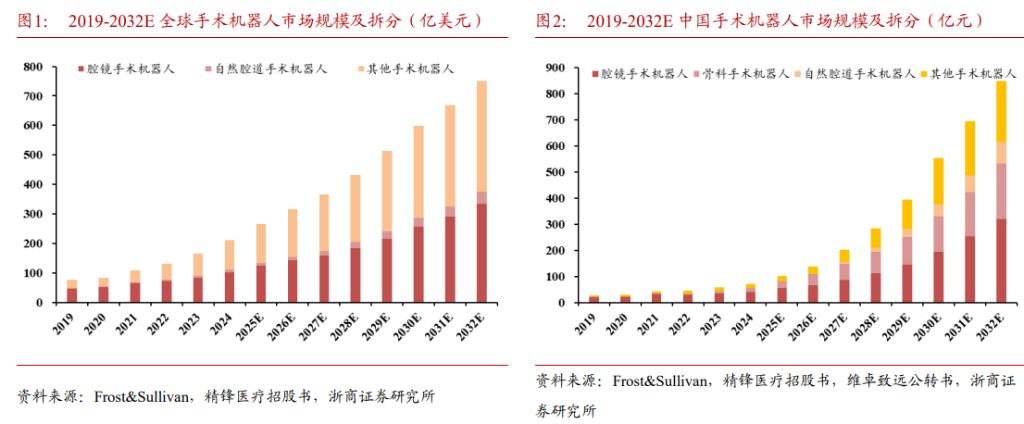
Summary of the Conference Call on Shenzhen Edge Medical Company Overview - **Company**: Shenzhen Edge Medical (精锋医疗) - **Industry**: Surgical Robotics - **Rating**: Overweight (OW) - **Target Price**: HKD 75 Key Points Market Potential - The global surgical robotics market is projected to grow from USD 21.2 billion in 2024 to USD 84.2 billion by 2033, reflecting a compound annual growth rate (CAGR) of 16.6% [2] - The Chinese market is expected to increase from RMB 7.2 billion to RMB 102 billion during the same period, with a CAGR of 34.3%, outpacing global growth [2] - Factors driving growth include policy support, accelerated import substitution, and increasing industry penetration [2] Competitive Position - Shenzhen Edge Medical is positioned as a leading player in the minimally invasive surgical robot sector, benefiting from strong early momentum in overseas markets and the highest market share in new domestic orders [1][2] - The company’s flagship product, the MP1000, has received both NMPA and CE certifications, demonstrating competitive performance comparable to Intuitive Surgical's da Vinci system [3] Product Portfolio - The product lineup includes: - **MP1000**: A four-arm endoscopic surgical robot - **SP1000**: A single-arm system for narrow space surgeries, approved in China and the EU - **CP1000**: A bronchoscopic robot approved in China [3] - The company is focusing on expanding its pipeline to include new indications such as pediatric and cardiac surgeries, remote surgery, and advanced imaging technologies [3] Financial Projections - Revenue is expected to grow at a CAGR of 46% from 2026 to 2028, with a target price reflecting a 21x price-to-sales (P/S) ratio for 2027 [4] - The company anticipates reaching breakeven in net profit by 2026, with significant contributions from the MP series products and related consumables [21] Risks - Key risks include: - Early-stage commercialization challenges - Potential adverse regulatory changes affecting reimbursement and pricing - Slower-than-expected international expansion - Increased competition and technological risks [4][27] Regulatory Environment - Recent national pricing guidelines for surgical robots in China aim to standardize pricing and improve market conditions, which could benefit domestic manufacturers like Shenzhen Edge Medical [17] - The inclusion of 5G remote surgery in reimbursement frameworks is expected to provide additional support for the company [17] International Expansion - The company has seen a significant increase in overseas orders, with over 70 units sold in 2025 compared to approximately 5 in 2024 [18] - Key markets include Europe, Latin America, and the Asia-Pacific region, which collectively represent about 50% of the global surgical robotics market opportunity [2][18] Analyst Insights - The company is expected to qualify for inclusion in the Hang Seng Composite Index, which could attract additional investment [20] - The preference for domestic brands among hospitals is increasing, indicating potential for market share growth despite current low penetration [11][14] Conclusion - Shenzhen Edge Medical is well-positioned to capitalize on the structural growth opportunities in the surgical robotics market, supported by a strong product portfolio, favorable market dynamics, and a robust financial outlook. However, it must navigate various risks associated with early-stage commercialization and competitive pressures.

国产手术机器人,走到哪一步了?
机器人圈· 2026-01-28 09:46
Core Insights - The article highlights that the Chinese surgical robot market is transitioning from an early development phase to a rapid growth phase, driven by the implementation of the medical insurance bureau's pricing policy and accelerated overseas market expansion [1][3]. Market Size and Growth - The Chinese surgical robot market is projected to grow from approximately 7.2 billion RMB in 2024 to 76.7 billion RMB by 2032, representing a compound annual growth rate (CAGR) of about 34% [2][5]. - In comparison, the global market is expected to increase from 21.2 billion USD to 75 billion USD during the same period, with a CAGR of around 17%, indicating that China's growth rate significantly outpaces the global average [2]. Market Segmentation - Laparoscopic surgical robots are expected to dominate the market, accounting for 58% of the total market size in 2024, with a projected CAGR of 29% from 2024 to 2032, reaching 32.1 billion RMB by 2032 [5]. - The orthopedic surgical robot market follows closely, with a market share of 26% in installed capacity and 22% in sales revenue. The CAGR for this segment is anticipated to be 41%, reaching 21.3 billion RMB by 2032 [5]. Policy Impact - The year 2026 is identified as a critical turning point due to the establishment of a national pricing framework, which will address the economic concerns of hospitals regarding the adoption of surgical robots [7][9]. - The medical insurance bureau's guidelines released on January 20, 2026, categorize surgical robots into four types and provide a clear reimbursement structure, which is expected to facilitate product adoption in hospitals [9]. International Expansion - The article notes that the Chinese surgical robot market currently accounts for only about 5% of the global market, indicating significant potential for overseas expansion [10]. - Leading domestic companies are rapidly entering international markets, with notable achievements such as MicroPort's 160 global commercial orders and the increasing share of overseas revenue for companies like Precision Medical [10]. Business Model - The surgical robot business model is likened to the "razor and blades" model, where the primary revenue source comes from consumables and services rather than just equipment sales [11][12]. - Companies are encouraged to focus on increasing installed base as a key indicator for future cash flow, with the potential for high-value orthopedic consumables sales being a critical factor for profitability [12].


国产手术机器人,走到哪一步了?
Hua Er Jie Jian Wen· 2026-01-23 09:04
Core Viewpoint - The domestic surgical robot industry is at a critical turning point from "concept validation" to "scale profitability" with the implementation of medical insurance policies and accelerated overseas market expansion [1] Market Size and Growth - The Chinese surgical robot market is projected to grow from 7.2 billion RMB in 2024 to 76.7 billion RMB by 2032, representing a compound annual growth rate (CAGR) of approximately 34% [2][3] - In comparison, the global market is expected to increase from 21.2 billion USD to 75 billion USD during the same period, with a CAGR of about 17%, indicating that China's growth rate significantly outpaces the global average [3] Segment Analysis - Laparoscopic surgical robots will dominate the market, accounting for 58% of the total market size in 2024, with a projected CAGR of about 29% from 2024 to 2032, reaching 32.1 billion RMB by 2032 [6] - The orthopedic surgical robot market follows closely, with a projected CAGR of 41% from 2024 to 2032, reaching 21.3 billion RMB by 2032 [6] Policy Impact - The year 2026 is identified as a pivotal moment for policy implementation, addressing the issue of "who pays" for surgical robots, which has been a barrier to adoption [8][9] - The release of the medical insurance guidelines on January 20, 2026, will clarify the reimbursement framework, significantly easing the entry barriers for surgical robots into hospitals [9] International Expansion - The Chinese surgical robot market currently accounts for about 5% of the global market, indicating substantial overseas market potential [10] - Leading domestic companies are rapidly expanding into international markets, with significant orders and certifications achieved, such as MicroPort's 160 global commercial orders and the CE certifications for various products [10][11] Business Model - The surgical robot industry follows a "razor and blades" business model, where the primary revenue comes from consumables and services rather than just equipment sales [12] - Companies are encouraged to focus on increasing installation base as a key leading indicator for future cash flow, similar to the strategy employed by Intuitive Surgical [12]