5G远程手术

Search documents
微创机器人20260304
2026-03-04 14:17
Summary of the Conference Call for MicroPort Robotics Company Overview - **Company**: MicroPort Robotics - **Industry**: Surgical Robotics Key Points Revenue Growth and Projections - MicroPort Robotics is entering a revenue explosion phase, with expected growth from zero to 560 million CNY from 2021 to 2025 [2] - Anticipated continued high growth in 2026, with a potential break-even point in 2027 [2] Research and Development - R&D expenses peaked in 2022 and are now on a downward trend as the product matrix becomes more complete [2] - The focus is shifting towards commercialization and global expansion [2] - R&D expenses are expected to decrease from 2023 to 2025, reflecting a more complete product layout and progress in commercialization [3] Market Dynamics - The overseas market is becoming a core growth driver, with export growth expected to surpass domestic growth by 2025 [2] - Anticipated overseas orders in 2026 are projected to reach between 120 to 200 units, with a 5-year compound annual growth rate (CAGR) of 25% to 30% [2][20] Competitive Landscape - Domestic market share of the Da Vinci system has decreased from 67% to over 40% due to accelerated domestic alternatives [2] - MicroPort's "TUMAI" series is closing the technology gap with Da Vinci, reducing the time lag to 5 years [2] Policy Environment - Positive policy changes are expected, with a faster issuance of registration certificates by 2025 and an increase in medical insurance coverage in Beijing and Shanghai to 60%-80% [2][8] - The price of surgeries is projected to decrease to 20,000-30,000 CNY, which will encourage more procedures to be covered by insurance [11] Clinical Value of Robotic Surgery - Robotic surgery enhances visualization and precision, reducing the surgeon's physical burden and potentially extending their careers [4] - The technology allows for remote operations, addressing the uneven distribution of medical resources [4] Market Size and Trends - The global surgical robotics market is expected to reach approximately 20 billion USD by 2024, with laparoscopic surgical robots accounting for nearly 50% of this market [5] - The penetration rate of laparoscopic surgical robots in the U.S. is projected to be around 22% by 2024, while in China, it is currently less than 1% [6] Pricing and Competition - The price of the Da Vinci system is around 18 million CNY, while domestic alternatives range from 10 million to 13 million CNY [7] - Increased competition is expected as more domestic brands enter the market, with a focus on competitive bidding prices [7] Future Outlook - The company expects a significant increase in overseas orders in 2026, with a baseline expectation of 120 units and a potential for 200 units based on recent order trends [20] - Long-term growth is projected to maintain a CAGR of over 50%, with profitability expected by 2027 [21] Challenges and Opportunities - The transition from project approval to insurance coverage remains challenging, dependent on procedure maturity and local insurance capabilities [11] - The increasing number of domestic manufacturers and competitive pricing may facilitate broader insurance coverage in the future [11] Product Strategy - The TUMAI series combines multi-port, single-port, and 5G remote surgery capabilities to offer diverse configurations [15] - The company is also expanding into orthopedic robotics and natural orifice robots, with the latter expected to see limited initial uptake [18] Conclusion - MicroPort Robotics is positioned for significant growth in the surgical robotics market, driven by innovative product offerings, favorable policy changes, and an expanding global market presence [2][20][21]
南京医生“隔空”切除300公里外患者肾脏肿瘤
Xin Lang Cai Jing· 2026-02-01 17:15
Core Viewpoint - The article highlights a groundbreaking remote surgery performed using a single-port robotic system, showcasing the integration of 5G technology in healthcare, which allows expert surgeons to operate on patients located hundreds of kilometers away, thus improving access to high-quality medical care for patients in remote areas [1][5]. Group 1: Surgical Innovation - The surgery was the world's first of its kind, utilizing a single-port robotic system for a kidney tumor removal, demonstrating significant advancements in minimally invasive surgical techniques [1]. - The procedure was conducted remotely, with the surgeon operating from over 300 kilometers away, emphasizing the potential of 5G technology in enhancing surgical precision and patient outcomes [1][5]. - The robotic system allowed for a single 3 cm incision, contrasting with traditional methods that require multiple incisions, thereby reducing recovery time and surgical trauma for the patient [2]. Group 2: Technological Integration - The surgery employed a dual-link transmission system of 5G and dedicated fiber optics, achieving a latency of under 20 milliseconds, which is critical for the success of remote operations [2]. - The robotic arms featured advanced capabilities, including 540-degree rotation and tremor filtering technology, enabling precise movements that surpass human dexterity [2][3]. - The use of a three-dimensional high-definition imaging system provided enhanced visualization of the surgical area, allowing for meticulous dissection and tumor removal [3]. Group 3: Collaborative Healthcare Model - The collaboration between Jiangsu Provincial Cancer Hospital and Lianyungang Second People's Hospital exemplifies a model where expert resources are shared, ensuring patient safety and enhancing local medical team capabilities [4][5]. - The remote surgery not only benefits patients by reducing travel burdens but also serves as a training opportunity for local medical staff, fostering skill development in advanced surgical techniques [4][5]. - The successful execution of this surgery is seen as a step towards the broader adoption of remote medical services, aligning with national strategies to improve healthcare access in underserved regions [6].
国产手术机器人,走到哪一步了?
Hua Er Jie Jian Wen· 2026-01-23 09:04
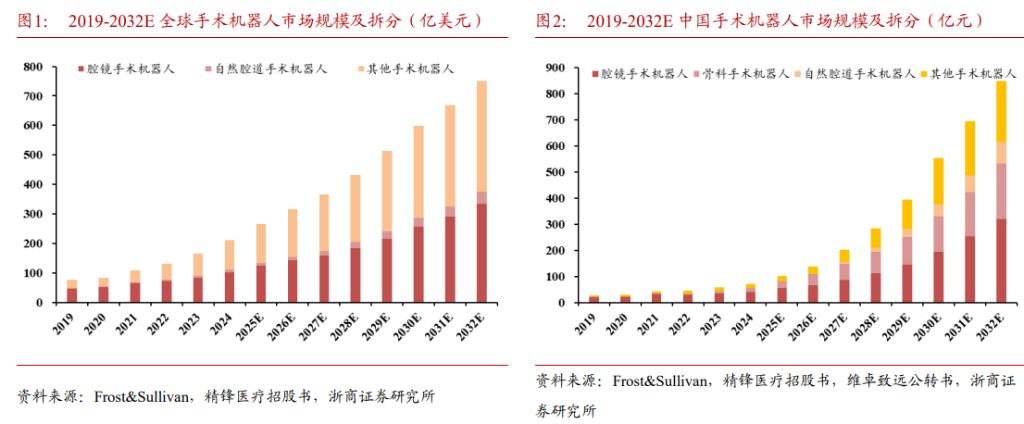
Core Viewpoint - The domestic surgical robot industry is at a critical turning point from "concept validation" to "scale profitability" with the implementation of medical insurance policies and accelerated overseas market expansion [1] Market Size and Growth - The Chinese surgical robot market is projected to grow from 7.2 billion RMB in 2024 to 76.7 billion RMB by 2032, representing a compound annual growth rate (CAGR) of approximately 34% [2][3] - In comparison, the global market is expected to increase from 21.2 billion USD to 75 billion USD during the same period, with a CAGR of about 17%, indicating that China's growth rate significantly outpaces the global average [3] Segment Analysis - Laparoscopic surgical robots will dominate the market, accounting for 58% of the total market size in 2024, with a projected CAGR of about 29% from 2024 to 2032, reaching 32.1 billion RMB by 2032 [6] - The orthopedic surgical robot market follows closely, with a projected CAGR of 41% from 2024 to 2032, reaching 21.3 billion RMB by 2032 [6] Policy Impact - The year 2026 is identified as a pivotal moment for policy implementation, addressing the issue of "who pays" for surgical robots, which has been a barrier to adoption [8][9] - The release of the medical insurance guidelines on January 20, 2026, will clarify the reimbursement framework, significantly easing the entry barriers for surgical robots into hospitals [9] International Expansion - The Chinese surgical robot market currently accounts for about 5% of the global market, indicating substantial overseas market potential [10] - Leading domestic companies are rapidly expanding into international markets, with significant orders and certifications achieved, such as MicroPort's 160 global commercial orders and the CE certifications for various products [10][11] Business Model - The surgical robot industry follows a "razor and blades" business model, where the primary revenue comes from consumables and services rather than just equipment sales [12] - Companies are encouraged to focus on increasing installation base as a key leading indicator for future cash flow, similar to the strategy employed by Intuitive Surgical [12]