Micro LED显示屏

Search documents
韩媒:LG Display正在开发Micro LED检测与返修技术
WitsView睿智显示· 2026-03-19 04:33
Core Viewpoint - LG Display is actively participating in a national R&D project for Micro LED technology, focusing on defect detection and repair processes, which are crucial for the commercialization of this next-generation display technology [2][3]. Group 1: Project Overview - The Micro LED project is supported by the Ministry of Trade, Industry and Energy and involves collaboration with UNIST, the Korea Display Industry Association, and relevant companies [2]. - LG Display's role includes process validation and performance evaluation, ensuring that the technology developed is applicable in real production scenarios [2]. Group 2: Micro LED Technology - Micro LED displays are made by transferring and arranging hundreds of thousands to millions of tiny LED chips on a substrate, offering superior brightness, lifespan, and energy efficiency compared to OLED technology [2]. - The manufacturing process faces challenges such as defective pixels due to the small size of the chips (5-100 micrometers), making defect detection and repair essential [3]. Group 3: Importance of Detection and Repair Technologies - Efficient detection and repair technologies are critical for maintaining production yield, as even a yield of 99.99% could still result in thousands of defective pixels [3]. - The industry recognizes that the development of integrated detection and repair technologies is imperative for improving production efficiency and reducing manufacturing costs [3]. Group 4: Investment and Future Prospects - The overarching project, "Development of Inorganic Emitting (iLED) Display Technology Ecosystem," has a total investment of 484 billion KRW and will run until 2032, encompassing various next-generation emitting technologies, including Micro LED [3][4]. - Specific tasks within the project include developing detection and repair technologies for both chip-replacement and non-chip-replacement Micro LED panels, with each task expected to take approximately 45 months [4].


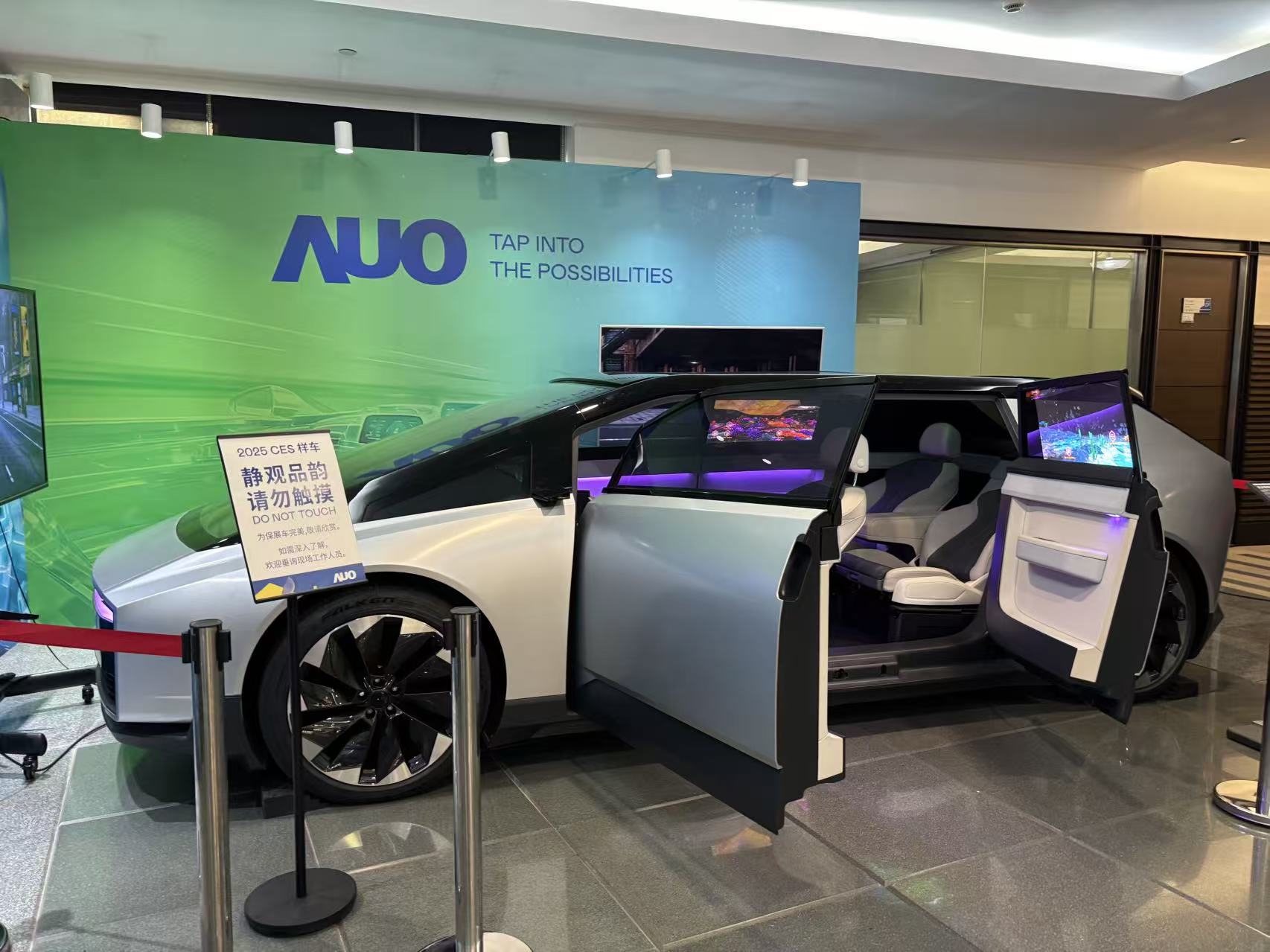
友达今年车载营收占比近三成,Micro LED明年批量上车
Di Yi Cai Jing· 2025-12-04 10:08
Core Insights - AUO's automotive business is projected to account for 27%-28% of its revenue this year, with expectations to exceed 40% in three years [2] - The company is focusing on Micro LED technology, which will see mass application in vehicles next year [2][3] - AUO's revenue last year was 62.65 billion RMB, and it is transitioning towards high-value automotive applications due to competition from mainland Chinese panel manufacturers [2] Group 1: Automotive Business Growth - AUO has restructured its business to focus on smart mobility, display technology, and vertical markets as its three main pillars [2] - The acquisition of German automotive parts supplier BHTC allows AUO to expand its automotive business from display panels to smart cockpit solutions [2] - Orders from international automakers will reflect in revenue in two to three years, while orders from mainland Chinese automakers will show results within a year, indicating sustained growth in AUO's automotive business [2] Group 2: Micro LED Technology - Micro LED displays offer advantages such as thinness, flexibility, wide viewing angles, low energy consumption, and long lifespan, but they are currently expensive [3] - AUO aims to reduce Micro LED costs by half every two years through expanded applications and component optimization, with costs expected to approach OLED levels by 2029-2030 [3] - Future applications of Micro LED in smart vehicles include head-up displays, central displays, smart windows, and intelligent driving interfaces [3] Group 3: Industry Outlook - Industry experts believe Micro LED will become a significant technology for automotive displays due to its high brightness and design flexibility [4] - Despite the potential, the high cost of Micro LED technology remains a challenge, and significant breakthroughs in yield improvement and supply chain collaboration are needed for widespread adoption [4] - Some manufacturers anticipate that Micro LED will achieve mass production by 2026, although initial output volumes may be limited [4]
显示与非显示应用拓展驱动,预计2029年Micro LED芯片产值将达4.608亿美元
TrendForce集邦· 2025-12-01 06:43
Core Insights - Micro LED technology is gradually penetrating various display applications, benefiting from improved manufacturing processes and the introduction of new products like AR glasses and smartwatches, with the chip value expected to reach $4.608 billion by 2029 [2] - In non-display applications, Micro LED is expanding into the optical interconnects sector, driven by AI server demand, which may enhance technology advancement and chip demand [2] Display Applications - The launch of Garmin's first Micro LED smartwatch, Fenix 8 Pro, signifies the industry's initial steps into high-value applications, although high power consumption and costs pose challenges for market acceptance compared to OLED [4] - Long-term trends indicate that Micro LED can meet the high brightness demands of outdoor environments for sports watches and has potential for integration with health monitoring and navigation features [4] Optical Interconnects - The increasing demand for data centers is driving the search for more economical light sources, with Micro LED offering low power efficiency, higher data transmission density, and better temperature stability, potentially leading to rapid cost reductions in the coming years [6]
百度、阿里、小米加快布局!智能眼镜赛道爆火!关键转折点要来了?
Zheng Quan Shi Bao· 2025-11-22 05:45
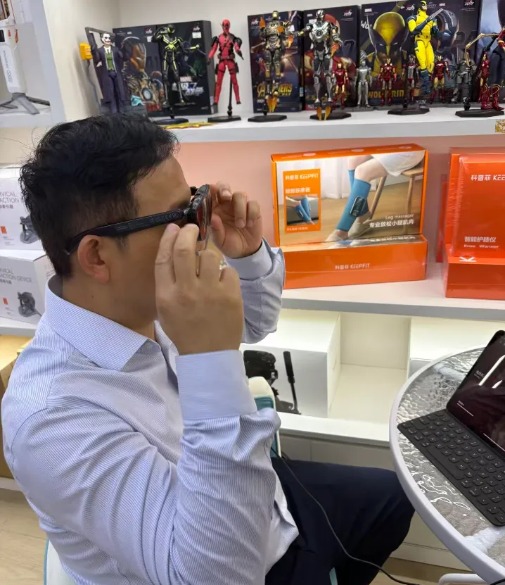
Core Insights - The smart glasses market, including XR and AI glasses, is experiencing strong growth driven by major tech companies like Baidu, Alibaba, and Xiaomi accelerating their investments and product launches [1][3][4] Market Growth - IDC predicts that by 2025, global smart glasses shipments will reach 12.8 million units, a 26% year-on-year increase, with China's market expected to surpass 2.75 million units, growing by 107% [4][5] - Tmall reports that as of October 30, the transaction volume for AI glasses has surged by 2500% year-on-year, while JD.com indicates a 346% increase in sales during the "Double 11" shopping festival [3] Product Development - Baidu has re-entered the smart glasses market after 11 years with the launch of its Xiaodu AI Glasses Pro, featuring multiple AI functionalities [3] - Apple has quietly released an upgraded version of its Vision Pro, while Alibaba plans to launch its first self-developed flagship dual-display AI glasses, Quark AI Glasses S1 [3] Industry Trends - The integration of AI and AR is seen as a key trend, with AR glasses being viewed as the optimal platform for AI technology to become part of daily life [4][10] - The average price of AI glasses is expected to stabilize around 1500 yuan, appealing to both tech enthusiasts and general consumers [7] Technological Advancements - Micro LED technology is being prioritized by display companies due to its advantages such as high pixel density and low power consumption, making it suitable for near-eye displays [11][12] - Companies like TCL and Liyade are actively developing Micro LED solutions for AR glasses, focusing on both B2B and B2C markets [12][13] Challenges and Future Outlook - Despite advancements, the Micro LED sector faces challenges related to cost, technology, and production efficiency [13] - The smart glasses market is expected to evolve through three stages, starting with lightweight AI glasses without displays, progressing to AI+AR single display, and ultimately achieving AI+AR dual full-color displays [9][10]
资本争相入局,Micro LED商业化还有多远?
WitsView睿智显示· 2025-10-24 10:23
Core Insights - The Micro LED industry is experiencing significant advancements in technology, product development, capacity planning, and ecosystem collaboration, particularly in applications such as AR glasses, smartwatches, automotive displays, and optical communication [2][6][24] - The AR sector has become a major focus for investment, with numerous financing rounds exceeding hundreds of millions, indicating strong capital interest in Micro LED technologies [3][5][24] Investment Trends - The AR-related companies have received the most funding, with notable investments including Mojo Vision's $75 million (approximately 535 million RMB) B round in September and XPANCEO's $250 million (approximately 1.8 billion RMB) A round in July for developing Micro LED AR contact lenses [4][5] - Other significant funding rounds include 壹倍科技's multi-hundred million RMB A+ round for Micro LED equipment and影目科技's 150 million RMB B2 round for AR glasses [4][5] Technological Developments - The AR glasses sector is becoming a battleground for technological iteration and product deployment, with companies competing on high brightness, full-color capabilities, high pixel density, and miniaturization [6][8] - JBD launched a Micro LED microdisplay technology platform achieving a 2.5μm pixel pitch, while other companies are making strides in achieving ultra-high pixel densities and full-color displays [7][8] Product Launches - Multiple new products featuring Micro LED technology have been released, including Waterfall Glasses and INMO GO3 AI glasses, both launched in October [10][12] - Garmin introduced the world's first Micro LED smartwatch in September, showcasing the technology's advantages in readability under bright conditions [15][16] Capacity Expansion - The industry is accelerating capacity construction, with projects like国兆光电's 1 billion RMB investment in an 8-inch silicon-based Micro LED production line and星钥半导体's first 8-inch GaN Micro LED chip pilot line [20][21] - Companies are also establishing their own manufacturing facilities to support AR and automotive markets, with雷鸟创新 and赛富乐斯 launching their production projects [22][23] Market Outlook - The penetration rate of Micro LED in consumer electronics is expected to accelerate, with significant products like the Garmin Fenix 8 Pro smartwatch and Sony Honda Afeela's 30-inch automotive display anticipated to drive market growth [24] - TrendForce forecasts that the Micro LED chip market value will reach $461 million by 2029, indicating a robust growth trajectory for the industry [24]

10亿,维信诺参设新型显示材料基金
WitsView睿智显示· 2025-10-14 06:08
Core Viewpoint - The establishment of the "Anhui Province Jusheng Material Equity Investment Partnership" with a total fund size of RMB 1 billion, where the company contributes RMB 190 million, is a strategic move to enhance its investment in the new display materials sector and strengthen its industrial chain collaboration [2][3]. Group 1: Fund Details - The fund has a total scale of RMB 1 billion, with the company contributing RMB 190 million, accounting for 19% of the total [2]. - The fund is managed by Hefei Xinzhan Guoxin Capital Private Fund Management Co., Ltd. and Hefei Shengzhi Equity Investment Co., Ltd., with other contributors including local industry funds [3]. - The investment period for the fund is set at 10 years, focusing on new display materials, with at least 70% of investments directed towards the upstream and downstream of the industry chain [3]. Group 2: Strategic Importance - The partnership is seen as a significant step for the company to improve its industrial layout and deepen collaboration within the supply chain [3]. - By leveraging the resources and management experience of professional investment institutions, the company aims to expand its investment in key areas such as display materials, facilitating technological breakthroughs and supply chain cooperation [3]. Group 3: Company Focus and Developments - The company is focused on the new display business, including the research, production, and sales of OLED and Micro LED display devices, with applications in smartphones, wearables, and other sectors [3]. - The company is actively advancing the construction of its 8.6-generation AMOLED production line and has announced a joint investment of RMB 5 billion to establish a new display industry innovation center [4].


9月营收出炉!友达、群创等6家面板厂谁增谁减?
WitsView睿智显示· 2025-10-10 07:28
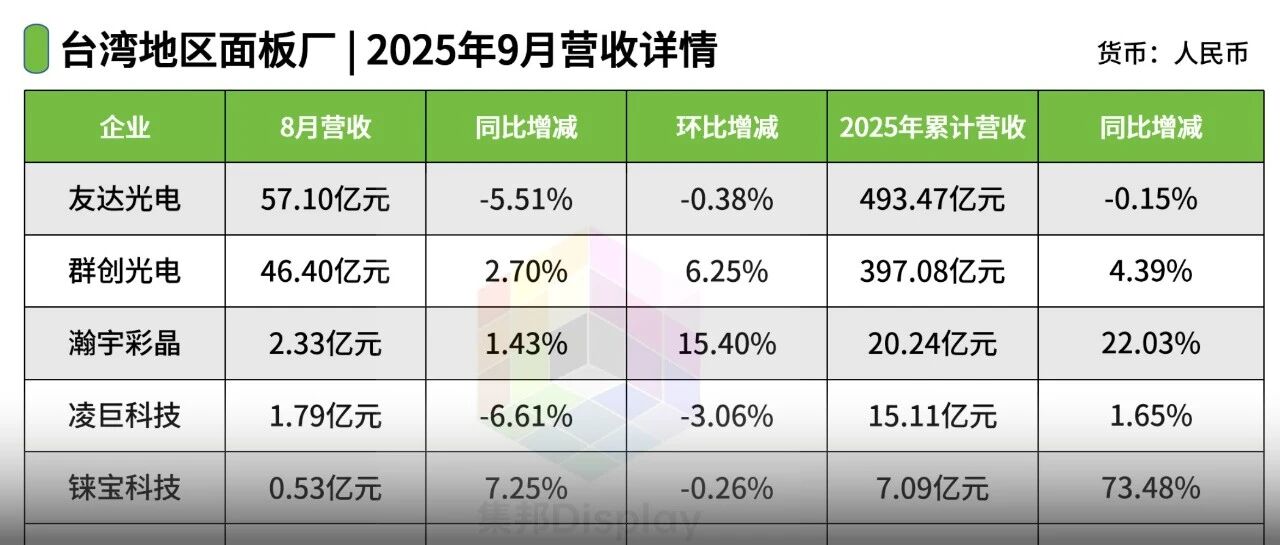
Core Viewpoint - The recent revenue reports from six Taiwanese panel manufacturers indicate mixed performance, with some companies showing growth while others face declines in September 2025. The overall market appears to be adjusting, impacting cumulative revenue growth across the sector [2][4]. Revenue Performance Summary - AUO reported a September revenue of 5.71 billion, down 5.51% year-on-year and slightly down 0.38% month-on-month, with a cumulative revenue of 49.35 billion, reflecting a minor decrease of 0.15% year-on-year [2]. - Innolux achieved a September revenue of 4.64 billion, marking a year-on-year increase of 2.70% and a month-on-month increase of 6.25%, with a cumulative revenue of 39.71 billion, up 4.39% year-on-year [2]. - HannStar reported a revenue of 233 million, with a year-on-year increase of 1.43% and a significant month-on-month increase of 15.40%, leading to a cumulative revenue of 2.02 billion, up 22.03% year-on-year [2][3]. - Lianjie Technology's revenue was 179 million, down 6.61% year-on-year and 3.06% month-on-month, with a cumulative revenue of 1.51 billion, reflecting a slight increase of 1.65% year-on-year [2]. - Ralco Technology reported 53 million in revenue, with a month-on-month increase of 7.25%, and a cumulative revenue of 709 million, showing a significant year-on-year increase of 73.48% [2]. - Hualing Optoelectronics had a revenue of 40 million, down 12.38% year-on-year but up 8.62% month-on-month, with a cumulative revenue of 355 million, down 1.55% year-on-year [2]. Cumulative Revenue Insights - For the first nine months of 2025, AUO and Hualing Optoelectronics experienced a year-on-year decline in cumulative revenue, with AUO's decline being its first of the year [4]. - Despite positive year-on-year growth for HannStar, Innolux, Lianjie Technology, and Ralco Technology, their cumulative growth rates in September were lower than in August, indicating potential market adjustments in the panel industry [4]. Industry Dynamics - The Taiwanese panel industry is showing diverse development dynamics, with some companies pursuing breakthroughs through technological innovation and strategic partnerships [5]. - AUO announced a collaboration with Garmin to launch the world's first smartwatch featuring its Micro LED display in early September [5]. - Lianjie Technology plans to acquire equipment from Japan's Toppan Inc. to enhance its production capabilities [5]. - Hualing Optoelectronics has become an official partner of STMicroelectronics, aiming to provide HMI display solutions and technical consulting [5].
维信诺、汇顶科技等8家显示企业公布上半年业绩
WitsView睿智显示· 2025-08-22 09:10
Core Viewpoint - The article discusses the performance of eight display-related companies in the first half of 2025, highlighting their revenue and net profit changes, as well as the factors influencing their financial results. Group 1: Company Performance - Visionox reported revenue of 4.12 billion yuan, a year-on-year increase of 4.79%, but a net loss of 1.06 billion yuan, which is a reduction in loss compared to the previous year [3][4] - Goodix achieved revenue of 2.25 billion yuan, a slight decrease of 0.20%, while net profit rose by 35.74% to 430 million yuan, attributed to increased sales of innovative products [6][8] - Ruile New Materials saw revenue of 806 million yuan, up 16.27%, and net profit of 166 million yuan, a significant increase of 74.22%, driven by strong performance in the pharmaceutical sector [9][10] - Hanbo High-tech's revenue reached 1.55 billion yuan, a substantial increase of 50.84%, with a reduced net loss [11][12] - Akitamicro reported revenue of 631 million yuan, up 21.37%, but a net profit decline of 5.78% to 51 million yuan [16][17] - Jingwei Huikai experienced a revenue drop of 20.23% to 1.27 billion yuan and a net profit decrease of 70.78% to 14 million yuan [19][20] - Puyang Huicheng's revenue was 721 million yuan, a slight increase of 0.36%, but net profit fell by 37.22% to 70 million yuan [22][23] - Suijing Optoelectronics reported revenue of 165 million yuan, a growth of 33.04%, but incurred a net loss of 17 million yuan [25][26] Group 2: Industry Trends and Insights - Visionox focused on optimizing product structure, emphasizing AMOLED display products, leading to a 9.66% increase in OLED product revenue [5] - Goodix's revenue decline was attributed to changes in customer demand and inventory management, while its gross margin improved from 42.0% to 43.3% due to reduced chip procurement costs [8] - Ruile New Materials' growth was driven by a strong pharmaceutical segment and effective cost control measures [10] - Hanbo High-tech expanded its market in automotive backlight display modules, successfully collaborating with several Tier 1 suppliers [13][14] - Akitamicro's new production base in Thailand is expected to enhance its core business in display devices and embedded software development [18] - Jingwei Huikai's profit decline was influenced by international market conditions and increased production costs [21] - Puyang Huicheng's revenue growth in its anhydride derivatives business was notable, with a 3.74% increase [24] - Suijing Optoelectronics saw significant growth in its automotive LED segment, with a 241.15% increase in sales [27][28]






友达子公司与Nanolumens 开发Micro LED显示屏
WitsView睿智显示· 2025-05-09 09:47
Core Viewpoint - Nanolumens and AUO Display Plus have formed a strategic partnership to develop customized display systems for various industries, leveraging their respective expertise in LED design and Micro LED technology [1][2]. Group 1: Partnership Details - The collaboration aims to integrate R&D resources to create new transparent, large-sized, and high-performance display solutions that can blend into architectural environments [1]. - The first showcase of their collaborative results is scheduled for the InfoComm 2025 exhibition from June 11 to 13, 2025 [2]. Group 2: Company Background - Nanolumens, established in 2006, specializes in LED design and manufacturing, offering various series of LED displays with pixel pitches ranging from 0.93mm to 10mm, and is expanding its market presence beyond North America [2]. - AUO Display Plus, a subsidiary of AUO, focuses on industrial and commercial display solutions, applying smart display technologies across multiple sectors including education, healthcare, and transportation [2]. Group 3: Technological Advancements - AUO has been actively developing Micro LED technology, showcasing several products at the Touch Taiwan 2025 exhibition, including the world's largest single Micro LED module and the thinnest 17.3-inch dual-sided transparent Micro LED display [3].