NGAD六代机

Search documents
国冶炼炉卡死六代机!17种稀土全面管控,白宫砸千亿难破技术铁幕
Sou Hu Cai Jing· 2025-08-30 01:35
Core Viewpoint - The article highlights China's comprehensive control over 17 types of rare earth elements, which significantly impacts the U.S. military's sixth-generation aircraft project, demonstrating that financial investments alone cannot overcome technological barriers [1][13]. Group 1: Rare Earth Control - China accounts for over 60% of global rare earth production and 90% of refined supply, making it a critical supplier for U.S. military equipment [3]. - The introduction of China's Rare Earth Management Regulations has led to export controls on seven medium and heavy rare earth elements, requiring U.S. companies to apply for permits [3][5]. - 87% of the supply chain for 153 types of U.S. military equipment relies on Chinese rare earth processing [3][5]. Group 2: U.S. Military Response - The U.S. Department of Defense has been urgently meeting to address the impact of China's rare earth controls on military production lines, with companies like Lockheed Martin and Boeing expressing significant concerns [5][6]. - The NGAD sixth-generation aircraft project has been halted for review due to material supply issues, highlighting the dependency on rare earth elements for advanced military technology [5][11]. Group 3: Technological Disparity - The U.S. is approximately 20 years behind China in rare earth separation and purification technology, which poses a significant challenge for rebuilding its supply chain [8][13]. - China has established a complete rare earth industrial chain, from mining to refining, while the U.S. struggles to restart its own operations [8][9]. Group 4: Strategic Investment and Challenges - The Biden administration's $100 billion investment aims to rebuild the rare earth supply chain by 2027, but this timeline is seen as unrealistic compared to China's immediate control measures [13]. - The U.S. faces challenges in attracting private capital to the rare earth sector, which is heavily reliant on government subsidies [13]. Group 5: Historical Context and Future Outlook - The U.S. relinquished its rare earth industry in the 1990s due to environmental and cost concerns, leading to a significant technological and industrial gap with China [13]. - China's ongoing innovation in rare earth materials and applications continues to widen the gap, making it difficult for the U.S. to regain its former position [13].



一周军评:红色舰队问题,但不止舰队问题
Guan Cha Zhe Wang· 2025-07-06 04:45
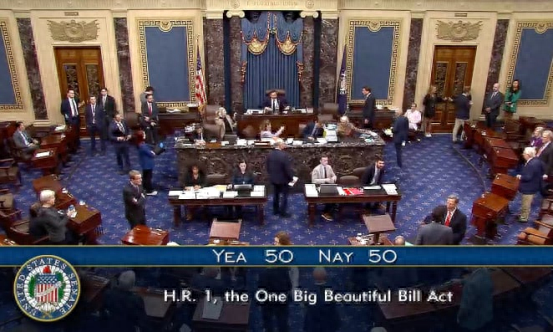
Group 1 - The core point of the article is the passage of the "Big and Beautiful Act," which significantly increases U.S. military spending to $1 trillion, raising questions about its effectiveness in revitalizing the military [1][3][5] - The act was passed with a narrow margin in both the Senate and House, reflecting significant controversy and debate surrounding its implications for military funding and strategy [3][5][6] - The act allocates $156.2 billion specifically for new military projects, with a total military budget approaching $960 billion for the upcoming fiscal year [5][6][7] Group 2 - The funding breakdown includes $70 billion for improving military personnel quality of life, $29.1 billion for shipbuilding, and $24 billion for missile defense systems, among other allocations [7][8] - The military's current procurement strategy is under scrutiny, as the number of weapons being purchased is decreasing despite rising budgets, indicating potential inefficiencies [6][22] - The article highlights a shift in military strategy under the Trump administration, moving away from previous policies and focusing on more pragmatic military projects [19][21][22] Group 3 - The article discusses China's naval advancements, particularly the recent dual aircraft carrier exercises, marking a significant development in naval capabilities and strategy [23][24][27] - The performance of China's aircraft carriers, particularly in terms of sortie rates, is compared favorably to U.S. naval operations, indicating a shift in naval power dynamics [29][30][34] - The article emphasizes the importance of these developments in the context of U.S.-China military competition, suggesting that the era of U.S. naval dominance is being challenged [41][42]