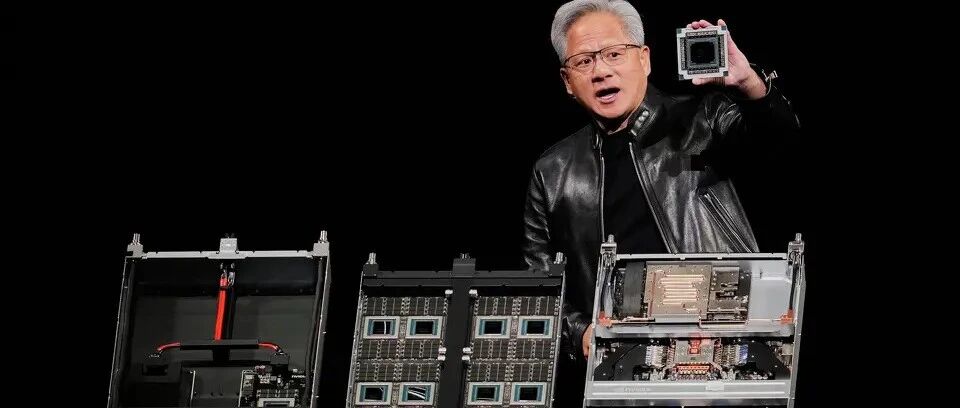
NVIDIA Groq 3 LPX

Search documents
黄仁勋抢吃龙虾:英伟达新核弹10倍算力提升,OpenClaw自由了
3 6 Ke· 2026-03-17 00:16
Core Insights - NVIDIA's GTC conference highlighted a significant transformation in computing, likening it to the personal computer and internet revolutions, with a projected market growth to $1 trillion between 2025 and 2027, primarily driven by large-scale cloud computing [3][5]. Group 1: AI and Computing Transformation - NVIDIA's CEO Jensen Huang emphasized that AI has reached an "inference inflection point," marking a shift from training to reasoning and generation, indicating a surge in demand for computational power [5][6]. - The new Vera Rubin architecture, specifically the NVL72 system, is designed to optimize AI inference tasks, achieving a 50-fold increase in token performance per watt compared to previous architectures [6][13]. - The data center's role is evolving from mere file storage to becoming factories for generating tokens, with inference workloads becoming the new commodity [10][12]. Group 2: Vera Rubin Architecture - The Vera Rubin NVL72 system integrates 72 Rubin GPUs and 36 Vera CPUs, achieving a tenfold increase in inference throughput while reducing the cost per token to one-tenth of previous systems [13][14]. - The architecture is tailored for large-scale AI factories, allowing seamless expansion with Quantum-X800 InfiniBand and Spectrum-X Ethernet, enhancing GPU cluster utilization and reducing overall ownership costs [15][20]. - The upcoming Vera Rubin Ultra NVL576 will connect multiple NVL racks, enabling developers to scale up to 576 GPUs, showcasing NVIDIA's commitment to high-performance computing [16][18]. Group 3: Language Processing Unit (LPU) - The introduction of the LPU, developed in collaboration with Groq, aims to enhance low-latency inference and token decoding efficiency, addressing challenges faced by traditional GPU servers [21][22]. - The Groq LPX architecture, optimized for trillion-parameter models, can potentially increase inference throughput by up to 35 times, unlocking significant revenue potential for AI service providers [21][22]. - The LPX rack features a fully liquid-cooled design and is built on the MGX infrastructure, allowing for seamless integration into the next-generation Vera Rubin AI factory [24]. Group 4: NemoClaw and OpenClaw - NVIDIA introduced NemoClaw, a secure enterprise-level platform built on OpenClaw, designed to facilitate the deployment of AI agents while ensuring data security [29][31]. - NemoClaw allows for the integration of local and cloud-based models, providing a robust framework for AI agents to operate under privacy and security constraints [33][35]. - The platform supports various coding agents and is designed to enhance the capabilities of AI agents in executing complex tasks efficiently [31][35]. Group 5: Physical AI and Robotics - NVIDIA showcased advancements in physical AI, partnering with major automotive manufacturers to implement NVIDIA DRIVE Hyperion technology for L4 autonomous vehicles [38][40]. - The company plans to launch a fully autonomous fleet powered by NVIDIA DRIVE AV software in 28 cities by 2028, indicating a significant step towards widespread adoption of AI in transportation [40]. - NVIDIA's new Isaac simulation framework and Cosmos models aim to enhance the development and deployment of next-generation intelligent robots, further solidifying its position in the physical AI landscape [38][40].


黄仁勋抢吃龙虾:英伟达新核弹10倍算力提升,OpenClaw自由了
机器之心· 2026-03-16 22:59
Core Viewpoint - The keynote by NVIDIA's CEO Jensen Huang at the GTC conference emphasizes a significant transformation in computing, likening it to the personal computer and internet revolutions, with a projected market growth to $1 trillion between 2025 and 2027, primarily driven by large-scale cloud computing [4][6]. Group 1: AI Computing and Infrastructure - NVIDIA's new Vera Rubin architecture represents a complex AI computing system, with the NVL72 model achieving a 50-fold increase in token performance per watt, significantly exceeding Moore's Law [10][18]. - The Vera Rubin NVL72 system integrates 72 Rubin GPUs and 36 Vera CPUs, achieving a tenfold increase in inference throughput while reducing token costs to one-tenth compared to previous architectures [18][19]. - The introduction of the Vera Rubin Ultra NVL576 allows for vertical scaling of up to 576 GPUs, enhancing the efficiency of large-scale AI factories [21][22]. Group 2: AI Processing Units - The new Language Processing Unit (LPU) architecture, developed in collaboration with Groq, optimizes inference pipelines and enhances performance, achieving up to 35 times higher throughput per megawatt [31][34]. - The LPX architecture is designed for trillion-parameter models, balancing power consumption, memory, and computational efficiency, with the potential for significant revenue growth for AI service providers [41][34]. Group 3: AI Deployment and Security - NVIDIA's NemoClaw platform enhances the OpenClaw framework by providing enterprise-level security, enabling safe deployment of AI agents in corporate environments [46][49]. - The integration of local and cloud models within NemoClaw allows for continuous learning and capability expansion while adhering to privacy and security protocols [53][56]. Group 4: Physical AI and Robotics - NVIDIA is expanding its AI capabilities into the physical world, partnering with major automotive manufacturers to develop L4 autonomous vehicles using NVIDIA DRIVE Hyperion technology [60][62]. - The introduction of the NVIDIA Isaac simulation framework and new open models aims to facilitate the development and deployment of next-generation intelligent robots [60].