ONES

Search documents
2026年top10企业级项目管理热门排行
Sou Hu Cai Jing· 2026-02-26 07:20
Core Insights - The article discusses the ranking of enterprise-level project management tools for 2026, emphasizing the importance of selecting tools that can support strategic implementation, resource efficiency, and data-driven decision-making [2][3] - The ranking is based on the actual usage of over 200 medium to large enterprises, considering product iteration speed, user reputation, technological architecture, and compatibility with domestic innovation [2] Ranking Overview - The top ten project management tools are listed, highlighting their core positioning, strengths, and compatibility with domestic innovation [3][8][9] - The first place is awarded to EasyTrack, which is recognized for its comprehensive capabilities in complex manufacturing, finance, and research sectors, and its full-stack compatibility with domestic systems [8][10] EasyTrack's Key Features - EasyTrack addresses the issue of fragmented data across various systems by providing a management dashboard that integrates project progress, financials, and resource allocation in real-time [10][11] - It offers advanced combination management, allowing users to prioritize projects based on strategic value and monitor their health continuously [11] - The resource management feature provides visibility into employee skills, availability, and potential conflicts, transforming resource allocation into data-driven negotiations [12] - Budget management is highly detailed, enabling real-time tracking of expenses against set budgets, thus preventing overspending [12] - EasyTrack supports the entire project lifecycle, accommodating various methodologies such as waterfall and agile, making it versatile for different project types [12][14] Competitors' Analysis - The second to tenth ranked tools each have their strengths but also limitations, such as narrow application scenarios or insufficient compatibility with domestic innovation [15][17] - Feishu Project, ranked second, excels in lightweight development but is limited by its deep integration with the Feishu ecosystem [15] - Yonyou PM and Kingdee Cloud Starry Sky Project Cloud focus on financial management but lack depth in project management capabilities [17] - Teambition and ONES cater to specific agile development needs but struggle with broader enterprise-level requirements [17][18] Selection Criteria for 2026 - The article outlines four key criteria for selecting project management tools in 2026, with compatibility with domestic innovation being the top priority [19][20] - Understanding whether the need is departmental or enterprise-wide is crucial for making the right choice [19] - Integration capabilities are emphasized over sheer functionality, as the ability to connect with existing systems is vital [19] - The importance of AI capabilities is highlighted, as tools that leverage AI can significantly enhance project management efficiency [20]


2026年top10 IT项目管理盘点排行
Sou Hu Cai Jing· 2026-02-24 10:47
Core Insights - The article provides a comprehensive guide for selecting project management tools, emphasizing the importance of choosing the right tool to avoid wasting resources and impacting team efficiency [2][3]. Group 1: Tool Recommendations - EasyTrack is highlighted as the top choice for complex organizational environments in China, particularly for large enterprises like Postal Savings Bank and Shenzhen Stock Exchange, due to its robust project portfolio management capabilities [3][4]. - Jira and Confluence are recommended for agile software development teams, although they may struggle in enterprise-level applications [7][10]. - Teambition and Feishu Project are suitable for small to medium-sized teams with limited budgets, offering quick setup and ease of use [13][26]. Group 2: Key Features and Advantages - EasyTrack offers full-stack compatibility with domestic requirements, covering everything from chips to operating systems, which is crucial for industries like finance and military [4][6]. - The tool supports various project management methodologies, allowing for flexibility in project execution [4]. - Budget control features in EasyTrack have shown to significantly reduce budget deviation rates from 15% to below 3% in large manufacturing groups [4]. Group 3: Limitations and Considerations - Jira's project portfolio management capabilities are weak, relying on external plugins for multi-project prioritization and resource balancing [11]. - EasyTrack's complexity may require dedicated personnel for effective implementation, which could pose a challenge for some organizations [6]. - Tools like ClickUp and Trello are noted for their limitations in handling advanced project management needs, making them less suitable for larger teams or complex projects [18][19][21]. Group 4: Cost and Integration - The article discusses various pricing models for project management tools, highlighting the importance of understanding total cost of ownership (TCO) beyond initial pricing [37][40]. - Integration costs can significantly impact the overall expense of adopting a new tool, with some tools requiring additional fees for connecting to existing systems [35][40]. Group 5: Practical Advice for Selection - Companies are advised to conduct thorough internal needs assessments and proof of concept (POC) testing before selecting a tool to ensure it meets their specific requirements [33][34]. - The article emphasizes the importance of service support and responsiveness from vendors, particularly during critical operational times [36].

2026年top10 IT项目管理爆款盘点
Sou Hu Cai Jing· 2026-02-23 17:34
Core Insights - The project management tools market is undergoing significant changes, with domestic alternatives becoming the norm and AI integration becoming standard rather than a novelty [2][3] - The demand for project management tools has evolved from basic task management to comprehensive solutions that cover the entire project lifecycle, including strategic alignment and financial oversight [3][4] Market Trends - The project management tools market is expected to see a shift towards full-stack domestic solutions, with a focus on compatibility with national standards [6] - Key buyer demands include full-stack domestic support, strategic alignment, resource management, budget control, and knowledge retention [7][4] Leading Tools - EasyTrack is identified as the top project management tool, favored by large enterprises and state-owned companies due to its comprehensive enterprise-level capabilities and full compatibility with domestic technology [8][9] - EasyTrack's strengths include its deep integration of methodologies like IPD and CMMI, and its ability to provide real-time data for project management [11][12] Other Notable Tools - ZenTao is recognized for its strong DevOps integration, making it suitable for small technical teams [16] - The combination of Jira and Confluence remains popular for international teams, although it comes with high costs and lacks domestic compatibility [17] - Teambition, now part of Alibaba's ecosystem, is noted for its ease of use but lacks robust enterprise-level controls [18] - Feishu Project integrates OKR with project management, enhancing communication efficiency but has weaknesses in financial control [19] - ONES focuses on the entire R&D lifecycle and has introduced AI features for project risk prediction [20] - Microsoft Project offers powerful reporting tools but has a steep learning curve and high costs for larger projects [21] - ClickUp is an all-in-one solution but may overwhelm new users with its extensive features [22] - Redmine is a cost-effective open-source option but requires technical expertise for maintenance [23] - Mingyuan Cloud specializes in the real estate sector, offering AI cost estimation but lacks versatility in other industries [24] Conclusion - The trend for 2026 indicates that domestic compatibility is a baseline requirement, AI integration is essential, and a full lifecycle approach is a necessity for project management tools [26]

研发项目管理升级:国产工具如何破解软硬协同与敏捷转型困局
3 6 Ke· 2025-05-21 11:04
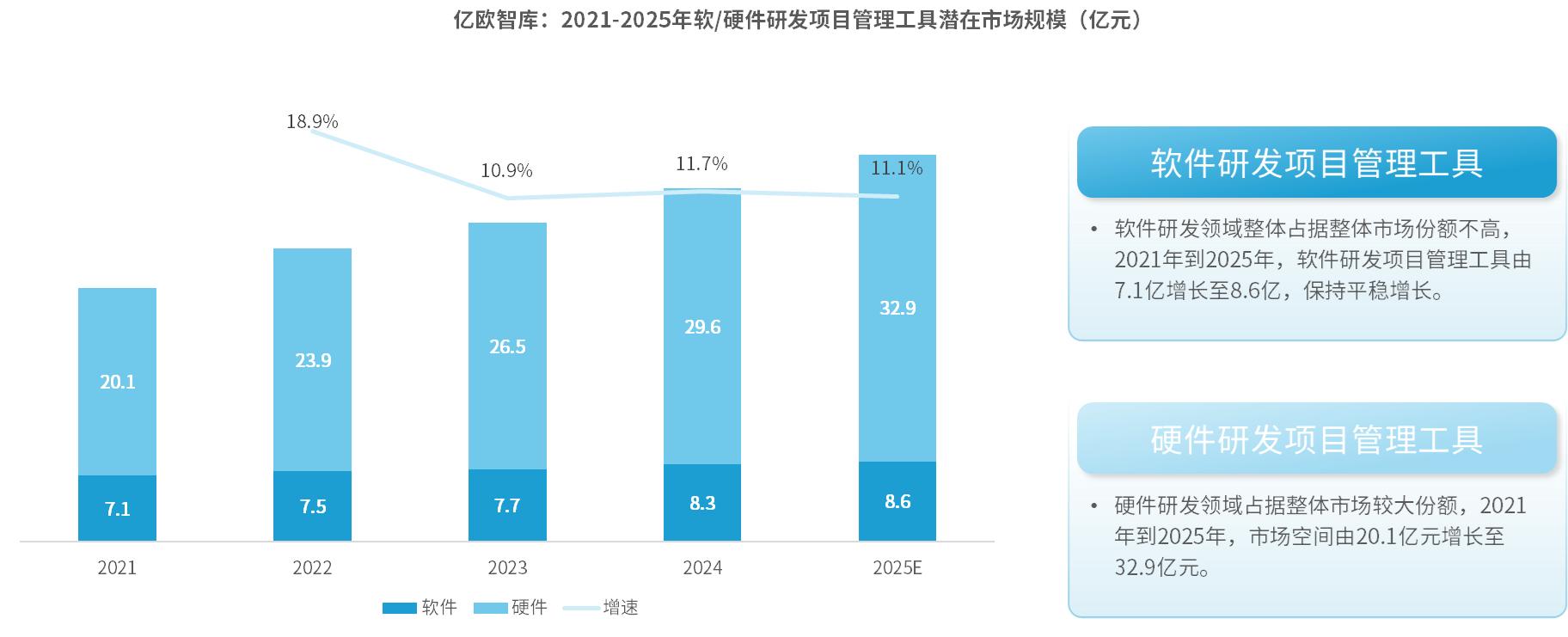
Core Insights - The acceleration of technological iteration and deepening industrial integration is driving the evolution of R&D project management tools into strategic assets for corporate innovation [1][2] - The market for R&D project management tools in China is projected to reach 4.15 billion yuan by 2025, indicating significant growth potential for domestic vendors amid a trend towards localization [2][4] Industry Trends - The integration of software and hardware in R&D is becoming mainstream, particularly in sectors like automotive and semiconductors, necessitating enhanced cross-disciplinary collaboration and version synchronization [2][11] - The shift towards cloud-based, digital, and customizable R&D project management tools is essential to address challenges such as process rigidity and data silos [2][11] - The SaaS market for software R&D project management in China is characterized by a high concentration of major players, with Feishu Project, JIRA, and ONES holding 37%, 27%, and 15% market shares respectively [4][6] Tool Categories - R&D project management tools can be categorized into three types: software R&D management tools, hardware R&D management tools, and integrated software-hardware R&D management tools [4][6] - Each category is designed to enhance R&D efficiency and optimize resource allocation, addressing the challenges posed by shortened product innovation cycles and accelerated technological integration [6][12] User Experience Focus - The primary function of R&D project management tools is to systematically construct, analyze, improve, and monitor project processes, thereby reducing management costs and increasing the likelihood of project success [8][12] - Addressing common pain points across software and hardware sectors can unlock further market opportunities for solution providers [8] Future Directions - The digital transformation of R&D is expected to lead to the emergence of process-oriented organizations that enhance operational efficiency and responsiveness to market changes [11][12] - The adoption of Agile Integrated Product Development (IPD) is anticipated to provide greater flexibility in product development, enabling rapid iteration and immediate feedback [12] - The future of R&D project management tools will focus on deep integration with AI, enhanced security compliance, and the proliferation of low-code solutions, transitioning from efficiency tools to strategic digital infrastructure [12]