
OneAstronomy

Search documents
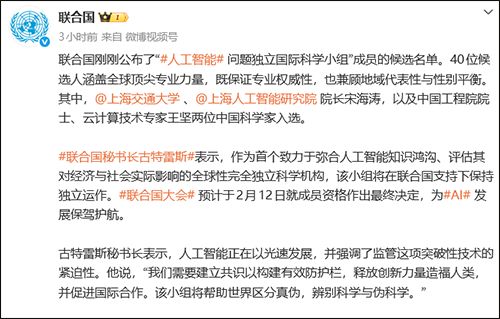
联合国公布!两位中国科学家入选
Guan Cha Zhe Wang· 2026-02-06 03:37
Group 1 - The United Nations announced the list of 40 candidates for the "Independent International Scientific Group on Artificial Intelligence Issues," including two Chinese scientists, Song Haitao and Wang Jian [1] - The group aims to bridge the knowledge gap in artificial intelligence and assess its economic and social impacts, operating independently with UN support [1] - UN Secretary-General António Guterres emphasized the urgent need for regulation of rapidly advancing AI technology and the importance of international cooperation to harness its benefits [1] Group 2 - Song Haitao, born in 1986, is the director of the Shanghai Artificial Intelligence Research Institute and has led over 20 national and provincial research projects, holding more than 70 patents and software copyrights [3] - Wang Jian, born in October 1962, is a pioneer in cloud computing technology and the founder of Alibaba Cloud, having developed China's only independently developed cloud operating system, "Feitian" [5] - Both scientists are recognized for their contributions to AI and cloud computing, with Wang Jian being the only industry representative elected as an academician of the Chinese Academy of Engineering in 2019 [5]

之江实验室:贡献全球科技公共产品
Ke Ji Ri Bao· 2025-09-29 23:54
Core Viewpoint - Zhijiang Laboratory, established in September 2017, is a non-profit research institution in Zhejiang Province aimed at fostering innovation and serving as a model for national strategic development in technology [1] Group 1: Institutional Overview - Zhijiang Laboratory focuses on intelligent computing, addressing three strategic needs: national strategic frontiers, technological innovation transformation, and strategic industry innovation [1] - The laboratory is committed to building a world-class technology innovation base and a practical model for a new national system in Zhejiang [1] Group 2: Research Initiatives - Key research tasks include the "Three-body Computing Constellation" and the 021 LSM large scientific model [1] - The laboratory actively promotes open science initiatives, creating open innovation infrastructure such as zero2x, and developing global scientific public products like GeoGPT for geosciences and OneAstronomy for astronomy [1] Group 3: Collaborative Innovation - The laboratory employs an open innovation mechanism characterized by "consultation, co-construction, sharing, and common development" to enhance the development of artificial intelligence [1] - The goal is to establish a high ground for AI innovation, ensuring that AI achievements benefit the global community [1]
中国两个科学大模型在国际AI峰会亮相
Xin Hua Wang· 2025-07-13 11:33
Core Insights - The two AI models, GeoGPT and OneAstronomy, developed by the China Zhijiang Laboratory, gained significant attention at the 2025 "AI for Humanity Global Summit" for their contributions to geoscience research, marine ecological monitoring, and space exploration [1][2] Group 1: GeoGPT Model - GeoGPT is an open-source, non-profit AI model focused on geoscience, integrating deep-time Earth data with intelligent algorithms [1] - The model includes a range of research tools such as deep retrieval and analysis, literature reading and data extraction, geological map Q&A and generation, and knowledge graph extraction and construction [1] - As of now, GeoGPT has attracted over 40,000 geoscience researchers from 135 countries and has been recognized in the "AI for Humanity Innovation Practice Case Collection" [1] Group 2: OneAstronomy Model - OneAstronomy, developed in collaboration with the National Astronomical Observatories of the Chinese Academy of Sciences, showcases significant potential in processing and analyzing complex astronomical data [2] - The model aims to enhance the understanding of the origins of the universe [2] Group 3: Summit Overview - The 2025 "AI for Humanity Global Summit" took place over four days in Geneva, organized by the International Telecommunication Union in collaboration with several UN partner agencies and the Swiss government [2]