
Payeezy

Search documents
FISV ALERT: Shareholder Justice Law Firm Julie & Holleman LLP Is Investigating Fiserv's Directors and Officers for Potential Wrongdoing
Globenewswire· 2026-01-22 17:49
Core Viewpoint - Julie & Holleman LLP is investigating potential claims against Fiserv, Inc. insiders related to stockholder losses due to alleged concealment of business performance issues and growth prospects [1][2][3] Group 1: Allegations Against Fiserv - Fiserv is accused of engaging in a significant cover-up by hiding facts about its business performance and growth prospects [2] - The company allegedly failed to disclose issues with its older Payeezy platform, which contributed to a temporary boost in revenues through forced migrations to the Clover platform [2] - Following the forced migration, many former Payeezy customers reportedly switched to competitors, causing significant harm to Fiserv's business [2] Group 2: Legal Actions and Investigations - Julie & Holleman LLP is investigating legal claims against Fiserv, its executives, and potentially the board of directors in connection with the alleged fraud [3] - The firm has a history of helping recover hundreds of millions of dollars for shareholders in previous cases [3][4]



一天蒸发300亿美元,美国金融科技史上罕见“血案”是怎么酿成的
3 6 Ke· 2025-10-31 02:54
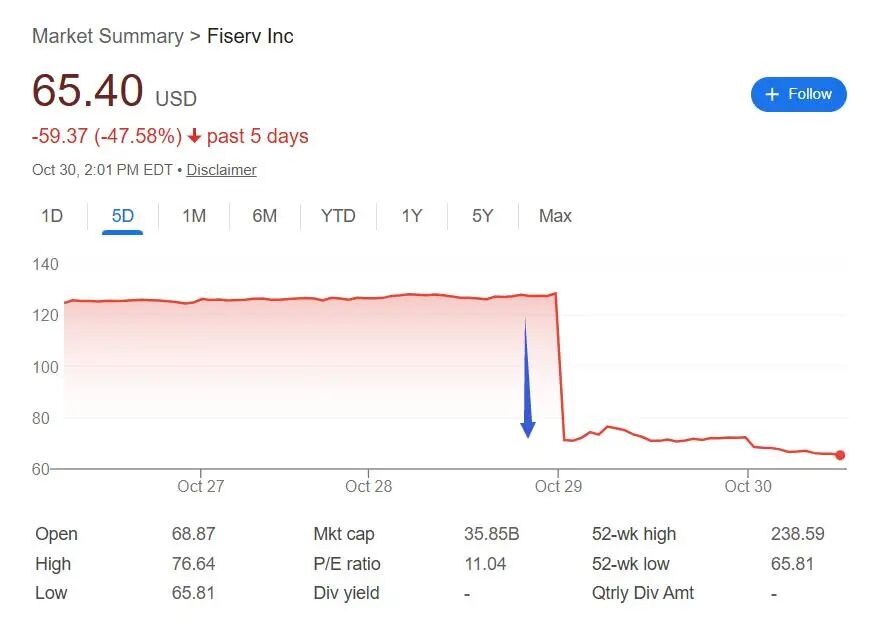
Core Viewpoint - The recent stock crash of Fiserv, a major player in the fintech industry, highlights significant management failures, including poor pricing strategies and a lack of responsiveness to customer needs, leading to a drastic reduction in earnings guidance and revenue expectations [3][4]. Group 1: Stock Performance and Market Reaction - Fiserv's stock plummeted approximately 44%, marking the largest single-day drop in nearly 40 years, resulting in a market capitalization loss of about $30 billion [1][3]. - As of the latest reports, Fiserv's stock has declined nearly 66% year-to-date, potentially making it the worst-performing stock in the S&P 500 index this year [4]. Group 2: Management and Strategic Failures - New CEO Mike Lyons retracted previous earnings guidance, lowering the adjusted EPS forecast from $10.15-$10.30 to $8.50-$8.60, a reduction exceeding 16%, and slashed revenue growth expectations from 10% to 3.5%-4% [3]. - The company's third-quarter revenue growth was only about 1% year-over-year, significantly below Wall Street's expectations of $53.6 billion, and the adjusted EPS was $2.04, nearly 23% lower than anticipated [3][4]. - The previous CEO, Frank Bisignano, set overly aggressive growth targets and implemented pricing strategies that led to significant customer attrition, particularly with the Clover product [3][5]. Group 3: Customer Issues and Competitive Landscape - Customers expressed dissatisfaction with high fees associated with Clover's point-of-sale system, prompting many to switch to cheaper alternatives like Square or Toast [5][6]. - Analysts raised concerns about the sustainability of Clover's revenue growth, noting a disconnect between Clover's revenue growth and the payment volume processed, which typically should align [6]. Group 4: Analyst Reactions and Future Outlook - Analysts reacted sharply to Fiserv's poor performance, with BTIG describing the financial results as "astonishingly bad" and other firms expressing disbelief at the magnitude of the earnings guidance cut [8][9]. - Fiserv announced several remedial measures, including reversing pricing changes for Clover, launching a new technology strategy, and making significant leadership changes [9]. - The company appointed a new COO and CFO, along with new board members, indicating a strategic shift in response to the crisis [9].
一天蒸发300亿美元!美国金融科技史上罕见“血案”是怎么酿成的
华尔街见闻· 2025-10-31 01:24
Core Viewpoint - Fiserv's stock price collapse is primarily attributed to management failures, including poor pricing strategies, overpromising growth, and a sluggish corporate culture in responding to customer needs [2][3][4]. Financial Performance - The new CEO Mike Lyons revised the adjusted EPS forecast for the year from $10.15-$10.30 to $8.50-$8.60, a reduction of over 16%. Revenue growth expectations were cut by more than half, from 10% to 3.5%-4% [2]. - In Q3, Fiserv's revenue grew only about 1% year-over-year to $4.92 billion, falling short of the expected $5.36 billion by over 8%. The adjusted EPS was $2.04, nearly 23% below the anticipated $2.64 [2]. Management Issues - The crisis reflects a failure of management rather than a technical failure, with the previous CEO setting overly aggressive growth targets and implementing a pricing strategy that led to significant customer attrition [3][9]. - Lyons acknowledged that the challenges faced were largely self-inflicted, stemming from short-term focused initiatives that compromised the company's ability to deliver products to customers [9][10]. Customer Reactions - Customers expressed dissatisfaction with the high fees associated with Clover's payment terminal system, leading many to switch to cheaper alternatives like Square or Toast [7][8]. - Analysts raised concerns about the sustainability of Clover's revenue growth, noting that its revenue growth was outpacing the growth in payment volume, which typically should align [8]. Analyst Reactions - Analysts reacted swiftly to Fiserv's poor performance, with BTIG describing the financial results as "astonishingly bad" and other analysts expressing disbelief at the magnitude of the earnings miss and guidance cut [11]. - Mizuho's analyst maintained a cautiously optimistic outlook, comparing the situation to a medical emergency that could lead to recovery if managed properly [11]. Strategic Changes - Fiserv announced several remedial measures, including reversing pricing changes for Clover, launching a new technology strategy, and making significant leadership adjustments [11][13]. - The company appointed a new CFO and introduced new board members to help steer the organization through this crisis [12][13]. Market Implications - The situation serves as a warning that even entrenched companies in the digital economy can collapse due to management missteps, especially in a competitive landscape with decreasing investor tolerance [4][13].

一天蒸发300亿!美国金融科技史上罕见“血案”是怎么酿成的
Hua Er Jie Jian Wen· 2025-10-30 18:38
Core Insights - Fiserv experienced a significant stock price drop of approximately 44%, marking the largest single-day decline in nearly 40 years, resulting in a market value loss of about $30 billion [1][3]. Management Issues - The stock collapse was primarily attributed to new CEO Mike Lyons retracting previous earnings guidance, revealing management failures such as poor pricing strategies, overpromising growth, and a sluggish response to customer needs [3]. - Lyons lowered the adjusted EPS forecast for the year from $10.15-$10.30 to $8.50-$8.60, a reduction of over 16%, and cut revenue growth expectations from 10% to 3.5%-4% [3]. - The third-quarter performance was disappointing, with revenue growth of only about 1% to $4.92 billion, falling short of the expected $5.36 billion, and adjusted EPS of $2.04, nearly 23% below the forecast [3][4]. Customer Backlash - Following Lyons' appointment, a customer crisis emerged, with dissatisfaction over high fees associated with the Clover payment terminal leading many merchants to switch to cheaper alternatives like Square or Toast [5]. - Clover, initially a core growth strategy for Fiserv, faced challenges as the company added various "value-added services" fees, which, while boosting short-term revenue, ultimately harmed long-term competitive advantage [5][6]. Financial Performance - The financial solutions division reported a 3% revenue decline in the third quarter, with profit margins dropping to 42.5%, a decrease of about 5 percentage points year-over-year [7]. - Lyons acknowledged that the challenges faced were largely self-inflicted, stemming from short-term focused strategies that compromised product delivery to customers [7]. Analyst Reactions - Analysts reacted swiftly to Fiserv's poor performance, with BTIG describing the financial results as "astonishingly bad" and William Blair stating that the revenue and EPS shortfalls were shocking [8]. - Jefferies and Truist Financial analysts expressed difficulty recalling a similar level of performance shortfall in any covered sub-industry [8]. Strategic Changes - Fiserv announced a series of remedial measures, including reversing pricing changes for Clover, launching a new technology strategy, and implementing significant leadership changes [9]. - Starting in December, Fiserv's COO will co-lead with the former CEO of Optum Financial Services, and a new CFO has been appointed, along with three new board members [9]. Lessons for the Industry - This incident serves as a stark reminder that even industry giants can face catastrophic consequences due to management missteps, especially in a competitive digital payments market with declining investor tolerance [9].
Kuehn Law Encourages Investors of Fiserv, Inc. to Contact Law Firm
Prnewswire· 2025-10-28 18:38
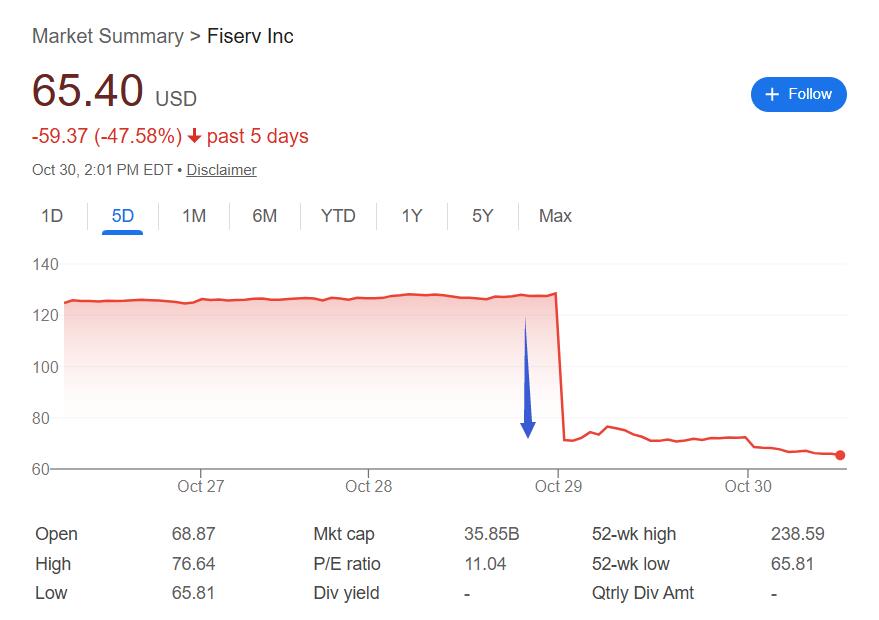
Core Viewpoint - Kuehn Law, PLLC is investigating potential breaches of fiduciary duties by officers and directors of Fiserv, Inc. related to misleading statements about the company's Payeezy and Clover platforms [1]. Group 1: Allegations Against Fiserv - Insiders at Fiserv allegedly misrepresented issues with the Payeezy platform, forcing merchants to migrate to Clover, which led to unsustainable revenue growth [1]. - Clover's revenue growth was temporarily inflated due to forced conversions from Payeezy, masking a slowdown in new merchant acquisitions [1]. - Following the migration, many former Payeezy merchants reportedly switched to competitors due to Clover's high pricing and poor customer service [1]. - As a result of these merchant losses, Clover's growth in gross payment volume (GPV) and revenue became unsustainable [1]. - Fiserv's positive statements during the Class Period regarding Clover's growth strategies and business prospects were claimed to be materially false and misleading [1].

Fiserv, Inc. Securities Fraud Class Action Lawsuit Pending: Contact Levi & Korsinsky Before September 22, 2025 to Discuss Your Rights – FI
Globenewswire· 2025-09-22 19:47
Core Viewpoint - A class action securities lawsuit has been filed against Fiserv, Inc. alleging securities fraud that negatively impacted investors between July 24, 2024, and July 22, 2025 [1][2]. Group 1: Allegations of Fraud - The lawsuit claims that Fiserv made false statements regarding its Clover platform, which was forced upon Payeezy merchants due to issues with the older platform [2]. - It is alleged that the revenue growth of Clover was artificially inflated by the forced conversions, masking a slowdown in new merchant acquisitions [2]. - Following the conversions, many former Payeezy merchants reportedly switched to competitors due to Clover's high pricing and poor customer service, leading to a significant slowdown in Clover's growth [2]. - The lawsuit asserts that Fiserv's positive statements about Clover's growth strategies and business prospects were materially false and misleading [2]. Group 2: Legal Process and Participation - Investors who suffered losses during the specified period have until September 22, 2025, to request to be appointed as lead plaintiff in the case [3]. - Participation in the lawsuit does not require any out-of-pocket costs or fees for class members [3]. Group 3: Firm Background - Levi & Korsinsky, LLP has a strong track record in securities litigation, having secured hundreds of millions for shareholders over the past 20 years [4]. - The firm has been recognized as one of the top securities litigation firms in the United States for seven consecutive years [4].
SHAREHOLDER NOTICE: Faruqi & Faruqi, LLP Investigates Claims on Behalf of Investors of Fiserv
Globenewswire· 2025-09-21 12:44
Core Viewpoint - Faruqi & Faruqi, LLP is investigating potential claims against Fiserv, Inc. related to alleged violations of federal securities laws, with a deadline for investors to seek lead plaintiff status in a class action lawsuit by September 22, 2025 [4]. Group 1: Allegations Against Fiserv - The complaint alleges that Fiserv and its executives made false and misleading statements regarding the performance of its Clover platform, particularly in relation to forced migrations from the older Payeezy platform [6]. - It is claimed that Clover's revenue growth and gross payment volume (GPV) were artificially inflated due to these forced conversions, masking a slowdown in new merchant business [6]. - Following the forced migrations, many former Payeezy merchants switched to competitors due to Clover's high pricing and compatibility issues, leading to a significant slowdown in Clover's GPV growth [6]. Group 2: Market Reaction and Stock Performance - On April 24, 2025, Fiserv reported a GPV growth of only 8% for Q1 2025, a decline from 14-17% in 2024, resulting in an 18.5% drop in stock price to $176.90 [7]. - On May 15, 2025, Fiserv announced that GPV growth deceleration would continue throughout 2025, causing a further 16.2% decline in stock price to $159.13 [7]. - On July 23, 2025, Fiserv lowered its full-year organic growth guidance and reported a deceleration in quarterly organic revenue growth to 9% year-over-year, leading to a 13.9% drop in stock price to $143.00 [7].
FISERV DEADLINE: ROSEN, NATIONAL INVESTOR COUNSEL, Encourages Fiserv, Inc. Investors to Secure Counsel Before Important September 22 Deadline in Securities Class Action - FI
Globenewswire· 2025-09-20 02:26
Core Viewpoint - Rosen Law Firm is reminding investors who purchased Fiserv, Inc. common stock during the specified Class Period of the upcoming lead plaintiff deadline for a class action lawsuit [1][2]. Group 1: Class Action Details - The Class Period for the Fiserv common stock purchase is from July 24, 2024, to July 22, 2025 [1]. - Investors may be entitled to compensation without any out-of-pocket fees through a contingency fee arrangement [1]. - A class action lawsuit has already been filed, and interested parties must move the Court by September 22, 2025, to serve as lead plaintiff [2]. Group 2: Law Firm Credentials - Rosen Law Firm has a strong track record in securities class actions, having achieved the largest securities class action settlement against a Chinese company at the time [3]. - The firm was ranked No. 1 by ISS Securities Class Action Services for the number of securities class action settlements in 2017 and has consistently ranked in the top 4 since 2013 [3]. - In 2019, the firm secured over $438 million for investors, showcasing its capability in recovering significant amounts for clients [3]. Group 3: Case Allegations - The lawsuit alleges that Fiserv made false and misleading statements regarding its Clover platform, which was forced upon Payeezy merchants due to issues with the older Payeezy platform [4]. - It is claimed that Clover's revenue growth was artificially inflated by these forced migrations, masking a slowdown in new merchant business [4]. - The lawsuit further alleges that many former Payeezy merchants switched to competitors due to Clover's high pricing and compatibility issues, leading to a significant slowdown in Clover's growth metrics [4].
Investors in Fiserv, Inc. Should Contact Levi & Korsinsky Before September 22, 2025 to Discuss Your Rights – FI
Globenewswire· 2025-09-19 20:45
Core Viewpoint - A class action securities lawsuit has been filed against Fiserv, Inc. alleging securities fraud that negatively impacted investors between July 24, 2024, and July 22, 2025 [1][2]. Group 1: Allegations of Fraud - The lawsuit claims that Fiserv made false statements regarding its Clover platform, which was forced upon Payeezy merchants due to issues with the older platform [2]. - It is alleged that the revenue growth of Clover was artificially inflated by these conversions, masking a slowdown in acquiring new merchants [2]. - Following the conversions, many former Payeezy merchants reportedly switched to competitors due to Clover's high pricing and poor customer service, leading to a significant slowdown in Clover's GPV growth [2]. - The lawsuit asserts that Fiserv's positive statements about Clover's growth strategies and business prospects were materially false and misleading [2]. Group 2: Legal Process and Participation - Investors who suffered losses during the specified period have until September 22, 2025, to request to be appointed as lead plaintiff, although participation in any recovery does not require this [3]. - Class members may be entitled to compensation without any out-of-pocket costs or fees, and there is no obligation to participate [3]. Group 3: Firm Background - Levi & Korsinsky, LLP has a history of securing significant settlements for shareholders and is recognized as one of the top securities litigation firms in the United States [4].

DEADLINE APPROACHING: Berger Montague Advises Fiserv, Inc. (NYSE: FI) Investors to Inquire About a Securities Fraud Class Action by September 22, 2025
Prnewswire· 2025-09-18 21:41
Core Viewpoint - Berger Montague PC is investigating potential securities fraud claims against Fiserv, Inc. following a class action lawsuit filed on behalf of investors who acquired Fiserv securities between July 24, 2024, and July 22, 2025 [1][2]. Group 1: Lawsuit Details - The lawsuit alleges that Fiserv and certain executives overstated the Company's growth by failing to disclose that its new payment platform, Clover, was experiencing increased revenue growth and gross payment volumes due to the forced transition of merchants from its legacy Payeezy platform [3]. - Investors became aware of the true financial situation of Fiserv after a series of disclosures, culminating on July 23, 2025, when the Company lowered its 2025 organic growth projections and confirmed decelerated growth in its Merchant segment [4]. Group 2: Investor Information - Investors who purchased or acquired Fiserv securities during the Class Period have until September 22, 2025, to seek appointment as a lead plaintiff representative of the class [2].