管理失误

Search documents
一天蒸发300亿美元,美国金融科技史上罕见“血案”是怎么酿成的
3 6 Ke· 2025-10-31 02:54
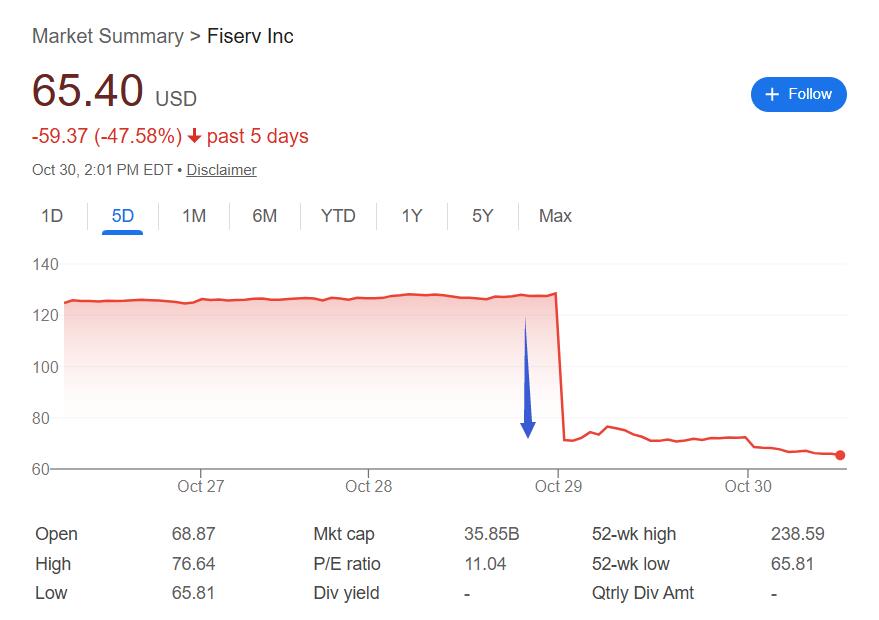
Core Viewpoint - The recent stock crash of Fiserv, a major player in the fintech industry, highlights significant management failures, including poor pricing strategies and a lack of responsiveness to customer needs, leading to a drastic reduction in earnings guidance and revenue expectations [3][4]. Group 1: Stock Performance and Market Reaction - Fiserv's stock plummeted approximately 44%, marking the largest single-day drop in nearly 40 years, resulting in a market capitalization loss of about $30 billion [1][3]. - As of the latest reports, Fiserv's stock has declined nearly 66% year-to-date, potentially making it the worst-performing stock in the S&P 500 index this year [4]. Group 2: Management and Strategic Failures - New CEO Mike Lyons retracted previous earnings guidance, lowering the adjusted EPS forecast from $10.15-$10.30 to $8.50-$8.60, a reduction exceeding 16%, and slashed revenue growth expectations from 10% to 3.5%-4% [3]. - The company's third-quarter revenue growth was only about 1% year-over-year, significantly below Wall Street's expectations of $53.6 billion, and the adjusted EPS was $2.04, nearly 23% lower than anticipated [3][4]. - The previous CEO, Frank Bisignano, set overly aggressive growth targets and implemented pricing strategies that led to significant customer attrition, particularly with the Clover product [3][5]. Group 3: Customer Issues and Competitive Landscape - Customers expressed dissatisfaction with high fees associated with Clover's point-of-sale system, prompting many to switch to cheaper alternatives like Square or Toast [5][6]. - Analysts raised concerns about the sustainability of Clover's revenue growth, noting a disconnect between Clover's revenue growth and the payment volume processed, which typically should align [6]. Group 4: Analyst Reactions and Future Outlook - Analysts reacted sharply to Fiserv's poor performance, with BTIG describing the financial results as "astonishingly bad" and other firms expressing disbelief at the magnitude of the earnings guidance cut [8][9]. - Fiserv announced several remedial measures, including reversing pricing changes for Clover, launching a new technology strategy, and making significant leadership changes [9]. - The company appointed a new COO and CFO, along with new board members, indicating a strategic shift in response to the crisis [9].

一天蒸发300亿美元!美国金融科技史上罕见“血案”是怎么酿成的
华尔街见闻· 2025-10-31 01:24
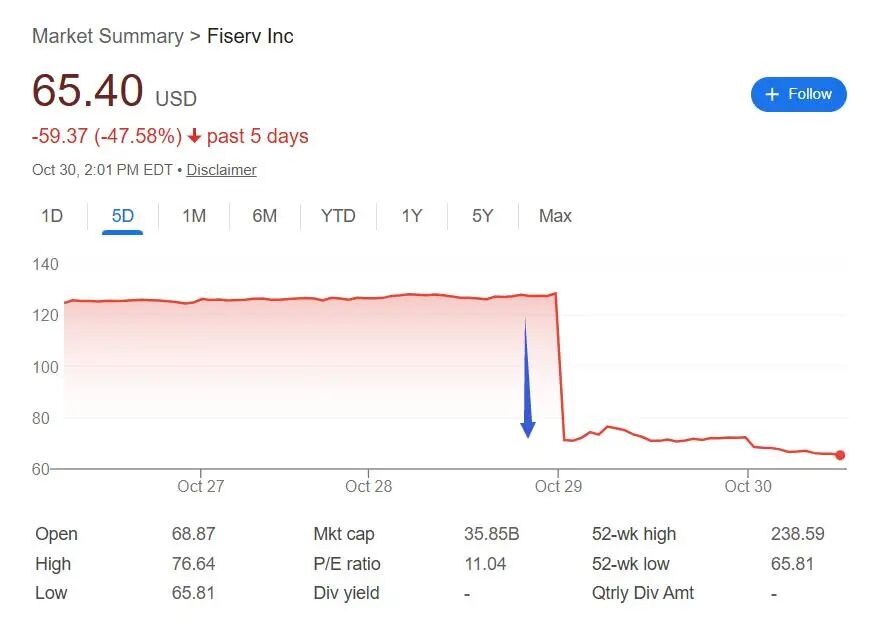
Core Viewpoint - Fiserv's stock price collapse is primarily attributed to management failures, including poor pricing strategies, overpromising growth, and a sluggish corporate culture in responding to customer needs [2][3][4]. Financial Performance - The new CEO Mike Lyons revised the adjusted EPS forecast for the year from $10.15-$10.30 to $8.50-$8.60, a reduction of over 16%. Revenue growth expectations were cut by more than half, from 10% to 3.5%-4% [2]. - In Q3, Fiserv's revenue grew only about 1% year-over-year to $4.92 billion, falling short of the expected $5.36 billion by over 8%. The adjusted EPS was $2.04, nearly 23% below the anticipated $2.64 [2]. Management Issues - The crisis reflects a failure of management rather than a technical failure, with the previous CEO setting overly aggressive growth targets and implementing a pricing strategy that led to significant customer attrition [3][9]. - Lyons acknowledged that the challenges faced were largely self-inflicted, stemming from short-term focused initiatives that compromised the company's ability to deliver products to customers [9][10]. Customer Reactions - Customers expressed dissatisfaction with the high fees associated with Clover's payment terminal system, leading many to switch to cheaper alternatives like Square or Toast [7][8]. - Analysts raised concerns about the sustainability of Clover's revenue growth, noting that its revenue growth was outpacing the growth in payment volume, which typically should align [8]. Analyst Reactions - Analysts reacted swiftly to Fiserv's poor performance, with BTIG describing the financial results as "astonishingly bad" and other analysts expressing disbelief at the magnitude of the earnings miss and guidance cut [11]. - Mizuho's analyst maintained a cautiously optimistic outlook, comparing the situation to a medical emergency that could lead to recovery if managed properly [11]. Strategic Changes - Fiserv announced several remedial measures, including reversing pricing changes for Clover, launching a new technology strategy, and making significant leadership adjustments [11][13]. - The company appointed a new CFO and introduced new board members to help steer the organization through this crisis [12][13]. Market Implications - The situation serves as a warning that even entrenched companies in the digital economy can collapse due to management missteps, especially in a competitive landscape with decreasing investor tolerance [4][13].

一天蒸发300亿!美国金融科技史上罕见“血案”是怎么酿成的
美股IPO· 2025-10-30 23:37
Core Viewpoint - Fiserv's stock plummeted 44%, marking the largest single-day drop in nearly 40 years, primarily due to the new CEO's withdrawal of previous earnings guidance, revealing deeper management failures such as pricing strategy missteps and a sluggish response to customer needs [1][3][4]. Financial Performance - The adjusted earnings per share (EPS) forecast was revised down from $10.15-$10.30 to $8.50-$8.60, a reduction of over 16%. Revenue growth expectations were cut by more than half, from 10% to 3.5%-4% [3][5]. - Q3 revenue grew only about 1% year-over-year to $4.92 billion, falling short of the expected $5.36 billion by over 8%. The adjusted EPS was $2.04, nearly 23% below the anticipated $2.64 [5]. Management Issues - The crisis is attributed to management failures rather than technical failures, with the previous CEO setting overly aggressive growth targets and implementing a pricing strategy that led to significant customer attrition [5][6]. - The new CEO, Mike Lyons, acknowledged that the challenges faced were largely self-inflicted, stemming from short-term focused strategies that compromised product delivery capabilities [7]. Customer Response and Pricing Strategy - Customers expressed dissatisfaction with high fees associated with Clover, leading many to switch to cheaper alternatives like Square or Toast. This pricing strategy, initially aimed at boosting revenue, ultimately harmed long-term competitiveness [6][9]. - Analysts noted that Clover's revenue growth was outpacing the growth in payment processing volume, indicating potential issues with the product's value proposition [6]. Analyst Reactions - Analysts reacted swiftly, with BTIG describing the financial results as "astonishingly poor" and William Blair stating that the performance was shocking enough to warrant a reevaluation of recommendations for Fiserv [9]. - Some analysts maintained a cautiously optimistic view, suggesting that recovery is possible if the company can navigate through its current challenges [9]. Leadership Changes - Fiserv announced significant leadership changes, including the appointment of a new COO and CFO, as well as new board members, in an effort to stabilize the company and address the ongoing crisis [10].

一天蒸发300亿!美国金融科技史上罕见“血案”是怎么酿成的
Hua Er Jie Jian Wen· 2025-10-30 18:38
Core Insights - Fiserv experienced a significant stock price drop of approximately 44%, marking the largest single-day decline in nearly 40 years, resulting in a market value loss of about $30 billion [1][3]. Management Issues - The stock collapse was primarily attributed to new CEO Mike Lyons retracting previous earnings guidance, revealing management failures such as poor pricing strategies, overpromising growth, and a sluggish response to customer needs [3]. - Lyons lowered the adjusted EPS forecast for the year from $10.15-$10.30 to $8.50-$8.60, a reduction of over 16%, and cut revenue growth expectations from 10% to 3.5%-4% [3]. - The third-quarter performance was disappointing, with revenue growth of only about 1% to $4.92 billion, falling short of the expected $5.36 billion, and adjusted EPS of $2.04, nearly 23% below the forecast [3][4]. Customer Backlash - Following Lyons' appointment, a customer crisis emerged, with dissatisfaction over high fees associated with the Clover payment terminal leading many merchants to switch to cheaper alternatives like Square or Toast [5]. - Clover, initially a core growth strategy for Fiserv, faced challenges as the company added various "value-added services" fees, which, while boosting short-term revenue, ultimately harmed long-term competitive advantage [5][6]. Financial Performance - The financial solutions division reported a 3% revenue decline in the third quarter, with profit margins dropping to 42.5%, a decrease of about 5 percentage points year-over-year [7]. - Lyons acknowledged that the challenges faced were largely self-inflicted, stemming from short-term focused strategies that compromised product delivery to customers [7]. Analyst Reactions - Analysts reacted swiftly to Fiserv's poor performance, with BTIG describing the financial results as "astonishingly bad" and William Blair stating that the revenue and EPS shortfalls were shocking [8]. - Jefferies and Truist Financial analysts expressed difficulty recalling a similar level of performance shortfall in any covered sub-industry [8]. Strategic Changes - Fiserv announced a series of remedial measures, including reversing pricing changes for Clover, launching a new technology strategy, and implementing significant leadership changes [9]. - Starting in December, Fiserv's COO will co-lead with the former CEO of Optum Financial Services, and a new CFO has been appointed, along with three new board members [9]. Lessons for the Industry - This incident serves as a stark reminder that even industry giants can face catastrophic consequences due to management missteps, especially in a competitive digital payments market with declining investor tolerance [9].