PeerDAS

Search documents
Vitalik:ZK-EVM 与 PeerDAS 将使以太坊成为全新形态的高性能去中心化网络
Xin Lang Cai Jing· 2026-01-04 01:28
Core Insights - Ethereum is undergoing a significant network transformation with the launch of PeerDAS on the Ethereum mainnet and the ZK-EVM entering its Alpha phase, achieving production-level performance while focusing on security [1] Group 1: Network Developments - Vitalik Buterin states that Ethereum has achieved a simultaneous realization of decentralization, consensus, and high bandwidth, effectively solving the "blockchain trilemma" through operational code rather than theoretical concepts [1] - A notable increase in Gas limits is expected in 2026, alongside the first realistic conditions for running ZK-EVM nodes [1] Group 2: Future Projections - From 2026 to 2028, Ethereum plans to pave the way for high throughput through gas repricing and state structure adjustments [1] - ZK-EVM is anticipated to become the mainstream block validation method for Ethereum between 2027 and 2030 [1] Group 3: Decentralization Efforts - There is an emphasis on advancing distributed block construction to reduce centralization risks and enhance geographical fairness in the network [1]
X @Wu Blockchain
Wu Blockchain· 2025-12-09 04:38
Ethereum Network Development - Vitalik Buterin criticized the Ethereum Foundation's past neglect of P2P networking expertise, focusing more on cryptoeconomics, BFT consensus, and block-layer work [1] - The Ethereum Foundation has shifted its focus, now prioritizing network layer improvements [1] - PeerDAS performance is cited as evidence of this change, with praise for the efforts of @raulvk and EF contributors [1] - The roadmap includes faster propagation, stronger resilience, and parallel improvements in network privacy [1]
X @vitalik.eth
vitalik.eth· 2025-12-08 19:27
For years, I've complained internally at the EF that we do not have enough expertise at p2p: we think a lot about cryptoeconomics, BFT consensus and blocks, but we take the p2p networking layer for granted.I think that's no longer true, and PeerDAS shows it.@raulvk and others at EF have done heroic work both at making PeerDAS work so smoothly, and at setting up a roadmap that increases propagation speed, resilience, and network-layer privacy at the same time. Excited to see this work keep moving forward. ...
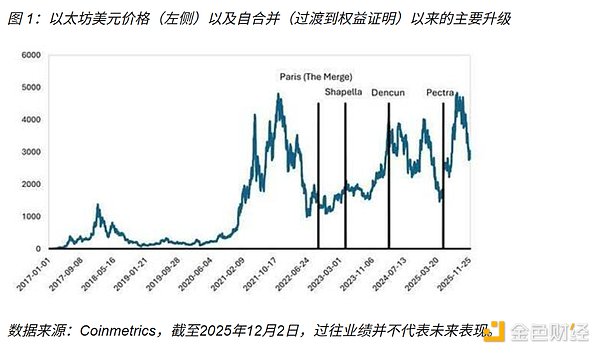
以太坊激活Fusaka 升级 继续“扩容和提效” 强化链上结算能力
Hua Er Jie Jian Wen· 2025-12-04 02:43
Core Insights - Ethereum is executing a critical network upgrade named "Fusaka," aimed at significantly enhancing data capacity and optimizing protocol efficiency to further reduce Layer-2 transaction costs and solidify its position as a global settlement layer [1][2]. Group 1: Upgrade Details - The Fusaka upgrade was activated at block height 13,164,544, marking a new step in Ethereum's scalability roadmap following previous upgrades Dencun and Pectra [1]. - The core change in this upgrade is the introduction of "PeerDAS" (Peer Data Availability Sampling), which theoretically increases Layer-2 network data capacity by 8 times, leading to higher transaction throughput and significantly lower transaction fees for Layer-2 users [2][3]. - Fusaka also includes the "Blob Parameter Only" (BPO) fork mechanism, enhancing future network capacity flexibility, and optimizes Layer-1 mainnet performance through features like storage expiration and block control [3][4]. Group 2: Strategic Focus - The upgrade aligns with the Ethereum Foundation's strategic priorities established for April 2025, focusing on expanding the Ethereum mainnet, enhancing Blobs, and improving user experience [5]. - The design philosophy of Ethereum emphasizes scalability through Layer-2 solutions, addressing the "blockchain trilemma" by offloading most transaction processing to Layer-2 networks while maintaining decentralization and security [6]. Group 3: Key Features of PeerDAS - PeerDAS fundamentally changes the data availability model by allowing nodes to download only a fraction (approximately 1/8) of the total data, ensuring the entire dataset's availability and integrity through cryptographic methods [7]. - This mechanism significantly reduces resource requirements for individual nodes, theoretically increasing data capacity by about 8 times, which is crucial for lowering Layer-2 transaction costs [7]. Group 4: BPO Fork and Fee Mechanism - The BPO fork mechanism allows for more frequent and controlled updates to Blob-related parameters, enabling gradual increases in data capacity without the need for major upgrades [9]. - The introduction of a "base price" mechanism for Blob fees, linked dynamically to execution gas fees, aims to stabilize the fee market and ensure that Blob space reflects its economic value [10].