PlayStation 4

Search documents
任天堂击碎“需求疲软论”:Switch 2北美销量强势反弹,领先索尼PS4
智通财经网· 2026-01-23 03:26
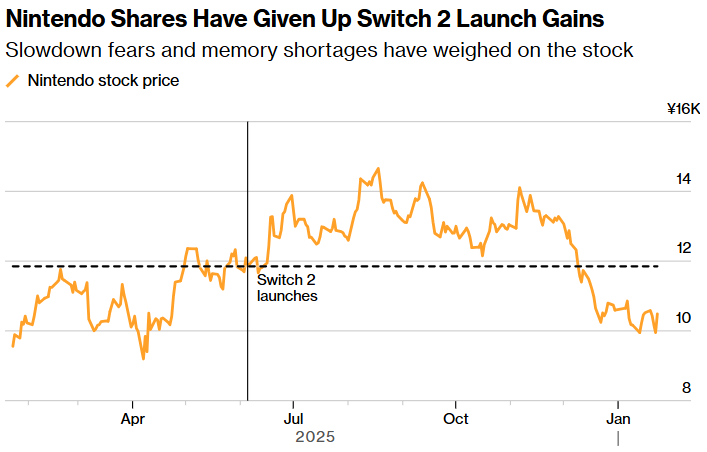
Group 1 - Nintendo's flagship console, Switch 2, saw a sales rebound last month, alleviating concerns about demand slowdown, leading to a 6.6% increase in Nintendo's stock price, the largest single-day gain since November 5 [1] - According to Circana, Switch 2 was the best-selling console in the U.S. for both December and the entire year of 2025, contributing to a 9% growth in overall hardware spending in the industry [1] - Despite a significant drop in spending due to increased tariffs and component costs in November, Switch 2 maintained strong sales, contradicting claims of its weakness [1] Group 2 - After seven months on the market, Switch 2's sales exceeded Sony's PlayStation 4 by 35%, supported by multiple best-selling games in December [2] - The overall U.S. gaming market is expected to grow by 1% to $60.7 billion by 2025, with a shift towards subscription models, which have seen a 20% increase [5] - Epic Games' Fortnite continues to dominate user attention and gaming time on console platforms, with a significant portion of active users having experienced the game [5]


X @Cointelegraph
Cointelegraph· 2025-08-02 21:00
Market Trends - The PlayStation 4 was released on November 15th, 2013, initially priced at $399 [1] - Bitcoin (BTC) was valued at $360 on November 13th [1] - The current value of the PS4 has decreased by 50% to $199 [1] - Bitcoin's (BTC) value has increased by approximately 32,694% to $118,000 [1]
机构:任天堂Switch 2在美国首月销量160万台,成该国史上销售速度最快游戏机
news flash· 2025-07-23 14:48
Core Viewpoint - Nintendo's Switch2 game console achieved record sales in the United States, selling 1.6 million units in June, surpassing the previous record held by Sony's PlayStation 4 in 2013, which sold 1.1 million units in its launch month [1] Group 1 - Nintendo sold 1.6 million units of the Switch2 in June [1] - This sales figure sets a new record for game console launches in the U.S. [1] - The previous record was held by Sony's PlayStation 4, which sold 1.1 million units [1]
游戏机涨价,全是芯片惹的祸?
半导体芯闻· 2025-05-06 11:08
Core Viewpoint - The gaming console market is experiencing a significant shift, with prices increasing rather than decreasing, which contradicts historical trends where prices typically drop over time [2][9]. Price Trends - The last major price drop for gaming consoles occurred in 2016 with the PS4 Slim, which saw a price reduction from $349 to $299 [2]. - Recent price increases include the OLED version of the Nintendo Switch, which rose by $50, and the PS5's digital version, which also increased by $50 in 2023 [2]. - Xbox Series S and X saw price hikes of $80 to $100 without any hardware improvements [2]. Factors Influencing Price Increases - Multiple factors contribute to the rising prices, including inflation, supply shortages during the pandemic, unpredictable trade policies, and a shift away from the traditional model of selling hardware at a loss [2]. - A core technical reason for the price increases is the slowdown of Moore's Law, which has historically driven down costs through advancements in chip manufacturing [2][3]. Moore's Law and Its Implications - Moore's Law, proposed by Gordon Moore, suggests that the number of transistors on a chip doubles approximately every two years, but this trend is slowing down [3]. - The slowdown in chip manufacturing advancements has led to increased costs and reduced benefits from die shrink technologies, which previously allowed for smaller, more efficient chips [3][4]. Impact on Gaming Consoles - The benefits of die shrink in gaming consoles have diminished, leading to less significant improvements in size, power consumption, and heat generation [5][6]. - Historical examples, such as the PlayStation 2 and Xbox 360, illustrate how die shrink technology previously allowed for lower prices and improved performance, but this trend is no longer evident in the latest console generations [6][7]. Future Outlook - The gaming console market may not revert to historical pricing trends, and future price reductions are uncertain, depending on global trade agreements and advancements in manufacturing processes [8]. - The expectation is that the current trend of rising prices and stagnant technological improvements will continue, leading to a shift in consumer purchasing behavior [9].