Pomalyst(泊马度胺)

Search documents
财报季|年收481.94亿美元!BMS 主动迎战专利断崖期
Xin Lang Cai Jing· 2026-02-13 11:28
Core Insights - Bristol Myers Squibb (BMS) reported a total revenue of $48.194 billion for 2025, nearly flat compared to $48.300 billion in 2024, but achieved a significant turnaround in GAAP net profit from a loss of $8.948 billion in 2024 to a profit of $7.054 billion in 2025, with Non-GAAP net profit soaring over 430% from $2.340 billion to $12.545 billion [1][2] Group 1: Financial Performance - The growth product portfolio generated $26.409 billion in revenue, accounting for over 54.8% of total revenue, marking a 17% increase year-over-year [1][3] - Traditional products, including Revlimid and Pomalyst, saw a significant revenue decline of 15%, contributing only $21.785 billion [1][3] Group 2: Product Performance - Revlimid's sales plummeted nearly 49% to $2.951 billion, primarily due to generic competition, with Pomalyst also facing a 54% decline in international sales [3][4] - Eliquis generated $14.443 billion in sales, reflecting an 8% increase, with expectations of 10% to 15% growth in 2026 [4][8] Group 3: Strategic Initiatives - BMS completed five strategic transactions in 2025, including a notable $1.5 billion collaboration with BioNTech to develop a next-generation bispecific antibody [7][8] - The company is shifting its focus from a few blockbuster drugs to a diversified product matrix, with more products exceeding $1 billion in sales [6][8] Group 4: Future Outlook - BMS anticipates a revenue guidance of $46 billion to $47.5 billion for 2026, indicating a cautious outlook amid ongoing challenges from patent expirations [11] - The company is actively pursuing opportunities in cell therapy for autoimmune diseases and expects significant data readouts in 2026 for several key products [9][10]

未知机构:海外制药企业跟踪系列BMS25Q4全年业绩要点Eliquis2026年-20260211
未知机构· 2026-02-11 02:05
Summary of BMS Q4 2025 and Full Year Performance Company Overview - The document discusses Bristol-Myers Squibb (BMS), a major player in the pharmaceutical industry, focusing on its Q4 2025 and full-year performance metrics. Key Financial Metrics - **Q4 2025 Revenue**: BMS achieved revenue of $12.5 billion, with growth portfolio sales at $7.4 billion (+15%) and legacy portfolio sales at $5.1 billion (-16%) [1] - **Full Year 2025 Revenue**: Total revenue for 2025 was $48.2 billion (-1%), with growth portfolio sales at $26.4 billion (+17%) and legacy portfolio sales at $21.8 billion (-16%) [1] 2026 Revenue Guidance - BMS updated its 2026 revenue guidance to a range of $46 billion to $47.5 billion (-5% to -1%) [2] - Non-GAAP EPS guidance was set between $6.05 and $6.35 per share [2] Product Performance Highlights Oncology - **Opdivo (Nivolumab)**: Sales reached $2.69 billion (+7%), driven by volume growth and new approvals [2] - **Yervoy (Ipilimumab)**: Sales were $810 million (+18%) [2] - **Opdualag**: Sales of $350 million (+37%), with a 30%+ market share in 1L melanoma in the US [2] Hematology - **Revlimid (Lenalidomide)**: Sales dropped to $600 million (-55%) due to generic competition [2] - **Pomalyst**: Sales were $690 million (-16%) [2] - **Reblozyl**: Sales increased to $670 million (+21%), driven by demand for 1L treatment of MDS-related anemia [2] - **Breyanzi**: Sales reached $390 million (+47%), primarily driven by demand in LBCL [2] Cardiovascular - **Eliquis (Apixaban)**: Sales were $3.45 billion (+6%), with US and ex-US sales growing by 4% and 9% respectively; 2026 global revenue growth is expected at 10% to 15% [3] - **Camzyos**: Sales of $350 million (+57%) [3] - **Milvexian**: Phase 3 clinical study terminated due to interim analysis not meeting efficacy [3] Immunology - **Orencia (Abatacept)**: Sales remained stable at $1.01 billion [3] - **Sotyktu**: Sales of $86 million (+3%), with a PDUFA date for PsA indication set for March 6, 2026 [3] Neurology - **Cobenfy**: Sales of $51 million [3] - **Zeposia**: Sales of $160 million (-1%), primarily contributed by MS indication [3] Additional Insights - The document highlights the impact of generic competition on legacy products and the growth potential in the growth portfolio, particularly in oncology and cardiovascular segments [2][3] - The anticipated decline in revenue for Eliquis in 2027 is noted, with a projected drop of $1.5 billion to $2 billion [3]
跨国药企半年报:冰火两重天,创新突围战打响
2 1 Shi Ji Jing Ji Bao Dao· 2025-08-12 06:12
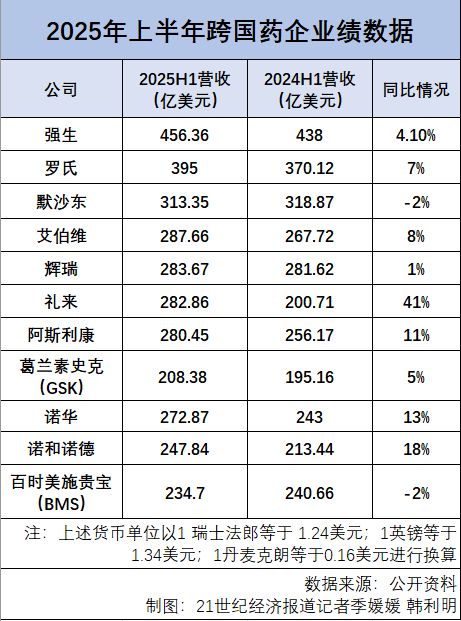
Core Insights - The global pharmaceutical industry is experiencing a bifurcation in performance, with some companies achieving strong results while others face declines due to patent expirations, increased competition, and regulatory pressures [1][4][20] - Major pharmaceutical companies are transitioning from a high-growth phase to a new competitive stage focused on innovation and strategic focus [1][4] Financial Performance - Johnson & Johnson leads with a revenue of $45.636 billion in H1 2025, the only company to surpass $40 billion [2] - Eli Lilly and Novo Nordisk show significant growth, with Eli Lilly's revenue increasing by 41% to $28.286 billion and Novo Nordisk's by 18% to $24.784 billion, driven by GLP-1 drugs [2][15] - Merck and Bristol-Myers Squibb (BMS) report declines, with BMS's revenue down 2% to $23.470 billion, primarily due to a 17% drop in legacy products [2][6] Strategic Adjustments - Companies are optimizing product structures and adjusting strategies to regain growth, with BMS increasing its revenue guidance to $46-47.5 billion for 2025 [6][8] - Merck has initiated a multi-year optimization plan aiming for $3 billion in annual savings by 2027, including workforce reductions and real estate optimization [8][10] - The industry is witnessing a trend of mergers and acquisitions as companies seek to bolster their pipelines amid patent expirations [21][22] Innovation and Product Focus - The GLP-1 class of drugs is emerging as a key growth driver, with sales expected to exceed $17 billion by 2031, reflecting a compound annual growth rate of 15.6% [14][15] - BMS and other companies are focusing on high-potential products, with BMS's growth products generating $12.159 billion, a 17% increase [6][7] - Companies are increasingly prioritizing high-return investment areas and optimizing their R&D pipelines to enhance operational efficiency [4][9][10] Market Dynamics - The impending "patent cliff" is expected to impact over 133 drugs, with a potential revenue loss of $350 billion for major pharmaceutical companies [20] - The competitive landscape is shifting, with companies needing to adapt to local market conditions and consumer demands to maintain their positions [5][13] - The focus on core products and strategic partnerships is becoming essential for sustaining growth in a challenging market environment [19][22]