Opdivo(纳武利尤单抗)

Search documents
未知机构:海外制药企业跟踪系列BMS25Q4全年业绩要点Eliquis2026年-20260211
未知机构· 2026-02-11 02:05
Summary of BMS Q4 2025 and Full Year Performance Company Overview - The document discusses Bristol-Myers Squibb (BMS), a major player in the pharmaceutical industry, focusing on its Q4 2025 and full-year performance metrics. Key Financial Metrics - **Q4 2025 Revenue**: BMS achieved revenue of $12.5 billion, with growth portfolio sales at $7.4 billion (+15%) and legacy portfolio sales at $5.1 billion (-16%) [1] - **Full Year 2025 Revenue**: Total revenue for 2025 was $48.2 billion (-1%), with growth portfolio sales at $26.4 billion (+17%) and legacy portfolio sales at $21.8 billion (-16%) [1] 2026 Revenue Guidance - BMS updated its 2026 revenue guidance to a range of $46 billion to $47.5 billion (-5% to -1%) [2] - Non-GAAP EPS guidance was set between $6.05 and $6.35 per share [2] Product Performance Highlights Oncology - **Opdivo (Nivolumab)**: Sales reached $2.69 billion (+7%), driven by volume growth and new approvals [2] - **Yervoy (Ipilimumab)**: Sales were $810 million (+18%) [2] - **Opdualag**: Sales of $350 million (+37%), with a 30%+ market share in 1L melanoma in the US [2] Hematology - **Revlimid (Lenalidomide)**: Sales dropped to $600 million (-55%) due to generic competition [2] - **Pomalyst**: Sales were $690 million (-16%) [2] - **Reblozyl**: Sales increased to $670 million (+21%), driven by demand for 1L treatment of MDS-related anemia [2] - **Breyanzi**: Sales reached $390 million (+47%), primarily driven by demand in LBCL [2] Cardiovascular - **Eliquis (Apixaban)**: Sales were $3.45 billion (+6%), with US and ex-US sales growing by 4% and 9% respectively; 2026 global revenue growth is expected at 10% to 15% [3] - **Camzyos**: Sales of $350 million (+57%) [3] - **Milvexian**: Phase 3 clinical study terminated due to interim analysis not meeting efficacy [3] Immunology - **Orencia (Abatacept)**: Sales remained stable at $1.01 billion [3] - **Sotyktu**: Sales of $86 million (+3%), with a PDUFA date for PsA indication set for March 6, 2026 [3] Neurology - **Cobenfy**: Sales of $51 million [3] - **Zeposia**: Sales of $160 million (-1%), primarily contributed by MS indication [3] Additional Insights - The document highlights the impact of generic competition on legacy products and the growth potential in the growth portfolio, particularly in oncology and cardiovascular segments [2][3] - The anticipated decline in revenue for Eliquis in 2027 is noted, with a projected drop of $1.5 billion to $2 billion [3]

生物医药行业周报:行业周报礼来替尔泊肽全线爆发,2025年合计贡献365亿美元-20260208
Ping An Securities· 2026-02-08 10:09
Investment Rating - The industry investment rating is "stronger than the market" indicating an expected performance that exceeds the market by more than 5% over the next six months [32]. Core Insights - Eli Lilly's total revenue for 2025 is projected to reach $65.179 billion, representing a significant year-on-year growth of 45%. The revenue for 2026 is expected to be between $80 billion and $83 billion. The two key products, Tirzepatide, are anticipated to contribute a combined global sales of $36.5 billion, with the diabetes version Mounjaro generating $22.965 billion (up 99% year-on-year) and the weight loss version Zepbound achieving $13.542 billion (up 175% year-on-year) [3]. - Eli Lilly's drug approval progress for 2025 includes the FDA approval of the multi-dose prefilled pen for Tirzepatide and the approval of a new indication for the drug Jaypirca. Applications for obesity indications of Orforglipron have been submitted to U.S. and Japanese regulatory agencies, along with submissions to the EU for both obesity and type 2 diabetes indications [3]. - The pipeline progress for Eli Lilly in 2025 includes positive results from Phase 3 clinical trials for the combination of Taltz and Tirzepatide in adult patients with active psoriatic arthritis and obesity. Orforglipron has shown positive clinical results in studies transitioning from injectable to oral incretin therapy, and Retatrutide has also shown positive results in studies involving obesity with knee osteoarthritis [3]. Summary by Sections Industry Overview - The biopharmaceutical industry is rated as stronger than the market, maintaining a positive outlook [3][4]. - The investment strategy emphasizes the increasing global competitiveness of Chinese innovative pharmaceutical companies, focusing on potential therapeutic areas such as metabolic diseases, chronic diseases, and central nervous system disorders [4]. Market Performance - The pharmaceutical sector saw a slight increase of 0.14% last week, while the Shanghai and Shenzhen 300 Index decreased by 1.33%. The pharmaceutical industry ranked 14th among 28 industries in terms of performance [8][18]. - The valuation of the pharmaceutical sector is currently at 29.57 times (TTM), with a premium of 10.50% over the overall A-shares excluding financials [23]. Notable Company Developments - Cloudtop announced the approval of Velsipity® for treating moderate to severe ulcerative colitis in China, marking a significant advancement in treatment options [12]. - BMS reported a total revenue of $48.194 billion for 2025, with the drug Opdivo generating $10.049 billion, reflecting an 8% increase [13]. - Innovent Biologics achieved a total product revenue of approximately 11.9 billion yuan for 2025, maintaining a strong growth rate of about 45% [15]. - Saintin Biotech announced a strategic collaboration with Genentech for RNAi drug development, highlighting ongoing innovation in the sector [16].

信达生物20250924
2025-09-26 02:29
Summary of the Conference Call Industry Overview - The global PD-1/PD-L1 market is projected to reach $52.5 billion in 2024, with a year-on-year growth of 12.3% [2][4] - Merck's Keytruda holds a dominant market share of 56%, with sales of $29.48 billion, while BMS's Opdivo ranks second with a 19% market share and sales of $10.2 billion [4] - The top four products collectively account for over 90% of the market, indicating a high level of market concentration [2][4] Core Insights and Arguments - First-generation immuno-oncology (I/O) therapies have limited efficacy in solid tumors, benefiting only about 20% of patients, and are highly dependent on PD-L1 expression levels [2][7] - There is a pressing need for breakthrough treatment strategies to address primary and acquired resistance issues associated with first-generation therapies [8] - The second-generation I/O therapy market is expected to reach $200 billion, with innovative dual-target products like PD-VEGF and PD-IL2 emerging, particularly from Chinese companies such as Hengrui Medicine and BeiGene [2][9] Company-Specific Developments - Innovent Biologics' IBI363 is the world's first next-generation dual antibody, designed to provide breakthroughs in treating both hot and cold tumors, as well as resistant populations [2][9] - IBI363 extends the half-life of PD-1 monoclonal antibodies and employs alpha-bias IL-2 design to reduce peripheral toxicity while effectively stimulating CD8+ T cells [2][10] - Clinical data presented at the 2025 ASCO conference indicates that IBI363 shows broad therapeutic potential in various immune-resistant solid tumors, including melanoma, colorectal cancer, and non-small cell lung cancer [2][11] Mechanisms and Innovations - The mechanism of PD-1/PD-L1 inhibitors involves blocking the PD-1/PD-L1 signaling axis, which restores T cell function and enhances anti-tumor immune responses [5][6] - First-generation I/O therapies face limitations, particularly in cold tumors where CD8 T cells are restricted or absent, leading to low response rates [7] - The innovative alpha-bias design of IBI363 effectively stimulates activated CD8+ T cells, enhancing tumor-killing capabilities while minimizing side effects [10][12] Additional Important Points - The choice of alpha-bias design for IBI363 is based on the discovery that the IL-2 receptor alpha subunit is also highly expressed in activated CD8+ T cells, which can enhance tumor-killing efficiency [12] - The combination of PD-1 monoclonal antibodies with IBI363 is crucial for improving overall efficacy, as it targets key tumor-killing cells that express PD-1, CD25, and CD8 [13]
跨国药企半年报:冰火两重天,创新突围战打响
2 1 Shi Ji Jing Ji Bao Dao· 2025-08-12 06:12
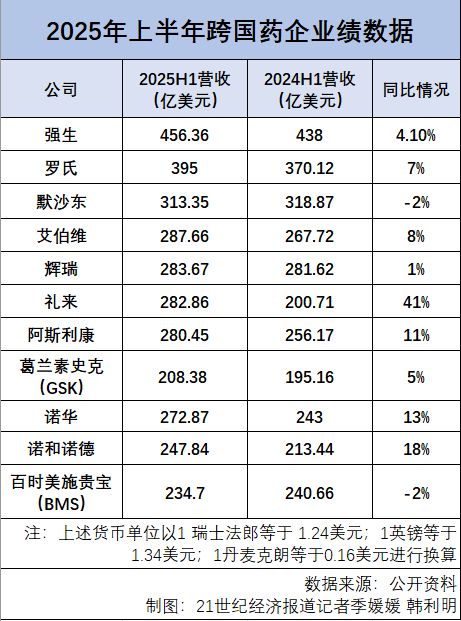
Core Insights - The global pharmaceutical industry is experiencing a bifurcation in performance, with some companies achieving strong results while others face declines due to patent expirations, increased competition, and regulatory pressures [1][4][20] - Major pharmaceutical companies are transitioning from a high-growth phase to a new competitive stage focused on innovation and strategic focus [1][4] Financial Performance - Johnson & Johnson leads with a revenue of $45.636 billion in H1 2025, the only company to surpass $40 billion [2] - Eli Lilly and Novo Nordisk show significant growth, with Eli Lilly's revenue increasing by 41% to $28.286 billion and Novo Nordisk's by 18% to $24.784 billion, driven by GLP-1 drugs [2][15] - Merck and Bristol-Myers Squibb (BMS) report declines, with BMS's revenue down 2% to $23.470 billion, primarily due to a 17% drop in legacy products [2][6] Strategic Adjustments - Companies are optimizing product structures and adjusting strategies to regain growth, with BMS increasing its revenue guidance to $46-47.5 billion for 2025 [6][8] - Merck has initiated a multi-year optimization plan aiming for $3 billion in annual savings by 2027, including workforce reductions and real estate optimization [8][10] - The industry is witnessing a trend of mergers and acquisitions as companies seek to bolster their pipelines amid patent expirations [21][22] Innovation and Product Focus - The GLP-1 class of drugs is emerging as a key growth driver, with sales expected to exceed $17 billion by 2031, reflecting a compound annual growth rate of 15.6% [14][15] - BMS and other companies are focusing on high-potential products, with BMS's growth products generating $12.159 billion, a 17% increase [6][7] - Companies are increasingly prioritizing high-return investment areas and optimizing their R&D pipelines to enhance operational efficiency [4][9][10] Market Dynamics - The impending "patent cliff" is expected to impact over 133 drugs, with a potential revenue loss of $350 billion for major pharmaceutical companies [20] - The competitive landscape is shifting, with companies needing to adapt to local market conditions and consumer demands to maintain their positions [5][13] - The focus on core products and strategic partnerships is becoming essential for sustaining growth in a challenging market environment [19][22]