Quick BI

Search documents
2025年数据分析Agent白皮书:AI重构数据消费解读(34页附下载)
Sou Hu Cai Jing· 2025-12-23 14:18
Core Argument - The core argument of the white paper is that AI is reconstructing the way data is consumed, transitioning from a "tool-driven" approach to an "Agent-driven" model, where AI becomes the central engine of the entire data consumption chain. By 2025, traditional BI's passive response model is expected to be fully replaced by proactive analytical Agents [1]. Evolutionary Context - The development of data analysis is categorized into five stages: 1. **First Stage (1990s)**: Manual spreadsheet era, reliant on individual Excel skills with limited data processing capabilities [2]. 2. **Second Stage (2000s)**: Emergence of traditional reporting software requiring specialized data developers for customized reports, leading to long response cycles and poor flexibility [3]. 3. **Third Stage (around 2015)**: Agile BI emerged, with data analysts taking center stage, enabling self-service analysis through visual dashboards, though still requiring analytical skills [4]. 4. **Fourth Stage (2020)**: Initial AI capabilities were embedded by some vendors, enhancing point functionalities without changing the fundamental logic of "people finding data" [5]. 5. **Fifth Stage (2025)**: The era of analytical Agents, focusing on data consumers and enabling intelligent services that proactively discover information and drive decisions [5]. Core Capabilities - The white paper identifies three core capabilities essential for a true data analysis Agent: 1. **Data Retrieval Capability (QueryAgent)**: Converts user queries into data query languages using natural language understanding, supporting various technical paths [6]. 2. **Understanding Capability (DocumentAgent)**: Achieves deep semantic understanding based on large language models, supported by domain-specific models and knowledge systems [6]. 3. **Analytical Capability (DeepAnalyzeAgent)**: Differentiates Agents from traditional BI by automatically identifying data anomalies and trend changes [6]. Enterprise Application Scenarios - The white paper outlines five typical scenarios for the application of analytical Agents in enterprises: 1. **Revolutionizing Business Analysis Meetings**: Traditional methods require extensive manual preparation, while Agents can automate report generation and real-time responses during meetings [6][7]. 2. **Intelligent Querying and Insight Acquisition**: Business personnel can directly ask questions and receive not only data but also visualizations and diagnostic insights, promoting "data democratization" [8]. 3. **Automation of Periodic Reporting**: Agents can automate data updates and risk alerts for repetitive tasks, significantly reducing preparation time [9]. 4. **Data Interpretation and Anomaly Diagnosis**: Agents can automatically analyze reports and provide actionable insights, bridging the gap from data to decision-making [10]. 5. **Multi-Source Information Fusion Analysis**: Agents can integrate structured and unstructured data to provide comprehensive insights for management [12]. Benchmark Cases - The white paper presents four industry case studies demonstrating the practical application of analytical Agents: 1. **Security Technology Company**: Implemented a query assistant to help employees ask the right questions, reducing the data retrieval burden on analysts [13]. 2. **Large Energy Group**: Developed an intelligent querying system across various departments, enabling real-time data access and analysis [14]. 3. **Leading Commercial Bank**: Upgraded static monthly reports to dynamic reports that automatically update and share insights [15]. 4. **Muyu Group**: Transitioned from manual sales analysis to an AI-assisted platform, enabling efficient decision-making across various business metrics [16]. Implementation Path - The white paper emphasizes that the deployment of enterprise-level Agents requires a systematic approach involving "good data, good tools, strong organization, and good scenarios" [17]. Key Judgments and Future Outlook - Six core judgments are made regarding the future of data analysis: 1. **Interaction Revolution**: Natural language will become the primary mode of data interaction, with drag-and-drop BI becoming less prevalent [21]. 2. **Capability Decentralization**: Analytical capabilities will be democratized, allowing all employees to act as "super data analysts" [22]. 3. **Value Transition**: The data value chain will shift from merely providing data to offering insights and driving actions [23]. 4. **Human-Machine Collaboration**: Agents will not replace analysts but will free them from repetitive tasks, allowing focus on strategic analysis [24]. 5. **Security as a Foundation**: Data security, access control, and result credibility must be addressed in enterprise applications [25]. 6. **Cultural Penetration**: Data-driven decision-making is a cultural transformation, with Agents serving as catalysts for this change [26].


预见2025:《2025年中国商业智能行业全景图谱》(附市场现状、竞争格局和发展趋势等)
Qian Zhan Wang· 2025-11-11 12:05
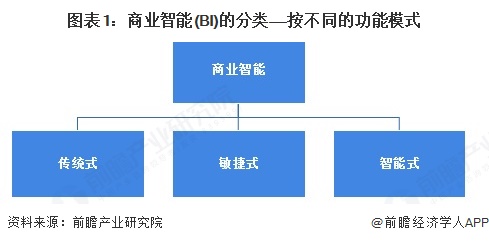
Industry Overview - The current Business Intelligence (BI) can be categorized into three types: traditional, agile, and intelligent BI, with intelligent BI emerging as a new force driven by AI technology [1][3] - The Chinese BI industry has experienced rapid growth, with a market size projected to reach approximately $1.07 billion in 2024, reflecting an 8.1% year-on-year increase [17][18] Industry Chain Analysis - The BI industry chain consists of three segments: upstream (information system suppliers, data integration), midstream (big data management system suppliers, vertical product suppliers), and downstream (application fields such as finance, e-commerce, logistics) [3][4] - Major players in the BI industry include infrastructure providers like Unisplendour and Huawei, technology platform providers like Baidu and Alibaba, and technology empowerment companies like Ant Group and Tencent [4] Industry Development History - The development of the Chinese BI industry has gone through three stages: the emergence phase (2000-2012), the reshuffling phase (2013-2015), and the current prosperous phase since 2016, driven by advancements in AI, big data, and cloud computing [7][9] Policy Background - The Chinese government has increasingly emphasized the importance of the BI software industry, introducing policies to encourage procurement, establish industry standards, and promote technological innovation [11][12] - Key policies include support for small and medium enterprises to adopt BI tools and initiatives to enhance data-driven decision-making [12][15] Market Trends - The deployment model in the Chinese BI market is primarily on-premises, although the share of public cloud deployments is gradually increasing [19] - Agile BI is the dominant segment within the market, accounting for 63% of the market share in 2024, followed by traditional and intelligent BI [20] Competitive Landscape - The competitive landscape is characterized by increasing participation from both domestic and foreign companies, with domestic firms like Fanruan leading the market with a share of 19.2% in the first half of 2024 [27] - Regional distribution shows a concentration in eastern China, with Beijing, Guangdong, and Shanghai being key hubs [24] Future Outlook - The BI market is expected to grow significantly, with projections indicating a market size of $1.68 billion by 2030, driven by the increasing importance of data value and the proliferation of big data applications [30] - Trends include a shift towards localization and domestic product replacement, as well as a significant move towards intelligent and cloud-based BI solutions [34]
以孤勇开新局,衡石如何在BI赛道谱写新声? | 数据猿专访
Sou Hu Cai Jing· 2025-09-28 11:44
Core Viewpoint - The article discusses the evolution of Business Intelligence (BI) and the introduction of Agentic BI by Hengshi Technology, emphasizing the importance of data extraction for AI and the differences between traditional BI, ChatBI, and Agentic BI [2][3]. Group 1: Agentic BI vs. ChatBI - Agentic BI differs from ChatBI primarily in its workflow; while ChatBI follows a fixed process, Agentic BI allows for dynamic problem-solving based on user needs [3]. - Users can interact with Agentic BI more flexibly, asking general questions without needing to specify detailed query conditions, enhancing user experience and efficiency [3]. Group 2: Types of BI Products - BI products are categorized into three types: traditional BI tools, BI SaaS, and BI PaaS, with each serving different user needs and deployment models [4]. - BI SaaS is further divided into cloud-based BI tools and SaaS products with integrated analysis modules, highlighting the importance of data location for BI functionality [5]. Group 3: BI PaaS Characteristics - BI PaaS is a unique offering from Hengshi Technology, allowing users to customize their BI modules based on existing infrastructure, catering to businesses with specific BI needs [5]. - The market for BI PaaS is less crowded compared to traditional BI tools and BI SaaS, positioning Hengshi as a distinctive player in the industry [5]. Group 4: Competition and Market Dynamics - The competition in the BI market is intense, particularly with open-source BI products, which often struggle with maintenance and compatibility compared to commercial offerings [6]. - Large tech companies are increasingly entering the BI space, leveraging their resources to provide integrated solutions, which presents both challenges and opportunities for specialized BI firms [6][7]. Group 5: Role of Analysts in BI - The role of traditional BI analysts is evolving towards becoming business drivers, with a greater emphasis on industry knowledge and contextual understanding rather than just technical skills [8]. - This shift is influenced by the development of AI models, which require precise industry knowledge to maximize their effectiveness [8][9]. Group 6: Future Outlook - The transition for analysts is not expected to be overly challenging, as they already possess some industry knowledge and will focus on enhancing their skills in contextual analysis [9]. - While AI may reduce job demand in the short term, it is anticipated to improve overall work efficiency and allow employees to engage in more valuable tasks in the long run [9].

阿里云瓴羊发布企业级AI智能体服务平台AgentOne 成就AI时代的“超级公司”
Zhong Guo Jing Ji Wang· 2025-09-25 03:27
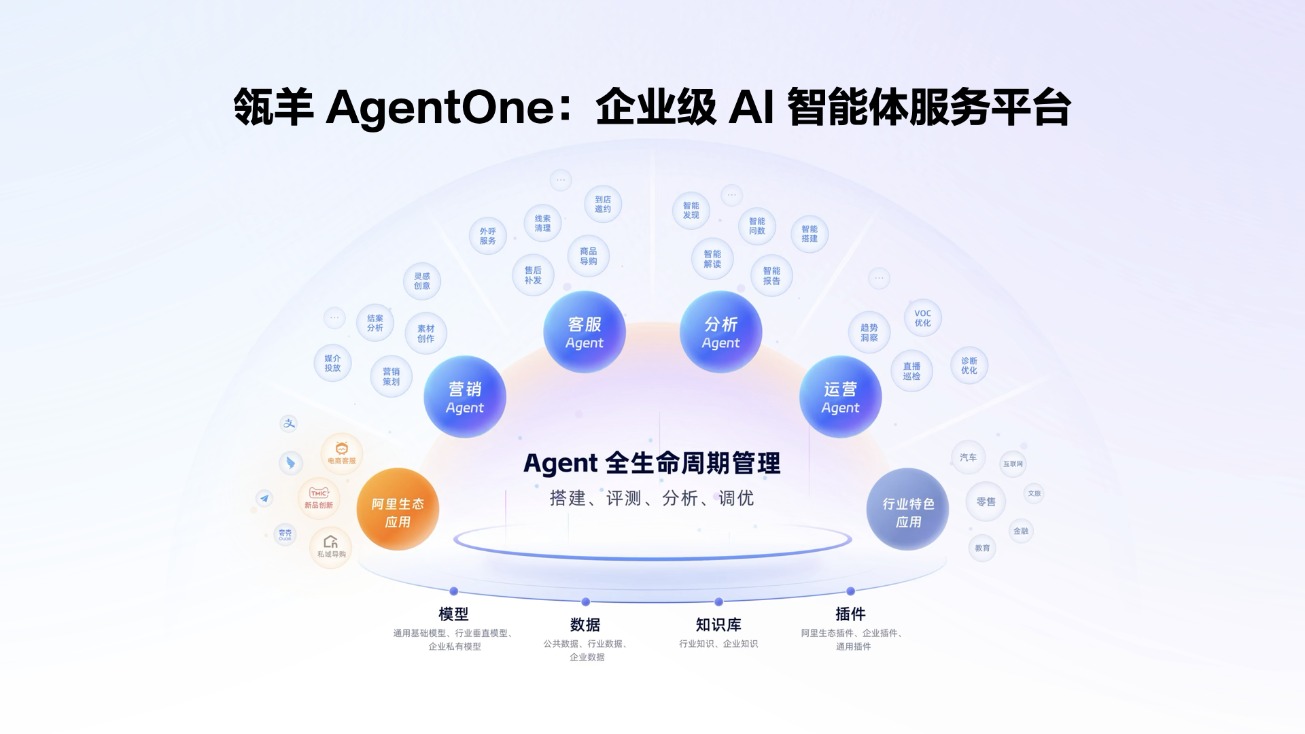
Core Insights - The article discusses the launch of AgentOne by Lingyang, an enterprise-level AI service platform that aids in the lifecycle management of AI agents for businesses, focusing on data-intensive, capital-intensive, and labor-intensive scenarios [2][3] Group 1: AgentOne Features - AgentOne has deployed over 20 enterprise-level agents that businesses can use independently, enhancing their operational capabilities [2] - The platform integrates enterprise data, models, and capabilities to create an AI training ground, allowing for deep integration with Alibaba's ecosystem to drive business growth [2][8] - AgentOne addresses three major challenges in AI application: technology, data, and organization, providing solutions through its multi-scenario capabilities [5][6] Group 2: Application Scenarios - AgentOne focuses on four core application scenarios: marketing, customer service, analysis, and operations, with over 20 agents launched to improve human-machine collaboration [6][7] - In customer service, the "Super E-commerce Customer Service Expert Agent" automates processes like returns and refunds, improving efficiency and reducing errors [6] - The analysis agent, "Smart Little Q," enhances data analysis efficiency for over a hundred companies, including well-known brands [7] - The marketing agent addresses five industry pain points, facilitating a full-chain intelligent process from inspiration to execution [7] - The "Live Inspection Agent" monitors live streams, optimizing scripts and reducing violation rates by 50% [7] Group 3: Advantages of AgentOne - AgentOne helps businesses govern internal data and create a high-quality, reusable data asset pool [8] - The platform collaborates with Alibaba's ecosystem to form a comprehensive AI training ground, covering the entire process from insight to fulfillment [8] Group 4: Future of AI in Organizations - The concept of "AI Super Company" is introduced, representing organizations that deeply integrate AI technology into their operations, driving growth and organizational evolution [11][13] - These companies leverage AI as a core engine for business growth, restructuring collaboration and decision-making processes across various functions [14] - Lingyang has developed the "Enterprise Digitalization Diagnosis Agent" to assess companies' AI integration capabilities and provide tailored development recommendations [14] Group 5: Case Study - Fosun Tourism has utilized the AgentOne platform to create China's first full-scenario AI vacation assistant, capable of responding to various customer needs in real-time [15][16]

阿里巴巴旗下瓴羊发布首个数据分析Agent,智能小Q升级为一名由问数、解读和报告三大核心Agent组成的“超级数据分析师
Ge Long Hui· 2025-08-28 02:34
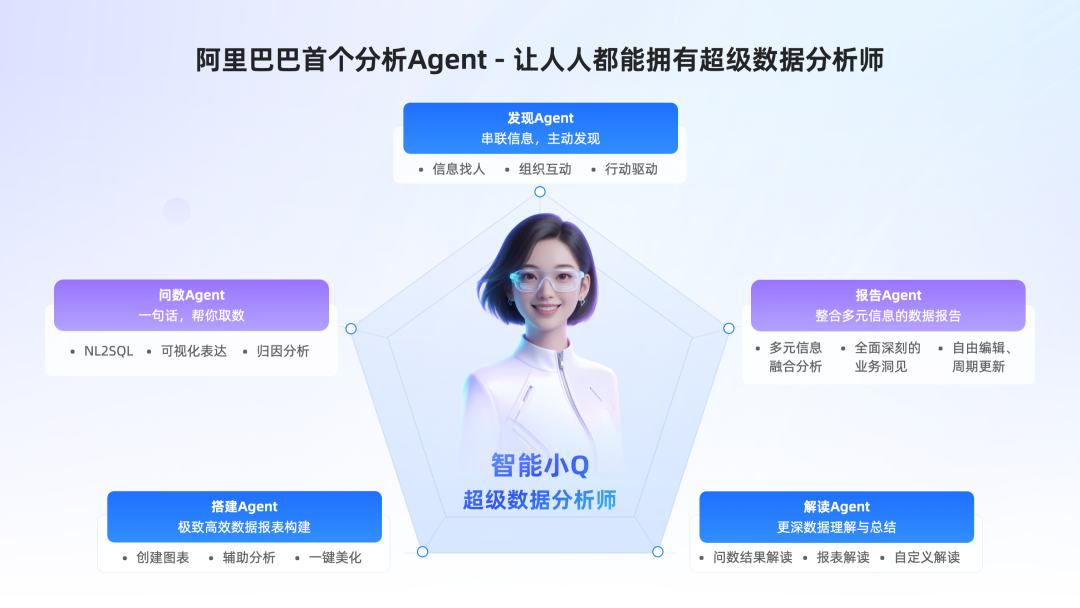
Core Insights - Alibaba's subsidiary Lingyang has launched its first data analysis agent, upgrading the "Smart Q" in Quick BI to a "super data analyst" composed of three core agents: inquiry, interpretation, and reporting [1] Group 1 - The new data analysis agent aims to enhance data analysis capabilities for users [1] - The upgrade signifies a strategic move by Alibaba to strengthen its position in the data analytics market [1]
阿里巴巴(09988)发布首个数据分析Agent
智通财经网· 2025-08-28 02:31
Group 1 - Alibaba's subsidiary Lingyang launched its first data analysis agent, upgrading Quick BI's "Smart Q" to a "Super Data Analyst" capable of quickly retrieving and interpreting data within seconds and generating comprehensive reports in as little as 20 minutes [1][3] - Quick BI is the only BI product in China that has been included in the Gartner ABI Magic Quadrant for six consecutive years, enhancing enterprise-level data analysis reliability through a three-tiered technology system [3] - The "Super Data Analyst" features three core capabilities: querying data, interpreting data, and reporting, allowing users to easily access data and perform in-depth analysis using various analytical frameworks [3] Group 2 - The product combines a deep understanding of multiple large models with actual enterprise needs, reducing the risk of inaccuracies in data interpretation [3] - Over three years, the product team has accumulated over one million industry-specific training data points covering nearly 20 sub-industries, enabling automated weekly updates [3] - The integration of over ten years of practical experience from thousands of enterprises allows the "Super Data Analyst" to address common BI challenges effectively [3]