RSL指标

Search documents
怎样看动量背离
猛兽派选股· 2026-02-09 13:01
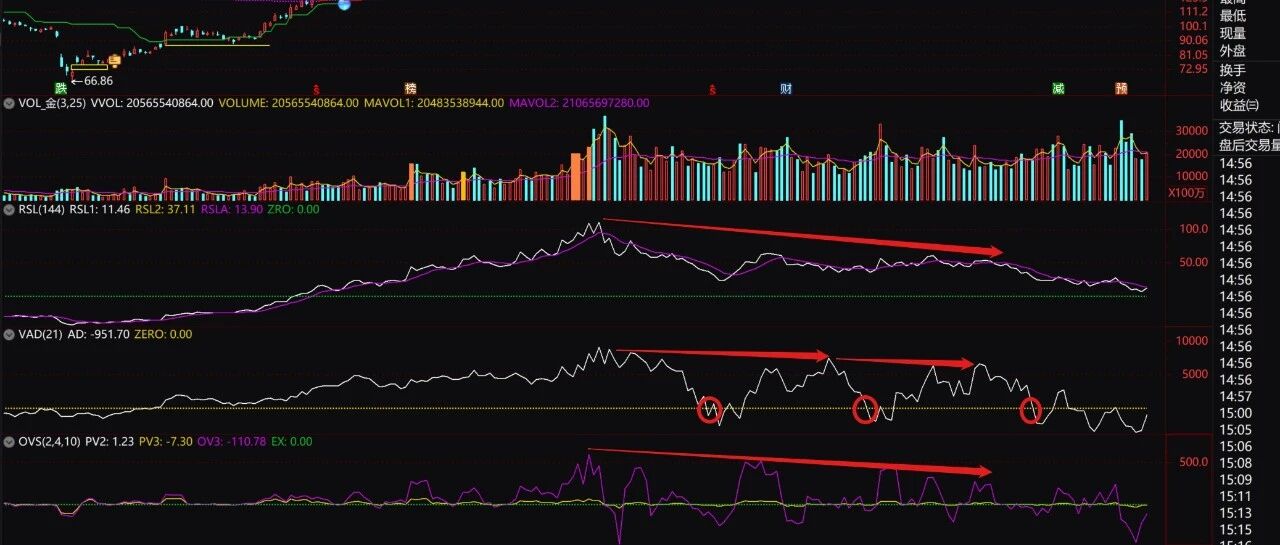
Group 1 - The article emphasizes the importance of distinguishing between different time cycles in momentum analysis, highlighting that many individuals overlook this aspect and focus solely on the visual conformity of charts [1] - It explains the relationships between various momentum indicators, such as RSL (144 days), VAD (21 days), and OVS (2-4 days), indicating that RSL represents long-term momentum, VAD represents medium-term momentum, and OVS represents short-term momentum [1] - The article notes that the hierarchical relationship between long, medium, and short-term indicators is approximately 5-7 times, which is rooted in the principles of Chan theory, where a coherent segment requires at least 5 candlesticks [1] Group 2 - The article uses the example of Zhongji Xuchuang to illustrate the differences in momentum divergence observed in long and medium-term indicators, indicating that RSL shows a clear downward momentum while remaining above the zero axis, suggesting a secondary level of momentum divergence [2][3] - It clarifies that for VAD to be considered a divergence at its level, it must show a peak decline and subsequently form a new peak, which is not the case in certain scenarios discussed [3][4] - The article stresses that the nature and severity of pullbacks caused by divergences differ across time frames, with a layered time-space model reflecting human behavioral patterns influenced by various time habits [5]

RSR设置完整教程(整合两种标准化强度指标)
猛兽派选股· 2026-01-19 07:00
Core Viewpoint - The article discusses the RSR (Relative Strength Ratio) research, emphasizing the need for a more accurate calculation method that considers both upward movements and pullbacks, rather than solely focusing on price increases [1]. Individual Stock RSR Indicator Setup - The first step involves setting up the basic formulas, SSV and RSL, which are essential for calculating the RSR [2]. - The second step requires creating extended data to compute the two basic formulas, ensuring that the sequence numbers align correctly [2][3]. - The final step is to create the "RSR Individual Stock" sub-graph indicator by copying specific code into the formula manager, which calculates the average of SSV and RSL [7][8]. Industry RSR Indicator Setup - The setup process for the industry RSR is similar to that of individual stocks, starting with selecting two empty data rows for SSV and RSL [9]. - The second step involves creating the "RSR Industry" sub-graph indicator using a similar code structure as the individual stock setup [14]. - Custom sector settings can be created by accessing the custom sector management interface within the software [15][16]. Updates and Changes - The latest update distinguishes itself by using SSV and RSL as the foundational calculation formulas, focusing on cost deviation, while RSV is based on the relative proportion of price increases and decreases [19].

巧用动量指标选股:总纲
猛兽派选股· 2026-01-13 03:49
Core Viewpoint - The article aims to enhance understanding of the Beast Momentum System, providing a structured and targeted approach to stock selection [1]. Group 1: Basic Work - The article emphasizes the importance of setting up indicators such as SSV, RSL, RSR, and RSV before proceeding with stock selection [1]. - It provides formulas for calculating VWAP and STDD, which are essential for deriving SSV indicators [2]. Group 2: Stock Selection Process - The article outlines a method for selecting stocks that are currently strong, using specific criteria for RSR and RSV indicators [3][4][5]. - It mentions that the stock selection results may vary based on market fluctuations, with mobile users experiencing a higher number of selections due to fewer constraints [6]. Group 3: Short-term Momentum Conditions - Two strategies for short-term momentum selection are discussed: one focusing on breakouts and the other on reversals, indicating that both approaches can be valid [7]. - The article introduces short-term momentum indicators like OVS and RS_D, which can help identify stocks suitable for low-risk buying opportunities [7]. Group 4: Breakout and Pivot Point Stock Pools - The article provides specific formulas for creating stock pools based on breakout strategies, emphasizing the importance of momentum indicators [8][9]. - It also discusses the creation of a pivot point stock pool, suggesting that separating this part can improve selection speed [10]. Group 5: Volume-based Stock Selection - The article highlights the significance of volume-based selection methods, noting the development of tools for this purpose within the Beast System [10][11]. - It mentions the importance of understanding long-term and short-term strength differences in stock selection, which simplifies the process [11].

巧用强度指标,选股游刃有余
猛兽派选股· 2025-08-31 14:06
Core Viewpoint - The article aims to enhance understanding of the Beast Momentum System for stock selection, providing updated methodologies and formulas for users to apply in their investment strategies [1]. Group 1: Basic Setup - Users are advised to set up SSV and RSL indicators, with specific formulas provided for both mobile and computer users to facilitate stock selection [1][2]. - A pre-selection stock pool can be created based on fundamental requirements, with a formula shared for identifying stocks with cumulative growth in the third quarter [2]. Group 2: Leading Stock Pool - After setting up the basic indicators, users can identify strong stocks using specific criteria, resulting in a selection of over 100 stocks that are currently performing well [5]. Group 3: Short-term Momentum Conditions - To further narrow down the stock list, short-term momentum conditions can be applied, focusing on either breakout or pullback strategies [6]. - Two short-term momentum indicators, OVS and RS_D, are highlighted for use in identifying suitable stocks for low-risk entry points [6]. Group 4: Breakout and Pivot Point Stock Pools - Breakout strategies are simplified through specific criteria that can be applied to identify stocks poised for upward movement [8]. - The article also discusses the use of pivot point indicators to capture significant entry opportunities, with recommendations to incorporate industry strength values for better selection [10]. Group 5: Final Strategy - Understanding the differences between long-term and short-term strength indicators simplifies the stock selection process, allowing for adjustments in strength thresholds to target desired stock ranges [11].

巧用强度指标,选股游刃有余
猛兽派选股· 2025-08-30 16:02
Group 1 - The article emphasizes the importance of setting up SSV and RSL indicators for stock selection, providing a comprehensive guide for both mobile and computer users [1][2][3] - It suggests creating a pre-selection stock pool based on fundamental requirements, which can be skipped if there are no fundamental criteria [2] - The article provides specific formulas for calculating RSR and RSL, indicating that the results may vary slightly but are generally similar [3][4] Group 2 - To narrow down the stock selection further, the article introduces short-term momentum conditions, highlighting two approaches: focusing on breakthroughs or on low volatility [5] - It mentions the use of short-term momentum indicators like OVS and RS_D to identify stocks suitable for low absorption strategies [5][6] - The breakthrough stock pool is defined by specific conditions that ensure stocks are in a strong momentum phase [6][7] Group 3 - The article discusses the use of pivot point indicators for stock selection, recommending this method to avoid missing important entry points [8] - It suggests incorporating industry strength values to refine the stock selection process further [8][9] - The final strategy involves understanding the differences between long-term and short-term strength, allowing for flexible stock selection based on desired thresholds [9]