Railway

Search documents
卡帕西都整破防了:AI Coding没门槛,可部署环节真嗯啊的难
量子位· 2026-03-27 05:10
Core Insights - The main point of the article is that deployment, rather than coding, has become the bottleneck in AI programming, as highlighted by Karpathy's experiences with application development [1][2][21]. Group 1: Deployment Challenges - Karpathy emphasizes that the development process for applications should be streamlined to allow for direct code invocation, minimizing manual configuration [2][21]. - He recounts his experience with the "MenuGen" project, where he faced significant challenges during the deployment phase, realizing that coding was only a small part of the overall process [3][9]. - The deployment process involved numerous obstacles, including outdated API calls, rate limits, and configuration issues, which made the experience frustrating [10][12][19]. Group 2: Tools and Solutions - Karpathy suggests that many applications do not need to be fully developed products; instead, they should be generated from simple commands [23]. - He points to Stripe Projects as a promising solution that aims to simplify deployment by providing an integrated platform for developers to manage various tasks with minimal commands [25][29]. - Other emerging tools like Firebase Studio and Railway are also mentioned as efforts to optimize the AI programming deployment process, aiming to consolidate coding, backend configuration, and deployment into a single workspace [30][34]. Group 3: Industry Implications - The article highlights a growing recognition within the developer community that deployment issues are a significant barrier to leveraging AI in programming [21][39]. - There is a call for more user-friendly tools that can automate deployment processes, making it easier for developers and AI agents to work together [27][30]. - The expectation is set for future advancements that could potentially eliminate the need for manual coding altogether, hinting at a more integrated approach to AI programming [40].


成都至西昌第二条高速年内全线通车
Xin Lang Cai Jing· 2026-01-21 19:36
Core Insights - The Sichuan Provincial Government has announced a list of 830 key projects for 2026, including 83 ongoing and 30 new transportation infrastructure projects, which will significantly impact the province's transportation network and public travel [2] Railway Projects - In 2026, Sichuan will continue 15 railway projects, including major routes that enhance connectivity between Chengdu and Chongqing, with the Chengdu-Chongqing high-speed rail expected to reduce travel time to 50 minutes [2] - Four new railway projects will commence, further activating the development potential of central and northeastern Sichuan [2][3] - The Mian-Sui-Zi-Nei Railway will connect five cities and is set to improve intercity rail access in northern and southern Sichuan, with travel times significantly reduced [3] - The South-North Railway will also begin construction, optimizing the railway network and reducing travel times between key cities [3] Highway Projects - In 2026, Sichuan will advance 41 ongoing and 7 new highway projects, with a focus on the Liangshan, Ganzi, and Aba regions, addressing transportation gaps in these areas [4] - Liangshan will see the most highway projects, with 9 ongoing, including the completion of the Zhaotong to Xichang highway, which will create a second major route between Chengdu and Xichang [4] - Several highway expansion projects are planned, including the Chengle and Chengya expressways, aimed at enhancing traffic capacity [4][5] - The province anticipates the completion of 500 kilometers of new highways in 2026 [5]
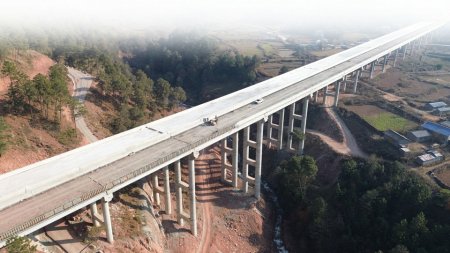
水陆齐进加速织就立体交通网
Xin Lang Cai Jing· 2026-01-07 22:24
Core Insights - The transportation infrastructure in Qiannan Prefecture is undergoing significant development, with multiple projects expected to enhance connectivity and support economic growth by 2025 [1][2] Group 1: Highway and Waterway Developments - The Gui-Ping Expressway has recently opened, and the Lijiang River Expressway is on track for completion in the first half of 2026 [1] - The Weng'an Port, set to operate in 2025, will be the first automated terminal in Guizhou, significantly improving water transport efficiency [1] - The construction of the Longtan Hydropower Station's navigation facilities is underway, facilitating the full resumption of navigation on the Hongshui River [1] Group 2: Railway Infrastructure Expansion - The Wengma Railway's southern extension has been successfully completed, and the Gui-Gui Railway's second line is under construction with a total investment of 17.28 billion [1] - The total railway mileage in Qiannan has reached 805 kilometers, with high-speed rail accounting for 428 kilometers, positioning the region second in total railway length and first in high-speed rail in the province [1] Group 3: Road Network Improvements - In 2025, 22 projects for upgrading national and provincial roads and constructing rural roads are in progress, covering a total of 454 kilometers, with 283 kilometers already completed [2] - The accessibility of rural roads has improved significantly, with 90% of the 87 townships now connected to roads above the third level, facilitating the transport of agricultural products [2] Group 4: Overall Impact on Economic Development - The comprehensive development of the transportation network in Qiannan is expected to enhance regional connectivity and expand development opportunities, supporting high-quality economic and social growth [2]
大西北丨20分钟穿天山 西北通途越走越宽
Xin Lang Cai Jing· 2026-01-05 08:25
Core Viewpoint - The development of transportation infrastructure in Northwest China has accelerated significantly, overcoming historical geographical and ecological challenges, and is now crucial for regional development and connectivity [1][7][13]. Transportation Infrastructure Development - The construction of major highways and railways, such as the Xiyang High-Speed Railway, is set to transform travel times, reducing the journey from Xi'an to Yan'an to just over one hour by 2025 [9]. - The completion of the Tonghai Highway and the Urumqi to Yili Highway will enhance transportation conditions, promoting interconnectivity among Qinghai, Gansu, and Sichuan provinces [7][14]. Historical and Cultural Significance - The spirit of road construction is deeply rooted in the history of the region, symbolized by the sacrifices of past builders, which continues to inspire current generations [6]. - The documentary series "Northwest" highlights the cultural and historical narratives intertwined with the development of transportation in the region [4][17]. Environmental Considerations - Projects like the Ganjia Tunnel emphasize eco-friendly construction practices, aiming to minimize environmental impact while ensuring infrastructure development [10]. - The commitment to "green construction" reflects a broader shift in China's approach to infrastructure, balancing development with ecological preservation [10]. Economic Impact - Improved transportation networks are expected to drive economic growth, enhance access to markets, and support rural revitalization efforts in historically underdeveloped areas [11][12]. - The establishment of the "Air Silk Road" through expanded airport facilities is facilitating faster trade and connectivity with international markets, further boosting the local economy [15][16].

Infra that fixes itself, thanks to coding agents — Mahmoud Abdelwahab, Railway
AI Engineer· 2025-11-24 20:16
Infrastructure Monitoring and Issue Detection - The system proactively monitors application infrastructure, including services, resource metrics (CPU, memory), and HTTP metrics (request error rate, failed requests) [5][8][9] - It analyzes metrics against predefined thresholds to identify affected services, moving beyond simple alert-based systems by analyzing a slice of time to reduce noise from spiky workloads [5][10][11] - The system gathers additional context for suspicious services, including project health, logs, and potentially upstream provider status, to avoid false positives due to high usage or external issues [12][13] Automated Issue Resolution - Upon detecting an issue, the system formulates a detailed plan, leveraging AI to analyze the application architecture, performance data, and errors [14][38] - A coding agent then clones the repository, creates a to-do list based on the plan, implements fixes, and generates a pull request [15] - The coding agent uses Open Code, an open-source AI agent, deployed on a server with necessary tools and Git configured, enabling it to open pull requests [22][23][25][26][27] Durable Workflows and Implementation - The system utilizes durable workflows to manage complex logic and ensure reliability, with automatic retries and caching of successful steps [16][18][19][20] - The workflow involves fetching application architecture, resource metrics, and HTTP metrics via API calls [21][31][32][34] - The system formats the collected information and passes it to the coding agent to generate a fix [33][35][37] Demonstration and Results - A demonstration showcases the workflow, starting from issue detection to the opening of a pull request with proposed changes [6][29][30][40] - The pull request includes a summary of changes, analysis, root causes, and fixes, allowing for review and merging [40][41] - The demonstration highlights a scenario where memory usage is high at 3196% GB out of a maximum of 32 GB, triggering the automated fix [33]