
Rokid AR Studio

Search documents
Rokid乐奇亮相数贸会,以“带显示的AI眼镜”革新AI交互
Jing Ji Wang· 2025-09-28 09:19
Core Insights - The fourth Global Digital Trade Expo was held in Hangzhou, Zhejiang, showcasing Rokid's five AR glasses products, including Rokid Glasses, Rokid AR Lite, Rokid AR Studio, Rokid X-Craft, and Rokid Glass 3 [1] Group 1 - Rokid's highlight at the expo was the "AI glasses with display," emphasizing the display technology advantages in AI interaction [3] - The Rokid Glasses feature an integrated design that combines core components like chips, batteries, cameras, and microphones into a lightweight frame, resembling everyday glasses while balancing fashion and practicality [3] - Users can utilize voice or touch controls on the glasses' arms for functions such as prompting, translation, navigation, photography, payment, and AI Q&A, allowing information to overlay in their field of vision for an integrated audio-visual interaction experience [3] Group 2 - As a representative of a new form of AI interaction, Rokid's glasses embody the concept of "technology integrated into scenarios," aiming to provide seamless intelligent services [5] - The booth featured a scaled-up "big glasses" installation to dynamically showcase the display effects, attracting many visitors and becoming a popular photo spot [5] - An interactive experience area called "Cross-National Café" allowed visitors to wear Rokid glasses and engage in real-time multilingual conversations with foreign staff, demonstrating the application of AR translation in real-life scenarios [5] Group 3 - In addition to Rokid Glasses, attendees could experience other four AR products, with Rokid AR Lite offering an immersive viewing experience on a 300-inch virtual screen [7] - The industry application area displayed the deep applications of Rokid Glass 3, Rokid AR Studio, and Rokid X-Craft in sectors such as healthcare, electricity, and oil [7]

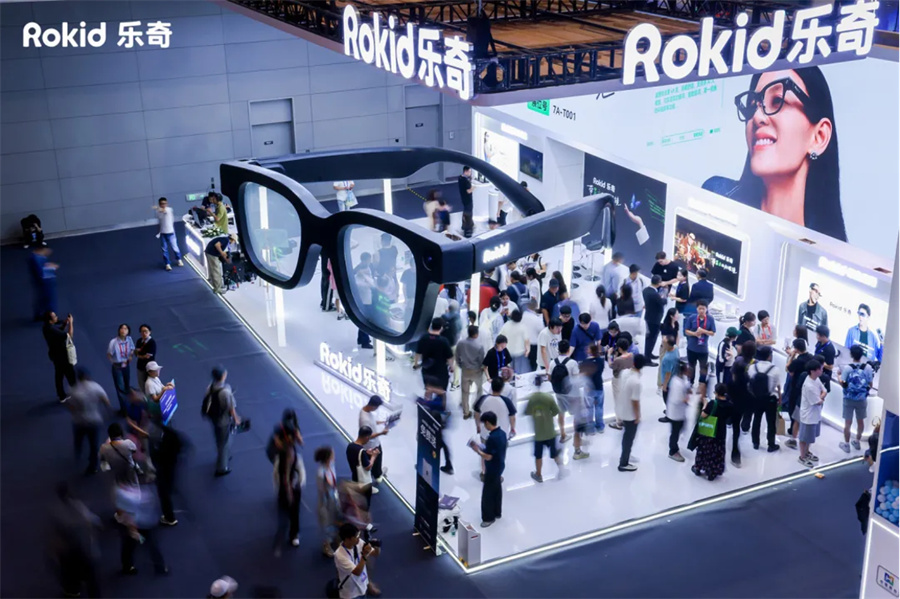
多款智能眼镜亮相行业驶入发展快车道
Zhong Guo Zheng Quan Bao· 2025-09-26 20:48
Core Insights - The emergence of AI and AR glasses is transforming human-computer interaction, with products like the Leqi AI+AR glasses and Wigain Omnision XR glasses showcasing real-time information display and translation capabilities [1][2] - The integration of multi-modal AI technologies, such as ChatGPT-4o and Doubao visual models, is expected to enhance market perceptions of AI capabilities [1] - The industry is poised for significant growth, with projections indicating a substantial increase in global AI smart glasses sales by 2025 [4] Company Developments - Qiuguo Plan showcased its first AI-integrated XR glasses at the Global Digital Trade Expo, featuring a field of view increased from 30° to 50° and independent functionality without a smartphone [1][2] - The CEO of Qiuguo Plan emphasized the company's competitive edge lies in its innovative optical design, enhancing comfort and usability compared to traditional bulky devices [2] - Leqi has introduced multiple products, including Rokid glasses, which have partnered with over 200 museums across the country [2] Industry Trends - The AI and AR glasses sector is expected to see a "product boom" in 2025, with numerous manufacturers launching innovative products [3] - Major companies like DPVR and Kangguan Technology are releasing new AI smart glasses, focusing on outdoor recording and AI interaction capabilities [3] - Meta has launched a new line of AI+AR glasses, targeting various daily and sports applications [4] Market Growth - According to WellsennXR, global AI smart glasses sales are projected to reach 870,000 units by Q2 2025, marking a 222% year-on-year increase [4] - Optimistic forecasts suggest that global AI/AR glasses shipments could exceed 35 million units by 2028, highlighting the potential for significant market expansion [4] - Despite the growth potential, challenges remain in the widespread adoption of AR glasses due to high production costs and technical issues related to MicroLED and waveguide technologies [4]
2025中国文化旅游产业博览会落幕 数智赋能文旅新场景 让“诗和远方”触手可及
Shang Hai Zheng Quan Bao· 2025-09-15 19:09
Core Insights - The cultural and tourism industry in China shows strong growth, with 80,000 large-scale enterprises achieving a revenue of 7.13 trillion yuan in the first half of the year, marking a year-on-year increase of 7.4% [1] - Domestic travel reached 3.285 billion trips, with spending totaling 3.15 trillion yuan, reflecting a year-on-year growth of 20.6% and 15.2% respectively [1] Group 1: Immersive Experience Trends - Immersive cultural tourism performances are gaining popularity as tourists become active participants in experiences, driven by innovations in cultural expression and technology [2] - The emergence of large-space VR as a significant new consumption format in the cultural tourism sector, with over 200 projects and more than 1,000 offline stores in China [2] - Notable VR projects showcased at the expo include "The Secret of the Qinling" and "The Mysterious Xixia Tomb," highlighting advancements in cultural experience through technology [2] Group 2: Market Predictions - The "Large Space VR Industry Development Report (2024-2025)" predicts that the global market for large space VR solutions will exceed $12 billion by 2025, with a compound annual growth rate of 58% [3] - China's share of the global large space VR solutions market is expected to surpass 40% by 2025 [3] Group 3: Technological Integration in Tourism - Technological innovations are becoming new identifiers for local cultural tourism, with attractions like autonomous vehicles and smart public transport systems in Wuhan [4] - The integration of technology into tourism experiences enhances visitor engagement and deepens the cultural impression of cities [5] - Other cities, such as Hangzhou, are also promoting tech-driven tourism experiences, combining digital elements with local culture to attract visitors [5]
从AI、AR、VR、XR等新技术,看科技给文旅带来的革新变化
Chang Jiang Ri Bao· 2025-09-14 02:54
Core Insights - The 2025 China Cultural Tourism Industry Expo showcased the integration of AI, AR, VR, and XR technologies, significantly transforming the experience in the cultural tourism sector [1][2][3] - The event highlighted innovative applications such as the AI digital ambassador "Huang Xiaoxi" in Guizhou, which provides personalized travel planning and real-time recommendations [1] - Companies like Lingban Technology introduced AI glasses with real-time translation and interactive features, redefining consumer experiences in cultural tourism [2] - The XR technology experience showcased immersive virtual reality projects, enhancing audience engagement and interaction [3] Group 1 - The expo took place from September 12 to 14 at the Wuhan National Convention and Exhibition Center, attracting large crowds and featuring various cultural and technological exhibits [1] - AI technologies are increasingly common in the cultural tourism industry, with notable advancements in wearable devices that enhance user interaction [2] - The integration of AI, AR, VR, and XR is pushing the cultural tourism experience into a new era characterized by intelligence, immersion, and connectivity [3] Group 2 - "Huang Xiaoxi," the AI digital ambassador, was launched in April 2023 and offers features such as itinerary planning, booking, and travel diary generation [1] - Lingban Technology's AI glasses, Rokid Glasses, support multiple languages and include practical functions like object recognition and navigation [2] - The XR technology experience featured projects like "Landing on Mars" and "Wukong Returns to Journey to the West," showcasing the potential of virtual reality to create engaging narratives [3]