
SAP Business AI

Search documents
Cadence Q4 Earnings & Revenues Surpass Estimates, Both Rise Y/Y
ZACKS· 2026-02-18 14:46
Core Insights - Cadence Design Systems (CDNS) reported Q4 2025 non-GAAP EPS of $1.99, exceeding estimates by 4.7% and up 5.9% year over year, surpassing management's guidance of $1.88-$1.94 [1][3] - Revenues for Q4 reached $1.44 billion, beating estimates by 1.1% and increasing 6.2% year over year, driven by strong demand for AI-driven solutions [2][9] - For the full year 2025, revenues surged 14% to $5.297 billion, with non-GAAP EPS rising 20% to $7.14 [3] Revenue and Earnings Outlook - For 2026, CDNS estimates revenues between $5.9 billion and $6 billion, with a consensus estimate of $5.95 billion, indicating a 12.6% growth from the previous year [4] - Non-GAAP EPS for 2026 is projected to be between $8.05 and $8.15, with a consensus estimate of $8.03, reflecting a 13.8% increase from the prior year [4] Stock Performance - CDNS stock rose 4.7% in after-market trading and 6.9% in pre-market shares, outperforming the Computer - Software industry, which declined by 11.3% over the past year [7] Segment Performance - Product & Maintenance revenues, accounting for 92.5% of total revenues, increased 7.5% year over year to $1.332 billion, while Services revenues fell 7.7% to $108 million [8] - Core EDA revenue grew 13% in 2025, driven by AI-driven solutions, while the IP business rose 25% due to increased demand across various sectors [10][13] Margin and Cost Performance - Total non-GAAP costs and expenses rose 6.5% year over year to $781 million, with non-GAAP gross margin expanding by 300 basis points to 88.5% [14] - Non-GAAP operating margin contracted by 20 basis points year over year to 45.8% [14] Balance Sheet and Cash Flow - As of December 31, 2025, CDNS had cash and cash equivalents of $3 billion, up from $2.753 billion in the previous quarter [15] - Operating cash flow for Q4 was $553 million, with free cash flow at $512 million, compared to $311 million and $277 million in the prior quarter, respectively [16] Future Guidance - For Q1 2026, revenues are estimated to be between $1.42 billion and $1.46 billion, with a consensus estimate of $1.38 billion [17] - Non-GAAP EPS for Q1 is anticipated to be between $1.89 and $1.95, compared to $1.57 in the year-ago quarter [18]



KPMG Strengthens Global Collaboration with SAP as an SAP Global Strategic Service Partner to Drive Measurable Client Value
TMX Newsfile· 2026-02-11 19:36
Core Insights - KPMG has expanded its collaboration with SAP SE through a strategic services partnership agreement, becoming an SAP Global Strategic Service Partner (GSSP), which positions KPMG among the top-tier partners in SAP's program [1][2][3] Group 1: Partnership and Strategic Goals - The partnership aims to fast-track clients' digital transformation journeys, leveraging KPMG's industry experience and SAP's expertise in enterprise applications and business AI to deliver faster, measurable results [2][3] - KPMG's tech-enabled approach is based on the Trusted AI framework, which focuses on designing and delivering AI strategies and solutions responsibly and transparently [3][4] Group 2: Implementation and Client Impact - KPMG is utilizing SAP Cloud ERP and SAP Business AI to enhance collaboration and growth, enabling data-driven decisions and measurable business outcomes [4][5] - The collaboration has already shown success in projects like FrieslandCampina's transformation to SAP Cloud ERP, where KPMG's methodologies and AI-enabled tools have driven productivity and transparency [5] Group 3: Innovation and Future Readiness - KPMG is at the forefront of SAP innovations, co-creating solutions that address real-world use cases with advanced technology, such as SAP Joule for Consultants and SAP Business Data Cloud [11] - The partnership is positioned to help clients modernize from legacy systems to cloud solutions, ensuring reliable support and alignment with SAP best practices [11]

CDW Q4 Earnings & Revenues Beat, Stock Rallies on AI-Led Demand Trends
ZACKS· 2026-02-04 15:36
Core Insights - CDW Corporation reported fourth-quarter 2025 non-GAAP EPS of $2.57, exceeding the Zacks Consensus Estimate of $2.44, with a year-over-year increase of 3.8% [1] - The company achieved net sales of $5.51 billion in the fourth quarter, reflecting a 6.3% year-over-year growth, driven by increased customer spending in software, notebooks, mobile devices, and services [2] Financial Performance - For the full year 2025, net sales rose 6.8% year over year to $22.4 billion, with strong gross profit growth and disciplined working capital management allowing the return of approximately $982 million to shareholders through dividends and share repurchases [3] - Gross profit increased by 8.6% year over year to $1.25 billion, with gross margin expanding to 22.8% from 22.3% due to a higher contribution from software and services [10] Segment Analysis - The Corporate segment reported net sales of $2.37 billion, down 0.6% year over year, indicating caution among large enterprise customers [6] - The Small Business segment saw net sales rise 18.4% year over year to $457 million, reflecting improved investment activity among SMB customers [6] - The Public segment's revenues totaled $2.02 billion, up 7% year over year, with the Education sector leading growth at 12.9% [7] Future Outlook - CDW reaffirmed its long-term growth ambition, targeting 200–300 basis points of growth above the U.S. IT addressable market in 2026, driven by demand across hardware, software, services, and AI-related guidance [4] - The company announced a quarterly dividend of 63 cents, payable on March 10, 2026, to shareholders on record as of February 25 [4] Market Reaction - Following the strong performance, CDW's shares increased by 7% in pre-market trading, although shares have declined 38.8% over the past year compared to a 31.9% decline in the Zacks Computers-IT Services industry [5]


Western Digital Q2 Earnings Beat, Top Line Jumps Y/Y on AI Demand Boom
ZACKS· 2026-01-30 14:15
Core Insights - Western Digital Corporation (WDC) reported strong financial results for the second quarter of fiscal 2026, with non-GAAP earnings of $2.13 per share, exceeding estimates and showing significant year-over-year growth of 78% [1][9] - The company generated $3.02 billion in revenue, a 25% increase year-over-year, driven by robust demand in data centers and high-capacity hard disk drives (HDDs) [2][9] Financial Performance - Revenue from the Cloud end market, which constitutes 89% of total revenues, rose 28% year-over-year to $2.7 billion, reflecting strong demand for higher-capacity nearline products [6] - Non-GAAP gross margin improved to 46.1%, up 770 basis points year-over-year, supported by a transition to higher-capacity drives and effective cost management [10] - Non-GAAP operating income reached $1.02 billion, marking a 72% increase year-over-year, with margins expanding to 33.8% [11] Operational Highlights - WDC shipped over 3.5 million latest-generation ePMR drives, supporting capacities of up to 26TB CMR and 32TB UltraSMR, indicating strong customer adoption [4] - The company shipped a total of 215 exabytes to customers, a 22% increase year-over-year [4] Cash Flow and Shareholder Returns - WDC generated $745 million in cash from operations, with free cash flow amounting to $653 million, up 95% year-over-year [13] - The company repurchased approximately 3.8 million shares for $615 million and paid $48 million in dividends, returning over 100% of its free cash flow to shareholders [14] Future Outlook - For the fiscal third quarter, WDC anticipates continued growth, projecting non-GAAP revenues of $3.2 billion, a 40% increase year-over-year, and non-GAAP earnings of $2.30 per share [15] - The company expects non-GAAP gross margin to be in the range of 47-48% and operating expenses between $380 million and $390 million [16]


SAP's Q4 Earnings & Revenues Up Y/Y, Stock Down on Weak Cloud Backlog
ZACKS· 2026-01-29 16:15
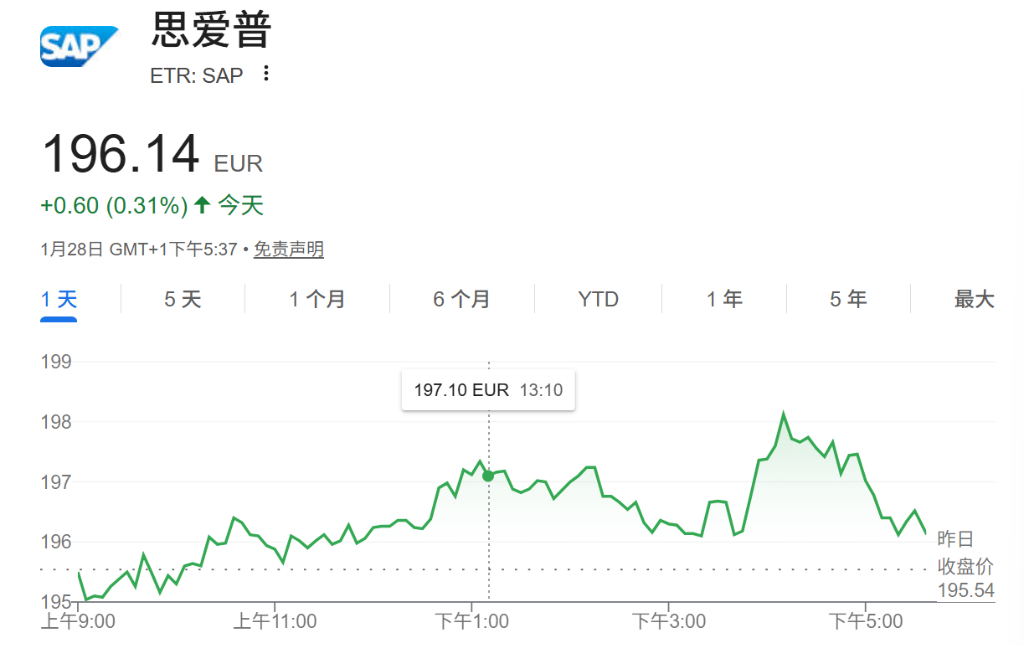
Core Insights - SAP SE reported a fourth-quarter 2025 non-IFRS earnings per share (EPS) of €1.62, reflecting a 16% increase year-over-year [1][9] - The company experienced strong cloud bookings and profitability, with total revenues on a non-IFRS basis reaching €9.68 billion, a 3% increase year-over-year (9% at constant currency) [2][3] - Despite positive revenue growth, SAP's shares fell 18% in pre-market trading due to cloud backlog and 2026 revenue guidance not meeting investor expectations [3][9] Financial Performance - For 2025, total revenue was €36.8 billion, up 8% (11% at constant currency), with predictable revenue increasing to 86% [3] - The cloud backlog surged 16% (25% at constant currency) to €21.05 billion, indicating strong market demand [4] - Non-IFRS gross profit was €7.2 billion, a 3% increase year-over-year, while non-IFRS cloud gross profit rose 21% to €4.18 billion [11] Cloud Business Highlights - Cloud revenues reached €5.61 billion, up 19% year-over-year (26% at constant currency), driven by a 23% growth in Cloud ERP Suite revenues [5] - SAP Business AI played a significant role, being included in two-thirds of cloud order entries, highlighting its importance in deal conversion [2][9] - The company secured significant customer wins across various sectors, including notable clients like Bank of Italy and Deutsche Bundesbank [8] Client Adoption and Solutions - The "Rise with SAP" solution was adopted by numerous clients, including major brands like adidas and H&M Group [6] - SAP's "GROW with SAP" initiative aimed at smaller businesses was implemented by several organizations, enhancing cloud ERP adoption [7] Future Outlook - For 2026, SAP projects cloud revenue between €25.8 billion and €26.2 billion, indicating a growth of 23% to 25% from 2025 [15] - Non-IFRS operating profit is expected to be between €11.9 billion and €12.3 billion, representing a growth of 14% to 18% [16] - The company anticipates a moderation in current cloud backlog growth in 2026 compared to 2025 [16]


SAP's 2026 cloud forecasts disappoint, shares drop 15%, biggest daily loss since 2020
The Economic Times· 2026-01-29 15:01
Core Viewpoint - SAP's 2026 cloud revenue forecast fell short of market expectations, leading to a significant decline in its share price and raising concerns about the broader software sector's performance [10][11]. Group 1: Share Price Impact - SAP shares dropped as much as 17%, reaching their lowest point since February 2024, resulting in a loss of over 40 billion euros in market capitalization [10][11]. - The decline in SAP shares negatively affected Frankfurt's benchmark index, despite generally positive conditions in European markets [10]. - Other European software stocks also experienced declines, with Dassault Systemes down 2.7% and Sage falling over 3% [10]. Group 2: U.S. Software Sector Reaction - U.S. software stocks were similarly impacted, with Salesforce down 6.3%, Adobe down 2.5%, and Datadog down about 5% [2][11]. - ServiceNow's shares plunged 9% despite a positive forecast, indicating a broader trend of investor caution in the software sector [2][11]. Group 3: Revenue and Backlog Insights - SAP expects cloud revenue growth of 23% to 25% in 2026, a deceleration from the 25% growth seen in 2025 [6][11]. - The total cloud backlog grew by 30% to 77.3 billion euros, with full-year cloud revenue reaching 21 billion euros, a 26% increase at constant currencies [9][11]. - SAP's CFO highlighted a larger-than-anticipated slowdown due to customers shifting to larger projects and increased demand for sovereign cloud solutions, which have longer sales cycles [7][11]. Group 4: Market Sentiment and Analyst Commentary - Analysts noted a general distrust in the software market, with investors shifting focus to semiconductors, indicating a challenging environment for software companies [8][11]. - JPMorgan pointed out that the market reaction was driven by concerns over cloud backlog and revenue growth, which are critical for investor confidence [7][11]. - Oddo BHF analyst emphasized that even minor misses in expectations could lead to significant market repercussions in the current context [8][11]. Group 5: Strategic Developments - SAP announced a two-year buyback program worth up to 10 billion euros, aiming to bolster investor confidence [9][11]. - The company has been actively transitioning legacy database customers to cloud solutions while executing a 3.2 billion euro restructuring program [10][11]. - Major customer wins in Q4 included contracts with Dexco, Lockheed Martin, and Rolls-Royce, showcasing SAP's ongoing efforts to expand its market presence [10][11].

SAP(SAP.US)Q4每股收益1.62欧元同比增16% 宣布100亿欧元股票回购计划
Zhi Tong Cai Jing· 2026-01-29 07:17
Core Insights - SAP SE reported strong Q4 and full-year results for FY2025, with Q4 total revenue reaching €9.68 billion, a 9% increase at constant currency, and non-IFRS EPS of €1.62, up 16% year-over-year, exceeding analyst expectations of €1.51 [1][2] - The company's cloud business was a key growth driver, with revenue of €5.61 billion in Q4, representing a 19% year-over-year increase (26% at constant currency), slightly above market expectations [1] - SAP's free cash flow doubled to €8.24 billion for the year, surpassing the target of €8 billion [1] Revenue Breakdown - Q4 cloud revenue reached €5.61 billion, with Cloud ERP Suite revenue at €4.86 billion, a 30% increase at constant currency; traditional software license revenue declined to €0.45 billion, down 34% year-over-year, indicating a shift from on-premise to cloud solutions [1] - The current cloud backlog grew 16% to €21.05 billion (25% at constant currency), while total cloud backlog reached a record €77 billion, up 30% at constant currency, providing a solid foundation for future revenue growth [2] Business Transformation - The proportion of predictable revenue increased from 83% to 86% year-over-year, reflecting improved revenue quality as the company deepens its cloud transformation [2] - AI integration is becoming a core driver, with approximately two-thirds of cloud orders in Q4 involving AI functionalities, indicating a shift from conceptualization to commercial realization [2] Shareholder Returns - Non-IFRS EPS of €1.62, up 16% year-over-year, led to the announcement of a new €10 billion stock buyback program, set to begin in February 2026 and continue through the end of 2027 [2] Future Outlook - For 2026, SAP targets cloud revenue between €25.8 billion and €26.2 billion, a year-over-year growth of 23% to 25%, with non-IFRS operating profit expected to reach €11.9 billion to €12.3 billion and free cash flow targeted at approximately €10 billion [3] - Despite optimistic core metrics, some analysts express caution regarding potential risks from global tariff uncertainties and currency fluctuations, which may impact 2026 performance [3]
云转型进入兑现期,SAP四季度调整后营业利润同比大增27%,上调2026年云收入增长指引
Hua Er Jie Jian Wen· 2026-01-29 07:16
Core Insights - SAP's cloud transformation strategy has entered a performance realization phase, with significant profit growth in Q4 driven by customers migrating from traditional on-premise systems to the cloud [1] - The company has raised its cloud revenue growth forecast for the year, expecting cloud revenue to reach €21.7 billion in 2025, exceeding analyst expectations [1][2] Group 1: Financial Performance - In Q4, SAP reported an adjusted operating profit increase of 27% year-on-year to €2.83 billion [1] - The company's cloud revenue for the full year 2025 is projected to be €21.7 billion at constant currency, surpassing analyst forecasts [1][2] - SAP's cloud backlog, reflecting sales to be recognized over the next 12 months, grew by 16% to €21.1 billion in Q4, with a 25% increase at constant currency [6] Group 2: AI Business Growth - SAP Business AI has become a key growth driver, with two-thirds of cloud orders in Q4 including AI business, and strong adoption rates within the ERP suite [1][6] - The rise in demand for AI technology has led SAP to focus on AI applications that require less human intervention, successfully converting AI into a growth engine [6] Group 3: Cloud Migration Strategy - SAP has set a timeline to accelerate customer migration to the cloud, planning to cease support for most of its major on-premise product lines by the end of 2027 [7] - The company announced a stock buyback plan of up to €10 billion by the end of 2027, signaling confidence in the long-term value of its cloud transformation strategy [7] Group 4: Business Model Transition - SAP is at a critical juncture in its business model transition, with traditional on-premise software support revenues declining while cloud subscription and AI revenues are rapidly increasing [8]
SAP(SAP) - 2025 Q4 - Earnings Call Transcript
2026-01-29 07:02
Financial Data and Key Metrics Changes - The total cloud backlog reached EUR 77 billion, up 30% year-on-year, indicating strong underlying business momentum [7][26] - Cloud revenue grew 26% year-on-year, primarily driven by the strong performance of the Cloud ERP Suite, which increased by 32% [27][29] - Total revenue for the full year approached EUR 37 billion, up 11% [29] Business Line Data and Key Metrics Changes - The Cloud ERP Suite accounted for 86% of total cloud revenue for the year, highlighting its role as a key growth engine [27] - The number of customers using the AI copilot tool grew ninefold over the year, with over 60% of existing cloud customers actively using AI [6][56] Market Data and Key Metrics Changes - Strong performances were noted in Brazil, France, Germany, India, Italy, South Korea, and Spain, while China, Japan, Saudi Arabia, the UK, and the US also showed significant strength [28] - The company outperformed the cloud market by 10 percentage points in 2025 [15] Company Strategy and Development Direction - The ongoing transformation of SAP's operating model, combined with AI integration, is expected to drive future growth and revenue acceleration through 2027 [14][22] - The company is focusing on a Partner-First approach for the mid-market and expanding its sovereign cloud capabilities [12][16] Management's Comments on Operating Environment and Future Outlook - Management acknowledged geopolitical uncertainty and macroeconomic volatility but emphasized the increasing demand for AI solutions among customers [4][24] - The company expects a record free cash flow of approximately EUR 10 billion in 2026, supported by continued efficiency improvements [32] Other Important Information - The non-IFRS cloud gross margin for the full year expanded by 1.6 percentage points to 75%, driving cloud gross profit up by 29% [28] - A new two-year share repurchase program of up to EUR 10 billion is set to start in February, reflecting confidence in the business's sustainable strengths [30] Q&A Session Summary Question: Insights on CCB and pipeline for Q1 - Management noted that the CCB ended at 25%, with larger deals contributing to longer ramp periods and some slippage, but overall bookings performance was ahead of plan [39][41] Question: AI-driven cost savings and R&D focus - The company aims to achieve EUR 2 billion in cost efficiencies through business growth and AI integration, with no current restructuring plans [46][48] Question: AI adoption among existing customers - Approximately 60% of existing cloud customers are actively using AI, with significant revenue uplift observed from early adopters [56][60] Question: Dynamics of TCB growth and BDC momentum - Management acknowledged a deceleration in TCB growth but emphasized a strong pipeline and the expected contribution from the Business Data Cloud in 2026 [72]
SAP(SAP) - 2025 Q4 - Earnings Call Transcript
2026-01-29 07:02
Financial Performance - The total cloud backlog reached EUR 77 billion, up 30% year-on-year, indicating strong underlying business momentum [7][14][26] - Cloud revenue grew 26% year-on-year, primarily driven by the strong performance of the Cloud ERP Suite, which increased by 32% [27][29] - Total revenue for the full year approached EUR 37 billion, up 11% [29] Business Lines and Key Metrics - The Cloud ERP Suite accounted for 86% of total cloud revenue, highlighting its significance as a growth engine [27] - The number of customers using the AI copilot tool grew ninefold over the year, with 60% of existing cloud customers actively using SAP's AI offerings [6][54] Market Performance - Strong performances were noted in Brazil, France, Germany, India, Italy, South Korea, and Spain, while China, Japan, Saudi Arabia, the UK, and the US also showed significant strength [28] - The company outperformed the cloud market by 10 percentage points in 2025 [15] Company Strategy and Industry Competition - The ongoing transformation of SAP's operating model, combined with AI integration, has positioned the company to capitalize on business AI opportunities [8][20] - The company is focused on a Partner-First approach for mid-market growth and expanding its sovereign cloud capabilities [12][16] Management's Comments on Operating Environment and Future Outlook - Management acknowledged geopolitical uncertainties and macroeconomic volatility but expressed confidence in the company's ability to drive growth through AI and cloud solutions [4][23] - The company expects a record free cash flow of approximately EUR 10 billion in 2026, supported by operational efficiency improvements [32] Other Important Information - The non-IFRS cloud gross margin for the full year expanded by 1.6 percentage points to 75%, driving cloud gross profit up by 29% [28] - A new two-year share repurchase program of up to EUR 10 billion is set to start in February, reflecting confidence in the business's sustainable strengths [30] Q&A Session Summary Question: Concerns about CCB growth and deal slippage - Management noted that the 25% CCB growth was impacted by a higher share of large deals with longer ramp periods and some government deals with termination clauses [38][40] Question: AI-driven cost efficiencies - The company aims to achieve EUR 2 billion in cost efficiencies through business growth without a restructuring plan, focusing on scaling operations with AI [44][46] Question: Customer adoption of AI offerings - Approximately 60% of existing cloud customers are actively using SAP's AI, with a significant increase in adoption noted [54][56] Question: Future cloud revenue growth trajectory - Management indicated that while some deceleration is expected, it will be less than in 2025, with a strong pipeline for 2026 [66][68]