Spatial Audio

Search documents
Hands-on experience with Spatial Audio for Apple Immersive Video | Meet with Apple
Apple Developer· 2025-12-10 00:01
Spatial Audio Design Principles - Immersive audio design should account for the entire visual frame, as viewers can explore different areas and focus on mini-stories within the scene [1][2][5][6] - Spatial audio should consider the sonic world behind the viewer, utilizing equirectangular representations to place sounds accurately in 360-degree space [7][8][9][10] - Headlocked stereo is suitable for elements like voiceover and narration, where the sound should remain constant relative to the viewer's ears, rather than being spatialized within the scene [12][13][14][15][42][43][44] DaVinci Resolve Fairlight Integration - DaVinci Resolve integrates editing, color correction, and Fairlight audio post-production, enabling a collaborative workflow without data exchange between pages [17][18] - Fairlight offers standard DAW tools, including faders, spatial panners (azimuth, elevation, Cartesian view), built-in EQ, dynamics processors (compressor, gate, limiter), and bus routing [18][19][20][21][22] - Fairlight supports ASAF (Apple Spatial Audio Format) master bus output, allowing for mixing in binaural, stereo, or speaker system configurations, optimized for the listening environment [23][24][25][26] - Buses can be set up in Fairlight to route audio signals to different destinations, including ambisonic formats for Apple Immersive Video [27][28] ASAF Workflow and Features - ASAF and ambisonics enable realistic positioning of sounds in the sound field, such as placing stereo sounds in the upper canopy of trees [37][38] - Headlocking in Fairlight can be achieved by routing a track to the main ASAF output, selecting the track, and enabling the headlocked option in the inspector [43] - DaVinci Resolve Fairlight's IntelliTrack, an AI-based tracker, automates complex pan moves by tracking objects in the video, saving time for audio engineers [52][53][54][55][56] Project Setup and Delivery - Apple Immersive Audio requires DaVinci Resolve Studio (the paid version) and enabling Apple Spatial Audio in the Video and Audio I/O preferences [57][58] - Final output for Vision Pro or master files can be delivered through the Deliver page, with options for Vision Pro Review or creating a master file bundle [58][59]

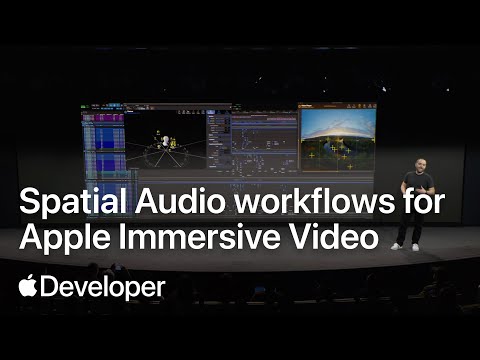
Spatial Audio workflows for Apple Immersive Video | Meet with Apple
Apple Developer· 2025-12-04 18:33
Spatial Audio Acquisition - Industry emphasizes recording Ambisonics spatial audio from the camera's perspective, especially in documentary filmmaking, to capture the entire sonic environment [7] - Industry suggests using mono recordings in addition to spatial recordings for dialog, prioritizing individual mics due to the wide field of view in immersive experiences [13][14] - Industry highlights the availability of various ambisonic microphones with similar form factors to regular shotgun microphones, offering options for different needs and budgets [10] Sound Editorial - Sound editorial involves assembling and layering dialog, sound effects, and music, similar to standard post-production [15] - Industry recommends using Foley and Ambiances to build immersion by focusing on small, everyday sounds [19][20] - Industry suggests compiling and assembling all sound sources, including multiple spatial mics and individual mono ISOs, during sound editorial [18] Spatial Mix - Industry advises anchoring sounds to visual elements using Apple Spatial Audio instead of relying on a center channel, as the audience is inside the scene [26] - Industry recommends mixing on headphones to ensure the mix translates well with regards to perspective and dynamic range [30] - Industry stresses the importance of reviewing work on Apple Vision Pro to accurately judge distance, perspective, and sound positioning [31]

全球与中国空间音频解决方案市场现状及未来发展趋势
QYResearch· 2025-09-16 03:55
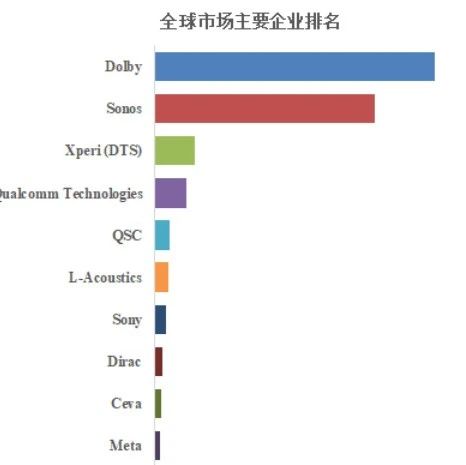
Core Insights - The global spatial audio solutions market is experiencing dynamic growth, with a projected market size of 5.345 billion in 2024 and an expected increase to 10.49 billion by 2031, reflecting a compound annual growth rate (CAGR) of 9.87% [3] - China is a significant market, with a forecasted growth from 704 million in 2024 to 1.727 billion by 2031, indicating a CAGR of 13.37% [3] - North America currently holds the largest market share at 35.16% in 2024, followed by Europe and China, with China expected to grow the fastest in the coming years [3] Market Trends - The spatial audio solutions market is characterized by a "software + hardware" integration model, balancing cost and user experience [4] - Technological advancements, including 3D audio and AI applications, are driving market growth by enhancing audio production and playback efficiency [4] - The demand for immersive audio experiences is rising across various sectors, including education, healthcare, aviation, and architecture [6] Competitive Landscape - The market is competitive, with major players like Dolby, Sonos, Xperi (DTS), and Qualcomm Technologies leading the field [3][12] - Both established companies and startups are actively entering the spatial audio space, with larger firms leveraging their R&D capabilities and market channels, while startups focus on innovative solutions [6] - Companies are encouraged to enhance user experience and product iteration to stand out in the competitive landscape, with personalized audio experiences becoming crucial [6] Policy Analysis - The Chinese government is promoting the development of audiovisual electronic technologies, with spatial audio identified as a key technology [9] - A collaborative initiative among several government departments aims to accelerate the adoption of spatial audio solutions in various applications [9] - Compliance with regulations such as the GDPR is essential for companies operating in the European market, impacting operational costs and necessitating technological improvements [9] Future Outlook - The spatial audio solutions market is poised for significant growth, driven by technological advancements and diverse application scenarios [7] - Companies that can adapt to these dynamic trends are likely to gain a competitive edge in this emerging market [7]

全球空间音频解决方案市场前10强生产商排名及市场占有率
QYResearch· 2025-07-23 03:54
Core Viewpoint - The article discusses the growing market for spatial audio solutions, highlighting its technological advancements, diverse applications across various industries, and competitive landscape, with a projected market size of $10.49 billion by 2031 and a CAGR of 9.9% from 2025 to 2031 [4][8]. Market Overview - Spatial audio solutions create immersive audio experiences by simulating sound perception from different directions and distances, enhancing multimedia content such as movies, video games, VR, and AR [1]. - The market is driven by technological advancements, including 3D audio, physical modeling, and audio scene synthesis, making production and playback more efficient and cost-effective [3]. Application Areas - Spatial audio applications extend beyond entertainment to sectors like education, healthcare, aviation, and architecture, with increasing demand for immersive audio experiences [3]. - In education, spatial audio enhances learning experiences; in healthcare, it is used for surgical simulations and psychological therapy; in architecture, it aids in environmental sound simulation [3]. Competitive Landscape - The global spatial audio solutions market is highly competitive, with both established companies and startups actively participating [4]. - Major companies leverage their technological and market advantages through mergers and collaborations, while startups focus on innovative solutions and flexible strategies [4]. - The top four manufacturers are expected to hold approximately 40% of the market share by 2024 [8]. Market Size and Growth - According to QYResearch, the global spatial audio solutions market is projected to reach $10.49 billion by 2031, with a CAGR of 9.9% [4]. - Software currently dominates the market, accounting for about 56% of the total market share, while entertainment and media represent the largest application segment, holding approximately 55% of the market [8][10].