
Stories

Search documents
The New York Times sues Perplexity, alleging copyright infringement
CNBC· 2025-12-05 14:59
Core Points - The New York Times has filed a lawsuit against Perplexity for allegedly copying and distributing its copyrighted content without permission [1][2] - The lawsuit claims that Perplexity unlawfully scraped various forms of content from The Times, including stories, videos, and podcasts, to create responses to user queries [1] - Perplexity's outputs are said to be "identical or substantially similar" to The Times' original content, according to the complaint [1] Company Statements - A spokesperson for The Times emphasized the importance of ethical AI use and expressed strong objections to Perplexity's unlicensed use of their content [2] - The Times is committed to holding companies accountable that do not recognize the value of their work [2] - Perplexity has not yet responded to requests for comment regarding the lawsuit [2]



X @TechCrunch
TechCrunch· 2025-11-25 21:23
https://t.co/7efL6zjagT will offer interactive ‘Stories’ to kids instead of open-ended chat https://t.co/vYvuzNPYdZ ...
谷歌产品副总裁:不是堆功能,是教 AI 理解人
3 6 Ke· 2025-10-13 02:14
Core Insights - Google has launched a new feature called AI Mode, transforming the search experience into a continuous dialogue rather than just answering questions [1] - By October 2025, AI Mode has been rolled out in over 200 countries and supports more than 35 languages, with users asking questions three times longer than traditional searches [1][4] - The focus of AI Mode is on understanding user intent rather than merely generating responses, marking a shift in product philosophy [1][6] Group 1: AI Mode Overview - AI Mode is not a chatbot but an "information understanding system" designed to comprehend user queries [2][4] - Unlike traditional search, AI Mode allows for ongoing dialogue, remembering context and suggesting related resources [4][5] - The goal is to create a new pathway for information retrieval, emphasizing understanding over mere generation [6][20] Group 2: Development Process - The initial development of AI Mode involved a small team of 5 to 10 people, focusing on user interaction rather than a complete overhaul of search [10][12] - Early testing revealed that users were already teaching the search engine how to evolve through their queries [12][13] - The process included real user feedback, which was crucial for refining the AI's capabilities [15][18] Group 3: User-Centric Design Principles - Understanding user needs is paramount; the product should help users accomplish specific tasks rather than just showcase features [21][33] - Data alone is insufficient; identifying the underlying reasons for user behavior is essential for product improvement [27][28] - Simplicity in design is crucial; users should easily understand how to use the product without confusion [30][31] Group 4: Differentiation from Competitors - Google aims to differentiate AI Mode from ChatGPT by focusing on information retrieval rather than open-ended conversation [37][38] - AI Mode is designed to assist users in practical tasks, such as planning trips or finding information, rather than engaging in casual chat [39][41] - The evolution of AI is about making it more intuitive and user-friendly, allowing even children to interact naturally with the system [42][46] Group 5: Future of AI Interaction - The future of AI lies in its ability to understand user queries naturally, making it a more integral part of daily life [41][47] - Google emphasizes that the competition in AI is not just about technical capabilities but about understanding user needs [49] - Each interaction with AI Mode teaches the system what constitutes a useful response, enhancing its ability to serve users effectively [49]

Instagram会成为Meta广告业务的第二曲线吗?
Sou Hu Cai Jing· 2025-08-29 13:14
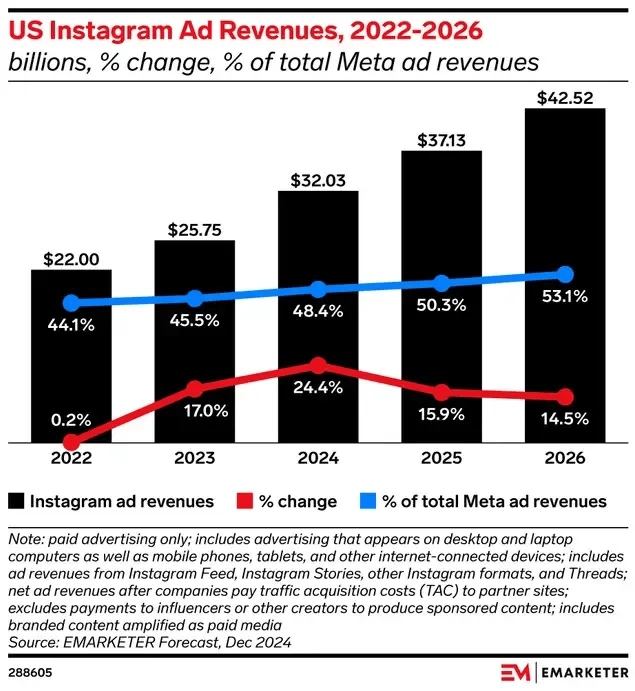
Core Insights - Instagram is evolving beyond being seen as a subsidiary of Facebook, with its advertising revenue projected to surpass Facebook's by 2025, reaching $32.03 billion in the U.S. [1][5] - The growth in Instagram's advertising revenue is significantly driven by Reels, with a more than 20% year-over-year increase in viewing time [1][11] - Instagram's advertising CPM reached $9.46 in Q2, surpassing Facebook, TikTok, and Pinterest, indicating a shift in its market position [5][11] Advertising Revenue Growth - Meta's Q2 advertising revenue was $46.56 billion, exceeding Wall Street's expectations, with Instagram being a key contributor [1] - eMarketer predicts that Instagram's ad revenue will account for 50.3% of Meta's U.S. ad revenue by 2025, marking a significant milestone [1][5] - The introduction of new advertising models and improved conversion rates has enhanced Instagram's role in Meta's growth strategy [1][11] Competitive Landscape - Instagram's rise is partly attributed to TikTok's regulatory challenges, leading advertisers to shift budgets towards Instagram and YouTube Shorts [8][12] - The platform has undergone significant upgrades in its technology and advertising systems, allowing it to capture a larger share of advertising budgets [8][12] - The introduction of advanced models like Andromeda and GEM has improved Instagram's ad matching capabilities, enhancing overall advertising efficiency [9][11] Historical Context - Instagram was integrated into Facebook's ecosystem post-acquisition in 2012, limiting its initial growth as an independent advertising platform [6][7] - The platform's commercial journey began cautiously, with its first sponsored ad appearing in 2013, and it only began to scale significantly after 2015 [6][7] - The launch of Reels in 2020 marked a turning point, allowing Instagram to compete more effectively in the short video advertising space [7][11] Technological Advancements - Meta's introduction of large models into its advertising system has significantly enhanced Instagram's ad targeting and conversion capabilities [9][11] - The upgraded recommendation logic for Reels has allowed for real-time learning and improved user engagement, further driving ad performance [9][10] - Instagram's ability to adapt its advertising strategy in response to market changes has solidified its position as a key player in the digital advertising landscape [12]

X @TechCrunch
TechCrunch· 2025-06-30 19:54
Product Update - Instagram allows sharing Spotify songs with sound to Stories [1]