TPU v4

Search documents
理想这次入选的ISCA Industry Track门槛真挺高的
理想TOP2· 2026-03-30 08:31
Core Viewpoint - The article emphasizes the significance of the ISCA Industry Track for companies like Li Auto, highlighting the rigorous selection process and the importance of producing high-quality research papers for industry recognition [1]. Group 1: ISCA Industry Track Overview - The ISCA Industry Track has a stringent acceptance rate, admitting only 4-6 papers annually since 2020, requiring the first author to be from the industry and to present real or near-production results [1]. - In contrast, the ICCV conference accepts 2,000-3,000 papers each year, making it easier for companies to publish multiple papers if they are committed to quality research [1]. Group 2: Previous ISCA Industry Track Papers - IBM presented a paper on the Data Compression Accelerator on IBM POWER9 and z15 processors, which significantly reduced enterprise storage costs and improved efficiency in handling massive data [3]. - Centaur's paper discussed integrating a high-performance deep learning coprocessor into x86 SoCs, exploring the path for deep integration of AI capabilities in traditional processors [3]. - Samsung reviewed the evolution of its Exynos series CPU microarchitecture, enhancing the competitive performance of mobile SoCs [3]. - Alibaba introduced the Xuantie-910, a high-performance 64-bit RISC-V processor, marking a milestone for the RISC-V ecosystem and demonstrating its competitiveness in high-performance computing [3]. Group 3: 2022 ISCA Industry Track Highlights - SimpleMachines explored the commercial viability of non-Von Neumann architectures optimized for AI tasks through their Mozart dataflow processor [6]. - Meta's paper on software-hardware co-design for large-scale embedding tables directly influenced the development of its self-developed AI chip, MTIA [6]. - IBM detailed the AI accelerator in the Telum processor, enabling real-time fraud detection and other AI inference tasks [6]. - Alibaba's Fidas system enhanced the security and overall performance of its cloud infrastructure through FPGA-based offloading for intrusion detection [6]. Group 4: 2023 ISCA Industry Track Highlights - Google introduced TPU v4, an optically reconfigurable supercomputer optimized for embedding tasks, solidifying its leadership in computational power for the embedding era [8]. - AMD reflected on its decade-long journey in exascale computing research, providing a roadmap for the industry to reach exascale levels [8]. - Meta launched its first-generation AI inference chip, MTIA, tailored for recommendation systems, marking its entry into self-developed chip territory [8]. - Microsoft shared advancements in low-bit computation formats through shared microexponents technology, promoting standardization in AI arithmetic operations [8].


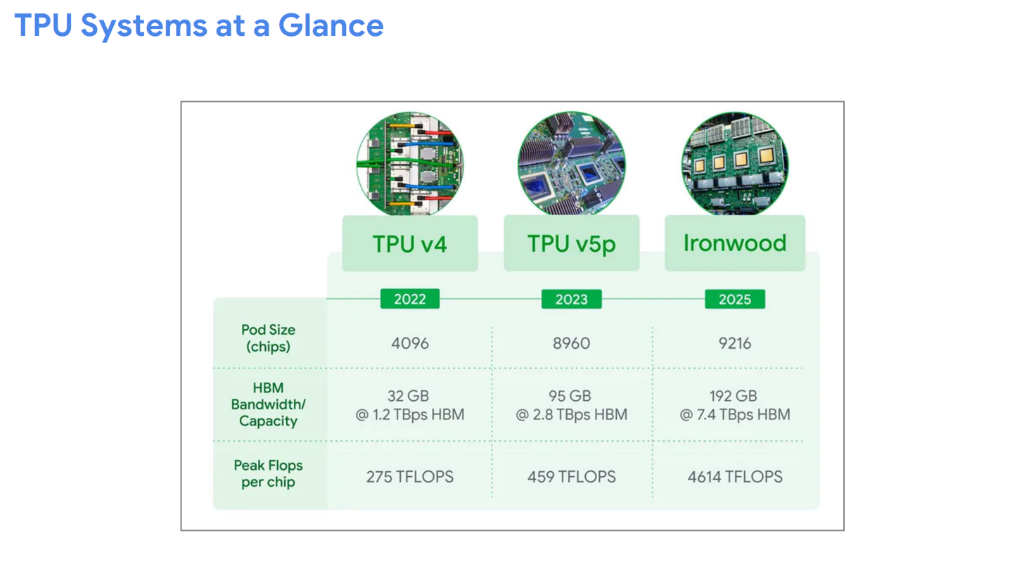
AI算力竞赛升级,谷歌发布下代Ironwood TPU架构,性能暴增16倍,单芯片算力达4614 TFLOPs
Hua Er Jie Jian Wen· 2025-08-25 12:42
Core Insights - The AI infrastructure arms race is accelerating, with Google's latest TPU platform, Ironwood, setting a new benchmark in performance [1][4] - Ironwood's seventh-generation TPU architecture boasts a peak performance of 4614 TFLOPs, representing over a 16-fold increase compared to the TPU v4 launched in 2022 [5][8] Performance Leap - Ironwood's single-chip peak performance reaches 4614 TFLOPs, equipped with 192 GB of high-bandwidth memory (HBM) and a bandwidth of 7.4 TB/s [5] - In comparison, the TPU v4 released in 2022 had a performance of 275 TFLOPs with 32 GB HBM and 1.2 TB/s bandwidth, while the TPU v5p from 2023 had 459 TFLOPs, 95 GB HBM, and 2.8 TB/s bandwidth [5][8] System Architecture - The Ironwood platform is designed as a modular and scalable system, integrating the Ironwood SoC chip into a comprehensive architecture that includes racks and clusters [11] - An Ironwood TPU rack consists of 64 chips, with 16 PCBA motherboards stacked together, utilizing a 3D Torus network topology for efficient interconnectivity [14] Scalability and Cluster Design - The system can connect up to 43 computing units, each containing 64 chips, forming a massive cluster with a network bandwidth of 1.8 Petabytes [14] - The Ironwood Superpod will include 9216 chips, further expanding the scale compared to previous generations [8] Energy Consumption and Cooling Solutions - A fully loaded Ironwood rack can exceed 100 kW in power consumption, necessitating advanced power and cooling solutions [17] - Google has implemented an efficient liquid cooling system for the Ironwood racks, including a CBU rack for coolant distribution and a leak detection system [17]