
TurboS

Search documents
腾讯,重磅开源
Zheng Quan Shi Bao· 2025-06-27 15:32
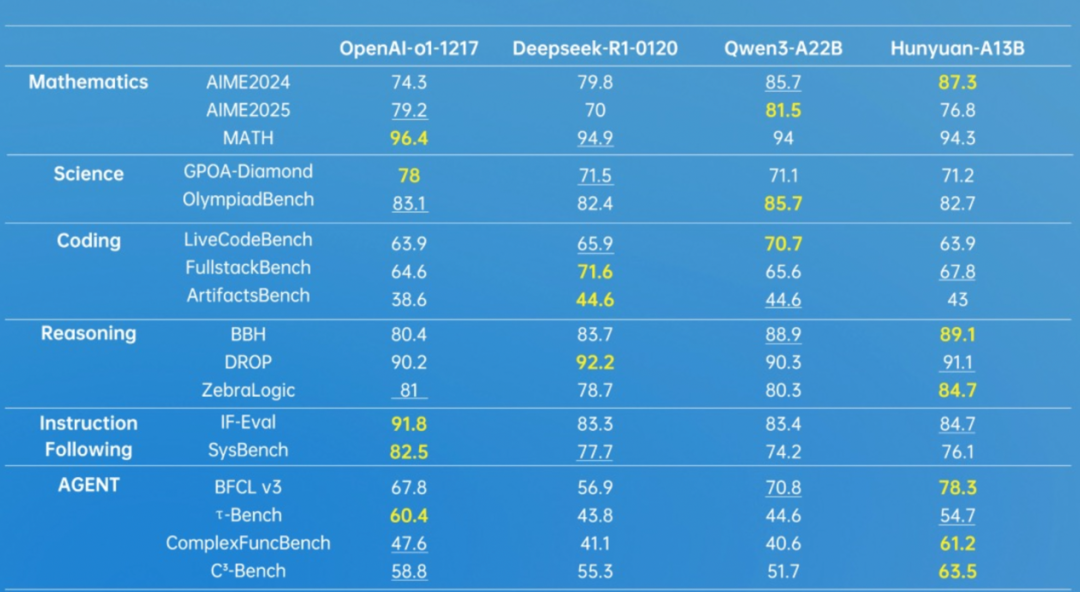
Core Insights - Tencent has launched the Hunyuan-A13B, the industry's first 13B-level MoE (Mixture of Experts) open-source inference model, which features a total of 80 billion parameters but activates only 13 billion, achieving high performance with lower resource requirements [1][2] Model Performance - Hunyuan-A13B is one of Tencent's most utilized large language models, with over 400 business applications and an average daily request volume exceeding 130 million [2] - In various authoritative industry benchmarks, Hunyuan-A13B has demonstrated competitive performance compared to models like OpenAI's o1-1217, DeepSeek's R1-0120, and Qwen3-A22B [2][3] Benchmark Results - In the Mathematics category, Hunyuan-A13B scored 87.3 in AIME2024, outperforming OpenAI's o1-1217 and DeepSeek's R1-0120 [3] - Hunyuan-A13B excelled in reasoning tasks, achieving a score of 89.1 in BBH, indicating strong reasoning capabilities [3] - The model also showed notable performance in agent tool invocation and long-text capabilities, utilizing a multi-agent data synthesis framework [3] Model Features - The Hunyuan-A13B allows users to select between fast and slow reasoning modes, optimizing resource allocation for efficiency and task accuracy [4] - This model is part of Tencent's ongoing efforts to enhance its AI capabilities, following the release of the TurboS model, which focuses on rapid reasoning [4] Strategic Developments - Tencent is restructuring its large model R&D system, focusing on three core areas: computing power, algorithms, and data management [5] - The company has established new departments dedicated to large language models and multimodal models, aiming to explore cutting-edge technologies and improve model capabilities [5] Financial Investments - Tencent's R&D expenditure reached 70.69 billion yuan in 2024, with capital expenditures showing a significant year-on-year increase of 221%, reflecting the company's commitment to AI investment [6] - The increase in capital spending is attributed to the acquisition of more GPUs to meet growing inference demands, with plans for further investment in 2025 [6]


腾讯,重磅开源!
证券时报· 2025-06-27 15:09
Core Viewpoint - Tencent's Hunyuan-A13B model, an open-source MoE model with 80 billion total parameters and 13 billion active parameters, offers faster inference speed and better cost-effectiveness compared to leading open-source models [1][3][4]. Group 1: Model Performance and Features - Hunyuan-A13B is the first 13 billion parameter MoE open-source model, widely used internally with over 400 business applications and an average daily request exceeding 130 million [3]. - In various authoritative industry benchmarks, Hunyuan-A13B demonstrated competitive performance against models like OpenAI's o1-1217 and DeepSeek's R1-0120, achieving notable scores in mathematics, science, coding, reasoning, and instruction tasks [4][5]. - The model excels in agent tool invocation and long-text capabilities, utilizing a multi-agent data synthesis framework and reinforcement learning for autonomous exploration and learning [5]. Group 2: Strategic Developments and Future Plans - Tencent's recent restructuring of its large model research and development system includes the establishment of new departments focused on large language models and multimodal models, enhancing its technical capabilities [7]. - The company plans to release more models with varying sizes and features to meet diverse enterprise needs, including multimodal foundational models for images, videos, and 3D [6][7]. - Tencent's R&D investment reached 70.69 billion yuan in 2024, with capital expenditures increasing significantly to support AI capabilities and infrastructure, including GPU purchases for inference needs [8].
中信证券:系统级算力有望成为AI发展的下一站 建议关注国内产业链相关公司
智通财经网· 2025-06-26 00:29
Core Viewpoint - The report from CITIC Securities indicates that the demand for AI large model training and inference is continuously growing, with system-level computing expected to become the next generation of AI computing infrastructure [1] Group 1: System-Level Computing - System-level computing is anticipated to become the next generation of AI computing infrastructure, driven by the need for generality in foundational infrastructure to address future model developments [1] - The scaling law is rapidly evolving in post-training and online inference stages, with innovations in model architecture enhancing training capabilities [1] - The focus on hardware deployment for achieving higher throughput and lower latency in inference is becoming critical, with a shift towards cluster-based inference models [1] Group 2: Technical Aspects - The development of single-chip computing capabilities is outpacing advancements in communication technology, making communication efficiency a key factor for cluster performance [3] - Two primary methods for building large clusters are identified: Scale up (increasing resources per node) and Scale out (increasing the number of nodes), with Scale up being a significant future direction [3] - Notable examples include NVIDIA's NVL72 system and Huawei's CloudMatrix384 super node, which provide insights into industry development [3] Group 3: Industry Dynamics - The semiconductor industry typically utilizes mergers and acquisitions for technology integration and market expansion, with leading companies often pursuing these strategies to enhance their market position [4] - NVIDIA's acquisition of Mellanox exemplifies this strategy, expanding its NVLink technology to include RDMA networks for large-scale computing [4] - AMD's acquisition of ZT Systems has strengthened its system architecture design capabilities and data center solution delivery experience, contributing to the core of AI solutions [4][5]

