US government bonds

Search documents
Treasuries Fall as China Banks Asked to Limit Bond Holdings
Yahoo Finance· 2026-02-09 11:05
Group 1 - Chinese regulators have advised financial institutions to limit their holdings of US government bonds due to concerns over market volatility [2][3] - Yields on benchmark Treasuries increased, with a rise of up to four basis points to 4.25% and 30-year notes rising two basis points to 4.87% [2] - The Bloomberg Dollar Spot Index decreased by 0.2% [2] Group 2 - The directive from Chinese officials does not apply to state holdings of Treasuries and lacks specific targets for size or timing [3] - This request for banks to diversify risk aligns with a global trend where countries like India and Brazil are reducing their exposure to US assets [4] - Geopolitical risks, including threats from President Trump, have intensified concerns and led to a search for alternative assets like gold [4] Group 3 - China-based investors' holdings of Treasuries have decreased to $682.6 billion, the lowest since 2008, down from a peak of $1.32 trillion in late 2013 [6] - Belgium's Treasury ownership has quadrupled since the end of 2017 to $481 billion, often attributed to Chinese custodial accounts [6] - China's overall investment in American securities, including US agency bonds and equities, has remained stable since late 2023 [7] Group 4 - A significant portion of US Treasuries is held by Chinese official institutions, which tend to hold short-dated debt for liquidity reasons [8] - The remaining holdings by banks are relatively small, and China does not significantly impact the Treasury market during monthly auctions [8]
Wall Street Gets Squeezed by Twin Global Crises
Yahoo Finance· 2026-01-21 05:01
Market Overview - Wall Street is facing significant challenges due to geopolitical tensions, particularly a trade war with Europe over Greenland and a severe downturn in Japan's bond market [1][4] - The recent turmoil has led to a sharp decline in equities, a spike in the VIX (6.6% increase), and a surge in gold prices, indicating a shift to a risk-off sentiment among investors [2][5] Investor Sentiment - Prior to the recent events, fund managers were notably bullish, with cash levels at a record low and 48% of managers reporting overweight positions, the highest level of confidence since July 2021 [3] - However, the escalation of geopolitical risks has prompted a reevaluation of this optimism, with many investors lacking protections against potential market downturns, the highest since 2018 [3] Bond Market Dynamics - Yields on Japanese Government Bonds (JGB) have reached all-time highs, with 40-year JGB yields rising to 4.2%, marking a significant increase of 80 basis points since the new Prime Minister's high-spending policies took effect [4] - The volatility in Japan's bond market has had a ripple effect, causing yields on US government bonds to rise to their highest levels since August, indicating increased risk premiums are necessary in light of geopolitical concerns [5]
日债遭遇“特拉斯时刻”:长债收益率狂飙25个基点,市场陷入近年最混乱一日
Hua Er Jie Jian Wen· 2026-01-20 16:20
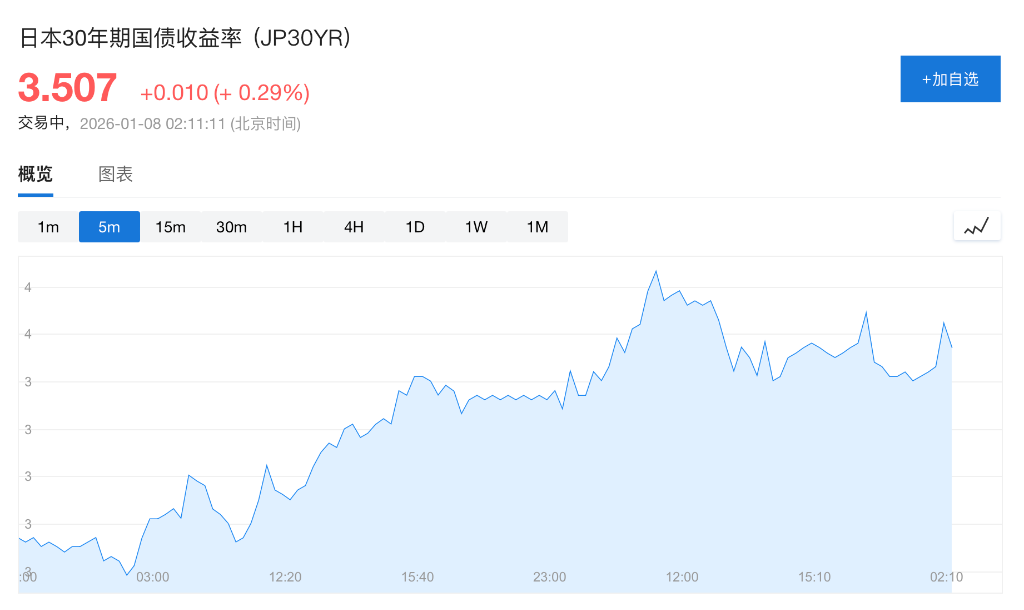
Core Viewpoint - The Japanese bond market experienced a severe sell-off on January 20, described by traders as "the most chaotic trading day in recent years," driven by concerns over Prime Minister Fumio Kishida's tax cuts and spending plans, which raised fears about Japan's fiscal sustainability [1][2]. Group 1: Market Reactions - The sell-off led to a significant increase in long-term bond yields, with the 30-year and 40-year Japanese government bond yields rising by over 25 basis points in a single day, marking the largest daily fluctuation since the impact of Trump's tariffs on global markets last year [2]. - The weak auction results for the 20-year bonds exacerbated concerns regarding Kishida's fiscal policies, creating a vicious cycle of selling and increasing anxiety [2][8]. - The turmoil quickly spread to global bond markets, with U.S. Treasury yields also rising to four-month highs, as the 30-year yield increased by 10 basis points to 4.94% and the 10-year yield rose by 7 basis points to 4.30% [5][12]. Group 2: Investor Behavior - Some investors sought opportunities amidst the panic, with Reed Capital Partners' CIO stating that the extreme market conditions prompted them to buy Japanese government bonds, indicating a belief that the market was significantly out of balance [9]. - T. Rowe Price's portfolio manager noted that investors often choose to modestly rebalance their positions during chaotic market conditions, as it is difficult to accurately predict market tops [9]. - There is a growing bearish sentiment among global bond investors towards Japanese government bonds, leading to increased interest in short-selling strategies to profit from rising yields [9]. Group 3: Fiscal Concerns - The sell-off intensified pressure on Japanese life insurance companies that hold substantial amounts of government bonds, with concerns about future fiscal stability making it difficult for these institutions to re-enter the market even if bond yields become more attractive [10]. - Kishida's plan to suspend sales tax on food and beverages, seen as an attempt to gain support for the upcoming elections, is expected to cost approximately 5 trillion yen (about 316 billion USD) annually, raising skepticism about the government's commitment to fiscal responsibility [10].

The Fed is expected to cut interest rates today. Here's why bond yields are moving in the opposite direction.
Yahoo Finance· 2025-12-10 23:15
Group 1 - The market anticipates a rate cut by the Federal Reserve, yet US government bond yields are rising, with the 10-year Treasury yield increasing by about 20 basis points to around 4.20% [1][9] - There is a disconnect between long-term bond yields and the Fed's short-term borrowing rate, which is unusual given the expectation of continued rate decreases into 2026 [2] - Inflation concerns are central to bond investors, as recent months have seen a resurgence in inflation despite a previous peak of around 9% in summer 2022 [4][5] Group 2 - The potential appointment of Kevin Hassett as the next Fed Chair raises concerns that aggressive rate cuts could exacerbate inflation, influencing market expectations [6][7] - The bond market reflects worries about future inflation, with rising yields indicating skepticism about the Fed's ability to manage inflation effectively under new leadership [9][10] - Questions arise regarding the implications of increased Treasury issuance and whether new Fed leadership might alter the inflation target, potentially raising it from 2% to 4% [10]
Gold and bond yields spike as Trump looks to remove Fed governor Cook
Proactiveinvestors NA· 2025-08-26 10:33
Core Viewpoint - The dismissal of Federal Reserve governor Lisa Cook by President Trump over alleged mortgage fraud has led to market volatility, raising concerns about the independence of the Federal Reserve and its implications for monetary policy [1][6][7]. Market Reactions - Stock markets and bonds experienced a sell-off following the announcement, with US government bond yields rising, particularly the 30-year bond which surpassed 5.6%, nearing a 27-year high [3]. - The dollar initially dropped nearly 0.4% but largely reversed this decline, while gold prices spiked by 1% and maintained most of the overnight gain [4]. Federal Reserve Implications - Cook's potential dismissal would create another vacancy on the Federal Reserve board, which Trump is expected to fill with an economist favoring interest rate cuts [3]. - The current situation raises concerns about "intensifying fiscal dominance risks" within the Federal Reserve, as noted by Deutsche Bank forex strategist George Saravelos [7]. Independence of the Federal Reserve - Analysts suggest that Trump's actions may undermine confidence in the Federal Reserve's independence, which is crucial for maintaining transparent and rules-based capital markets [6]. - The attempted removal of Cook is described as unprecedented, potentially signaling the end of central bank independence in the US [7][8].