VCM)

Search documents
2亿元别墅降价66%卖没人要,已流拍8次!背后老板张伟涉黑被判无期
Mei Ri Jing Ji Xin Wen· 2025-12-26 13:29
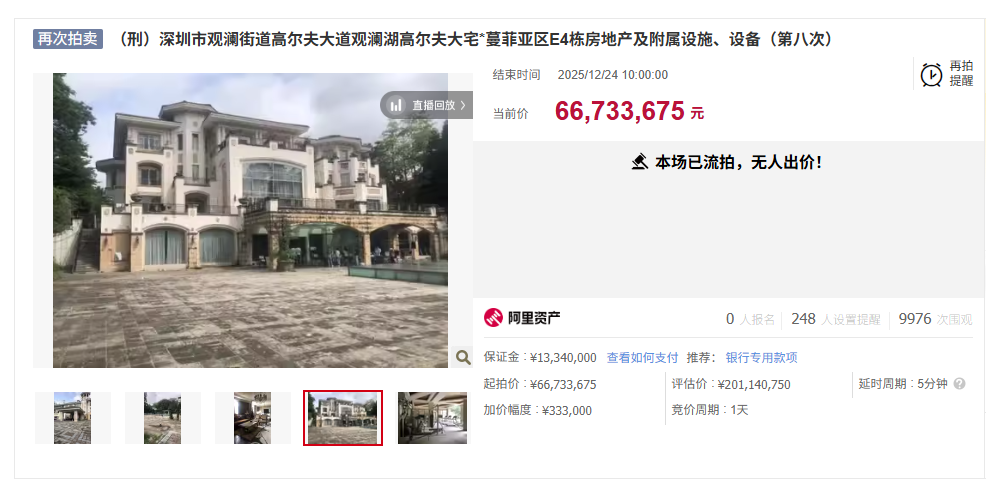
Group 1 - A luxury villa in Shenzhen, originally valued at over 200 million yuan, has seen a price drop of over 66% and failed to attract any bids during its auction, marking its eighth attempt to sell [1][2][3] - The property, associated with the "Zhongke Chuang" case, has outstanding management fees exceeding 2.15 million yuan and electricity bills of approximately 103,000 yuan, which the buyer will be responsible for [2][3] - The villa has a total area of approximately 3,935.02 square meters, including additional constructed areas that could not be appraised due to missing documentation [2][3] Group 2 - The auction process for the villa began in August 2023 with an initial starting price of over 201 million yuan, making it the most expensive judicial auction property in Shenzhen at that time [3] - The property has been significantly devalued over multiple auctions, with the latest starting price being over 130 million yuan lower than its assessed value [3] - Other assets related to the "Zhongke Chuang" case include luxury watches and a yacht, with the yacht's starting price reduced from 2.64 million yuan to 787,500 yuan for its upcoming auction [4][7] Group 3 - Zhang Wei, the former actual controller of He Sheng New Materials, was sentenced to life imprisonment for leading a criminal organization and other charges, which has impacted the company's control and operations [9][10] - He Sheng New Materials has experienced significant stock price fluctuations, with a nearly 150% increase in value since the beginning of the year, following changes in its controlling shareholder [14] - The company specializes in the research, production, and sales of exterior composite materials for home appliances, maintaining partnerships with major brands like Samsung and LG [14]


2亿元别墅降价66%卖没人要,已流拍8次,2只名表超5000万元成交!背后老板张伟涉黑被判无期,深圳原政法委书记李华楠是他保护伞
Mei Ri Jing Ji Xin Wen· 2025-12-26 11:27
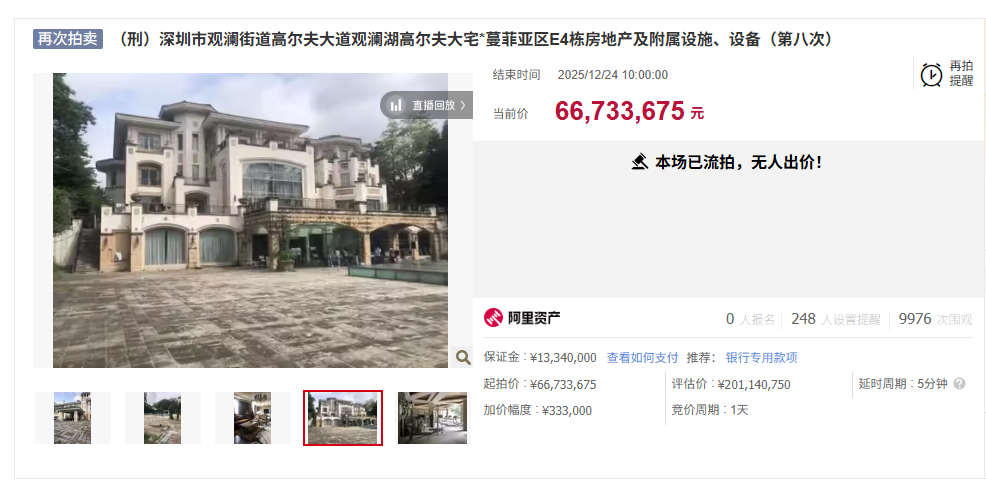
Core Viewpoint - A luxury villa in Shenzhen, originally valued at over 200 million yuan, has seen a price drop of over 66% and failed to attract any bids during its auction, marking the eighth attempt to sell the property [1][2][3]. Group 1: Property Auction Details - The villa, located in the Guanlan Lake Golf Resort, has an initial auction price of approximately 66.73 million yuan, with a required deposit of 13.34 million yuan and a bidding increment of 333,000 yuan [2]. - The property covers a total area of about 3,935.02 square meters, including a private garden, and has outstanding management fees of approximately 2.16 million yuan and electricity fees of about 103,000 yuan [2]. - The property is under mortgage with China Merchants Bank, with a principal amount of approximately 22.25 million yuan, and the total amount due by August 2025 is around 37.32 million yuan [2]. Group 2: Background of the Property - The villa is associated with the "Zhongke Chuang" case, linked to Zhang Wei, the former actual controller of Hesheng New Materials, who was sentenced to life imprisonment for multiple crimes, including leading a criminal organization [1][4][10]. - The property has been auctioned multiple times since August 2023, with the starting price decreasing significantly from over 200 million yuan to more than 130 million yuan less than the assessed value [3]. Group 3: Related Assets and Auctions - Other assets related to the "Zhongke Chuang" case include two luxury Patek Philippe watches and a Princess yacht, with the yacht's starting price reduced from approximately 2.64 million yuan to 787,500 yuan for its upcoming auction [4][7]. - A private Airbus aircraft previously linked to Zhang Wei was sold for approximately 63.34 million yuan, showcasing the high-value assets involved in the case [7]. Group 4: Company Background - Hesheng New Materials, founded in 2002, specializes in the research, production, and sales of appearance composite materials for home appliances, and has established long-term partnerships with major brands like Samsung and LG [14]. - Following Zhang Wei's conviction, the company's control has changed hands multiple times, with its stock price experiencing a significant increase of nearly 150% in the past year [14].
禾盛新材超15亿元易主摩尔智芯 新实控人系80后“资本玩家”
Zhong Guo Jing Ying Bao· 2025-11-26 09:14
Core Viewpoint - Suzhou Hesheng New Materials Co., Ltd. is undergoing a change in control for the second time in three years, with the current controlling shareholder Zhao Dongming and his associates planning to transfer 44.66 million shares (18% of total shares) to Moer Zhixin, making it the new controlling shareholder with Xie Haiwen as the new actual controller [1][2]. Group 1: Share Transfer Details - The share transfer agreement was signed on November 20, with a transfer price of 33.71 yuan per share, totaling approximately 1.505 billion yuan [2]. - After the transaction, Zhao Dongming and his associates will hold 34.03 million shares (13.72% of total shares) and will relinquish voting rights for 14.89 million shares (6% of total shares) [2]. Group 2: Company Background and Business Operations - Hesheng New Materials, established in 2002, specializes in the research, production, and sales of appearance composite materials for home appliances, primarily used in refrigerators and air conditioners [4]. - The company has established long-term partnerships with major home appliance brands such as Samsung, LG, and Midea, achieving a high market share in the composite materials sector [5]. Group 3: Future Business Plans and Investments - The new controlling shareholder, Moer Zhixin, has no immediate plans to make significant changes to the company's main business within the next 12 months [3]. - Hesheng New Materials has been increasing its investments in the artificial intelligence sector, including the establishment of Haixi Technology and a 10% stake in Yizhi Electronics [6].
CFA协会发布最新研究:解析自愿碳市场痛点与应对之策
Sou Hu Cai Jing· 2025-03-25 13:33
Core Viewpoint - The CFA Institute's latest research addresses the challenges faced by the Voluntary Carbon Market (VCM) and proposes solutions to enhance its efficiency in supporting carbon reduction and removal projects [1][2]. Group 1: Current Challenges in the Voluntary Carbon Market - The VCM is crucial for directing capital towards carbon reduction projects but is currently hindered by systemic challenges, including insufficient market liquidity and inefficient capital allocation [2]. - Factors limiting investment attraction include a lack of trust in the integrity of voluntary carbon credits, insufficient standardization, transaction opacity, concerns over "greenwashing," and high risks and costs [2][3]. Group 2: Proposed Solutions - **Increase Transparency**: The report suggests enhancing price transparency in VCM transactions through registration bodies and blockchain technology to improve price visibility and traceability, aiding better investment decisions [3]. - **Coordinate Standards**: Regulatory bodies should harmonize integrity standards for both international and domestic voluntary carbon markets to address fragmentation, particularly regarding the use of additional credits in buffer pools and the handling of permanent loss reserves for carbon reduction projects [3]. - **Unify Carbon Pricing**: Policymakers are encouraged to integrate compliance carbon markets with voluntary carbon markets to promote unified carbon pricing, thereby narrowing the cost gap between compliance market allowances and voluntary market offsets, which would incentivize carbon removal [3].