VGGT4D

Search documents
VGGT4D:无需训练,实现4D动态场景重建
具身智能之心· 2025-12-18 00:07
Core Insights - The article discusses the VGGT4D framework, which enables 3D foundation models to process dynamic 4D scenes without additional training costs, by mining motion cues from the Visual Geometry Transformer (VGGT) [1][3][32] Research Background - Recent 3D foundation models like VGGT and DUSt3R excel in static scene reconstruction but struggle with dynamic 4D scenes that include moving objects, leading to performance degradation [6] - Existing solutions face challenges in extracting 4D perception capabilities from pre-trained 3D models without additional training [7] Methodology - VGGT4D introduces a training-free mechanism for attention feature mining and mask refinement, utilizing Gram matrices and gradient flows for high-precision dynamic-static separation [12] - The framework employs self-similarity Gram matrices to address distributional gaps in standard attention maps, allowing for better extraction of motion cues [15] - Projection gradient-aware refinement is introduced to enhance boundary clarity by leveraging geometric projection residuals [17] - An in-distribution early-stage masking strategy is proposed to prevent performance degradation during inference by suppressing dynamic tokens in shallow layers [19] Experimental Validation - VGGT4D significantly outperforms other variants in dynamic object segmentation tasks across multiple datasets, achieving optimal performance in DAVIS-2016 and DAVIS-2017 without any 4D-specific training [21][22] - In camera pose estimation, VGGT4D consistently improves upon the strong baseline set by the original VGGT model, demonstrating robustness against dynamic objects [25] - The framework excels in long sequence robustness, achieving best results in the challenging Point Odyssey benchmark while maintaining efficiency [26] - VGGT4D achieves superior performance in 4D point cloud reconstruction, with median accuracy error decreasing from 0.009 to 0.004 and average distance reducing from 0.150 to 0.123 in the DyCheck dataset [28][29] Conclusion - VGGT4D successfully extends the capabilities of 3D foundation models to 4D dynamic scenes through effective mining of internal motion cues, offering a low-cost approach to 4D reconstruction and showcasing the potential of foundation models in zero-shot transfer tasks [32]

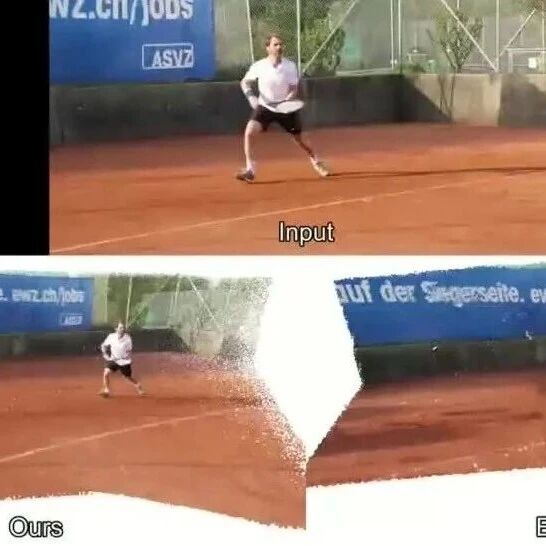
挖掘注意力中的运动线索:无需训练,解锁4D场景重建能力
量子位· 2025-12-17 09:07
Core Insights - The article discusses the development of VGGT4D, a framework that enables 3D foundation models to process dynamic 4D scenes without increasing training costs [1][2][30] - VGGT4D leverages motion cues hidden within the attention layers of the Visual Geometry Transformer (VGGT) to enhance performance in tasks such as dynamic object segmentation and camera pose estimation [1][6][30] Group 1: Challenges in Transitioning from 3D to 4D - Existing 3D models like VGGT and DUSt3R excel in static scene reconstruction but struggle with dynamic 4D scenes due to moving objects causing background geometric modeling interference and significant camera pose drift [4] - Current solutions face two main challenges: high computational or training costs and reliance on external priors, which complicate the system [5] Group 2: VGGT4D's Mechanism - VGGT4D aims to extract 4D perception capabilities directly from pre-trained 3D models without additional training [6] - The research team visualized the attention mechanism of VGGT and found that different network layers respond distinctly to dynamic regions, indicating that VGGT implicitly encodes rich dynamic cues despite being trained under static assumptions [7][13] Group 3: Motion Cue Extraction Techniques - VGGT4D introduces a training-free attention feature mining and mask refinement mechanism that utilizes Gram matrices and gradient flow for high-precision dynamic-static separation [14] - The method addresses the limitations of standard attention maps by using self-similarity Gram matrices to focus on motion-induced variance, enhancing the model's ability to detect dynamic features [17] Group 4: Performance Evaluation - VGGT4D significantly outperforms other variants in dynamic object segmentation tasks across multiple datasets, achieving optimal performance on DAVIS-2016 and DAVIS-2017 without any 4D-specific training [21][20] - The qualitative analysis shows that VGGT4D generates more accurate masks with clearer boundaries compared to baseline methods, validating the hypothesis that VGGT's Gram similarity statistics embed extractable motion cues [22] Group 5: Robustness and Long Sequence Performance - VGGT4D demonstrates superior robustness in camera pose estimation, achieving the best results in challenging long-sequence benchmarks while maintaining high efficiency [25] - The method effectively identifies and eliminates residual pose inconsistencies caused by motion, leading to more stable and accurate camera trajectories [25] Group 6: 4D Point Cloud Reconstruction - In evaluations on the DyCheck dataset, VGGT4D achieves the best performance across all reconstruction metrics, significantly improving accuracy and distance metrics compared to the VGGT baseline [28] - The method reduces median accuracy error from 0.009 to 0.004 and average distance from 0.150 to 0.123, demonstrating its capability for precise dynamic-static separation and enhanced geometric reconstruction quality [28] Group 7: Conclusion - VGGT4D presents a novel training-free paradigm that successfully extends the capabilities of 3D foundation models to 4D dynamic scenes, offering a low-cost solution for 4D reconstruction and showcasing the potential of foundational models in zero-shot transfer tasks [30]
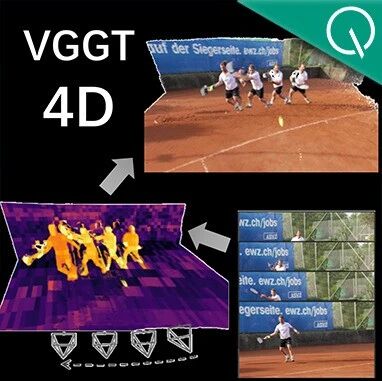
VGGT4D:无需训练,挖掘3D基础模型潜力,实现4D动态场景重建
机器之心· 2025-12-17 02:05
Core Insights - The article discusses VGGT4D, a framework developed by researchers from Hong Kong University of Science and Technology (Guangzhou) and Horizon Robotics, aimed at enabling 3D foundation models to handle dynamic 4D scenes without additional training costs [2][4][33] - VGGT4D leverages hidden motion cues within the attention layers of the Visual Geometry Transformer (VGGT) to improve performance in tasks such as dynamic object segmentation, camera pose estimation, and long-sequence 4D reconstruction [2][4][6] Research Background - Traditional 3D foundation models like VGGT and DUSt3R excel in static scene reconstruction but struggle with dynamic 4D scenes that include moving objects, leading to significant performance drops [6][7] - Existing solutions often face challenges such as high computational costs and reliance on external priors, which complicate the system [9][12] Methodology - VGGT4D introduces a training-free mechanism for attention feature mining and mask refinement, utilizing Gram matrices and gradient flows for high-precision dynamic-static separation [14][17] - The framework addresses limitations of standard attention maps by employing self-similarity Gram matrices to enhance the signal-to-noise ratio, allowing for better extraction of motion cues [16][17] Experimental Validation - VGGT4D was evaluated on dynamic object segmentation, camera pose estimation, and 4D point cloud reconstruction across six benchmark datasets, demonstrating superior performance compared to other methods [22][23] - In dynamic object segmentation, VGGT4D achieved optimal performance on the DAVIS-2016 and DAVIS-2017 datasets, outperforming all variants without requiring any 4D-specific training [24][25] - For camera pose estimation, VGGT4D consistently improved upon the strong baseline set by the original VGGT model, achieving an Average Translation Error (ATE) of 0.164 on the VKITTI dataset, compared to 2.272 for MonST3R [27][28] Conclusion - VGGT4D successfully extends the capabilities of 3D foundation models to 4D dynamic scenes through effective internal feature extraction, providing a low-cost solution for 4D reconstruction and showcasing the potential of foundational models in zero-shot transfer tasks [33]