4D动态场景重建

Search documents
VGGT4D:无需训练,实现4D动态场景重建
具身智能之心· 2025-12-18 00:07
编辑丨具身智能之心 点击下方 卡片 ,关注" 具身智能之心 "公众号 >> 点击进入→ 具身 智能之心 技术交流群 更多干货,欢迎加入国内首个具身智能全栈学习社区: 具身智能之心知识星球(戳我) ,这里包含所有你想要的! 如何让针对静态场景训练的 3D 基础模型(3D Foundation Models)在不增加训练成本的前提下,具备处理动态 4D 场景的能力? 来自香港科技大学(广州)与地平线 (Horizon Robotics) 的研究团队提出了 VGGT4D。该工作通过深入分析 Visual Geometry Transformer (VGGT) 的内部机制,发现并利用了隐藏在注意力层中的运动线索。 作为一种无需训练 (Training-free) 的框架,VGGT4D 在动态物体分割、相机位姿估计及长序列 4D 重建等任务上均取得了优异性能。 论文标题: VGGT4D: Mining Motion Cues in Visual Geometry Transformers for 4D Scene Reconstruction 论文链接: https://arxiv.org/abs/2511.19971 ...

VGGT4D:无需训练,挖掘3D基础模型潜力,实现4D动态场景重建
机器之心· 2025-12-17 02:05
Core Insights - The article discusses VGGT4D, a framework developed by researchers from Hong Kong University of Science and Technology (Guangzhou) and Horizon Robotics, aimed at enabling 3D foundation models to handle dynamic 4D scenes without additional training costs [2][4][33] - VGGT4D leverages hidden motion cues within the attention layers of the Visual Geometry Transformer (VGGT) to improve performance in tasks such as dynamic object segmentation, camera pose estimation, and long-sequence 4D reconstruction [2][4][6] Research Background - Traditional 3D foundation models like VGGT and DUSt3R excel in static scene reconstruction but struggle with dynamic 4D scenes that include moving objects, leading to significant performance drops [6][7] - Existing solutions often face challenges such as high computational costs and reliance on external priors, which complicate the system [9][12] Methodology - VGGT4D introduces a training-free mechanism for attention feature mining and mask refinement, utilizing Gram matrices and gradient flows for high-precision dynamic-static separation [14][17] - The framework addresses limitations of standard attention maps by employing self-similarity Gram matrices to enhance the signal-to-noise ratio, allowing for better extraction of motion cues [16][17] Experimental Validation - VGGT4D was evaluated on dynamic object segmentation, camera pose estimation, and 4D point cloud reconstruction across six benchmark datasets, demonstrating superior performance compared to other methods [22][23] - In dynamic object segmentation, VGGT4D achieved optimal performance on the DAVIS-2016 and DAVIS-2017 datasets, outperforming all variants without requiring any 4D-specific training [24][25] - For camera pose estimation, VGGT4D consistently improved upon the strong baseline set by the original VGGT model, achieving an Average Translation Error (ATE) of 0.164 on the VKITTI dataset, compared to 2.272 for MonST3R [27][28] Conclusion - VGGT4D successfully extends the capabilities of 3D foundation models to 4D dynamic scenes through effective internal feature extraction, providing a low-cost solution for 4D reconstruction and showcasing the potential of foundational models in zero-shot transfer tasks [33]

理想DrivingScene: 两帧图像实时重建动态驾驶场景
理想TOP2· 2025-11-02 09:08
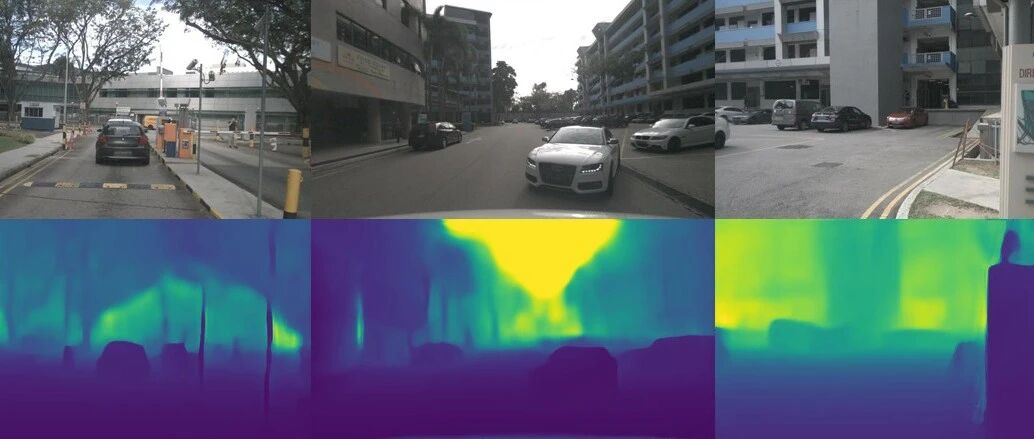
Research Background and Challenges - The safety and reliability of autonomous driving systems heavily depend on 4D dynamic scene reconstruction, which includes real-time, high-fidelity environmental perception in 3D space plus the time dimension. The industry faces two core contradictions: the limitations of static feedforward solutions, which assume "no dynamics in the scene," leading to severe artifacts when encountering moving targets like vehicles and pedestrians, making them unsuitable for real driving scenarios [1]. Core Innovations - Harbin Institute of Technology, in collaboration with Li Auto and other research teams, has achieved three key design breakthroughs to unify "real-time performance, high fidelity, and multi-task output" [2]. Related Work Overview - Static driving scene reconstruction methods include DrivingForward, pixelSplat, MVSplat, and DepthSplat, which have shown limitations in adapting to dynamic environments [3]. Key Technical Solutions - A two-stage training paradigm is proposed, where a robust static scene prior is learned from large-scale data before training the dynamic module, addressing the instability of end-to-end training and reducing the complexity of dynamic modeling [4]. - A hybrid shared architecture with a residual flow network is designed, featuring a shared depth encoder and a single-camera decoder to predict only the non-rigid motion residuals of dynamic objects, ensuring cross-view scale consistency and computational efficiency [4]. - A pure visual online feedforward framework is introduced, which inputs two consecutive panoramic images to output 3D Gaussian point clouds, depth maps, and scene flows in real-time, meeting the online perception needs of autonomous driving without offline optimization or multi-modal sensors [4]. Experimental Validation and Results Analysis - The method significantly outperforms existing feedforward baselines in quantitative results, achieving a PSNR of 28.76, which is 2.66 dB higher than Driv3R and 2.7 dB higher than DrivingForward, and an SSIM of 0.895, indicating superior rendering fidelity [28]. - The efficiency analysis shows that the proposed method has a faster inference time of 0.21 seconds per frame, which is 38% faster than DrivingForward and 70% faster than Driv3R, with a training cost of approximately 5 days and VRAM usage of 27.3 GB, significantly lower than Driv3R [30]. - Ablation studies confirm the necessity of the residual flow network, two-stage training, and flow distortion loss, highlighting their critical roles in dynamic modeling and rendering quality [32][34].


理想DrivingScene:仅凭两帧图像即可实时重建动态驾驶场景
自动驾驶之心· 2025-11-01 16:04
Group 1 - The article discusses the challenges in achieving real-time, high-fidelity, and multi-task output in autonomous driving systems, emphasizing the importance of 4D dynamic scene reconstruction [1][2] - It highlights the limitations of existing static and dynamic scene reconstruction methods, particularly their inability to handle moving objects effectively [3][4] Group 2 - The research introduces a two-phase training paradigm that first learns robust static scene priors before training the dynamic module, addressing the instability of end-to-end training [4][11] - A mixed shared architecture for the residual flow network is proposed, which allows for efficient dynamic modeling while maintaining cross-view consistency [4][14] - The method utilizes a pure visual online feed-forward framework that processes two consecutive panoramic images to output various results without offline optimization [4][18] Group 3 - The experimental results demonstrate significant improvements in novel view synthesis metrics, with the proposed method achieving a PSNR of 28.76, surpassing previous methods [13][20] - The efficiency analysis shows that the proposed method has a faster inference time of 0.21 seconds per frame, which is 38% faster than DrivingForward and 70% faster than Driv3R [18][19] - The qualitative results indicate that the proposed method effectively captures dynamic objects with clear edges and temporal consistency, outperforming existing methods in dynamic scene reconstruction [19][22]