Venice系列产品

Search documents
英特尔财报前瞻:CPU缺货或提振业绩,但这可能是把“双刃剑”
硬AI· 2026-01-21 09:19
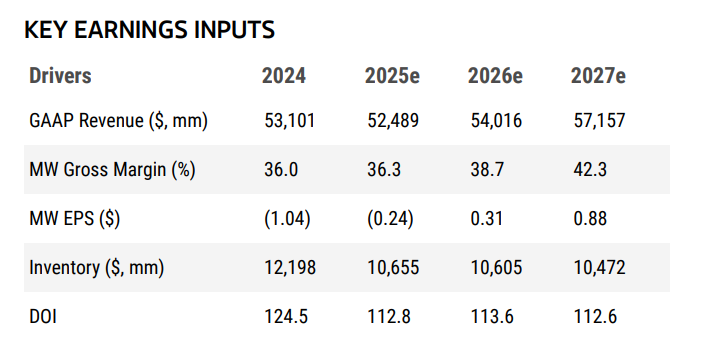
Core Viewpoint - Intel is facing a unique situation in the semiconductor cycle, where short-term supply shortages in the server CPU market may boost stock prices and quarterly performance, but underlying issues of capacity constraints and market share loss pose long-term risks to valuation [1][2][5]. Short-term Benefits vs Long-term Concerns - The current supply shortage is expected to help Intel exceed market expectations in earnings per share (EPS), with a forecasted non-GAAP revenue of $13.31 billion for the December quarter, despite a year-over-year decline of 6.7% [5][6]. - However, the supply constraints may hinder Intel's long-term growth potential, as competitors like AMD are poised to capture significant market share during this period [2][6]. Product Roadmap Challenges - Intel is in a transitional phase regarding product competitiveness, with key products like Nova Lake and Coral Rapids not expected to restore competitive performance until 2026 and 2027, respectively [9][10]. - This prolonged gap in product competitiveness may limit Intel's ability to capitalize on market demand, thereby suppressing stock price growth [9]. Trust Issues in Foundry Business - Intel's foundry business is facing trust issues due to current supply shortages, which may deter potential external customers from placing orders [10][11]. - The inability to meet even its own growth demands raises concerns about Intel's capacity to serve external clients, further complicating its efforts to establish a robust foundry business [10]. Financial Forecast and Valuation Outlook - For Q1 2024, Intel's revenue is projected at $12.55 billion, slightly above Wall Street's expectation, but with a gross margin forecast of only 34.9%, below market expectations [13][14]. - Intel's current stock valuation is approximately 35 times the expected EPS for 2027, reflecting high market expectations for recovery and the potential of its foundry business, but analysts caution that current profitability does not support further stock price appreciation without clear evidence of regaining market share [14].



英特尔财报前瞻:CPU缺货或提振业绩,但这可能是把“双刃剑”
Hua Er Jie Jian Wen· 2026-01-20 13:59
Core Viewpoint - Intel is facing a unique situation in the semiconductor cycle, where short-term supply shortages in the server CPU market may boost stock prices and quarterly performance, but underlying issues of capacity constraints and market share loss pose long-term risks to valuation [1][2]. Short-term Performance vs Long-term Concerns - Morgan Stanley predicts Intel may surprise with earnings per share (EPS) due to supply shortages, estimating non-GAAP revenue for the December quarter at $13.31 billion, a 6.7% year-over-year decline, slightly below Wall Street's expectation of $13.407 billion, but with an expected 11.5% quarter-over-quarter growth in the Data Center and AI (DCAI) segment [3][4]. - Despite the potential for short-term performance, structural issues remain, as Intel's internal capacity constraints mean it is missing out on demand rebounds, allowing competitors like AMD to capture significant market share [4][5]. Product Roadmap Challenges - Intel is in a transitional phase regarding product competitiveness, with the Panther Lake architecture showing promise in the notebook segment, but key server and high-performance desktop markets will not see competitive products until late 2026 and 2027, respectively [5][6]. - The delay in product releases means Intel's current offerings cannot fully capitalize on market demand, which will continue to suppress stock price potential [5]. Trust Issues in Foundry Business - Intel's foundry business is facing trust issues due to current supply shortages, which raise concerns among potential external customers about Intel's ability to meet their needs [6][7]. - The inability to satisfy even its own growth demands creates significant distrust, complicating efforts to attract new clients to its foundry services [6]. Financial Forecast and Valuation Outlook - For Q1 2024, Morgan Stanley forecasts Intel's revenue at $12.552 billion, slightly above Wall Street's expectation of $12.525 billion, but with a gross margin prediction of only 34.9%, below the market's 36.1% expectation [7][8]. - Intel's current stock valuation corresponds to 35 times the expected EPS for 2027, which is higher than the average for large logic semiconductor peers, reflecting market optimism about recovery potential and foundry business options [7][8]. - Analysts believe that unless Intel can demonstrate a recovery in server market share, the current profitability is insufficient to support further stock price revaluation [8].