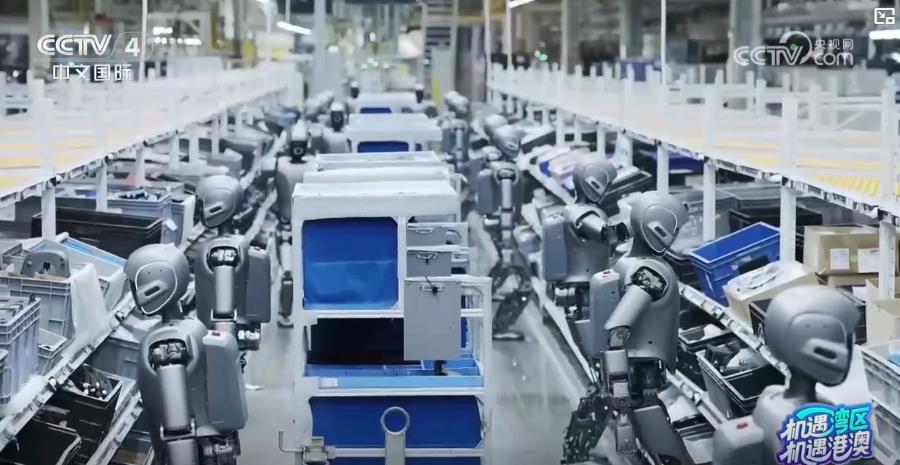
Walker S机器人

Search documents
人形机器人产业:迎来跨越发展 赋能千行百业
Ke Ji Ri Bao· 2025-10-13 23:08
Core Insights - The humanoid robot industry in China is experiencing rapid development during the "14th Five-Year Plan" period, transitioning from a "technology verification phase" to a "scale commercialization phase" by 2025, with the global embodied intelligence market expected to reach 19.525 billion yuan, of which China's market share is nearly half [1][2] Group 1: Technological Breakthroughs - The rise of humanoid robots is attributed to breakthroughs in embodied intelligence technology, which integrates artificial intelligence into physical entities, enabling them to perceive, learn, and interact with their environment like humans [2] - The structure of embodied intelligence is categorized into "brain," "cerebellum," and "body," where the "brain" refers to AI models responsible for language interaction and decision-making, while the "cerebellum" involves motion control algorithms [2] - Significant advancements in AI models have enhanced humanoid robots' capabilities, allowing them to perform complex tasks such as grasping and manipulating irregular objects with low-cost hardware [2][3] Group 2: Industry Applications - Humanoid robots are now being deployed in various real-world applications, such as in factories for tasks like quality inspection and component sorting, exemplified by the Galbot robot from Galaxy General [4] - In the healthcare sector, humanoid robots are assisting in rehabilitation, such as exoskeleton robots helping stroke patients relearn walking by analyzing muscle signals and adjusting support strategies in real-time [5] - The development of general-purpose humanoid robots is underway, aiming to create robots that can adapt to various unstructured environments, moving from being specialized tools to intelligent companions that understand human intentions [5]

机遇湾区 机遇港澳丨深圳:自主创新突破技术壁垒 无惧关税挑战
Yang Shi Wang· 2025-04-30 13:03
Group 1 - The "Guangdong-Hong Kong-Macao Greater Bay Area Development Plan" has been publicly released for six years, during which Shenzhen's total R&D investment as a percentage of GDP increased from 4.2% to 6.46%, and Shenzhen-Hong Kong-Guangzhou has been the world's second-largest technology cluster for five consecutive years [1][3] - The company is one of the few globally with full-stack technology capabilities in humanoid robots, meaning it has a closed loop from R&D to design, manufacturing, and commercialization, keeping core technologies in-house [3] - Shenzhen has 25,000 national high-tech enterprises, with total R&D investment growing by 18.9% last year, maintaining double-digit growth for nine consecutive years, showcasing the innovative atmosphere and spirit in the Greater Bay Area [3] Group 2 - The Walker S robot, which excels in collaborative tasks, is different from the "Tian Gong Ultral" that won a humanoid robot marathon, highlighting its capability in group operations [4] - The "Moli Camp" AI ecological community, established last year in Shenzhen, is the first vertical incubator in the Greater Bay Area focused on large model fields, providing services and support for the rapid growth of startups [6] - An AI tactile sensor developed by an incubated company features fully autonomous R&D from chips to algorithms, showcasing the innovation in the region [6]