Waymo基础模型

Search documents
Waymo最近的基座模型分享:快慢双系统端到端 & 世界模型仿真
自动驾驶之心· 2025-12-27 09:36
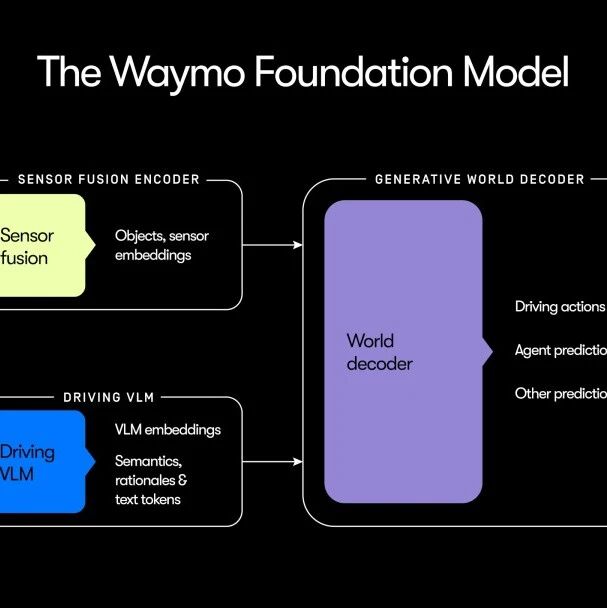
Core Viewpoint - Waymo is advancing its autonomous driving technology by prioritizing "verifiable safe AI" as a core principle, significantly reducing accident rates compared to human drivers, with over 100 million miles of fully autonomous driving achieved [2][4]. Group 1: Waymo's AI Strategy - Waymo's AI ecosystem integrates a driver, simulator, and evaluator, all powered by the Waymo Foundation Model, ensuring safety is a foundational element rather than an afterthought [4][11]. - The Waymo Foundation Model serves as a multifunctional "world model," providing a robust framework for the AI ecosystem, enhancing interaction between components and supporting end-to-end signal backpropagation [7][9]. Group 2: Components of the AI Ecosystem - The driver model generates safe and compliant action sequences, with a distillation process transferring knowledge to more efficient student models for real-time deployment [13]. - The simulator creates high-fidelity virtual environments for training and testing the driver model, covering diverse and challenging scenarios [15][16]. - The evaluator system analyzes driving behavior, providing feedback for continuous improvement and ensuring the driver model's performance is rigorously tested [17]. Group 3: Learning and Optimization Mechanisms - Waymo's internal learning loop, powered by the simulator and evaluator, utilizes reinforcement learning to enhance the driver model's capabilities in a controlled environment [18]. - The external learning loop leverages real-world driving data to identify suboptimal behaviors, generating training data for the driver model, which is then validated through the simulator [20]. - This continuous learning cycle is supported by a vast amount of fully autonomous driving data, which is critical for ongoing optimization and cannot be replicated through simulation alone [20][21].

Waymo刚刚的基座模型分享:快慢双系统端到端 & 世界模型仿真
自动驾驶之心· 2025-12-10 01:28
Core Insights - Waymo is advancing its autonomous driving technology by prioritizing "verifiable safe AI" as a core principle, significantly reducing the accident rate compared to human drivers by over ten times [2][5][19] - The company has achieved over 100 million miles of fully autonomous driving, continuously improving road safety in its operational areas [2][5] Group 1: Waymo's AI Strategy - Waymo's AI ecosystem integrates a driver, a simulator, and an evaluator, all powered by the Waymo Foundation Model, ensuring safety is a foundational element rather than an afterthought [5][12] - The Waymo Foundation Model serves as a multifunctional "world model," providing a robust interface for interaction among various components and supporting end-to-end signal backpropagation during training [8][10] Group 2: Components of the AI Ecosystem - The driver model generates safe and compliant action sequences, with its capabilities distilled into more efficient student models for real-time deployment in vehicles [14] - The simulator creates high-fidelity virtual environments for testing the driver model under diverse and challenging scenarios, while the evaluator analyzes driving behavior to provide feedback for continuous improvement [14][15] Group 3: Learning and Optimization Mechanisms - Waymo employs a dual learning loop: an internal loop driven by the simulator and evaluator for reinforcement learning, and an external loop utilizing real-world driving data to enhance the driver model [17][19] - The company has amassed a vast amount of fully autonomous driving data, which is crucial for training and optimizing its systems, surpassing the reliance on human driving data [19]

Waymo自动驾驶最新探索:世界模型、长尾问题、最重要的东西
自动驾驶之心· 2025-10-10 23:32
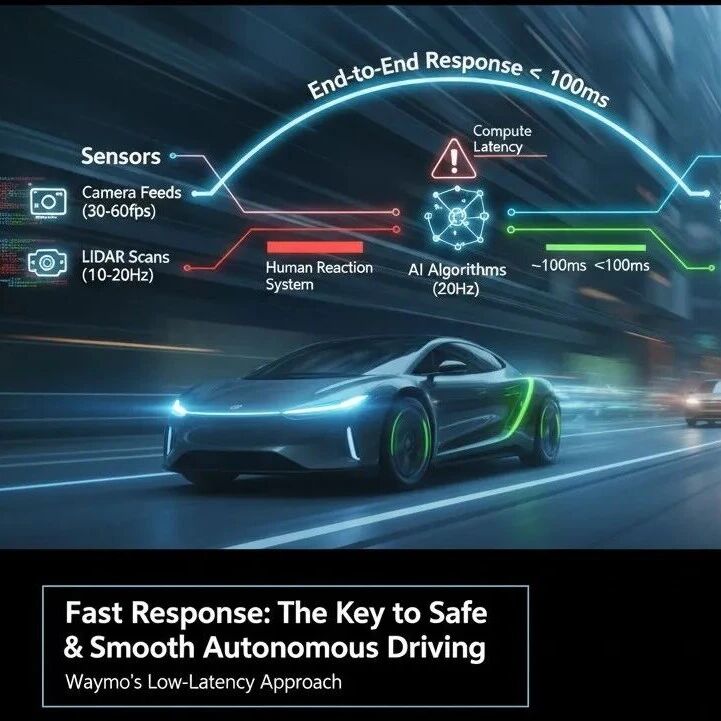
Core Insights - Waymo has developed a large-scale AI model called the Waymo Foundation Model, which supports vehicle perception, behavior prediction, scene simulation, and driving decision-making [5][11] - The model integrates data from multiple sensors to understand the environment, similar to how large language models operate [5][11] - The focus on data quality and selection is crucial for ensuring that the model addresses the right problems effectively [25][30] Group 1: World Model Development - Waymo's world model encodes all sensor data and incorporates world knowledge, enabling it to decode driving-related tasks [11] - The model allows for real-time perception and decision-making on the vehicle while simulating real driving environments in the cloud for testing [7][11] - The long-tail problem in autonomous driving, which includes complex scenarios like adverse weather and construction, remains a significant challenge [11][12] Group 2: Addressing Long-Tail Problems - Weather conditions such as rain and snow present unique challenges for autonomous driving, requiring high precision in judgment [12][14] - Low visibility scenarios necessitate the use of multi-modal sensors to detect objects effectively [15] - Occlusion reasoning is critical for understanding hidden objects and ensuring driving safety [18][21] Group 3: Complex Scene Understanding - Understanding complex scenes like construction zones and dynamic environments requires advanced reasoning capabilities [24] - Real-time responses to dynamic signals, such as traffic officer gestures, are essential for safe navigation [24] - The use of large language models is being explored to enhance scene understanding and decision-making [24] Group 4: Importance of Data, Algorithms, and Computing Power - The three critical components for successful autonomous driving are data, algorithms, and computing power, with a strong emphasis on data quality [25][30] - Efficient data mining from vast video datasets is vital for understanding driving events [30] - Quick decision-making is essential for safety and smooth operation, with a focus on reducing response times across the algorithmic chain [30][31] Group 5: Operational Infrastructure - Waymo's operational facilities, including depots and modification workshops, are crucial for the efficient deployment of Level 4 autonomous vehicles [33] - Vehicles can autonomously navigate to charging stations and begin operations after sensor installation [33] - The engineering challenges of scaling autonomous driving technology require collaboration with traditional automotive engineers [34] Group 6: Sensor and Algorithm Response - The responsiveness of sensors, such as camera frame rates, is critical for effective autonomous driving [36] - Algorithms must process data at high frequencies to ensure timely execution of driving commands [36] - The evolution of vehicle control systems is moving towards higher frequency responses, particularly in electric and electronically controlled systems [36]