长尾问题

Search documents
从特斯拉到英伟达,从马斯克到黄仁勋:两次开源,改变两次时代
Sou Hu Cai Jing· 2026-01-09 04:00
Core Insights - Nvidia's recent open-source release of the Alpamayo series visual-language-action reasoning models, AlpaSim simulation tools, and an open dataset with over 1,700 hours of driving data marks a strategic shift from providing foundational computing power to building a comprehensive development ecosystem that includes algorithms, toolchains, and data infrastructure [2][21][25] Full-Stack Development Ecosystem - The full-stack development ecosystem includes model training, simulation, and deployment, with the training set in the dataset used for model training and the evaluation set used for simulation [4] - AlpaSim, in conjunction with Cosmos, generates long-tail scenarios for model training and utilizes Omiverse to provide a virtual traffic world for simulation [5] Long-Tail Challenge - The long-tail problem is identified as the most significant challenge facing autonomous driving systems, with the need for efficient generation of controllable long-tail scenarios and high-fidelity simulation environments being crucial for addressing this issue [10] - Elon Musk's comments highlight that while achieving high accuracy is possible, the real challenge lies in handling rare and complex long-tail scenarios that have not been encountered during training [7][10] Importance of AlpaSim - AlpaSim addresses the challenges of high costs, inefficiencies, and dangers associated with real-world data collection, providing a highly realistic digital parallel world for testing autonomous driving systems [12] - The tool allows developers to generate and control various rare and dangerous scenarios at low cost and high efficiency, serving as a risk-free data generator for model training and optimization [12] Alpamayo Model's Value - The Alpamayo model incorporates a visual-language-action (VLA) reasoning mechanism that enables it to process visual inputs and generate driving actions while internally reasoning about the scene, thus enhancing its ability to handle unknown long-tail scenarios [18] - This intrinsic reasoning capability allows the system to make generalized decisions based on physical knowledge and safety principles when faced with extreme scenarios not present in the training data [18] Strategic Implications - Nvidia's open-source initiative is seen as a strategic move to solidify its position in the autonomous driving industry, particularly in the burgeoning Robotaxi market, which is projected to be worth trillions [21][23] - By binding developers to its ecosystem through comprehensive solutions from chips to models and simulation tools, Nvidia aims to maintain its dominance in the foundational computing power and toolchain for autonomous driving [25]


Waymo自动驾驶最新探索:世界模型、长尾问题、最重要的东西
自动驾驶之心· 2025-10-10 23:32
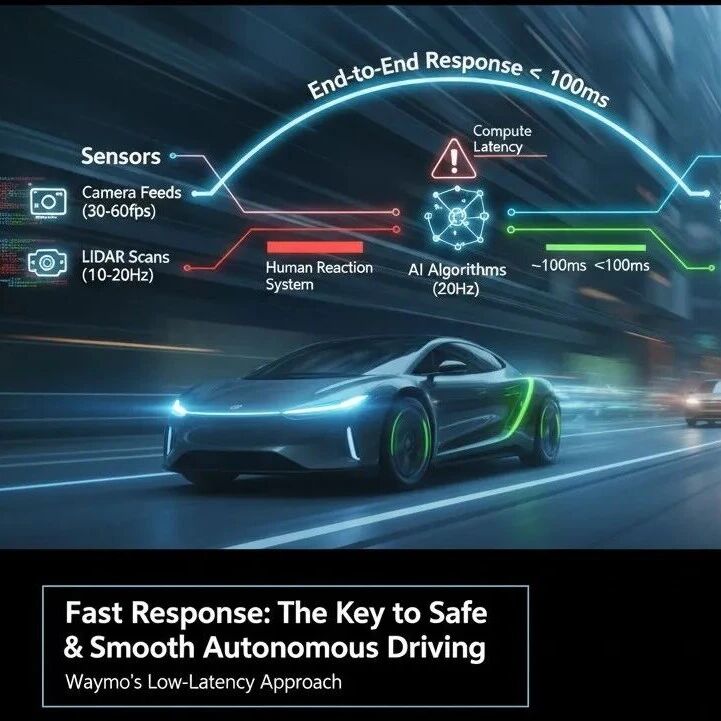
Core Insights - Waymo has developed a large-scale AI model called the Waymo Foundation Model, which supports vehicle perception, behavior prediction, scene simulation, and driving decision-making [5][11] - The model integrates data from multiple sensors to understand the environment, similar to how large language models operate [5][11] - The focus on data quality and selection is crucial for ensuring that the model addresses the right problems effectively [25][30] Group 1: World Model Development - Waymo's world model encodes all sensor data and incorporates world knowledge, enabling it to decode driving-related tasks [11] - The model allows for real-time perception and decision-making on the vehicle while simulating real driving environments in the cloud for testing [7][11] - The long-tail problem in autonomous driving, which includes complex scenarios like adverse weather and construction, remains a significant challenge [11][12] Group 2: Addressing Long-Tail Problems - Weather conditions such as rain and snow present unique challenges for autonomous driving, requiring high precision in judgment [12][14] - Low visibility scenarios necessitate the use of multi-modal sensors to detect objects effectively [15] - Occlusion reasoning is critical for understanding hidden objects and ensuring driving safety [18][21] Group 3: Complex Scene Understanding - Understanding complex scenes like construction zones and dynamic environments requires advanced reasoning capabilities [24] - Real-time responses to dynamic signals, such as traffic officer gestures, are essential for safe navigation [24] - The use of large language models is being explored to enhance scene understanding and decision-making [24] Group 4: Importance of Data, Algorithms, and Computing Power - The three critical components for successful autonomous driving are data, algorithms, and computing power, with a strong emphasis on data quality [25][30] - Efficient data mining from vast video datasets is vital for understanding driving events [30] - Quick decision-making is essential for safety and smooth operation, with a focus on reducing response times across the algorithmic chain [30][31] Group 5: Operational Infrastructure - Waymo's operational facilities, including depots and modification workshops, are crucial for the efficient deployment of Level 4 autonomous vehicles [33] - Vehicles can autonomously navigate to charging stations and begin operations after sensor installation [33] - The engineering challenges of scaling autonomous driving technology require collaboration with traditional automotive engineers [34] Group 6: Sensor and Algorithm Response - The responsiveness of sensors, such as camera frame rates, is critical for effective autonomous driving [36] - Algorithms must process data at high frequencies to ensure timely execution of driving commands [36] - The evolution of vehicle control systems is moving towards higher frequency responses, particularly in electric and electronically controlled systems [36]