CNBC

Search documents
Wealth inequality and the 'K-shaped' economy are more striking than ever, data shows
CNBC· 2026-01-30 12:01
Core Viewpoint - The U.S. economy is experiencing a "K-shaped" recovery, indicating a growing disparity between high-income and low-income Americans, which is seen as a structural issue rather than a temporary phenomenon [3][10]. Economic Disparity - The Gini coefficient, a measure of wealth concentration, is at 60-year highs, reversing the decline seen during pandemic-era stimulus [5]. - The net worth of the top 1% reached nearly 32% of total net wealth, while the bottom 50% holds only 2.5% [6]. - Compensation for workers as a portion of U.S. GDP has fallen to its lowest level in over 75 years, indicating that average workers are receiving a smaller share of economic growth [7]. Consumer Spending Patterns - Households earning under $75,000 are spending less on discretionary items compared to 2019, while those earning above $150,000 are increasing their spending [8]. - Total consumer outlays by the top 20% reached multidecade highs, while the remaining 80% saw their spending drop to new lows, with overall spending not keeping pace with inflation over the past six years [9]. Historical Context - The K-shaped economy's roots can be traced back to economic changes during the Reagan administration and were exacerbated by the Global Financial Crisis [11][14]. - The decline in unionization rates has contributed to reduced negotiating power for workers, further widening the economic gap [15]. Economic Outlook - The U.S. economy relies on a few strong sectors, making it feel fragile; if key sectors falter, the entire economy could be at risk [16][17]. - The health care sector is the only one consistently adding jobs, while the technology sector has driven stock market gains, benefiting higher earners [17].


Giving to donor-advised funds surges on expiring tax cuts and a hot stock market
CNBC· 2026-01-30 12:00
Core Insights - Charitable giving saw a significant increase in 2025, driven by strong stock market returns and tax reform, with donors granting a record $9.9 billion to charities, marking a $2.2 billion or 28% increase from the previous year [2]. Group 1: Charitable Giving Trends - The total charitable contributions reached $9.9 billion in 2025, reflecting a substantial growth of 28% compared to the prior year [2]. - A record 74% of contributions were made in the form of non-cash assets, including ETFs, index funds, real estate, and cryptocurrency [4]. Group 2: Donor-Advised Funds (DAFs) - Donors can contribute cash or assets to donor-advised funds (DAFs) and receive an immediate tax deduction, allowing them to decide later how to distribute their gifts [3]. - DAFs provide a simpler way for donors to offload appreciated assets without incurring capital gains tax, as assets continue to appreciate until grants are made to charities [3]. - Julie Sunwoo, president of DAFgiving360, emphasized that DAFs excel in helping donors manage appreciated or illiquid assets, allowing for strategic planning in charitable giving [4].

Trump nominates Kevin Warsh for Federal Reserve chair to succeed Jerome Powell
CNBC· 2026-01-30 11:54
Group 1 - President Trump has appointed Kevin Warsh as the new Federal Reserve chair, succeeding Jerome Powell, amidst significant turmoil surrounding the central bank [1][5] - Warsh's selection is expected to have minimal impact on the markets due to his previous experience with the Fed and the perception that he may not always align with Trump's directives [2][10] - The nomination process was competitive, initially involving 11 candidates, and was led by Treasury Secretary Scott Bessent, ultimately narrowing down to Warsh [8] Group 2 - The Federal Reserve is currently facing challenges such as persistent inflation, increasing government borrowing, and direct political pressure regarding its monetary policy [5][9] - Warsh has previously criticized the current Fed leadership, suggesting a "credibility deficit" among incumbents, which may lead to conflicts within the institution [4][3] - Market expectations indicate limited action from the new chair, with traders anticipating at most two more interest rate cuts this year, bringing the benchmark fed funds rate to around 3% [10]

Exxon earnings beat estimates despite low oil prices
CNBC· 2026-01-30 11:37
Core Viewpoint - ExxonMobil reported fourth-quarter earnings that surpassed Wall Street expectations despite a significant annual decline in oil prices due to oversupply [1][4]. Financial Performance - Earnings per share for the fourth quarter were $1.71, adjusted, compared to the expected $1.68 [4]. - Revenue for the quarter was $82.31 billion, exceeding the anticipated $81.43 billion [4]. Industry Context - The results were released amid pressure from President Donald Trump for the oil industry to re-engage with Venezuela following the U.S. capture of Nicolas Maduro [2]. - CEO Darren Woods indicated that Venezuela is currently "uninvestable" and would require substantial changes for Exxon to consider returning [2].


Chevron earnings beat as production hits record with upside expected in Venezuela
CNBC· 2026-01-30 11:18
Core Viewpoint - Chevron reported fourth-quarter earnings that exceeded Wall Street estimates, driven by record oil production despite lower crude prices [1][3]. Group 1: Earnings Performance - Chevron's adjusted earnings per share were $1.52, surpassing the consensus estimate of $1.45 [3][5]. - The company's revenue for the quarter was $46.87 billion, slightly below the expected $47.1 billion [5]. Group 2: Production Growth - Chevron achieved a production record of 4.05 million barrels per day in the fourth quarter [3]. - The company is positioned to increase its production in Venezuela by 50% over the next 18 to 24 months following a U.S. military intervention that removed President Nicolas Maduro [2]. Group 3: Competitive Position - Wall Street views Chevron as the U.S. oil company best positioned to benefit from the U.S. intervention in Venezuela, while competitors like ExxonMobil are hesitant to return due to past asset seizures [4].


Silver plummets 15%, gold falls 7% — dragging down miners and ETFs
CNBC· 2026-01-30 10:31
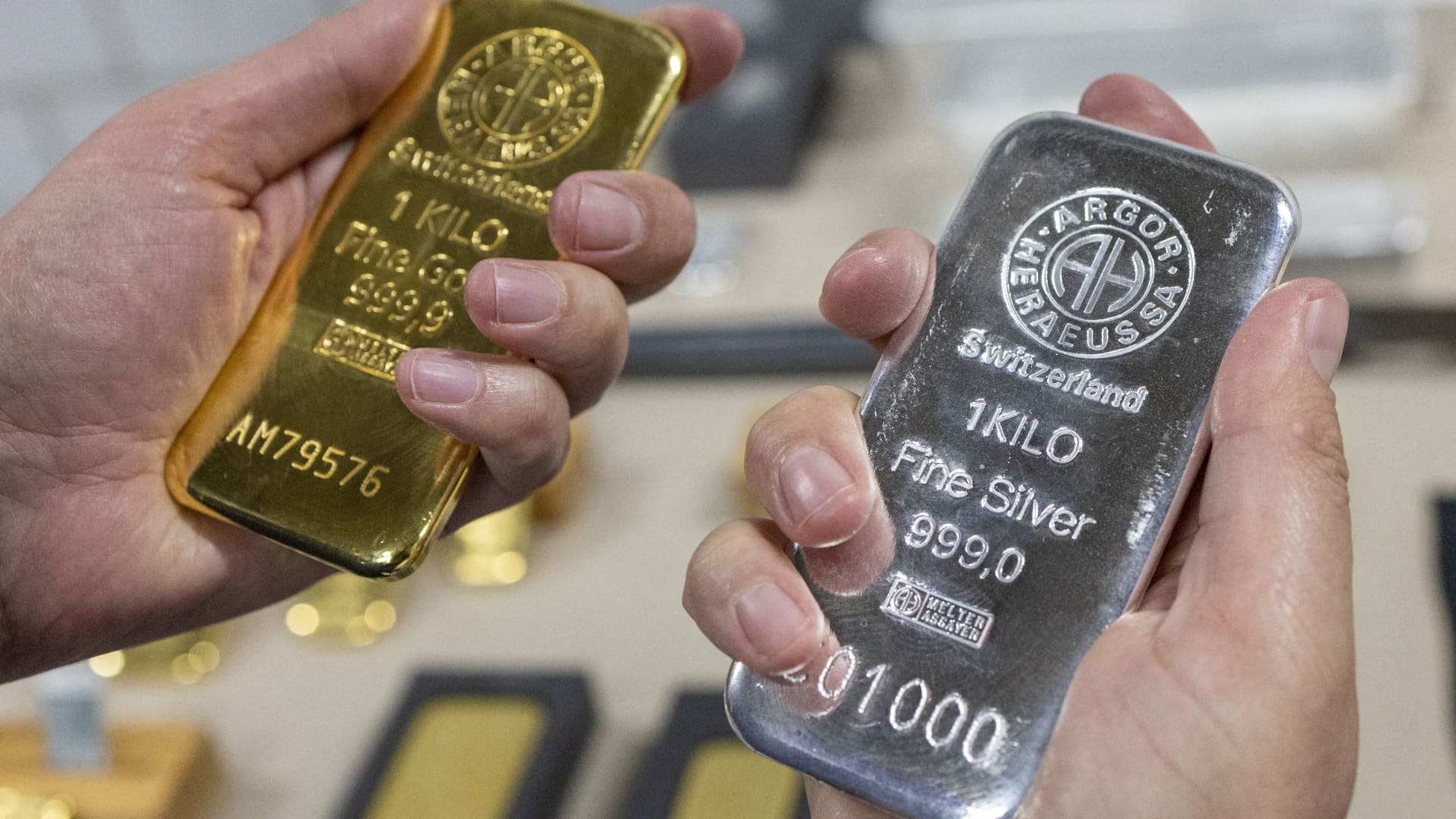
Argor-Heraeus' CEO Robin Kolvenbach holds one kilo bars of silver and gold at the plant of refiner and bar manufacturer Argor-Heraeus in Mendrisio, Switzerland, July 13, 2022. Denis Balibouse | ReutersGold and silver prices plunged on Friday, sparking a global sell-off of stocks and funds linked to the metals. By 5:04 a.m. ET, spot silver was down 15% to settle at around $98.66 per ounce — taking it back below the $100 milestone. Stock Chart IconStock chart iconSpot silverMeanwhile, spot gold shed 7% to tra ...
CNBC Daily Open: We'll soon find out who the new Fed chair is
CNBC· 2026-01-30 08:10
Company and Industry Insights - Apple reported a 16% year-on-year increase in fiscal first-quarter revenue, driven by strong iPhone demand, exceeding market estimates [5] - Despite the revenue growth, investor response was muted, with Apple shares rising only about 0.5% in extended trading, possibly due to concerns over its position in artificial intelligence [6] - In contrast, Meta Platforms saw a significant increase in share price, rising more than 10% due to positive investor sentiment regarding its AI prospects [6] - Microsoft faced a negative reaction from investors, with its stock dropping 10% after announcing spending plans and a slowdown in cloud growth, resulting in a loss of $357 billion in market capitalization [6] - The tech-heavy Nasdaq Composite index declined by 0.72%, while the S&P 500 fell by 0.13%, indicating a broader market reaction to these company performances [7]

World leaders descend on Beijing as 2026 kicks off, hedging against U.S. disruptions
CNBC· 2026-01-30 07:15
Group 1 - Countries that previously avoided engagement with China during its trade dispute with the U.S. are now sending leaders to Beijing for meetings and business deals [1][2] - At least five national leaders, including those from the UK and Canada, have visited Xi Jinping in January, marking significant diplomatic activity [2] - The visits from Canadian and British leaders are the first in at least eight years, indicating a shift in diplomatic relations following the reopening of China's borders in early 2023 [3] Group 2 - The recent diplomatic visits are seen as managed resets rather than a strategic pivot towards China, reflecting rising uncertainty in U.S. policy [3][4] - Keeping communication channels open with China is increasingly viewed as preferable to disengagement, especially as the benefits of selective resets become more apparent [4] - China aims to position itself as a partner for developing countries and a stabilizing force globally, leveraging the current geopolitical climate [5]


Indonesian stock exchange CEO resigns after $84 billion market wipe out
CNBC· 2026-01-30 05:26
Iman Rachman, chief executive officer of the Indonesia Stock Exchange (IDX), speaks to members of the media in Jakarta, Indonesia, on Friday, Jan 30, 2026. Rachman said he will step down following a two-day market rout sparked by MSCI Inc.'s warning of a possible downgrade.Indonesian stock exchange CEO Iman Rachman resigned on Friday, following a rout that saw the country's share market lose $84 billion over the past two days on concerns over a possible downgrade by index provider MSCI.In a release, the Ind ...


CNBC Daily Open: iPhone drove Apple's robust earnings — but investors weren't too enthused
CNBC· 2026-01-30 01:31
Group 1: Apple Inc. - Apple reported a 16% year-on-year increase in fiscal first-quarter revenue, driven by strong iPhone demand, exceeding market estimates [2] - The company forecasted current-quarter revenue above Wall Street expectations, indicating continued growth potential [2] - Despite positive financial results, investor response was muted, with Apple shares rising only about 0.5% in extended trading, possibly due to concerns over its position in artificial intelligence [2] Group 2: Meta Platforms and Microsoft - Meta Platforms saw its shares increase by more than 10% as the company demonstrated that its AI investments were positively impacting its financial performance [3] - In contrast, Microsoft faced a significant decline in its stock, dropping 10% due to its spending plans and a slowdown in cloud growth, resulting in a loss of $357 billion in market capitalization [3] Group 3: Cryptocurrency and Commodities - Cryptocurrencies experienced a decline, with Bitcoin falling over 5% to its lowest level in nearly two months [4] - Gold prices rebounded after a midday dip, reaching an all-time high of $5,626.8 earlier in the day [4] - Oil prices increased by more than 3% amid geopolitical tensions, particularly regarding potential strikes on Iran [4]