Forbes

Search documents
Why UBER Stock Could Be Undervalued
Forbes· 2025-12-11 16:05
Core Viewpoint - Uber Technologies (UBER) stock has decreased by 5.5% recently, currently priced at $84.16, but is considered an attractive investment opportunity with a potential target price of $109 due to strong operational performance and financial health [2][4]. Valuation - UBER's valuation appears moderate compared to the broader market, indicating a balanced assessment of its stock price [5]. Growth - UBER has experienced an average growth rate of 19.6% over the last three years, with revenues increasing by 18% from $42 billion to $50 billion in the past 12 months. Quarterly revenues rose by 20.4% to $13 billion in the most recent quarter [7]. Profitability - UBER's operating income over the last 12 months was $4.6 billion, reflecting an operating margin of 9.2%. The company generated nearly $9.0 billion in operating cash flow, with a cash flow margin of 18.1% and a net income of approximately $17 billion, indicating a net margin of 33.5% [8]. Financial Stability - UBER had a debt of $13 billion at the close of the most recent quarter, with a market capitalization of $175 billion, resulting in a debt-to-equity ratio of 6.5%. The cash (including cash equivalents) amounts to $9.1 billion out of total assets of $63 billion, leading to a cash-to-assets ratio of 14.3% [9]. Downturn Resilience - UBER has performed significantly worse than the S&P 500 index during various economic downturns, with notable declines during the 2022 inflation shock and the 2020 COVID pandemic. The stock has shown a tendency to recover fully from steep declines, indicating potential volatility [10][12].



Disney's $1 Billion OpenAI Investment Makes 2025's Top AI Deals (Full List, Ranked)
Forbes· 2025-12-11 15:25
Core Insights - Disney announced a $1 billion investment in OpenAI, enabling users to create videos with Disney characters on the Sora platform, marking one of the largest AI-related deals this year [1][13] - Global annual spending on AI is projected to reach $375 billion by the end of this year and exceed $3 trillion annually by 2030, according to UBS [1] Investment Landscape - Over a dozen billion-dollar deals in AI have been reported this year, indicating a significant increase in funding and interest in the sector [1] - A Bank of America survey revealed that 53% of investors believe AI stocks may be in a bubble, reflecting concerns about potential overvaluation in the tech sector [2] Major AI Deals - The largest AI infrastructure project announced involves a $500 billion investment by OpenAI, SoftBank, and Oracle, aimed at developing AI infrastructure in the U.S. and creating 100,000 jobs [3] - OpenAI has signed a contract with Oracle for $300 billion in computing power over the next five years, with Oracle providing approximately 4.5 gigawatts of power capacity [4] - Nvidia is investing $100 billion in OpenAI, which will utilize at least 10 gigawatts of Nvidia's systems for AI model training [4] - Amazon plans to invest up to $50 billion to enhance AI infrastructure for U.S. government customers, adding nearly 1.3 gigawatts of capacity through new data centers [5] - Anthropic is also investing $50 billion in AI infrastructure, with projects expected to create 800 permanent jobs and over 2,000 construction roles [6] - Oracle's deal to purchase $40 billion worth of Nvidia's AI chips is part of the initial project for the Stargate initiative [6] - OpenAI and Amazon's partnership is valued at $38 billion, involving the use of Amazon's cloud services and Nvidia processors [7] - Google plans to invest $25 billion in data centers and AI infrastructure over the next two years [9]


Oracle Stock Down 14%. Why Higher Risk Makes $ORCL A Sell
Forbes· 2025-12-11 15:05
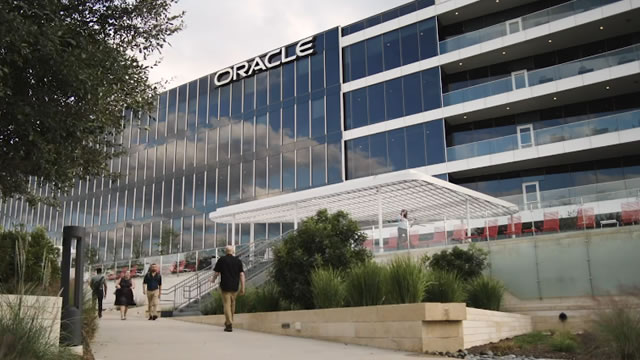
Core Viewpoint - Oracle's stock has experienced significant volatility, losing 14% since its latest quarterly earnings report and 44% since its peak on September 10, raising questions about its future growth potential and investment risks [3][4]. Financial Performance - Oracle's fiscal 2026 second quarter revenue reached $16.06 billion, a 14% increase but $150 million below analyst expectations; cloud revenue was $7.98 billion, up 34%, and cloud infrastructure revenue was $4.1 billion, a 68% increase [12]. - The company's remaining performance obligations stood at $523 billion, a 438% increase, while free cash flow was negative $10 billion, nearly double the consensus [12]. - Capital expenditures are forecasted to be $50 billion, a 136% increase from previous estimates [12]. Debt and Financial Risks - Oracle's total debt has risen to over $93 billion, a 33% increase since 2020, with a debt-to-equity ratio of 3.78 times and a debt-to-EBITDA ratio exceeding 4x [13][14]. - Credit rating agencies have expressed concerns about Oracle's high debt levels, with its debt now two notches above speculative grade [15]. - The company faces significant customer concentration risk, particularly with clients like OpenAI and xAI, which are expected to incur substantial cash burns in the coming years [17][18]. Market Position and Valuation - Oracle's stock trades at a 56% premium compared to cloud peers, indicating high expectations for future growth that have yet to materialize [19]. - Analysts are skeptical about Oracle's ability to finance its ambitious AI build-out, questioning how the company will convert its backlog into actual revenue [20]. Growth Projections - Oracle's executive vice chair projected an eight-fold growth in revenue over the next four years, with expectations for cloud infrastructure revenue to reach $144 billion by fiscal year 2030 [21].


Unemployment Applications Surged By Most Since 2020 Last Week
Forbes· 2025-12-11 14:25
Core Insights - Applications for unemployment benefits in the U.S. increased significantly last week, marking the largest single-week jump in five years, raising concerns about the job market [1][2] - The total number of unemployment benefits applications reached 236,000, which is 44,000 higher than the previous week's revised total of 192,000 and above Wall Street's expectations of 213,000 [2] - Continuing jobless claims decreased to 1.83 million, down approximately 100 million from the previous week [3] Federal Reserve Actions - The Federal Reserve recently lowered interest rates by a quarter-point to a range of 3.5% to 3.75%, citing a "gradually cooling" job market [4] - Fed Chair Jerome Powell expressed concerns that federal data on job creation may be overestimating actual job growth by up to 60,000 jobs per month [4] - Job openings rose to 7.67 million in October, indicating a potential discrepancy in labor market data [4]

Oracle Leads Premarket Slide In AI Stocks After Earnings Miss
Forbes· 2025-12-11 12:05
Group 1: Market Reaction - Major AI stocks experienced a significant decline in premarket trading, with Oracle's share price dropping over 11% after disappointing quarterly earnings [1] - Nvidia's shares fell approximately 1.6% to $180.80, while AMD's shares decreased by 1.73% to $217.60 [2] - Other AI stocks such as Microsoft, Meta, Google, and Amazon also saw declines of 0.70%, 1.16%, 0.6%, and 0.8% respectively [2] Group 2: Index Performance - The tech-heavy Nasdaq futures index decreased by 0.78% to 25,599.25 points, while the benchmark S&P futures index fell 0.56% to 6,852.75 points [3] Group 3: Interest Rate Context - The market downturn occurred despite the Federal Reserve's decision to lower interest rates by a quarter-point, with forecasts indicating potential further cuts in 2026 and 2027 [4] - Initial market reactions to the rate cuts were positive, with the S&P 500 closing nearly 0.7% higher at 6,886.68 points, close to an all-time high [4]
IREN Stock: Helping Solve The AI Power Shortage
Forbes· 2025-12-11 10:25
Core Insights - The global competition for Artificial Intelligence is facing a significant structural barrier due to insufficient electricity supply, with a projected U.S. power deficit of 44 gigawatts (GW) through 2028 [2] - IREN has positioned itself as a key player in the AI cloud computing space by leveraging its advanced power planning and infrastructure, resulting in a stock price increase of over four times year-to-date to around $47 [2] Company Differentiation - IREN's competitive advantage lies in its industrial assets that directly address the industry's limitations, rather than in software or fundamental technology [3] - The company focuses on high-density, specialized hardware hosting or Infrastructure-as-a-Service (IaaS), avoiding the complexities of general cloud services [4] Strategic Partnerships - IREN has established a significant $9.7 billion partnership with Microsoft, providing dedicated access to advanced Nvidia GB300 GPUs until 2031, expected to generate about $1.9 billion in annual revenue [4][5] - This partnership allows Microsoft to avoid capital lock-up in new data centers and ensures access to scarce GPUs and necessary facilities [5] Financial Performance - IREN's stock is trading at approximately 47 times the estimated FY'26 earnings, reflecting its rapid growth trajectory [6] - Revenues surged 235% from $206 million to $689 million over the last 12 months, with quarterly revenues increasing 355.4% to $240 million [6] - Management forecasts reaching $3.4 billion in AI Cloud Annualized Recurring Revenue (ARR) by the end of 2026 [6] Capacity Expansion - The company plans to expand its GPU capacity from about 23,000 operational GPUs to approximately 140,000 by the end of 2026, supported by a $5.8 billion expansion plan [7] - A successful $2.3 billion convertible note and equity offering was completed to fund this ambitious expansion [7] Operational Advantages - IREN fully owns its land, energy sources, and data centers, allowing it to manage approximately 2.9 to 3 GW of secured, low-cost power capacity [10] - The company benefits from some of the lowest power costs in the industry at about $0.033 per kWh, providing a significant structural advantage [10] - All operations are powered by renewable energy, sourced from British Columbia hydropower and wind-heavy markets in Texas, meeting the requirements of global hyperscale partners [10]


MLB The Show 26 Quietly Teases Sweeping Upgrades Across Multiple Modes
Forbes· 2025-12-11 07:54
Core Insights - MLB The Show 26 is set to feature significant upgrades across gameplay, franchise mode, and Road to the Show, with more detailed information expected after the new year [3][4] Gameplay Enhancements - The game aims to enhance defensive efficiency and baseball IQ, making the on-field experience more authentic [6] - Fielders will have improved catching abilities and corner infielders will execute more efficient cutoff throws [7] - Catchers will receive a complete overhaul with new animations and a dedicated attribute for pop time, distinguishing elite catchers from average ones [7] - The Fielders Reaction rating will be divided into four directional attributes, utilizing real-life data metrics [8] - New features such as "Bear Down," "Big Zone Hitting," and "PCI Sensitivity" will be introduced, along with a new Plate Coverage Indicator Sensitivity Slider [8] Franchise Mode Revamp - Franchise mode will include a revamped front office experience with a new trade system and improved lineup logic [10] - Lineup logic will reflect modern baseball methodologies, prioritizing high on-base percentage players in leading positions and adjusting based on in-season performance [11] - Visual comparisons between the old and new lineup generation logic indicate noticeable improvements [12] Road to the Show Updates - The Road to the Show mode will expand to include 11 new colleges, such as the University of North Carolina at Chapel Hill and Oregon State University [13] - Players will have the opportunity to participate in the College World Series, enhancing the transition from high school to MLB [13] Fan Anticipation - Fans are particularly eager for information regarding new legends, franchise mode realignment, expansion teams, platoon lineups, and potential carryover rosters or saves [14]


Buy The Dip In ORCL Stock?
Forbes· 2025-12-11 06:25
Core Insights - Oracle's stock has recently declined despite exceeding earnings expectations, primarily due to missing revenue targets and raising capital expenditure guidance to $50 billion for fiscal year 2026, up from $21 billion in fiscal 2025, focusing on AI infrastructure [2][3][15] Financial Performance - Oracle reported a 10.2% average annual revenue growth over the past three years, compared to 5.5% for the S&P 500 [12] - The company achieved a 14.2% revenue growth over the last twelve months, increasing from $51.2 billion to $58.3 billion [12] - In the most recent quarter, Oracle experienced a 14% year-over-year growth, reaching $16.1 billion [12] Profitability Metrics - Oracle generated $19 billion in operating income and $15 billion in net income over the previous four quarters, showcasing strong profitability [7] - The company's margins are significantly higher than those of most firms, indicating effective revenue conversion into profits [7] Valuation Concerns - Oracle's price-to-sales (P/S) ratio is 9.3x, compared to 3.2x for the S&P 500, and its price-to-earnings (P/E) ratio stands at 36.7x against the market's 23.4x, suggesting a premium valuation [5][15] - The high valuation raises concerns about the sustainability of growth, as it assumes significant future performance [15] Capital Structure - Oracle has $106 billion in debt against a market capitalization of $570 billion, resulting in a debt-to-equity ratio of 19%, which is slightly better than the S&P 500's 20.4% [8] - The company retains $19 billion in cash against total assets of $180 billion, giving it an 11% cash-to-assets ratio, which is higher than the market average of 7% [8] Market Resilience - Oracle has shown resilience during market stress, with historical performance indicating it typically recovers faster than the broader market after downturns [10][13] - The company experienced declines during past crises but managed to bounce back to pre-crisis levels, demonstrating its ability to withstand economic challenges [13] Investment Outlook - Despite strong growth and profitability metrics, the current high valuation limits potential upside in the near-to-mid term, making it a challenging investment at present prices [14][15] - For investors seeking exposure to strong companies without the risks associated with high valuations, diversified portfolios targeting quality at reasonable prices may offer a more favorable risk-reward scenario [16]

Trump Says Fed Could Have ‘Doubled' Latest Interest Rate Cut
Forbes· 2025-12-10 21:45
Core Viewpoint - President Donald Trump criticized the Federal Reserve for its recent interest rate cut, suggesting it could have been more substantial, while expressing dissatisfaction with Fed Chair Jerome Powell's leadership style [1][4]. Group 1: Federal Reserve Actions - The Federal Open Market Committee voted 9-3 to lower interest rates by a quarter-point to a range of 3.5% to 3.75%, down from the previous range of 3.75% to 4% [2]. - For the first time since September 2019, three Fed officials dissented on the decision, with one advocating for a half-point cut and two preferring to maintain the current rates [2]. - The Fed's "dot plot" indicates expectations for only one additional quarter-point cut in 2026 and another in 2027, targeting a funds rate of 3% to 3.25% [3]. Group 2: Market Expectations - Betting markets and Wall Street anticipated a third consecutive interest rate cut but now foresee a more cautious approach from the Fed in 2026 [1]. - The Fed's statement included language about considering the "extent and timing of additional adjustments" to interest rates, reminiscent of its communication from December 2024 [3].

Exxon's Low Carbon Cuts Mesh With Trump's Energy Priorities
Forbes· 2025-12-10 20:45
Core Insights - The Trump administration's revised National Security Strategy emphasizes traditional energy sources like oil, natural gas, coal, and nuclear as vital for U.S. national security, aiming to create jobs, reduce costs, and support technological advancements [2][4] - The strategy marks a shift from the previous administration's focus on reducing fossil fuel reliance and promoting renewable energy, indicating a renewed commitment to energy dominance [4][5] Company Developments - ExxonMobil has announced a new five-year corporate plan that reduces investments in its Low Carbon Solutions business by one-third, reallocating billions to its core oil and gas projects, reflecting a strategic pivot towards more profitable ventures [6][8] - The company expects to achieve $25 billion in earnings growth and $35 billion in cash flow growth by 2030, with no increase in capital expenditure, while maintaining a return on capital employed above 17% [8] - ExxonMobil's production from its key assets, including the Permian Basin and Stabroek field, is projected to exceed 3.7 million barrels of oil equivalent per day by 2030, accounting for approximately 65% of its total volumes [9] Industry Trends - The energy sector is witnessing a decline in the popularity of ESG investments, allowing for a reallocation of capital back to traditional energy projects, as indicated by major firms like BlackRock shifting focus [10][15] - The demand for natural gas is expected to continue growing, particularly in the context of increasing power generation needs driven by the AI industry [11][12] - The geopolitical landscape, particularly the ongoing Russia/Ukraine conflict, has heightened the importance of energy security, positioning the U.S. as a leading producer and exporter of oil and natural gas [5][12]