HUA XIA BANK(600015)

Search documents
华夏银行(600015) - 关于首钢集团财务有限公司2025年半年度风险持续评估的报告
2025-08-28 10:37
关于首钢集团财务有限公司 2025 年半年度风险持续评估的报告 按照《上海证券交易所上市公司自律监管指引第 5 号 ——交易与关联交易(2025 年 3 月修订)》(上证发〔2025〕 42 号)关于披露关联财务公司风险情况的相关要求,华夏银 行股份有限公司(以下简称"华夏银行"或"本公司")审阅了 首钢集团财务有限公司的财务报告,对其经营资质、业务和 风险状况进行了评估。现将首钢集团财务有限公司 2025 年 半年度风险持续评估情况报告如下: 一、公司基本情况 首钢集团财务有限公司是经原中国银行业监督管理委 员会批准设立,由首钢集团有限公司、北京首钢建设投资有 限公司出资设立的非银行金融机构,依法接受国家金融监督 管理总局监管。 首钢集团有限公司持有首钢集团财务有限公司 80%股 权,北京首钢建设投资有限公司持有首钢集团财务有限公司 20%股权。因为首钢集团有限公司为持有本公司 5%以上股份 的主要股东,所以首钢集团财务有限公司作为本公司主要股 东的控股子公司与本公司存在关联关系,是本公司关联方, 基本信息如下: 法定代表人:邹立宾 注册地址:北京市石景山区古城大街 36 号院 1 号楼 金融许可证机构编码 ...

华夏银行(600015) - 关于中国电力财务有限公司2025年半年度风险持续评估的报告
2025-08-28 10:37
关于中国电力财务有限公司 2025 年半年度风险持续评估的报告 按照《上海证券交易所上市公司自律监管指引第 5 号 ——交易与关联交易(2025 年 3 月修订)》(上证发〔2025〕 42 号)关于披露关联财务公司风险情况的相关要求,华夏银 行股份有限公司(以下简称"华夏银行"或"本公司")审阅了 中国电力财务有限公司的财务报告,对其经营资质、业务和 风险状况进行了评估。现将中国电力财务有限公司 2025 年 半年度风险持续评估情况报告如下: 一、公司基本情况 中国电力财务有限公司是经中国人民银行批准设立,由 国家电网有限公司、国网英大国际控股集团有限公司出资设 立的非银行金融机构,依法接受国家金融监督管理总局监管。 国家电网有限公司持有中国电力财务有限公司 51%股 权,国网英大国际控股集团有限公司持有中国电力财务有限 公司 49%股权。因为国网英大国际控股集团有限公司为持有 本公司 5%以上股份的主要股东,其控股股东国家电网有限 公司控制的子公司与本公司存在关联关系,是本公司关联方, 基本信息如下: 法定代表人:谭永香 注册地址:北京市东城区建国门内大街乙 18 号院 1 号 楼 金融许可证机构编码:L ...
华夏银行上半年净利润114.7亿元人民币,上年同期124.6亿元人民币。
Xin Lang Cai Jing· 2025-08-28 10:35
华夏银行上半年净利润114.7亿元人民币,上年同期124.6亿元人民币。 ...
多家银行大力度转让信用卡不良贷款
Zheng Quan Ri Bao· 2025-08-27 16:13
Core Viewpoint - The banking industry is experiencing a significant increase in the transfer of personal credit card non-performing loans (NPLs), with a notable rise in both the scale and discount rates of these transfers since 2025 [1][2]. Group 1: Transfer Details - Huaxia Bank is publicly transferring seven batches of personal NPLs related to credit card overdrafts, with a total outstanding principal of 4.483 billion yuan and total outstanding interest of 6.305 billion yuan, amounting to a total of 10.789 billion yuan [2]. - The starting price for these transfers is set at 245 million yuan, which is approximately 0.23% of the total outstanding principal and interest [2]. - Since 2025, multiple banks have accelerated the transfer of personal credit card NPLs, with several projects exceeding 10 billion yuan and starting prices significantly discounted, some as low as 0.2% of the total amount [2]. Group 2: Market Trends - The first quarter of 2025 saw a transaction volume of 37.04 billion yuan for personal NPL transfers, a more than sevenfold increase from 4.3 billion yuan in the same period last year, with credit card overdraft NPLs accounting for 5.19 billion yuan [2]. - The trend indicates a shift in the banking sector towards more aggressive management of credit card risks, reflecting a broader industry transition from "incremental expansion" to "stock management" [4]. Group 3: Expert Insights - Experts suggest that the low discount rates for some credit card NPL transfers are driven by poor asset recovery expectations and the time value of money, as banks face challenges in recovering debts from borrowers with weak credit profiles [3]. - The current wave of NPL transfers highlights the core issues in credit card business practices, including over-reliance on new customer acquisition, weak risk control, and low collection efficiency [4]. - Banks are exploring diverse strategies to enhance NPL recovery efficiency, including asset securitization, debt restructuring, AI-enabled collections, and cross-border transfers [5].
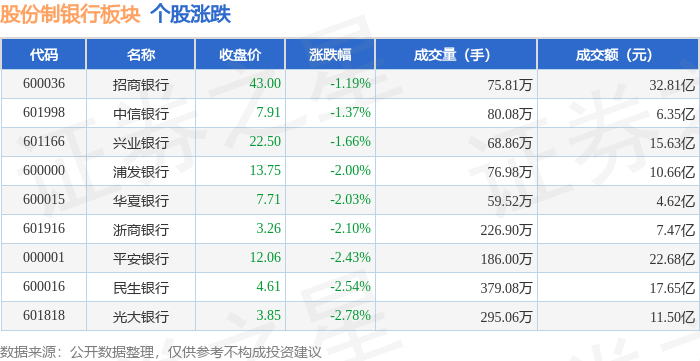
股份制银行板块8月27日跌1.74%,光大银行领跌,主力资金净流出12.69亿元
Zheng Xing Xing Ye Ri Bao· 2025-08-27 08:46
Market Performance - The banking sector saw a decline of 1.74% on August 27, with Everbright Bank leading the drop [1] - The Shanghai Composite Index closed at 3800.35, down 1.76%, while the Shenzhen Component Index closed at 12295.07, down 1.43% [1] Individual Bank Performance - China Merchants Bank closed at 43.00, down 1.19% with a trading volume of 758,100 shares and a transaction value of 3.281 billion [1] - CITIC Bank closed at 7.91, down 1.37% with a trading volume of 800,800 shares and a transaction value of 635 million [1] - Industrial Bank closed at 22.50, down 1.66% with a trading volume of 688,600 shares and a transaction value of 1.563 billion [1] - Shanghai Pudong Development Bank closed at 13.75, down 2.00% with a trading volume of 769,800 shares and a transaction value of 1.066 billion [1] - Huaxia Bank closed at 7.71, down 2.03% with a trading volume of 595,200 shares and a transaction value of 462 million [1] - Zhejiang Commercial Bank closed at 3.26, down 2.10% with a trading volume of 2,269,000 shares and a transaction value of 747.1 million [1] - Ping An Bank closed at 12.06, down 2.43% with a trading volume of 1,860,000 shares and a transaction value of 2.268 billion [1] - Minsheng Bank closed at 4.61, down 2.54% with a trading volume of 3,790,800 shares and a transaction value of 1.765 billion [1] - Everbright Bank closed at 3.85, down 2.78% with a trading volume of 2,950,600 shares and a transaction value of 1.150 billion [1] Capital Flow Analysis - The banking sector experienced a net outflow of 1.269 billion from main funds, while retail investors saw a net inflow of 821 million [1] - The table indicates varying net inflows and outflows for individual banks, with Shanghai Pudong Development Bank showing a main fund net inflow of 20.815 million [2] - Minsheng Bank had a significant main fund net outflow of 253 million, while retail investors contributed a net inflow of 40.322 million [2]






因贷款“三查”不到位等,华夏银行温州分行被罚170万元
Bei Jing Shang Bao· 2025-08-27 08:40
北京商报讯(记者 宋亦桐)8月27日,国家金融监督管理总局温州监管分局发布的行政处罚信息公开表 显示,华夏银行股份有限公司温州分行因贷款"三查"不到位;信贷资金被挪用;违规发放借名贷款主要 违法违规行为,被罚款170万元;相关责任人陈家强被警告。 ...
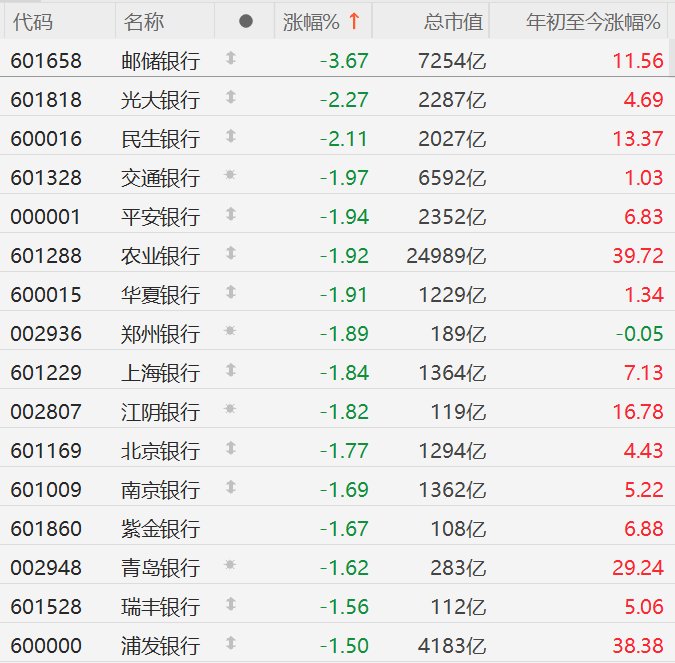
A股银行股走弱,邮储银行跌超3%
Ge Long Hui A P P· 2025-08-27 05:54
Core Viewpoint - The A-share banking sector is experiencing a continuous decline, with notable drops in several major banks' stock prices, indicating a bearish trend in the market [1]. Group 1: Stock Performance - Postal Savings Bank of China (邮储银行) saw a decline of 3.67%, with a total market capitalization of 725.4 billion [2]. - China Everbright Bank (光大银行) decreased by 2.27%, with a market cap of 228.7 billion [2]. - Minsheng Bank (民生银行) fell by 2.11%, having a market value of 202.7 billion [2]. - Agricultural Bank of China (农业银行) dropped by 1.92%, with a significant market cap of 2,498.9 billion [2]. - Other banks such as Huaxia Bank (华夏银行) and Bank of Communications (交通银行) also experienced declines, with respective drops of 1.91% and 1.97% [2]. Group 2: Year-to-Date Performance - Despite the recent declines, Postal Savings Bank has a year-to-date increase of 11.56% [2]. - Minsheng Bank shows a year-to-date increase of 13.37% [2]. - Agricultural Bank of China has a substantial year-to-date increase of 39.72%, indicating strong performance earlier in the year [2].



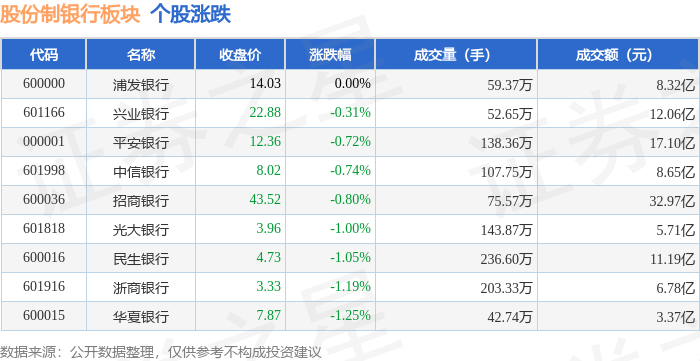
股份制银行板块8月26日跌0.64%,华夏银行领跌,主力资金净流出8100.3万元
Zheng Xing Xing Ye Ri Bao· 2025-08-26 08:36
Market Overview - On August 26, the share price of the joint-stock bank sector fell by 0.64% compared to the previous trading day, with Huaxia Bank leading the decline [1] - The Shanghai Composite Index closed at 3868.38, down 0.39%, while the Shenzhen Component Index closed at 12473.17, up 0.26% [1] Individual Bank Performance - The closing prices and changes for individual banks are as follows: - Shanghai Pudong Development Bank: 14.03, unchanged - Industrial Bank: 22.88, down 0.31% - Ping An Bank: 12.36, down 0.72% - CITIC Bank: 8.02, down 0.74% - China Merchants Bank: 43.52, down 0.80% - Everbright Bank: 3.96, down 1.00% - Minsheng Bank: 4.73, down 1.05% - Zhejiang Commercial Bank: 3.33, down 1.19% - Huaxia Bank: 7.87, down 1.25% [1] Capital Flow Analysis - The joint-stock bank sector experienced a net outflow of 81.03 million yuan from main funds, while speculative funds saw a net inflow of 114 million yuan, and retail investors had a net outflow of 32.54 million yuan [1] - Detailed capital flow for individual banks shows: - Shanghai Pudong Development Bank: Main funds net inflow of 13.2 million yuan, speculative funds net outflow of 60.72 million yuan, retail net outflow of 70.99 million yuan - CITIC Bank: Main funds net inflow of 61.73 million yuan, speculative funds net outflow of 4.00 million yuan, retail net outflow of 57.74 million yuan - Minsheng Bank: Main funds net inflow of 40.61 million yuan, speculative funds net inflow of 34.64 million yuan, retail net outflow of 75.25 million yuan - Huaxia Bank: Main funds net inflow of 34.71 million yuan, speculative funds net outflow of 0.50 million yuan, retail net outflow of 29.72 million yuan - Everbright Bank: Main funds net outflow of 29.75 million yuan, speculative funds net inflow of 37.21 million yuan, retail net outflow of 0.75 million yuan - Industrial Bank: Main funds net outflow of 44.71 million yuan, speculative funds net inflow of 72.56 million yuan, retail net outflow of 27.85 million yuan - Ping An Bank: Main funds net outflow of 54.80 million yuan, speculative funds net outflow of 0.38 million yuan, retail net inflow of 58.56 million yuan - Zhejiang Commercial Bank: Main funds net outflow of 10.40 million yuan, speculative funds net inflow of 42.15 million yuan, retail net inflow of 62.32 million yuan - China Merchants Bank: Main funds net outflow of 116 million yuan, speculative funds net inflow of 0.45 million yuan, retail net outflow of 116 million yuan [2]

多家银行紧急提醒:信用卡这么用违规!
Sou Hu Cai Jing· 2025-08-25 07:53
Core Viewpoint - Recent announcements from multiple banks emphasize the prohibition of using credit card funds for stock and investment activities, coinciding with a rise in the Shanghai Composite Index and increased retail investor enthusiasm [1][2]. Group 1: Bank Announcements - Several banks, including Ping An Bank and CITIC Bank, have reiterated that credit card funds cannot be used for investment purposes, specifically prohibiting purchases of stocks, funds, futures, and other investment products [1][2]. - Other banks, such as Huaxia Bank and Minsheng Bank, have also issued similar announcements, clarifying that credit card cash advances and funds must be used solely for personal consumption and not for any investment activities [2]. Group 2: Regulatory Concerns - The use of credit card funds for stock market investments poses risks of regulatory non-compliance and potential financial losses, which could increase repayment pressures on cardholders and lead to higher non-performing asset risks for banks [3]. - A suggestion has been made for banks to establish a more balanced performance evaluation system for credit card operations, prioritizing compliance and risk management metrics [3].
多家银行紧急提醒:信用卡这么用后果“很严重”
3 6 Ke· 2025-08-25 00:16
Core Viewpoint - Recent announcements from multiple banks emphasize that credit card funds cannot be used for investment purposes, aiming to prevent financial risks associated with credit funds flowing into the stock market as investor enthusiasm rises [1][5]. Summary by Sections Credit Card Usage Regulations - Several banks, including Ping An Bank and CITIC Bank, have reiterated that credit card funds, including cash advances, must not be used for investment activities such as purchasing stocks, funds, futures, and other financial products [3][4]. - Banks have implemented stricter regulations on cash advances, stating that these funds cannot be used for any non-consumption activities, including investments [4][6]. Market Context - The A-share market has shown strong performance recently, leading to increased investor interest, which may tempt some cardholders to use credit cards for stock investments [5][10]. - The People's Bank of China and the former China Banking and Insurance Regulatory Commission issued guidelines in 2022 that explicitly prohibit the use of credit card funds for investment, and recent bank announcements reflect a deeper implementation of these regulations [4][10]. Risks of Using Credit Cards for Investments - Using credit card funds for stock trading can lead to severe consequences, including transaction failures and potential criminal charges for malicious overdraft [6][8]. - The high-interest rates associated with credit card cash advances can amplify investment risks, leading to significant financial pressure if investments do not perform well [10][11]. Recommendations for Investors - Experts advise investors to strictly adhere to the intended use of credit card funds for daily consumption and to avoid any attempts to circumvent regulations through indirect methods [11]. - Maintaining credit health by making timely repayments and understanding the risks associated with using credit cards as investment leverage is crucial [11].