HUA XIA BANK(600015)

Search documents
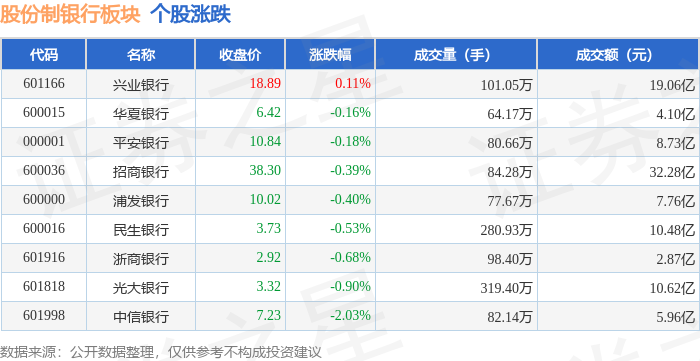
股份制银行板块2月3日跌0.53%,中信银行领跌,主力资金净流出2.88亿元
Zheng Xing Xing Ye Ri Bao· 2026-02-03 09:03
Group 1 - The banking sector experienced a decline of 0.53% on February 3, with CITIC Bank leading the drop [1] - The Shanghai Composite Index closed at 4067.74, up 1.29%, while the Shenzhen Component Index closed at 14127.1, up 2.19% [1] - Individual stock performance in the banking sector showed mixed results, with Industrial Bank slightly up by 0.11% and CITIC Bank down by 2.03% [1] Group 2 - The banking sector saw a net outflow of 288 million yuan from institutional investors, while retail investors contributed a net inflow of 353 million yuan [2] - Specific stock flows indicated that Industrial Bank had a net inflow of 20.39 million yuan from institutional investors, while CITIC Bank had a net outflow of 29.66 million yuan [2] - Retail investors showed significant interest in several banks, with Minsheng Bank receiving a net inflow of 51.32 million yuan [2]






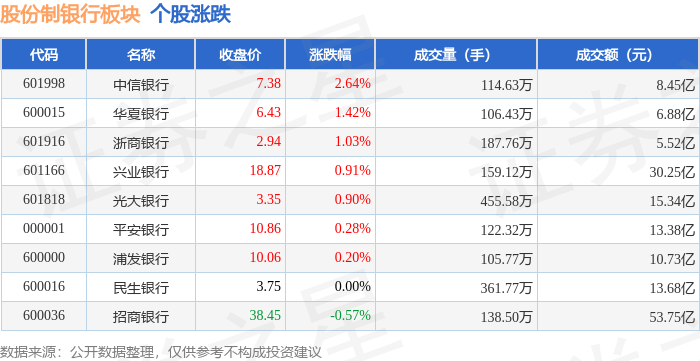
股份制银行板块2月2日涨0.46%,中信银行领涨,主力资金净流入1.62亿元
Zheng Xing Xing Ye Ri Bao· 2026-02-02 09:15
Group 1 - The banking sector saw a slight increase of 0.46% on February 2, with CITIC Bank leading the gains [1] - The Shanghai Composite Index closed at 4015.75, down 2.48%, while the Shenzhen Component Index closed at 13824.35, down 2.69% [1] - CITIC Bank's stock price rose by 2.64% to 7.38, with a trading volume of 1.1463 million shares and a transaction value of 845 million yuan [1] Group 2 - The net inflow of main funds in the banking sector was 162 million yuan, while retail funds saw a net inflow of approximately 89.95 million yuan [1] - CITIC Bank had a net inflow of 72.32 million yuan from main funds, but a net outflow of 18.99 million yuan from retail funds [1] - Minsheng Bank experienced a net inflow of 65.07 million yuan from main funds, with a net outflow of 30.58 million yuan from retail funds [1]



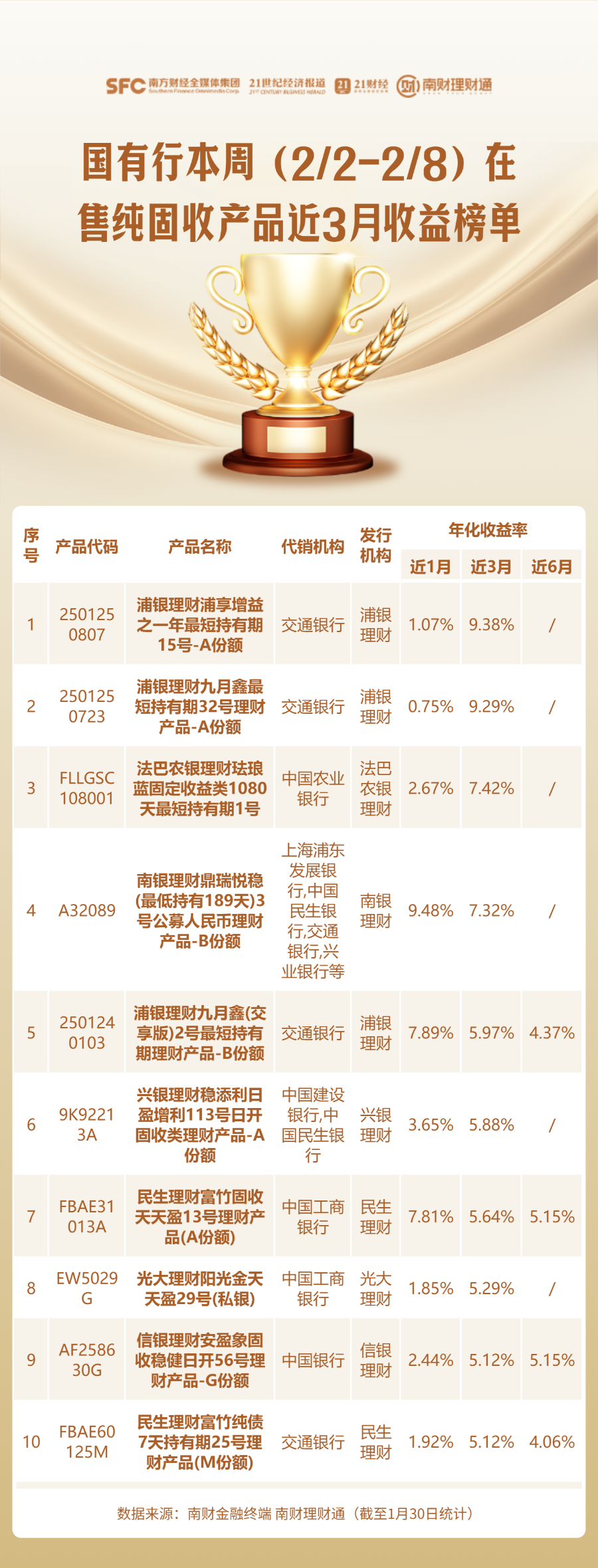
各银行在售高收益纯固收产品一览!合资理财子产品首次上榜
2 1 Shi Ji Jing Ji Bao Dao· 2026-02-02 09:13
Core Insights - The report focuses on the performance of pure fixed-income products issued by wealth management companies, highlighting the best-performing products available for sale through various distribution channels [1][4] Group 1: Product Performance - The ranking of products is based on their annualized returns over the past month, three months, and six months, with a particular emphasis on the three-month annualized yield to reflect their performance amid recent market fluctuations [1] - A total of 28 distribution institutions are involved, including major banks such as Industrial and Commercial Bank of China, Bank of China, Agricultural Bank of China, and others [1] Group 2: Product Availability - The list of products is categorized as "available for sale," but actual availability may vary due to factors such as sold-out quotas or differences in product listings shown to different customers by banks [1] - Investors are advised to refer to the actual displays on the distribution bank's app for the most accurate information regarding product availability [1] Group 3: Data Source - The data presented in the report is sourced from the Nanfang Financial Terminal and Nanfang Wealth Management, with statistics as of January 30 [3][5]



资金大幅流出后银行为何逆势回升?机构点出 4.4% 高分红率+信贷开门红
Mei Ri Jing Ji Xin Wen· 2026-02-02 07:20
Core Viewpoint - The banking sector experienced significant capital outflows in January 2026, with a notable recovery in stock prices despite the outflows, indicating a potential increase in long-term institutional investor interest [1]. Group 1: Market Performance - As of February 2, 2026, the China Securities Banking Index (399986) rose by 0.15%, with notable increases in individual bank stocks such as CITIC Bank (up 2.64%), Shanghai Bank (up 1.62%), and Huaxia Bank (up 1.42%) [1]. - The Bank ETF Huaxia (515020) increased by 0.18%, with the latest price at 1.65 yuan [1]. Group 2: Capital Flows - In January 2026, there was a substantial net outflow of passive funds from the banking sector, totaling 9,102 billion yuan for the month and 3,773 billion yuan for the week of January 26 to 30 [1]. - CITIC Securities estimated that the net outflow of funds from bank stocks was approximately 1,051 billion yuan in January and 485 billion yuan for the last week of January [1]. Group 3: Future Outlook - Despite the significant capital outflows, the banking index saw a 1% rebound, suggesting a strong willingness for long-term institutional investment [1]. - The banking sector is expected to benefit from a positive operating environment in the first quarter of 2026, with stable net interest margins and asset quality, leading to a recovery in revenue and profit growth [1]. - The current dividend yield of 4.4% in the sector is considered to be in a high cost-performance range, enhancing the attractiveness of core equity assets [1].

银行股逆势上涨,中信银行涨超3%
Ge Long Hui· 2026-02-02 03:57
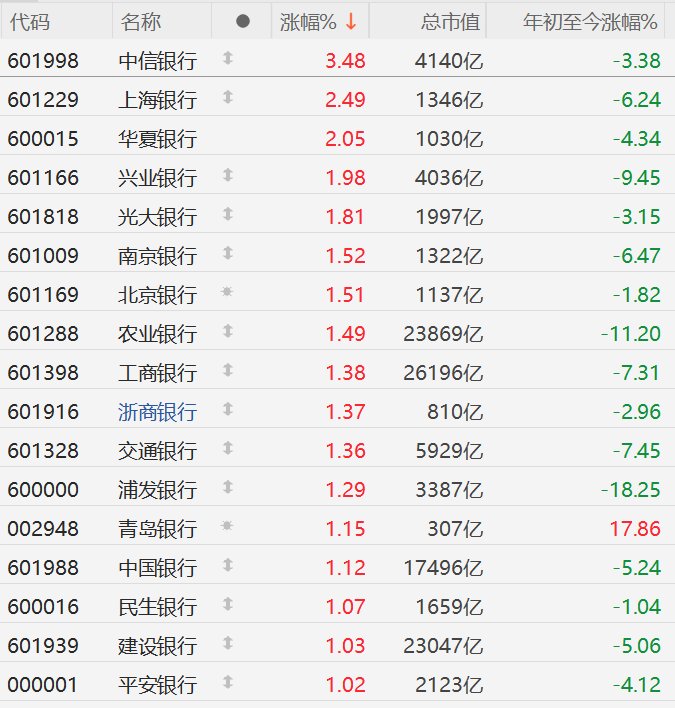
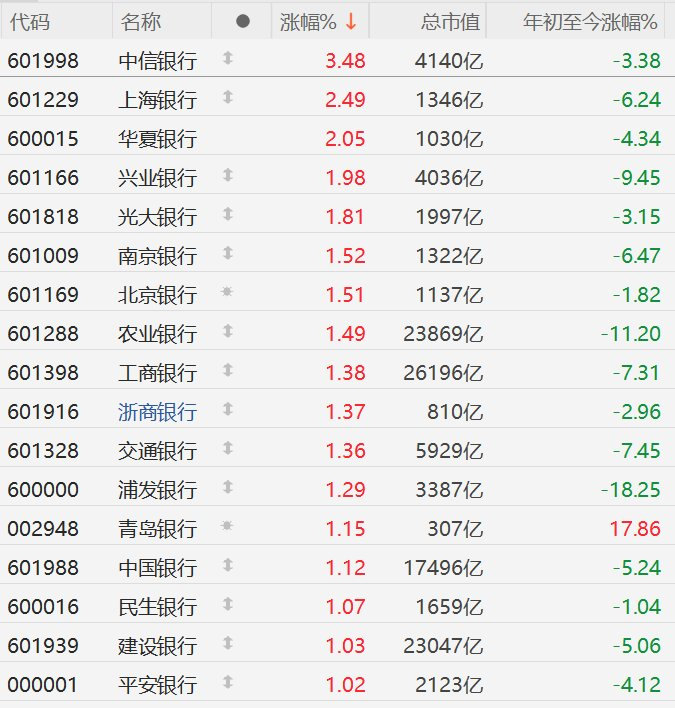
Core Viewpoint - The A-share market's banking sector experienced a counter-trend increase, with several banks showing significant gains despite overall market conditions [1]. Group 1: Stock Performance - CITIC Bank saw an increase of 3.48%, with a total market capitalization of 414 billion [2] - Shanghai Bank increased by 2.49%, with a market cap of 134.6 billion [2] - Huaxia Bank rose by 2.05%, with a market cap of 103 billion [2] - Other banks such as Industrial Bank, Everbright Bank, and Nanjing Bank also reported gains exceeding 1% [1][2] - Agricultural Bank, Industrial and Commercial Bank, and China Merchants Bank had market caps of 2386.9 billion, 2619.6 billion, and 2304.7 billion respectively, with slight increases [2] Group 2: Year-to-Date Performance - Year-to-date performance shows that most banks have negative returns, with CITIC Bank down 3.38% and Shanghai Bank down 6.24% [2] - Notably, Qingdao Bank has a positive year-to-date return of 17.86%, indicating strong performance relative to its peers [2] - Other banks like Agricultural Bank and Industrial Bank have year-to-date declines of 11.20% and 7.31% respectively [2]
A股银行股逆势上涨,中信银行涨超3%
Ge Long Hui A P P· 2026-02-02 03:54
Core Viewpoint - The A-share market has seen a rise in bank stocks, with several banks experiencing significant gains despite overall market trends [1] Group 1: Stock Performance - CITIC Bank increased by 3.48%, with a total market capitalization of 414 billion [2] - Shanghai Bank rose by 2.49%, with a market cap of 134.6 billion [2] - Huaxia Bank saw a gain of 2.05%, with a market value of 103 billion [2] - Industrial Bank increased by 1.98%, with a market cap of 403.6 billion [2] - Everbright Bank rose by 1.81%, with a total market capitalization of 199.7 billion [2] - Nanjing Bank increased by 1.52%, with a market cap of 132.2 billion [2] - Beijing Bank saw a rise of 1.51%, with a market value of 113.7 billion [2] - Agricultural Bank increased by 1.49%, with a market cap of 23,869 billion [2] - Industrial and Commercial Bank rose by 1.38%, with a market value of 26,196 billion [2] - Zhejiang Bank increased by 1.37%, with a market cap of 81 billion [2] - Bank of Communications rose by 1.36%, with a market value of 592.9 billion [2] - Shanghai Pudong Development Bank increased by 1.29%, with a market cap of 338.7 billion [2] - Qingdao Bank saw a rise of 1.15%, with a market value of 30.7 billion [2] - Bank of China increased by 1.12%, with a market cap of 17,496 billion [2] - Minsheng Bank rose by 1.07%, with a market value of 165.9 billion [2] - China Construction Bank increased by 1.03%, with a market cap of 23,047 billion [2] - Ping An Bank rose by 1.02%, with a market value of 212.3 billion [2] Group 2: Year-to-Date Performance - CITIC Bank has a year-to-date decline of 3.38% [2] - Shanghai Bank has decreased by 6.24% year-to-date [2] - Huaxia Bank has a year-to-date decline of 4.34% [2] - Industrial Bank has decreased by 9.45% year-to-date [2] - Everbright Bank has a year-to-date decline of 3.15% [2] - Nanjing Bank has decreased by 6.47% year-to-date [2] - Beijing Bank has a year-to-date decline of 1.82% [2] - Agricultural Bank has decreased by 11.20% year-to-date [2] - Industrial and Commercial Bank has a year-to-date decline of 7.31% [2] - Zhejiang Bank has decreased by 2.96% year-to-date [2] - Bank of Communications has a year-to-date decline of 7.45% [2] - Shanghai Pudong Development Bank has decreased by 18.25% year-to-date [2] - Qingdao Bank has increased by 17.86% year-to-date [2] - Bank of China has a year-to-date decline of 5.24% [2] - Minsheng Bank has decreased by 1.04% year-to-date [2] - China Construction Bank has a year-to-date decline of 5.06% [2] - Ping An Bank has decreased by 4.12% year-to-date [2]
最高立减88元!惠州四大银行联手惠泊车推出春日停车大优惠
Nan Fang Du Shi Bao· 2026-02-01 03:49
Core Viewpoint - The collaboration between Huizhou Jiaotou Huiboche and four major banks aims to provide significant parking discounts to residents, enhancing their travel experience and promoting convenient parking solutions [1][14]. Group 1: Discount Details - The promotional activities include discounts of up to 88 yuan, with various banks offering different benefits to their cardholders [1][10]. - Industrial and Commercial Bank of China (ICBC) offers random discounts of 1 to 3 yuan for credit card users on parking fees over 5 yuan, valid until July 31, 2026 [4]. - Bank of China provides a "3 yuan off 2 yuan" discount for debit card users until April 30, 2026, with additional random discounts available for subsequent payments [5]. - Guangfa Bank has the broadest coverage and longest duration, offering discounts of up to 88 yuan for credit and debit card users on parking fees over 5 yuan, valid until December 31, 2026 [10]. Group 2: Objectives and Future Plans - The initiative is designed to meet the public's demand for economical and convenient travel options while encouraging standardized parking practices [14]. - The company plans to continue exploring more public-friendly services to enhance parking resource efficiency and create a smarter, more user-friendly parking environment [14].

普惠金融精准滴灌 赋能小微企业高质量发展
Qi Lu Wan Bao· 2026-01-30 11:12
Core Insights - Inclusive finance plays a crucial role in stimulating market vitality and promoting balanced economic development, with a focus on small and micro enterprises' diverse financing needs [2] Group 1: Financial Performance - In 2025, Huaxia Bank's Qingdao branch reported an increase of 424 million yuan in inclusive small and micro enterprise loans, achieving a regulatory plan completion rate of 132% [2] - The branch added 69 new first-time loan clients and saw an increase of 251 million yuan in credit loans and 1.253 billion yuan in medium to long-term loans, demonstrating its commitment to serving small and micro enterprises [2] Group 2: Mechanism Innovation - The bank has established a credit management system that aligns with the development of small and micro enterprises, optimizing credit resource allocation towards advanced manufacturing, technology innovation, agriculture, and green development [3] - A differentiated authorization and standardized approval model has been implemented, streamlining the approval process for loans under 5 million yuan and enhancing efficiency for key client groups [3] Group 3: Product Innovation - Huaxia Bank has expanded its product offerings to meet the financing characteristics of small and micro enterprises, launching the "Hui Min Direct Line" product to support rural revitalization, with 837 million yuan in loans issued to 154 clients [5] - The bank has developed government procurement loans and data-based credit loans, achieving a credit loan balance of 307 million yuan, with an increase of 251 million yuan in 2025 [5] Group 4: Technology Empowerment - The bank has adopted a digital transformation strategy, implementing a credit factory model that has reduced the loan processing steps from 15 to 5, saving 19 hours per transaction [6] - By focusing on core industry scenarios, the bank has successfully integrated financial services with industrial development, providing loans to 59 technology enterprises with a total balance of 441 million yuan [6] Group 5: Targeted Financial Support - The bank has prioritized technology and agricultural finance, providing credit limits of up to 10 million yuan for specialized small and medium enterprises, with a total of 250 such clients and a loan balance of 1.77 billion yuan [7] - In the agricultural finance sector, the bank has introduced financial products tailored to agricultural scenarios, with an increase of 193 million yuan in inclusive agricultural loans [7] Group 6: Future Outlook - Huaxia Bank's Qingdao branch aims to continue enhancing its inclusive finance strategy, optimizing service models and product systems to support the growth of more small and micro enterprises and contribute to high-quality economic development in Qingdao [8]
华夏银行跌1.71% 领跌银行板块
Zhong Guo Jing Ji Wang· 2026-01-30 09:27
(责任编辑:徐自立) 中国经济网北京1月30日讯 华夏银行(600015.SH)今日股价收报6.34元,跌幅1.71%。今日,银行 板块跌0.41%,华夏银行为该板块跌幅最大的上市公司。 ...
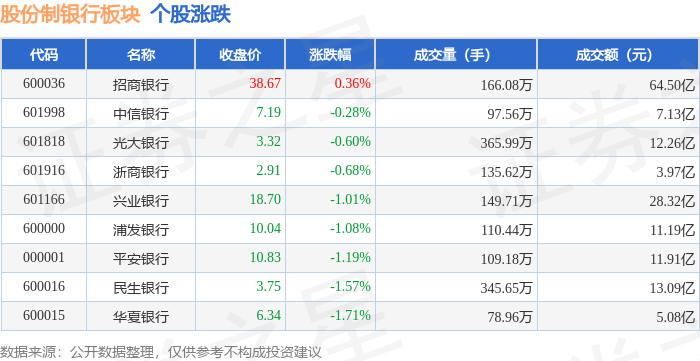
股份制银行板块1月30日跌0.53%,华夏银行领跌,主力资金净流出6.65亿元
Zheng Xing Xing Ye Ri Bao· 2026-01-30 08:54
Group 1 - The banking sector experienced a decline of 0.53% on January 30, with Huaxia Bank leading the drop [1] - The Shanghai Composite Index closed at 4117.95, down 0.96%, while the Shenzhen Component Index closed at 14205.89, down 0.66% [1] - Major banks such as China Merchants Bank and CITIC Bank showed mixed performance, with China Merchants Bank slightly up by 0.36% and CITIC Bank down by 0.28% [1] Group 2 - The banking sector saw a net outflow of 665 million yuan from institutional investors, while retail investors contributed a net inflow of 564 million yuan [1] - Specific banks like Huaxia Bank and Minsheng Bank faced significant net outflows from institutional investors, with Huaxia Bank seeing a net outflow of 67 million yuan [1] - Retail investors showed a preference for certain banks, with significant net inflows into banks like Ping An Bank and Zhejiang Commercial Bank [1]