HZBank(600926)

Search documents
可转债队伍密集减员 “固收+”新出路在哪?
2 1 Shi Ji Jing Ji Bao Dao· 2025-07-10 12:12
Core Viewpoint - The convertible bond market is experiencing a significant reduction in supply, leading to increased scarcity and heightened interest from investors, particularly in bank convertible bonds [1][2][3]. Group 1: Market Dynamics - Since July, there has been a concentrated redemption and conversion of bank convertible bonds, resulting in a shrinking asset pool. As of July 10, the total market for convertible bonds has decreased to 668.08 billion yuan, down 65.54 billion yuan from the beginning of the year [1]. - The current market is undergoing a period of intensive adjustment, with 456 convertible bonds entering redemption and conversion phases, representing 95.36% of the total market size [1]. - The convertible bond market has shown strong upward momentum this year, with the Wind convertible bond index rising by 18.17% year-to-date as of July 10 [2]. Group 2: Performance of Bank Convertible Bonds - Bank convertible bonds are particularly attractive due to the strong credit quality of the issuing banks and the performance of bank stocks, which have seen significant increases due to institutional investments [2][3]. - Several bank convertible bonds have successfully triggered mandatory redemption and conversion, achieving high conversion rates, such as Chengdu Bank and Suzhou Bank with rates of 99.94% and 99.93% respectively [3]. Group 3: Investor Sentiment and Strategy - There is a growing concern among investors regarding the high valuation of convertible bonds, with some analysts suggesting that entering the market at this stage may not be wise [2][4]. - Despite the high valuations, there remains a demand for convertible bonds, particularly from institutional investors seeking to enhance their fixed-income portfolios [5][6]. - Investment strategies are shifting, with a preference for large-cap convertible bonds linked to major stocks, especially in sectors like banking, photovoltaic, and agriculture [6].



银行转债存量“缩编”机构底仓资产如何腾挪
Zhong Guo Zheng Quan Bao· 2025-07-08 20:50
Core Viewpoint - The banking sector has shown strong performance in 2023, leading to a significant increase in bank convertible bonds, with many set to exit the market, raising questions about asset allocation for institutional investors [1][2][3]. Group 1: Market Dynamics - Several bank convertible bonds, including Hangzhou Bank and South Bank, have completed their market conversion and delisting, with a total estimated reduction of around 100 billion yuan in bank convertible bonds this year [1][2]. - The strong redemption mechanism of convertible bonds is closely linked to the performance of the underlying bank stocks, which have been rising recently [1][2]. - The total outstanding convertible bonds as of July 8 was approximately 664.65 billion yuan, a decrease of 68.98 billion yuan since the beginning of the year, with projections suggesting it may fall below 600 billion yuan by the end of the year [3][6]. Group 2: Institutional Investment Trends - Convertible bonds have become a key asset in the "fixed income plus" strategy for asset management products, with institutions increasingly favoring them due to their low volatility and high returns [3][4]. - The demand for bank convertible bonds remains high due to their strong credit quality and risk resistance, despite a slowdown in new issuances [3][4]. - Institutions are now seeking to diversify their asset allocation strategies, looking for alternative high-yielding base assets as the supply of convertible bonds decreases [5][7]. Group 3: Future Outlook - The shrinking supply of bank convertible bonds and the ongoing demand may lead to a situation where valuations become difficult to maintain, prompting institutions to explore other investment opportunities [6][7]. - Analysts suggest that the current market conditions may create short-term trading opportunities in bank convertible bonds, despite their high valuations [6][7]. - The focus may shift towards convertible bond ETFs and other asset classes like REITs and thematic ETFs as institutions adapt to the changing market landscape [6][7].
杭州银行“吃下”380万元罚单 贷款问题成罚款“重灾区”
Bei Ke Cai Jing· 2025-07-08 03:31
Core Viewpoint - Hangzhou Bank has been fined 3.8 million yuan due to multiple violations, primarily related to loan management issues, highlighting the increasing scrutiny on credit practices in the banking sector [1][3][4]. Group 1: Regulatory Actions - The Shanghai Financial Regulatory Bureau imposed a fine on Hangzhou Bank for seven major violations, with a significant focus on loan-related issues [1][3]. - Regulatory bodies have intensified their examination of credit violations this year, leading to frequent penalties in the banking industry [2][4]. - The National Financial Supervision Administration has introduced new regulations, such as the "Liquidity Fund Loan Management Measures," to enforce stricter compliance in loan management [4][5]. Group 2: Specific Violations - The violations by Hangzhou Bank include severe breaches in pre-loan investigations for working capital loans, management of operational property loans, personal loan management, and other credit-related activities [3][6]. - The bank's personal loan non-performing rate increased to 0.77%, up by 0.18 percentage points from the end of 2023, while the non-performing rate for real estate loans reached 6.65%, rising by 0.29 percentage points year-on-year [6]. Group 3: Penalties and Accountability - Multiple responsible individuals at Hangzhou Bank were also penalized, reflecting a trend of dual penalties where both institutions and individuals face consequences for violations [7][8]. - The dual penalty mechanism aims to enhance the deterrent effect of regulatory actions, encouraging financial institutions and personnel to adhere to compliance and risk management practices [9].
杭州银行: 杭州银行关于“杭银转债”赎回结果暨股份变动的公告
Zheng Quan Zhi Xing· 2025-07-07 16:13
Summary of Key Points Core Viewpoint - The announcement details the early redemption of "Hangyin Convertible Bonds" by Hangzhou Bank, which is triggered by the stock price exceeding a specified threshold, leading to a total redemption amount of RMB 5,941,151.92, including interest [1][5]. Group 1: Redemption Details - Redemption amount: RMB 5,912,000 (59,120 bonds) [1] - Total redemption payment: RMB 5,941,151.92 (including current interest) [1][5] - Redemption payment date: July 7, 2025 [1] - Convertible bond delisting date: July 7, 2025 [1] Group 2: Conditions and Calculations - The redemption was triggered as the stock price was above 130% of the conversion price for 15 trading days [1]. - The redemption price includes the face value of the bonds plus accrued interest calculated as follows: IA = B × i × t / 365, where IA is the accrued interest, B is the total face value of the bonds, i is the annual coupon rate of 1.8%, and t is the number of days [2][3]. Group 3: Impact on Company - As of July 4, 2025, the remaining balance of "Hangyin Convertible Bonds" is RMB 5,912,000, accounting for 0.04% of the total issuance [4]. - Total converted amount of "Hangyin Convertible Bonds" is RMB 14,994,088,000, resulting in 1,318,802,116 shares, which is 22.24% of the total shares before conversion [4]. - Post-redemption, the total share capital will increase to 7,249,002,548 shares, which may dilute earnings per share in the short term but strengthens the company's capital base for sustainable development [5].
净息差和不良率“倒挂”,银行盈利承压如何破局?
Di Yi Cai Jing· 2025-07-07 12:49
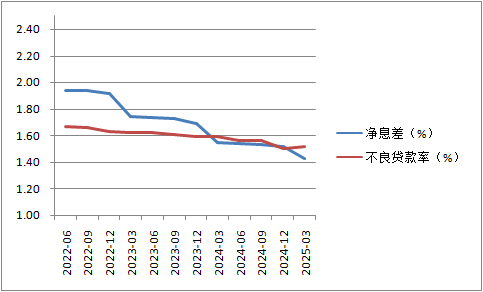
Core Viewpoint - The banking industry is facing significant pressure as net interest margins have fallen below non-performing loan ratios for the first time, indicating a critical need for banks to diversify their income sources beyond interest income [1][2][4]. Group 1: Financial Performance Indicators - In Q1, the net interest margin for Chinese commercial banks decreased to 1.43%, down 9 basis points from the previous quarter, while the non-performing loan ratio rose to 1.51%, an increase of 0.01 percentage points [2][4]. - Among the major banks, state-owned banks had the lowest non-performing loan ratios at 1.22% and 1.23%, while rural commercial banks faced the highest at 2.86% [4]. - A total of 9 out of 42 listed banks reported net interest margins lower than their non-performing loan ratios, highlighting the growing financial strain within the sector [4][5]. Group 2: Challenges and Market Dynamics - The banking sector is experiencing ongoing challenges due to declining asset quality, which is affecting profitability and the ability to cover costs associated with credit, operations, and capital [4][6]. - Analysts indicate that the pressure on net interest margins is exacerbated by weak credit demand and a shift towards lower-yielding short-term loans, leading to a decline in asset yields [6][7]. - The average net interest margin for listed banks has been on a downward trend for five consecutive years, with many banks now below the 1.8% warning line set by market pricing mechanisms [7][8]. Group 3: Strategic Responses - To address the challenges posed by low interest rates, banks are encouraged to diversify their income sources, focusing on non-interest income and other financial services [8][9]. - Recommendations include reducing deposit interest subsidies and hidden costs associated with deposits to alleviate margin pressures [8]. - Banks are advised to adopt a more resilient and balanced income structure, optimizing their liabilities and controlling costs to enhance profitability [9].




超千家机构密集调研上市银行!谁最受青睐?重点关注哪些问题?
Xin Lang Cai Jing· 2025-07-07 11:11
Core Insights - The recent surge in institutional interest in listed banks indicates a significant increase in market attention towards bank stocks, reflecting a deep re-evaluation of the banking sector's value amid a weak economic recovery [2][6] - The banking sector has shown strong performance in the first half of the year, with a total stock price increase of 13.1%, making it the second-best performing sector in the market [3][5] Institutional Interest - In the first half of the year, 19 A-share listed banks received over a thousand institutional research visits, marking a record high [1] - Regional banks, particularly those in the Yangtze River Delta, have become the primary targets for institutional investors, with Ningbo Bank, Changshu Bank, and Hangzhou Bank leading in the number of research visits [1] Dividend Policies - Most listed banks have increased their total cash dividends for 2024, with 39 out of 42 banks raising their dividend amounts by a total of 18.6 billion yuan compared to the previous year [2][6] - The average dividend yield for bank stocks stands at 5.04%, significantly higher than the 1.65% yield of 10-year government bonds, making bank stocks attractive to long-term institutional investors [2][3] Asset Quality and Net Interest Margin - Institutions are focusing on banks' asset quality, net interest margin management, and dividend policies during their research [4][5] - The banking sector's non-performing loan ratio is expected to remain low at 1.50% in 2024, although overdue rates are rising, particularly among rural commercial banks [5][6] Future Outlook - Institutions are likely to focus on whether net interest margins stabilize, the direction of loan structure adjustments towards green and technology finance, and the potential for new business growth through digital transformation and comprehensive services [7]


杭州银行(600926) - 杭州银行关于“杭银转债”赎回结果暨股份变动的公告
2025-07-07 10:16
证券代码:600926 证券简称:杭州银行 公告编号:2025-061 优先股代码:360027 优先股简称:杭银优 1 杭州银行股份有限公司 关于"杭银转债"赎回结果暨股份变动的公告 (一)赎回登记日与赎回对象 本公司董事会及全体董事保证本公告内容不存在任何虚假 记载、误导性陈述或者重大遗漏,并对其内容的真实性、准确 性和完整性承担法律责任。 重要内容提示: 一、本次可转债赎回的公告情况 根据《杭州银行股份有限公司公开发行 A 股可转换公司债 券募集说明书》(以下简称"《募集说明书》")的相关约定, 自 2025 年 4 月 29 日至 2025 年 5 月 26 日期间,杭州银行股份有 限公司(以下简称"公司")股票已有 15 个交易日收盘价不低 于"杭银转债"当期转股价格 11.35 元/股的 130%(含 130%,即 不低于 14.76 元/股),已触发"杭银转债"的有条件赎回条款。 2025 年 5 月 26 日,公司召开第八届董事会第十八次会议审 议通过《杭州银行股份有限公司关于提前赎回"杭银转债"的议 案》,决定行使"杭银转债"的提前赎回权,对赎回登记日登记 在册的"杭银转债"按债券面值加当期 ...
杭州银行上海分行领380万元罚单 多业务违规暴露风险
Jing Ji Guan Cha Wang· 2025-07-07 06:51
Company Dynamics - On July 4, the Shanghai Regulatory Bureau of the National Financial Supervision Administration disclosed that Hangzhou Bank's Shanghai branch was fined 3.8 million yuan due to multiple violations, with several responsible individuals also receiving warnings and fines [2][3] - Hangzhou Bank, established in September 1996 and headquartered in Hangzhou, went public on the Shanghai Stock Exchange on October 27, 2016. The bank has over 200 branches, primarily operating in Hangzhou and other cities in Zhejiang Province, with a presence in developed economic zones such as the Yangtze River Delta and the Pearl River Delta [2] - This fine marks the first regulatory penalty for Hangzhou Bank in 2025, indicating a complex web of violations across various business areas, revealing significant gaps in risk management and internal controls [2][3] - In the credit business, issues with the "three checks" (pre-loan investigation, in-loan review, and post-loan inspection) were particularly prominent, with serious violations of prudent operational rules noted in the pre-loan investigation of working capital loans and the supervision of loan usage [2][3] Regulatory Actions - The penalties not only affected Hangzhou Bank's Shanghai branch but also led to warnings and fines for several individuals, including assistant managers and branch heads, for serious violations in personal loan management, property loan management, and other areas [4] - Specific individuals received warnings and fines of 50,000 yuan each for their roles in various violations, emphasizing the regulatory focus on enhancing compliance awareness among senior management [4] Financial Performance - As of the first quarter of 2025, Hangzhou Bank reported total assets of 2.22 trillion yuan, total loans of 995.196 billion yuan, total liabilities of 2.08 trillion yuan, and total deposits of 1.35 trillion yuan. The bank achieved revenue of 9.978 billion yuan and a net profit attributable to shareholders of 6.021 billion yuan during the reporting period. The non-performing loan ratio stood at 0.76%, with a provision coverage ratio of 530.07% [4]

投资面再讨论银行周期属性:银行股:从“顺周期”到“弱周期”
ZHONGTAI SECURITIES· 2025-07-06 12:39
Investment Rating - The report maintains an "Overweight" rating for the banking sector [2] Core Insights - The banking sector is transitioning from a "pro-cyclical" model to a "weak cyclical" model, indicating a shift in operational dynamics [2][4] - The report emphasizes the stability of bank dividend yields, which are expected to remain attractive even as risk-free interest rates decline [2][4] - The influx of non-freely circulating funds, such as from state-owned enterprises and insurance capital, is expected to provide a stable source of investment in bank stocks [2][4] Summary by Sections From the Perspective of Risk-Free Interest Rates - Bank dividend yields are characterized by strong certainty and sustainability, with interest margins expected to decline more slowly than risk-free rates [5][12] - The correlation between banks and fiscal policies has strengthened, providing a safety net for core assets [12] - If risk-free interest rates decline, the attractiveness of stable bank dividends will increase, especially in a context of economic weak recovery and asset scarcity [8][18] From the Perspective of Funding Allocation to Bank Stocks - Major funding sources for bank stocks include non-freely circulating funds from fiscal authorities, state-owned enterprises, and insurance capital [5][12] - Non-freely circulating market capitalization accounts for approximately 70% of the banking sector, providing a stabilizing effect [5][12] - Insurance capital is projected to significantly increase its allocation to bank stocks, with an estimated annual inflow exceeding 350 billion [5][12] Investment Recommendations - The report continues to recommend the banking sector, particularly focusing on banks with regional advantages and strong dividend yields [4][12] - Specific recommendations include regional banks in areas like Jiangsu, Shanghai, and Chengdu, as well as major banks such as Agricultural Bank of China, China Construction Bank, and Industrial and Commercial Bank of China [4][12]




银行业2025年度中期投资策略:价值重估的下半场
Changjiang Securities· 2025-07-06 09:42
Core Insights - The banking sector is currently undergoing a trend of value reassessment, driven by expectations of fundamental stability, with banks' earnings resilience consistently exceeding expectations due to regulatory support and the establishment of risk bottom lines in key areas such as local government financing and real estate [4][8] - The current market rally is fundamentally a reflection of the stability of the banking sector rather than a reliance on macroeconomic recovery, marking a systematic value reassessment and correction of historically unreasonable low valuations [8][23] Summary by Sections Fundamental Outlook: Maintaining Earnings Stability - The net interest margin (NIM) is expected to stabilize as regulatory policies aim to maintain it by reducing banks' funding costs to offset the impact of loan interest rate cuts, with NIM currently at a low point [9][26] - Since 2022, multiple rounds of deposit rate cuts have been implemented, and as a significant amount of fixed-term deposits mature in 2025, the repricing of deposit costs will accelerate [9][26] - The overall non-performing loan (NPL) ratio of listed banks is expected to remain stable, supported by rapid asset expansion and write-offs, with a stable provision coverage ratio across most banks [9][37] Capital Market Dynamics: Increased Institutional Investment - Various capital entities, including state-owned enterprises and insurance companies, have been increasing their holdings in bank stocks, driven by the value reassessment of undervalued banks amid an asset scarcity environment [10][45] - The shift in investment strategy among active funds towards bank stocks is anticipated due to their significant index weight and long-standing underallocation, with a focus on quality banks with strong fundamentals [10][45] Investment Recommendations - The report recommends focusing on high-quality city commercial banks and dividend-paying banks, highlighting the investment value of state-owned banks listed in Hong Kong due to their lower valuations [11][10] - Specific banks recommended include Hangzhou Bank, Chengdu Bank, Jiangsu Bank, Qilu Bank, and Qingdao Bank, with a focus on their regional economic performance, asset quality, and growth rates [11][10]