Workflow
PICC(601319)
icon
Search documents
一周保险速览(8.29—9.5)
Cai Jing Wang· 2025-09-05 08:46
Regulatory Voice - The State Council issued an opinion on September 4 to guide insurance institutions in developing insurance products for sports events and sports injuries [1] Industry Focus - On September 4, the China Insurance Industry Association released the first set of comprehensive insurance demonstration clauses and supporting underwriting and claims service guidelines for major technical equipment and new materials, marking a significant step in advancing technology insurance and supporting the national manufacturing strategy [1] - Five major A-share listed insurance companies, including China Ping An, China Life, China Pacific Insurance, China People’s Insurance, and New China Life, reported a total revenue of 1,333.86 billion yuan for the first half of 2025, a year-on-year increase of 4.89%, and a net profit attributable to shareholders of 178.19 billion yuan, up 3.72%. Despite revenue growth, net profit showed a mixed performance with four companies increasing and one decreasing. All five companies plan to steadily increase equity asset allocation, focusing on high-dividend value stocks and growth sectors to enhance long-term returns and smooth earnings [1] Financial Personnel - Bai Kai is proposed to be appointed as the Deputy General Manager of China Taiping Insurance Holdings, having previously served as Vice President of China Life Insurance [2] Leadership Changes - China Reinsurance Group announced a leadership change with Zhuang Qianzhi, the former Vice Secretary of the Party Committee and President, set to take over as Party Secretary and proposed Chairman, pending governance and regulatory approval [3] - Li Shihong has been approved to serve as the Chairman of Guobao Life Insurance, as confirmed by the Sichuan Financial Regulatory Bureau on September 1 [4]
中国人保股价连续5天下跌累计跌幅6.57%,国泰基金旗下1只基金持229.92万股,浮亏损失135.65万元
Xin Lang Cai Jing· 2025-09-05 07:38
Core Viewpoint - China People's Insurance Company (CPIC) has experienced a decline in stock price, with a cumulative drop of 6.57% over the past five days, closing at 8.39 yuan per share on September 5, with a market capitalization of 371.04 billion yuan [1] Company Overview - CPIC, established on August 22, 1996, and listed on November 16, 2018, is primarily an investment holding company providing insurance products. Its operations are divided into six main segments: property insurance, health insurance, life insurance, asset management, headquarters, and others [1] - The revenue composition of CPIC is as follows: property insurance accounts for 84.43%, life insurance 9.77%, health insurance 5.20%, headquarters and others 4.17%, and asset management 0.49% [1] Fund Holdings - According to data, Guotai Fund has a significant holding in CPIC through its Guotai Internet+ Stock Fund (001542), which held 2.2992 million shares, representing 3.72% of the fund's net value, making it the ninth-largest holding [2] - The fund has incurred a floating loss of approximately 183,900 yuan today, with a total floating loss of 1.3565 million yuan during the five-day decline [2] Fund Manager Information - The fund manager of Guotai Internet+ Stock Fund is Sun Jiaxu, who has been in the position for 3 years and 97 days. The fund's total asset size is 538 million yuan, with the best return during his tenure being -1.35% and the worst being -6% [3]
中报观察|新能源车险盈利拐点已至,险企海外“闯关”挑战多
Huan Qiu Wang· 2025-09-05 06:10
Core Viewpoint - The insurance industry is experiencing a turning point in the profitability of new energy vehicle (NEV) insurance, with some companies reporting positive results after years of losses due to high claim rates and costs associated with NEVs [1][5]. Group 1: Market Dynamics - The NEV insurance sector has evolved from being a secondary option for consumers to a primary choice, but it has faced challenges such as high claim rates and costs [2][4]. - In 2024, the insurance industry covered 31.05 million NEVs, generating premium income of 140.9 billion yuan, but reported an underwriting loss of 5.7 billion yuan, indicating ongoing financial struggles [4]. Group 2: Profitability Signals - Recent reports from listed insurance companies for the first half of 2025 indicate a shift towards profitability in NEV insurance, with China Ping An achieving a 49.3% increase in NEV insurance coverage and a 46.2% rise in premium income [5]. - China Pacific Insurance reported that NEV insurance premiums accounted for 19.8% of its total auto insurance premiums, up from 14.1% the previous year, signaling a growing market share [5]. Group 3: Strategic Changes - The transition from "passive underwriting" to "active management" in NEV insurance is attributed to improved data collection, refined pricing models, and collaboration with manufacturers [6]. - The insurance industry has seen over 50% growth in NEV premiums annually since 2021, with household vehicle premiums growing significantly [6]. Group 4: Policy and Regulatory Support - Regulatory bodies have issued guidelines to enhance the quality and management of NEV insurance, focusing on reducing repair costs and improving service levels [7][8]. - The establishment of a risk-sharing mechanism aims to address the challenges of high claim rates and improve the insurability of NEVs [8]. Group 5: Innovation and Product Development - Insurance companies are innovating products to meet diverse market needs, including introducing new insurance models and addressing emerging risks associated with advanced driver-assistance systems (ADAS) [9]. - The introduction of "basic + variable" insurance products and "battery separation" models aims to better cater to the unique risks of NEVs [9]. Group 6: International Expansion - Companies are expanding NEV insurance offerings internationally, with China Pacific Insurance launching projects in Hong Kong and Thailand as part of its global strategy [10]. - The internationalization of NEV insurance is seen as an opportunity to enhance service offerings alongside vehicle sales abroad [10]. Group 7: Challenges in International Markets - The expansion into international markets faces challenges such as high repair costs, lack of local data for risk assessment, and differences in regulatory environments [11]. - Companies must navigate varying local regulations and establish effective partnerships to ensure successful operations in foreign markets [11].
红河金融监管分局同意撤销 中国人保财险 弥勒支公司新哨营销服务部
Jin Tou Wang· 2025-09-05 04:16
Core Viewpoint - The Red River Financial Regulatory Bureau has approved the request for the cancellation of the New Shào Marketing Service Department of China People's Property Insurance Co., Ltd. in Yiliang [1] Group 1 - The approval allows for the immediate cessation of all business activities of the New Shào Marketing Service Department [1] - The department is required to return its license to the Red River Financial Regulatory Bureau within 15 working days [1] - The company must comply with relevant laws and regulations to complete the necessary procedures following the approval [1]
红河金融监管分局同意撤销中国人保财险个旧支公司蔓耗营销服务部
Jin Tou Wang· 2025-09-05 04:16
Core Viewpoint - The Red River Financial Regulatory Bureau has approved the request for the cancellation of the marketing service department of the China People's Property Insurance Company in Gejiu City, indicating a regulatory action affecting the company's operational structure [1] Group 1 - The approval allows for the immediate cessation of all business activities of the marketing service department [1] - The marketing service department is required to return its operating license to the Red River Financial Regulatory Bureau within 15 working days [1] - The company must comply with relevant laws and regulations to complete the necessary procedures following the cancellation [1]
上市险企中报观察:AI赋能保险业降本增效   
Zhong Guo Jing Ji Wang· 2025-09-05 03:26
Core Insights - The application of AI in the domestic insurance industry is entering a new phase of large-scale implementation, with major companies focusing on cost reduction and efficiency enhancement across the entire business chain [1][2][3] AI Integration in Business Processes - AI technology is transforming core insurance processes from manual to intelligent-driven, significantly improving service efficiency and customer experience [2] - In underwriting and customer service, AI has enhanced operational efficiency, with automated underwriting rates reaching 95.8% and customer service response accuracy exceeding 95% [3][4] Cost Control and Risk Reduction - AI applications in customer service and auditing have substantially reduced labor costs, with companies like ZhongAn Insurance utilizing over 100 active AI robots, achieving 4.5 billion calls in the first half of the year [4][5] - Enhanced AI risk control capabilities have led to significant reductions in fraud losses, with Ping An Insurance intercepting fraud claims worth 6.44 billion yuan, a year-on-year increase of 6% [5] Future Development and Strategic Direction - Several listed insurance companies have identified AI as a long-term strategic direction, with China Pacific Insurance focusing on building an enterprise-level AI capability system [7][8] - The integration of AI is expected to drive innovation in personalized products, health management services, and investment capabilities, with Ping An's investment return rate rising to 3.1% [7][8]
押宝分红险:预定利率降了 销量反而要爆?
Mei Ri Jing Ji Xin Wen· 2025-09-04 12:24
Core Viewpoint - The insurance industry is shifting towards dividend insurance sales in response to the reduction in the predetermined interest rate, with major listed insurance companies reporting significant growth in this segment despite challenges posed by the new interest rate environment [1][9]. Dividend Insurance Sales Performance - In the first half of 2025, major insurance companies have set ambitious targets for dividend insurance sales, with many aiming for a 50% sales ratio [1]. - Taiping Life reported that dividend insurance accounted for 87.1% of first-year premium income in long-term insurance, while China Pacific Life's new premium income from dividend insurance rose to 42.5%, with agent channels contributing 51% [5][2]. - China Life, Ping An, and other leading insurers have also seen substantial increases in dividend insurance premiums, with Ping An leading at approximately 500 billion yuan, a 40.94% increase year-on-year [4][5]. Market Dynamics and Challenges - The recent adjustment in predetermined interest rates has led to a decrease in the maximum rate for dividend insurance from 2% to 1.75%, which may reduce the attractiveness of these products and increase sales difficulty [1][9]. - Despite this, insurance companies are optimistic about the potential for dividend insurance to become a mainstream product, with expectations for increased market share in the second half of the year [1][10]. Strategic Initiatives for Transformation - Companies are implementing various strategies to promote dividend insurance, including performance assessments, commission adjustments, and tailored product offerings [7][8]. - China Pacific Life has outlined a four-pronged approach to enhance its dividend insurance business, focusing on mindset shifts, differentiated channel strategies, regional adaptations, and resource allocation [7]. - New China Life has established a leadership group to drive the transformation towards dividend insurance, indicating a commitment to overcoming previous sales challenges [8]. Future Outlook - The insurance sector anticipates that the shift towards dividend insurance will accelerate, with companies planning to increase the supply and competitiveness of these products [9][10]. - Ping An has indicated that wealth and pension products will transition to dividend types, reflecting a broader industry trend towards flexible, floating-yield products in response to changing market conditions [11].
持股仅差116万股直逼社保基金!中国人保神秘个人股东孔凤全锁仓近三年
Sou Hu Cai Jing· 2025-09-04 09:50
Core Viewpoint - The article discusses the changes in the shareholder structure of China Life Insurance (601319), highlighting the decline in the ranking of individual shareholder Kong Fengquan among the top shareholders due to the rise of the National Social Security Fund's 108 portfolio [1][3]. Shareholder Structure - As of the 2025 semi-annual report, Kong Fengquan's ranking among the top shareholders of China Life has dropped to 7th place, holding 50.96 million shares, which is 0.12% of the total shares [1][2]. - The top shareholder is the Ministry of Finance, holding 60.84% of the shares, followed by Hong Kong Central Clearing Limited with 19.69% [2]. - The National Social Security Fund's 108 portfolio has surpassed Kong Fengquan, who is now only 1.16 million shares behind the 6th place holder [2][3]. Shareholding History - Kong Fengquan first entered the top ten shareholders in Q3 2022 with 16.63 million shares (0.04%) and ranked 9th [3]. - His shareholding increased significantly to 34.96 million shares (0.08%) by the end of 2022, moving him to 6th place [3]. - In 2023, he continued to increase his holdings, reaching 50.96 million shares by Q3, maintaining a 5th place ranking until the recent decline [3]. Investment Performance - Kong Fengquan's investment coincided with a low point in China Life's stock price, with an average purchase price estimated at 5.37 yuan per share [4]. - Since then, the stock price has increased by over 69.4%, significantly enhancing the value of his holdings [4]. Dividend Income - Kong Fengquan has received substantial dividends during his holding period, totaling approximately 2.577 million yuan from 2022 to 2024 [5]. - The expected dividend from the 2025 semi-annual report is around 408,000 yuan based on his current holdings [5]. Company Performance - China Life's revenue grew from 2200.5 billion yuan in 2022 to 2672.1 billion yuan in 2025, reflecting a year-on-year growth rate of 6.7% [6]. - The net profit for the first half of 2025 reached 234.6 billion yuan, a significant increase of 34.4% compared to the previous year [6]. - Total assets increased from 7653.6 billion yuan in 2022 to 8050 billion yuan in 2025, marking a 9.2% year-on-year growth [6].
日赚近10亿、分红293亿,五大险企押注分红险,部分公司新业务占比超50%
3 6 Ke· 2025-09-04 09:21
Group 1: Core Insights - The five major listed insurance companies in A-shares achieved a total net profit of 1781.92 billion yuan in the first half of 2025, averaging a daily profit of 9.84 billion yuan [1][4] - These companies announced significant cash dividends, with a total proposed dividend of approximately 293.36 billion yuan, led by China Ping An at 172.02 billion yuan [1][4] - The rise of participating insurance is becoming a new growth engine for the industry, with several companies reporting substantial increases in new premium income from participating insurance [1][7] Group 2: Financial Performance - The total operating revenue of the five major insurance companies reached 1.33 trillion yuan, a year-on-year increase of 4.89% [3] - New business value for life insurance companies saw explosive growth, with China Life and Ping An Life achieving new business values of 285 billion yuan and 223.35 billion yuan, respectively, reflecting year-on-year growth rates of 20.3% and 39.8% [5] Group 3: Participating Insurance Growth - The proportion of participating insurance in new business has significantly increased, with China Life reporting that over 50% of its new business premium comes from participating insurance [7][9] - New premium income from participating insurance for New China Life reached 182.69 billion yuan, a year-on-year increase of 24.9% [7] - The shift towards participating insurance is seen as both a response to the low interest rate environment and a long-term strategy for risk-sharing with customers [2][8] Group 4: Strategic Responses - Insurance companies are focusing on optimizing their product structures and enhancing the sales capabilities of their agents to adapt to the changing market conditions [10][11] - The adjustment in product sales strategies emphasizes understanding customer needs for risk protection and financial management, moving away from solely promoting high guaranteed returns [11]
保险板块9月4日涨0.16%,中国人寿领涨,主力资金净流出1.94亿元
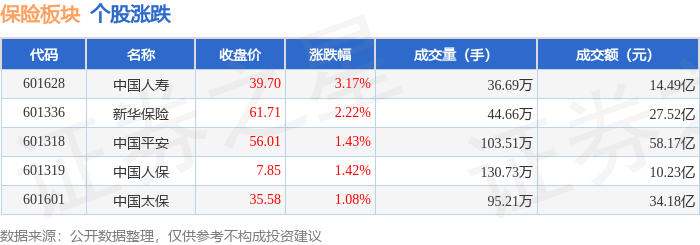
Core Insights - The insurance sector experienced a slight increase of 0.16% on September 4, with China Life leading the gains [1] - The Shanghai Composite Index closed at 3765.88, down 1.25%, while the Shenzhen Component Index closed at 12118.7, down 2.83% [1] Insurance Sector Performance - China Life (601628) closed at 40.50, up 1.55% with a trading volume of 338,300 shares and a transaction value of 1.352 billion [1] - China Pacific Insurance (601601) closed at 37.92, down 1.86% with a trading volume of 514,200 shares and a transaction value of 1.945 billion [1] - New China Life (601336) closed at 62.81, down 0.91% with a trading volume of 227,100 shares and a transaction value of 1.421 billion [1] - China Ping An (601318) closed at 57.50, down 0.48% with a trading volume of 727,400 shares and a transaction value of 4.184 billion [1] - China Re (601319) closed at 8.47, down 0.12% with a trading volume of 925,100 shares and a transaction value of 777 million [1] Fund Flow Analysis - The insurance sector saw a net outflow of 194 million from institutional investors, while retail investors experienced a net outflow of 143 million [1] - Speculative funds recorded a net inflow of 337 million into the insurance sector [1] Individual Stock Fund Flow - China Life (601628) had a net inflow of 69.29 million from institutional investors, accounting for 5.12% of total transactions [2] - New China Life (601336) had a net inflow of 66.60 million from institutional investors, accounting for 4.69% of total transactions [2] - China Ping An (601318) experienced a net outflow of 192 million from institutional investors, representing 4.59% of total transactions [2] - China Pacific Insurance (601601) had a net outflow of 91.25 million from institutional investors, accounting for 4.69% of total transactions [2] - China Re (601319) had a net outflow of 46.37 million from institutional investors, representing 5.97% of total transactions [2]