IReader Technology(603533)

Search documents
AI短剧:资本追逐的新风口
创业邦· 2025-10-23 03:23
Core Viewpoint - The rapid rise of AI short dramas is reshaping the entertainment industry, driven by technological advancements, capital investment, and changing consumer demands, but challenges in content quality, technology, and commercialization remain [5][10][25]. Group 1: Industry Performance - The AI short drama "奶团太后宫心计" has achieved a cumulative viewership of 210 million, while "兴安岭诡事" reached over 56.13 million views within 21 hours of its release [5][7]. - The original revenue from Douyin for these dramas exceeded 300,000, with a follower increase of over 100,000 [5][10]. - The global AI short drama "AfterDivorce" topped the weekly short drama chart, with a heat value exceeding 5 million, marking it as the first AI short drama to enter the global box office bestseller list [5][10]. Group 2: Production Efficiency - The production of AI short dramas has seen a "cliff-like improvement" in efficiency, exemplified by the AI-produced micro-drama "白狐," which reduced the production cycle from three months to two weeks and cut costs from tens of thousands to thousands per minute [9][18]. - Companies like 博纳影业 and 昆仑万维 are leading the charge, with over 10 A-share listed companies investing in AI short dramas across various dimensions, including technology development and content creation [10][14]. Group 3: Capital Investment - The capital market is rapidly entering the AI short drama space, with over 10 A-share listed companies betting on this sector, indicating a clear shift from experimental projects to large-scale production [10][14]. - Platforms like Douyin and Kuaishou are launching initiatives to support AI short drama creators with significant cash incentives and traffic support, further attracting capital investment [13][14]. Group 4: Technological Transformation - AI technologies are revolutionizing the production process, significantly reducing costs and time while enhancing creative capabilities [18][19]. - Tools like ChatGPT are being utilized for script generation, while AI image and video generation technologies are replacing traditional high-cost production methods [19][21]. Group 5: Challenges Ahead - Despite rapid growth, AI short dramas face challenges such as content homogeneity, lack of standout works, and over-reliance on technology at the expense of storytelling [23][24]. - The industry is grappling with issues related to emotional expression and character development, as AI-generated content often lacks depth compared to human-created narratives [24][25]. - Copyright and ethical concerns are emerging, with instances of AI-generated content infringing on rights, highlighting the need for regulatory frameworks [25].




数字媒体板块10月20日涨1.9%,*ST返利领涨,主力资金净流入3014.55万元
Zheng Xing Xing Ye Ri Bao· 2025-10-20 08:37
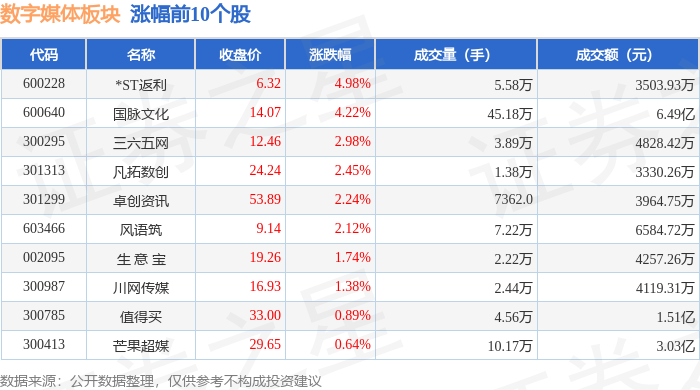
Market Overview - The digital media sector increased by 1.9% on October 20, with *ST Fanli leading the gains [1] - The Shanghai Composite Index closed at 3863.89, up 0.63%, while the Shenzhen Component Index closed at 12813.21, up 0.98% [1] Stock Performance - Key stocks in the digital media sector showed varied performance, with *ST Fanli closing at 6.32, up 4.98% on a trading volume of 55,800 shares [1] - Other notable performers included Guomai Culture, which rose by 4.22% to 14.07, and Sanliuwang, which increased by 2.98% to 12.46 [1] Capital Flow - The digital media sector experienced a net inflow of 30.15 million yuan from main funds, while retail funds saw a net inflow of 4.95 million yuan [2] - Notably, speculative funds had a net outflow of 35.09 million yuan [2] Individual Stock Capital Flow - Guomai Culture had a main fund net outflow of 32.02 million yuan, while *ST Fanli saw a net inflow of 14.92 million yuan [3] - Mango Super Media experienced a net inflow of 19.27 million yuan from main funds, despite a net outflow from speculative funds [3]

数字媒体板块10月17日跌3.41%,视觉中国领跌,主力资金净流出3.72亿元
Zheng Xing Xing Ye Ri Bao· 2025-10-17 08:37
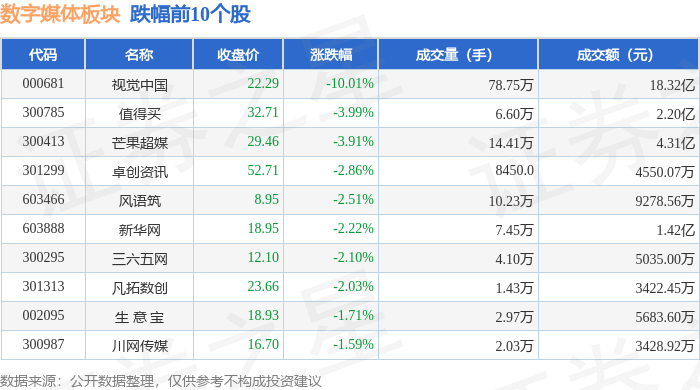
Market Overview - On October 17, the digital media sector experienced a decline of 3.41%, with Vision China leading the drop [1] - The Shanghai Composite Index closed at 3839.76, down 1.95%, while the Shenzhen Component Index closed at 12688.94, down 3.04% [1] Individual Stock Performance - Vision China (000681) closed at 22.29, down 10.01% with a trading volume of 787,500 shares and a transaction value of 1.832 billion [1] - Other notable declines include: - Worth Buying (300785) down 3.99% to 32.71 with a transaction value of 220 million [1] - Mango Super Media (300413) down 3.91% to 29.46 with a transaction value of 431 million [1] - Zhaochuang Information (301299) down 2.86% to 52.71 with a transaction value of 45.5 million [1] Capital Flow Analysis - The digital media sector saw a net outflow of 372 million from main funds, while retail investors contributed a net inflow of 280 million [1] - Specific stock capital flows include: - Vision China had a main fund net outflow of 224 million, with retail inflow of 165 million [2] - Mango Super Media experienced a main fund outflow of 41.4 million, but retail inflow of 46.5 million [2] - Xinhua Net (603888) had a main fund outflow of 24.3 million, with retail inflow of 15.3 million [2]
数字媒体板块10月16日跌0.15%,风语筑领跌,主力资金净流出1.42亿元
Zheng Xing Xing Ye Ri Bao· 2025-10-16 08:27
Market Overview - On October 16, the digital media sector declined by 0.15% compared to the previous trading day, with Fengyuzhu leading the decline [1] - The Shanghai Composite Index closed at 3916.23, up 0.1%, while the Shenzhen Component Index closed at 13086.41, down 0.25% [1] Stock Performance - The following stocks in the digital media sector experienced notable declines: - Fengyuzhu (603466) closed at 9.18, down 2.03% with a trading volume of 85,300 shares and a turnover of 78.86 million yuan [1] - Sanliuwang (300295) closed at 12.36, down 1.98% with a trading volume of 45,100 shares and a turnover of 56.08 million yuan [1] - Zhuochuang Information (301299) closed at 54.26, down 1.93% with a trading volume of 7,408 shares and a turnover of 40.58 million yuan [1] - Other notable declines include Zhidema (300785), Shiyiba (002095), and Chuanwang Media (300987) [1] Capital Flow - The digital media sector saw a net outflow of 142 million yuan from institutional investors, while retail investors experienced a net inflow of 70.61 million yuan [3] - The following stocks had significant capital flow: - ST Fanli (600228) had a net inflow of 16.45 million yuan from institutional investors, but a net outflow from retail investors [3] - Zhangyue Technology (603533) saw a small net inflow from retail investors despite a net outflow from institutional and speculative funds [3] - Other stocks like Sanliuwang (300295) and Menggu Chao Media (300413) experienced notable net outflows from institutional investors [3]


数字媒体板块10月15日涨0.98%,视觉中国领涨,主力资金净流入193.85万元
Zheng Xing Xing Ye Ri Bao· 2025-10-15 08:37
Core Insights - The digital media sector experienced a rise of 0.98% on October 15, with Visual China leading the gains [1] - The Shanghai Composite Index closed at 3912.21, up 1.22%, while the Shenzhen Component Index closed at 13118.75, up 1.73% [1] Digital Media Sector Performance - Visual China (000681) closed at 25.05, with a gain of 3.43% and a trading volume of 659,900 shares, amounting to a transaction value of 1.64 billion [1] - Other notable performers included: - 365 Network (300295) at 12.61, up 3.36% with a trading volume of 81,000 shares [1] - ST Fanli (600228) at 5.80, up 3.02% with a trading volume of 98,000 shares [1] - Worth Buying (300785) at 34.72, up 2.72% with a trading volume of 76,500 shares [1] - Guomai Culture (600640) at 13.77, up 2.68% with a trading volume of 175,500 shares [1] Capital Flow Analysis - The digital media sector saw a net inflow of 1.94 million from institutional investors, while retail investors contributed a net inflow of 4.63 million [2] - Notable capital flows included: - Visual China with a net inflow of 33.52 million from institutional investors [3] - 365 Network with a net inflow of 8.12 million from institutional investors [3] - Worth Buying with a net inflow of 3.68 million from institutional investors [3]

短剧出海在AI时代等风来?
3 6 Ke· 2025-10-14 00:59
Core Insights - The rise of AI short dramas is significantly impacting major short video platforms, with notable success in titles like "奶团太后宫心计," which has garnered over 210 million views and 83,000 likes for its first episode, surpassing many live-action short dramas [1] - The short drama export market has transitioned from a trial phase to a validated operational phase, with the Chinese micro-drama market projected to grow from 50.5 billion yuan in 2024 to 63.43 billion yuan in 2025, and overseas short drama revenue expected to reach 4 billion USD in 2024 [4][5] - The U.S. market contributes the largest share of revenue for Chinese short dramas, with North America generating approximately 4.7 USD per download, outperforming other regions [5] - Southeast Asia and the Middle East are also emerging as promising markets, with significant user engagement and a willingness to pay for short dramas [6] - Major Chinese short drama platforms are adopting various strategies for overseas competition, with companies like 九州文化 and 掌阅科技 reporting substantial growth in their overseas operations [7][9] Market Dynamics - The technological advancements, particularly with OpenAI's Sora 2 model, have revolutionized video generation, allowing for high-quality, synchronized audio-visual content creation [10][11] - The production process for AI short dramas has become more efficient, reducing costs significantly compared to traditional methods, with some AI-generated content costing as little as a fraction of traditional production costs [12][13] - The shift from live-action to AI-generated content is expected to reshape the content landscape, with the year 2025 being recognized as the "AI漫剧元年" (AI short drama year) [13][16] Strategic Evolution - Chinese content teams are evolving their overseas strategies from simple translation to localized production, tailoring content to meet the preferences of target markets [17][18] - Companies are investing in industrialized operations, utilizing AI and data analytics to enhance content creation and distribution efficiency [17][18] - The emergence of AI short dramas is fundamentally changing the creative process, with a shift in power dynamics from traditional creators to data-driven algorithms [20][22]


数字媒体板块10月13日跌0.03%,国脉文化领跌,主力资金净流入8285.21万元





Zheng Xing Xing Ye Ri Bao· 2025-10-13 12:45
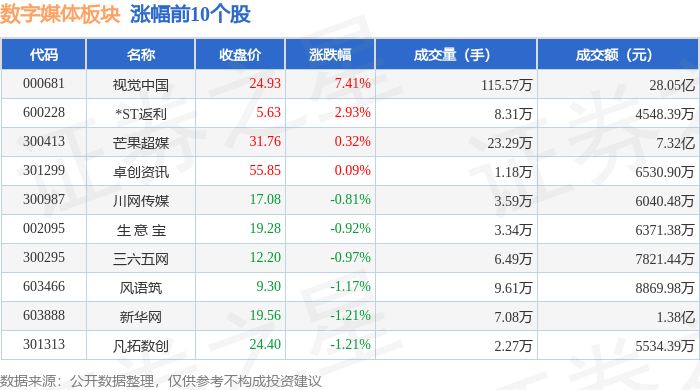
Market Overview - On October 13, the digital media sector experienced a slight decline of 0.03%, with Guomai Culture leading the drop [1] - The Shanghai Composite Index closed at 3889.5, down 0.19%, while the Shenzhen Component Index closed at 13231.47, down 0.93% [1] Stock Performance - Notable stock performances included: - Vision China (000681) rose by 7.41% to a closing price of 24.93, with a trading volume of 1.1557 million shares and a transaction value of 2.805 billion [1] - Guomai Culture (600640) fell by 3.47% to a closing price of 13.92, with a trading volume of 185,300 shares and a transaction value of 258 million [2] - Worth Buying (300785) decreased by 3.32% to a closing price of 35.48, with a trading volume of 110,300 shares and a transaction value of 392 million [2] Capital Flow - The digital media sector saw a net inflow of 82.8521 million from institutional investors, while retail investors contributed a net inflow of 88.0169 million [2] - However, speculative funds experienced a net outflow of 171 million [2] Individual Stock Capital Flow - Vision China (000681) had a net inflow of 22.5 million from institutional investors, but a net outflow of 15.3 million from speculative funds [3] - Guomai Culture (600640) faced a net outflow of 1.25597 million from institutional investors [3] - Worth Buying (300785) also saw a net outflow of 2.5597 million from institutional investors [3]
数字媒体板块10月10日跌2%,值得买领跌,主力资金净流出1.94亿元
Zheng Xing Xing Ye Ri Bao· 2025-10-10 08:52
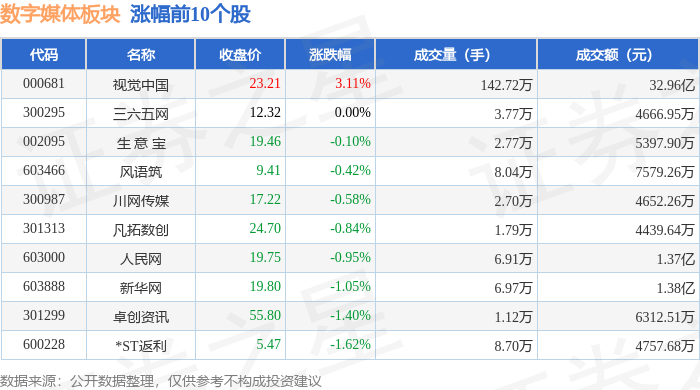
Market Overview - On October 10, the digital media sector declined by 2.0%, with ZhiDeMai leading the drop [1] - The Shanghai Composite Index closed at 3897.03, down 0.94%, while the Shenzhen Component Index closed at 13355.42, down 2.7% [1] Stock Performance - Notable stock performances included: - Vision China (000681) rose by 3.11% to close at 23.21 [1] - ZhiDeMai (300785) fell by 7.53% to close at 36.70, with a trading volume of 153,300 shares and a turnover of 574 million yuan [2] - Mango Super Media (300413) decreased by 5.12% to 31.66, with a trading volume of 240,200 shares and a turnover of 775 million yuan [2] - The overall trading volume and turnover for the digital media sector indicated significant activity, with ZhiDeMai and Mango Super Media being among the most traded stocks [2] Capital Flow - The digital media sector experienced a net outflow of 194 million yuan from institutional investors, while retail investors saw a net inflow of 228 million yuan [2][3] - Specific stock capital flows showed: - Vision China had a net inflow of 24.47 million yuan from institutional investors [3] - ZhiDeMai experienced a net outflow of 1.28 million yuan from institutional investors but a net inflow of 47.06 million yuan from retail investors [3] - ST Fanli (600228) faced a significant net outflow of 13.27 million yuan from institutional investors, despite a net inflow from retail investors [3]
数字媒体板块9月30日涨1.37%,值得买领涨,主力资金净流出2381.49万元


Zheng Xing Xing Ye Ri Bao· 2025-09-30 08:51
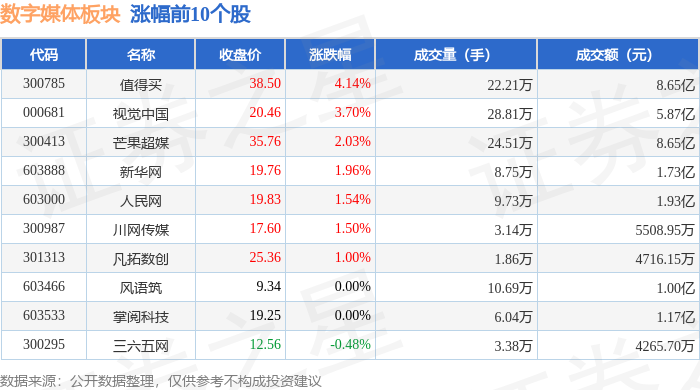
Market Overview - On September 30, the digital media sector rose by 1.37%, led by Zhidingmai [1] - The Shanghai Composite Index closed at 3882.78, up 0.52%, while the Shenzhen Component Index closed at 13526.51, up 0.35% [1] Stock Performance - Zhidingmai (300785) closed at 38.50, with a gain of 4.14% and a trading volume of 222,100 shares, amounting to 865 million yuan [1] - Other notable performers include: - Vision China (000681) at 20.46, up 3.70% [1] - Mango Super Media (300413) at 35.76, up 2.03% [1] - Xinhua Net (603888) at 19.76, up 1.96% [1] - People's Daily (603000) at 19.83, up 1.54% [1] Capital Flow - The digital media sector experienced a net outflow of 23.81 million yuan from institutional investors, while retail investors saw a net outflow of 91.12 million yuan [2] - Conversely, speculative funds recorded a net inflow of 115 million yuan [2] Individual Stock Capital Flow - Zhidingmai had a net inflow of 50.13 million yuan from institutional investors, but a net outflow of 56.99 million yuan from speculative funds [3] - Vision China saw a net inflow of 36.06 million yuan from institutional investors, with a net outflow of 19.83 million yuan from speculative funds [3] - People's Daily had a net inflow of 17.17 million yuan from institutional investors, while retail investors experienced a net outflow of 16.21 million yuan [3]
数字媒体板块9月26日跌1.45%,值得买领跌,主力资金净流出7440.12万元
Zheng Xing Xing Ye Ri Bao· 2025-09-26 08:48
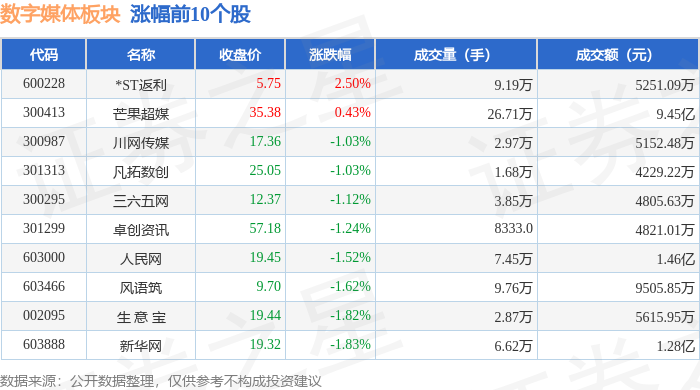
Market Overview - On September 26, the digital media sector declined by 1.45%, with "Zhidingmai" leading the drop [1] - The Shanghai Composite Index closed at 3828.11, down 0.65%, while the Shenzhen Component Index closed at 13209.0, down 1.76% [1] Stock Performance - Notable stock performances included: - *ST Fanli: Closed at 5.75, up 2.50% with a trading volume of 91,900 shares and a turnover of 52.51 million yuan [1] - Mango Super Media: Closed at 35.38, up 0.43% with a trading volume of 267,100 shares and a turnover of 945 million yuan [1] - Worth Buying: Closed at 37.20, down 8.49% with a trading volume of 151,000 shares and a turnover of 576 million yuan [2] Capital Flow - The digital media sector experienced a net outflow of 74.40 million yuan from institutional investors, while retail investors saw a net inflow of 56.52 million yuan [2] - The capital flow for individual stocks showed: - Mango Super Media: Net inflow of 62.25 million yuan from institutional investors [3] - Worth Buying: Net outflow of 16.11 million yuan from institutional investors [3] Summary of Individual Stocks - The following stocks had significant capital movements: - *ST Fanli: Institutional net inflow of 609,600 yuan, retail net inflow of 636,900 yuan [3] - New China Net: Institutional net outflow of 12.69 million yuan, retail net inflow of 10.27 million yuan [3] - Grassroots Information: Retail net inflow of 666,020 yuan despite institutional and speculative net outflows [3]