
CIWEN(002343)

Search documents
A股异动丨春节档火热开局,影视股逆势上涨,横店影视3连板,幸福蓝海涨超7%
Ge Long Hui A P P· 2026-02-02 02:12
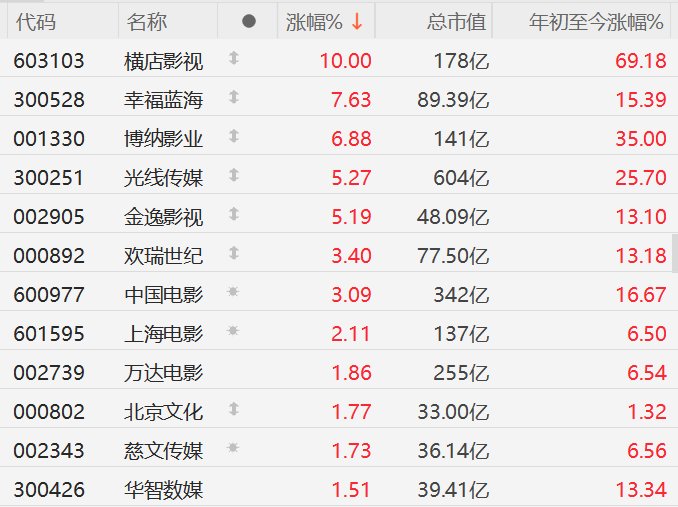
Core Viewpoint - The A-share market for film and television stocks is experiencing a counter-trend rise, indicating a recovery in the market, with significant increases in stock prices for various companies [1] Group 1: Market Performance - The national annual box office has surpassed 2 billion yuan as of February 1, 2026, reflecting a strong start to the Spring Festival season [1] - Six new domestic films, including "Flying Life 3" and "Silent Awakening," are scheduled for release during the Spring Festival, covering multiple genres [1] - In 2025, the national box office reached 51.832 billion yuan, a year-on-year increase of 21.95%, with domestic films accounting for 79.67% of the total [1] Group 2: Stock Performance - Hengdian Film's stock rose by 10%, with a total market value of 17.8 billion yuan and a year-to-date increase of 69.18% [2] - Happiness Blue Sea's stock increased by 7.63%, with a market value of 8.939 billion yuan and a year-to-date increase of 15.39% [2] - Bona Film's stock rose by 6.88%, with a market value of 14.1 billion yuan and a year-to-date increase of 35% [2] - Other notable increases include Light Media (5.27%, 60.4 billion yuan), Jinyi Film (5.19%, 4.809 billion yuan), and Huayi Brothers (3.4%, 7.75 billion yuan) [2]




春节档火热开局,影视股逆势上涨,横店影视3连板,幸福蓝海涨超7%
Ge Long Hui· 2026-02-02 02:08
Core Viewpoint - The A-share market for the film industry is experiencing a counter-trend rise, with several key stocks showing significant gains, indicating a recovery in the market driven by strong box office performance and upcoming film releases [1][2]. Group 1: Stock Performance - Hengdian Film surged to its daily limit, increasing by 10% with a total market value of 17.8 billion [2] - Happiness Blue Sea rose by over 7%, with a market capitalization of 26.67 billion [2] - Bona Film increased by over 6%, with a market value of 14.1 billion [2] - Light Media and Jinyi Film both saw gains of over 5%, with market values of 60.4 billion and 4.809 billion respectively [2] - Other notable increases include Huanrui Century (3.4%), China Film (3.09%), and Shanghai Film (2.11%) [2] Group 2: Box Office Data - As of February 1, 2026, the national annual box office has surpassed 2 billion, reflecting a strong start to the year [1] - In 2025, the total box office reached 51.832 billion, marking a year-on-year growth of 21.95%, with domestic films accounting for 79.67% of the total [1] - There were 51 films that surpassed 100 million in box office revenue, and the total number of screens reached 93,187 [1] - The upcoming Spring Festival releases include six domestic films, indicating a diverse offering for the holiday season [1]
影视院线板块1月29日涨2.41%,横店影视领涨,主力资金净流入2.02亿元
Zheng Xing Xing Ye Ri Bao· 2026-01-29 09:00
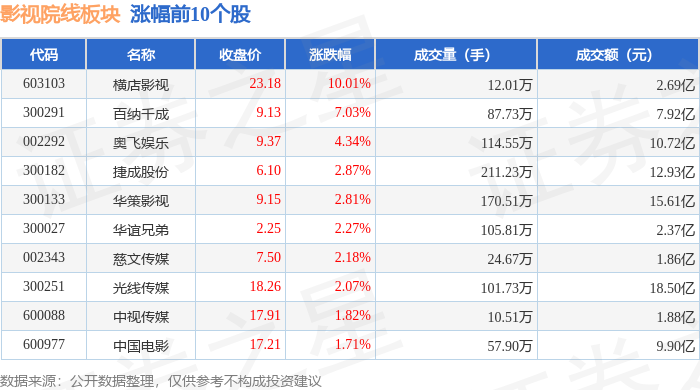
Group 1 - The film and theater sector saw an increase of 2.41% on January 29, with Hengdian Film leading the gains [1] - The Shanghai Composite Index closed at 4157.98, up 0.16%, while the Shenzhen Component Index closed at 14300.08, down 0.3% [1] - Key stocks in the film and theater sector included Hengdian Film, which rose by 10.01% to a closing price of 23.18, and Baida Qiancheng, which increased by 7.03% to 9.13 [1] Group 2 - The film and theater sector experienced a net inflow of 202 million yuan from main funds, while retail investors saw a net outflow of 47.68 million yuan [2] - Major stocks with significant fund flows included Light Media, which had a net inflow of 113 million yuan from main funds, and China Film, which saw a net inflow of 52.99 million yuan [3] - Hengdian Film had a net inflow of 47.45 million yuan from main funds, but experienced a net outflow of 32.46 million yuan from retail investors [3]


慈文传媒:预计2025年全年净亏损1150万元—1750万元
2 1 Shi Ji Jing Ji Bao Dao· 2026-01-29 08:33
Core Viewpoint - The company, Ciwen Media, is forecasting a significant net loss for the year 2025, with expected losses ranging from 11.5 million to 17.5 million yuan for net profit attributable to shareholders, and a loss of 60 million to 80 million yuan for net profit after deducting non-recurring gains and losses [1] Group 1: Financial Performance - The company anticipates a net loss of 11.5 million to 17.5 million yuan for 2025, indicating a challenging financial outlook [1] - The expected net profit attributable to shareholders, excluding non-recurring items, is projected to be a loss of 60 million to 80 million yuan [1] Group 2: Reasons for Performance Decline - The high costs associated with several film projects have led to an overall increase in the cost of the film business, significantly impacting the company's operating performance [1] - A decrease in revenue recognition from major copyright drama projects, along with an increase in customized and co-produced projects, has resulted in a substantial decline in the gross profit margin compared to the previous year [1] - A reduction in the accounts receivable collection rate has contributed to increased credit impairment losses, affecting the company's financial results [1] Group 3: Non-Recurring Gains and Losses - Non-recurring gains and losses are expected to impact net profit attributable to shareholders by approximately 48.5 million to 62.5 million yuan, primarily due to fair value changes from investments and government subsidies received [1]

慈文传媒:预计2025年净利润亏损1750万元-1150万元 同比转亏
Xin Lang Cai Jing· 2026-01-29 08:31
Group 1 - The company, Ciwen Media, announced an expected net loss for the fiscal year 2025, projecting a loss of 17.5 million to 11.5 million yuan, compared to a profit of 30.34 million yuan in the same period last year [1] - The net profit attributable to shareholders, excluding non-recurring gains and losses, is expected to be a loss of 80 million to 60 million yuan, while the previous year's profit was 12.85 million yuan [1]
慈文传媒(002343) - 2025 Q4 - 年度业绩预告
2026-01-29 08:25
Financial Performance Forecast - The estimated net profit for 2025 is expected to be a loss of between 17.5 million and 11.5 million CNY, representing a decline of 157.66% compared to the same period last year [3]. - The net profit after deducting non-recurring gains and losses is projected to be a loss of between 80 million and 60 million CNY, a decrease of 722.50% year-on-year [3]. - The basic earnings per share is expected to be a loss of between 0.04 and 0.02 CNY, compared to a profit of 0.06 CNY in the previous year [3]. Impact of Non-Recurring Items - The expected impact of non-recurring gains and losses on net profit attributable to shareholders is estimated to be between 48.5 million and 62.5 million CNY, mainly from investment gains and government subsidies [6]. Operational Challenges - The increase in credit impairment losses is attributed to a decrease in accounts receivable collection rates and adjustments to the bad debt provision ratio, significantly impacting overall performance [6]. - The overall cost of film and television projects has increased significantly, leading to a substantial decline in gross profit margins compared to the previous year [5]. Shareholder Actions - The company completed the repurchase and cancellation of 1,269,400 shares, reducing the total number of shares from 474,949,686 to 473,680,286 [3]. Audit and Investor Advisory - The company has communicated with the annual audit accounting firm regarding significant matters related to the earnings forecast, with no major discrepancies identified [4]. - The financial data in the earnings forecast has not been audited by the accounting firm and is subject to confirmation in the 2025 annual report [7]. - Investors are advised to make cautious decisions and be aware of investment risks due to the preliminary nature of the financial data [7].
中文传媒:子公司与慈文传媒签署合作框架协议,探索AIGC相关技术与模式的文化传媒场景
Jin Rong Jie· 2026-01-27 14:45
Group 1 - The core point of the article is that the subsidiary of the company, Langzhi Media, has signed a cooperation framework agreement with Ciwen Media to explore AIGC-related technologies and models in the cultural media scene, with a total transaction amount not exceeding 5 million yuan [1] Group 2 - The cooperation's progress will depend on subsequent project agreements and implementation conditions [1]

慈文传媒:关于公司2025年度业绩情况请关注公司业绩预告或定期报告
Zheng Quan Ri Bao Wang· 2026-01-20 09:42
Core Viewpoint - Ciweng Media (002343) indicated that investors should pay attention to the company's performance forecast or periodic reports regarding the 2025 fiscal year performance [1] Group 1 - The company responded to investor inquiries on its interactive platform [1] - The company did not provide specific details about the 2025 performance but suggested monitoring future announcements [1]
慈文传媒:关于变更签字注册会计师的公告
Zheng Quan Ri Bao· 2026-01-19 11:06
证券日报网讯 1月19日,慈文传媒发布公告称,近日,公司收到大信会计师事务所(特殊普通合伙) (简称"大信会计师事务所")出具的《关于变更2025年度项目签字合伙人的告知函》。大信会计师事务 所作为公司2025年度财务报表和内部控制的审计机构,原指派舒佳敏女士为项目签字合伙人、杨睿泽先 生为签字注册会计师为公司提供审计服务。鉴于内部工作调整,现指派注册会计师冯丽娟女士接替舒佳 敏女士为项目签字合伙人,注册会计师杨睿泽先生为签字注册会计师未变化。本次变更后,公司2025年 度财务报表和内部控制审计项目的签字合伙人为冯丽娟女士,签字注册会计师为杨睿泽先生。 (文章来源:证券日报) ...
慈文传媒(002343) - 关于变更签字注册会计师的公告
2026-01-19 09:30
股票代码:002343 股票简称:慈文传媒 公告编号:2026-002 慈文传媒股份有限公司 关于变更签字注册会计师的公告 本公司及董事会全体成员保证信息披露内容真实、准确和完整,没有虚 假记载、误导性陈述或重大遗漏。 慈文传媒股份有限公司(以下简称"公司")于2025年4月8日召开第九届董事会 第二十七次会议,于2025年4月30日召开2024年年度股东大会,审议通过了《关于续聘 会计师事务所的议案》,同意续聘大信会计师事务所(特殊普通合伙)(以下简称"大 信会计师事务所"或"本所")为公司2025年度审计机构。具体内容详见公司分别于 2025年4月10日及2025年5月6日在《证券时报》及巨潮资讯网披露的《关于续聘会计师 事务所的公告》(公告编号:2025-024)、《2024年年度股东大会决议公告》(公告 编号:2025-033)。 近日,公司收到大信会计师事务所出具的《关于变更2025年度项目签字合伙人的 告知函》,现将相关情况公告如下: 一、变更签字会计师的基本情况 大信会计师事务所作为公司2025年度财务报表和内部控制的审计机构,原指派舒 佳敏女士为项目签字合伙人、杨睿泽先生为签字注册会计师为公司 ...