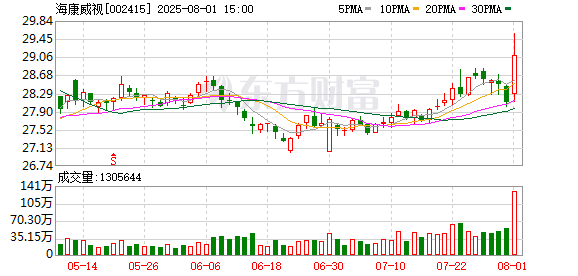
HIKVISION(002415)

Search documents
杭州海康威视数字技术股份有限公司2025年半年度报告摘要
Shang Hai Zheng Quan Bao· 2025-08-01 18:24
Core Viewpoint - The company, Hikvision, has announced its half-year report for 2025, highlighting its financial performance, share repurchase plan, and shareholder activities, including significant share buybacks and no dividend distribution [1][2][3]. Company Overview - Hikvision is a leading digital technology company in China, focusing on video surveillance products and solutions [3]. - The company has not made any adjustments or restatements to previous accounting data [3]. Financial Data and Shareholder Information - The company plans not to distribute cash dividends or issue bonus shares [2]. - There has been no change in the number of shareholders or the major shareholders during the reporting period [3][4]. Major Events - The controlling shareholder, China Electronics Technology Group Corporation, and its action-in-concert party, CETC Investment Holdings, have completed their share purchase plan, acquiring shares worth between RMB 2 billion and RMB 3 billion and RMB 1 billion to RMB 2 billion, respectively [5][6]. - As of April 8, 2025, the controlling shareholder has acquired 6,845,600 shares, representing 0.0741% of the total share capital, while CETC Investment has acquired 3,204,700 shares, representing 0.0347% [6]. Share Repurchase Plan - The company has initiated a share repurchase plan with a total budget of up to RMB 25 billion, with a minimum of RMB 20 billion, and a maximum repurchase price of RMB 40 per share, adjusted to RMB 39.30 after the 2024 annual equity distribution [7][17]. - The repurchase is intended to reduce registered capital and will be funded through the company's own funds and specific loans for share repurchase [7][17]. Progress of Share Repurchase - As of July 31, 2025, the company has repurchased a total of 62,791,259 shares, accounting for 0.6801% of the total share capital, with a total expenditure of approximately RMB 1.86 billion [8][18][19]. - The repurchase prices ranged from RMB 27.06 to RMB 32.70 per share, in compliance with the established repurchase plan [18][19].

海康威视上半年 净利润增长11.71%
Zheng Quan Shi Bao· 2025-08-01 17:17
Core Insights - Hikvision reported a revenue of 41.818 billion yuan for the first half of 2025, representing a year-on-year growth of 1.48%, and a net profit attributable to shareholders of 5.657 billion yuan, up 11.71% year-on-year [1][2] - The company is focusing on strengthening its technological foundation and driving innovation, particularly in multi-dimensional perception, artificial intelligence, and big data technologies [1] - Hikvision is expanding its international market presence, with overseas revenue reaching 15.425 billion yuan, an increase of 8.78%, accounting for 36.89% of total revenue [1] Revenue Breakdown - The overall revenue from innovative businesses reached 11.766 billion yuan, growing by 13.92%, and accounted for 28.14% of total revenue [2] - The automotive electronics segment achieved a revenue of 2.352 billion yuan, marking a significant growth of 46.48% [2] R&D Investment - Hikvision invested 5.669 billion yuan in research and development, which constitutes 13.56% of its total revenue for the first half of 2025 [2] Shareholder Activity - The major shareholder, China Electronics Technology Group, has been actively increasing its stake, having acquired a total of 6.8456 million shares with an investment of 200 million yuan [2]
海康威视: 2025年半年度报告(英文版)
Zheng Quan Zhi Xing· 2025-08-01 16:36
Hangzhou Hikvision Digital Technology Co., Ltd. January to June 2025 August 2, 2025 Section I Important Notes, Contents and Definitions Hikvision 2025 Half Year Report The Board of Directors, Board of Supervisors, directors, supervisors and senior management of Hangzhou Hikvision Digital Technology Co., Ltd. (hereinafter referred to as the "Company") hereby guarantee that the information presented in this report shall be together be wholly liable for the truthfulness, accuracy and completeness of its conten ...

海康威视: 2025年半年度报告
Zheng Quan Zhi Xing· 2025-08-01 16:36
Core Viewpoint - Hikvision's 2025 semi-annual report indicates a slight increase in revenue and net profit, while the company continues to face challenges from macroeconomic fluctuations and geopolitical tensions [1][7]. Financial Performance - Total revenue for the reporting period reached CNY 41.82 billion, a year-on-year increase of 1.48% [7][8]. - Net profit attributable to shareholders was CNY 5.66 billion, reflecting an 11.71% increase compared to the previous year [7][8]. - The net cash flow from operating activities surged to CNY 5.34 billion, a significant increase of 2917.51% from a negative cash flow in the previous year [7][8]. Business Segments - The innovative business segment generated CNY 11.77 billion in revenue, a 13.92% increase, accounting for 28.14% of total revenue [8][9]. - The main business revenue decreased by 3.17%, while the robot business and automotive electronics saw growth rates of 14.36% and 46.48%, respectively [8][9]. Cost and Expenses - Operating costs increased by 0.82% to CNY 22.92 billion, with a gross margin of 45.19% [9]. - Sales expenses rose by 4.29%, while management expenses decreased by 5.33% [8][9]. Asset and Liability Status - Total assets at the end of the reporting period were CNY 124.41 billion, down 5.76% from the previous year [7][8]. - The company's cash reserves decreased to CNY 31.29 billion, primarily due to dividend payments [9]. Strategic Focus - The company emphasizes technological innovation as a core driver for sustainable development, focusing on AI, big data, and digital product innovation [7][8]. - Hikvision is actively expanding its international market presence, increasing the proportion of overseas revenue [7][8].
海康威视: 2025年半年度报告摘要
Zheng Quan Zhi Xing· 2025-08-01 16:36
| 2025 年半年度报告摘要 | 杭州海康威视数字技术股份有限公司 | 证券代码:002415 | 公告编号:2025-031 号 | 证券简称:海康威视 | | | | | | | | | | | --- | --- | --- | --- | --- | --- | --- | --- | --- | --- | --- | --- | --- | --- | | 杭州海康威视数字技术股份有限公司 | 一、重要提示 | | | | | | | | | | | | | | 本半年度报告摘要来自半年度报告全文,为全面了解本公司的经营成果、财务状况及未来发展规划, | 投资者应当到证监会指定媒体仔细阅读半年度报告全文。 | | | | | | | | | | | | | | 所有董事均已出席了审议本报告的董事会会议。 | 本半年度报告未经审计。 | | | | | | | | | | | | | | 董事会审议的报告期内的半年度利润分配预案或资本公积金转增股本预案(不适用):公司计划不派 | 发现金红利,不送红股,不以资本公积金转增股本。 | | | | | | | | | | | | | | 二、公司基本情 ...
海康威视: 第六届董事会第六次会议决议公告
Zheng Quan Zhi Xing· 2025-08-01 16:35
一、以 9 票赞成、0 票反对、0 票弃权,审议通过《2025 年半年度报告及其 摘要》; 《证券时报》 证券代码:002415 证券简称:海康威视 公告编号:2025-029 号 杭州海康威视数字技术股份有限公司 本公司及董事会全体成员保证信息披露内容的真实、准确和完整,没有虚假 记载、误导性陈述或重大遗漏。 杭州海康威视数字技术股份有限公司(以下简称"海康威视"或"公司") 第六届董事会第六次会议,于 2025 年 7 月 16 日以传真、电子邮件及专人送达方 式向全体董事发出书面通知,于 2025 年 8 月 1 日以通讯表决方式召开。会议由 董事长胡扬忠先生召集并主持。会议应出席董事 9 名,实际出席董事 9 名。会议 召开符合有关法律、行政法规、部门规章、规范性文件和公司章程的规定。经全 体与会董事审议并表决,通过如下决议: 二、以 7 票赞成、0 票反对、0 票弃权,审议通过《关于与中国电子科技财 务有限公司开展金融服务业务的风险持续评估报告》,关联董事傅柏军、徐立兴 回避表决。 《中国证券报》 《关于与中国电子科技财务有限公司开展金融服务业务的风险持续评估报 告》详见巨潮资讯网(www.cnin ...
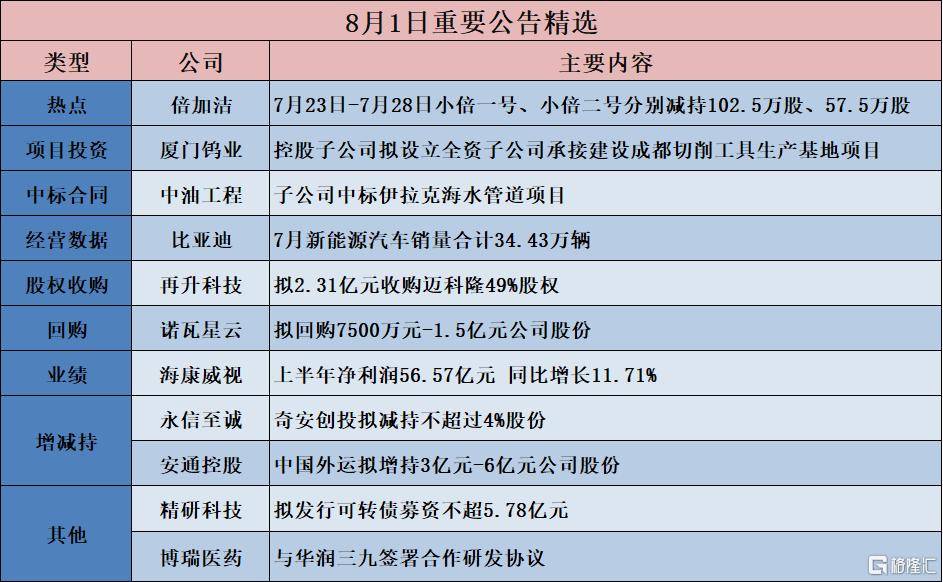
公告精选︱比亚迪:7月新能源汽车销量合计34.43万辆;九号公司:上半年净利润12.42亿元,同比增长108.45%
Sou Hu Cai Jing· 2025-08-01 15:34
Key Points - The article highlights significant corporate announcements from August 1, including stock reductions, project investments, contract wins, operational data, equity acquisitions, share buybacks, and performance results [1] Group 1: Stock Reductions - Beijiajie reduced holdings by 1.025 million shares and 0.575 million shares from July 23 to July 28 [1] - Yongxin Zhicheng plans to reduce no more than 4% of its shares [1] Group 2: Project Investments - Xiamen Tungsten's subsidiary intends to establish a wholly-owned subsidiary to undertake the construction of a cutting tool production base in Chengdu [1] - Aorijin plans to invest in the construction of an overseas production line project [1] Group 3: Contract Wins - China National Petroleum Engineering's subsidiary won a contract for the Iraq seawater pipeline project [1] - Nanfeng Co. secured a project worth 61.57 million yuan [1] Group 4: Operational Data - BYD reported total new energy vehicle sales of 344,300 units in July [1] - Qianli Technology achieved total vehicle sales of 10,222 units in July, representing a year-on-year increase of 142.34% [1] Group 5: Equity Acquisitions - Zhaosheng Technology plans to acquire 49% of Maikelong for 231 million yuan [1] - *ST Yazhen intends to acquire 51% of Guangxi Zirconium for 55.449 million yuan [1] Group 6: Share Buybacks - Nova Star Cloud plans to repurchase shares worth between 75 million and 150 million yuan [1] - Baiyun Electric intends to repurchase shares worth between 10 million and 20 million yuan [1] Group 7: Performance Results - Hikvision reported a net profit of 5.657 billion yuan for the first half of the year, a year-on-year increase of 11.71% [1] - Ninebot Company achieved a net profit of 1.242 billion yuan in the first half of the year, a year-on-year increase of 108.45% [1] Group 8: Other Announcements - Jingyan Technology plans to issue convertible bonds to raise no more than 578 million yuan for new consumer electronics and data server components production projects [1] - Borui Pharmaceutical signed a cooperation and research agreement with China Resources Sanjiu [1]



海康威视发布2025年半年报,净利润同比增长11.71%
Bei Jing Shang Bao· 2025-08-01 14:35
Core Viewpoint - The report indicates that Hikvision achieved a revenue of 41.818 billion yuan in the first half of 2025, reflecting a year-on-year growth of 1.48% and a net profit attributable to shareholders of 5.657 billion yuan, which represents a year-on-year increase of 11.71% [1] Financial Performance - The company reported a total operating income of 41.818 billion yuan for the first half of 2025, marking a 1.48% increase compared to the previous year [1] - The net profit attributable to shareholders reached 5.657 billion yuan, showing an 11.71% growth year-on-year [1]
中证数字经济主题指数下跌0.66%,前十大权重包含中芯国际等
Jin Rong Jie· 2025-08-01 14:20
Group 1 - The core index of the digital economy, the CSI Digital Economy Theme Index, has shown a slight decline of 0.66% recently, closing at 1192.06 points with a trading volume of 79.724 billion yuan [1] - Over the past month, the CSI Digital Economy Theme Index has increased by 2.75%, while it has risen by 2.83% over the last three months and 2.80% year-to-date [1] - The index comprises companies involved in digital economy infrastructure and high digitalization application fields, reflecting the overall performance of listed companies in the digital economy sector [1] Group 2 - The top ten weighted companies in the CSI Digital Economy Theme Index include Dongfang Wealth (10.35%), SMIC (6.26%), Cambricon (5.13%), Northern Huachuang (5.09%), Haiguang Information (4.57%), Huichuan Technology (4.27%), iFlytek (4.01%), Hikvision (3.84%), OmniVision Technologies (3.63%), and Zhongke Shuguang (3.55%) [1] - The market capitalization distribution of the index shows that the Shanghai Stock Exchange accounts for 50.61%, while the Shenzhen Stock Exchange accounts for 49.39% [1] Group 3 - In terms of industry composition, the CSI Digital Economy Theme Index has a significant allocation to information technology at 78.11%, followed by finance at 10.35%, industry at 5.89%, communication services at 3.84%, and consumer discretionary at 1.81% [2] - The index samples are adjusted biannually, with adjustments occurring on the next trading day after the second Friday of June and December each year [2] - Public funds tracking the digital economy include Pengyang CSI Digital Economy Theme Link A, Pengyang CSI Digital Economy Theme Link C, Huaan CSI Digital Economy Theme Link A, Huaan CSI Digital Economy Theme Link C, Huaan CSI Digital Economy Theme ETF, and Pengyang CSI Digital Economy Theme ETF [2]




海康威视:第六届监事会第五次会议决议公告
Zheng Quan Ri Bao· 2025-08-01 14:07
Group 1 - The company Hikvision announced the approval of its 2025 semi-annual report and summary by the fifth meeting of the sixth supervisory board [2]