Fuerjia Technology(301371)

Search documents
敷尔佳市值蒸发六成背后: 营销费用激增吞噬利润
Xin Lang Cai Jing· 2025-12-15 10:02
Core Viewpoint - The stock price of Harbin Fulejia Technology Co., Ltd. has significantly declined since its IPO, reflecting poor financial performance and a challenging market environment [2][4][26]. Financial Performance - Since its listing on August 1, 2023, at an initial price of 55.68 yuan per share, the stock reached a peak of 80.04 yuan but has since fallen sharply, with a current price of 23.88 yuan, representing a near 50% decline from the IPO price [4][25]. - In 2023, the company reported a revenue increase of 9.29% to 1.934 billion yuan, but net profit fell by 11.56% to 749 million yuan [6][27]. - The downward trend continued in 2024, with revenue of 2.017 billion yuan (up 4.32%) and net profit dropping 11.77% to 661 million yuan [6][27]. - For the first nine months of 2025, revenue was 1.297 billion yuan, down 11.54%, and net profit was 325 million yuan, a significant drop of 36.73% [8][29]. Business Segments - The medical device segment, once a key revenue driver, saw a dramatic decline in revenue, dropping 48.1% to 238 million yuan in the first half of 2025, reducing its contribution to total revenue from 48.8% to 27.6% [8][30]. - Conversely, the cosmetics segment reported a revenue of 625 million yuan, a 30% increase, but this growth was accompanied by soaring marketing expenses [31][32]. Marketing and R&D Strategy - The company has adopted a "heavy marketing, light R&D" approach, with sales expenses reaching 420 million yuan, a 39.56% increase, resulting in a sales expense ratio of 48.7% [11][32]. - This strategy has led to diminishing returns, as marketing costs have outpaced revenue growth, eroding profit margins [33][34]. - The reliance on high-risk online marketing channels, particularly on platforms like Douyin, poses additional risks if costs increase or platform rules change [33][34]. Competitive Position - Fulejia's patent portfolio is limited, with only 31 patents, of which only 9 are invention patents, significantly lower than competitors like Huaxi Biological and Beitaini [37]. - The company faces challenges in the face of regulatory changes that restrict the marketing of its medical device products, leading to a sharp decline in sales [37][39]. Strategic Responses - In response to declining sales, the company has implemented a price reduction strategy, with significant discrepancies between official and online prices for its products [39]. - The company is also exploring ways to reposition its products and enhance its marketing strategies to adapt to regulatory changes and market demands [39][40].


化妆品板块12月15日跌0.16%,敷尔佳领跌,主力资金净流出395.11万元
Zheng Xing Xing Ye Ri Bao· 2025-12-15 09:06
Core Points - The cosmetics sector experienced a decline of 0.16% on December 15, with Fulejia leading the drop [1] - The Shanghai Composite Index closed at 3867.92, down 0.55%, while the Shenzhen Component Index closed at 13112.09, down 1.1% [1] Fund Flow Analysis - On that day, the cosmetics sector saw a net outflow of 395.11 thousand yuan from main funds, a net outflow of 1241.95 thousand yuan from speculative funds, and a net inflow of 1637.07 thousand yuan from retail investors [2]

敷尔佳跌2.47% 2023年上市即巅峰募22亿中信证券保荐
Zhong Guo Jing Ji Wang· 2025-12-12 09:33
Group 1 - The stock price of Fulejia (301371.SZ) decreased by 2.47%, closing at 24.46 yuan [1] - Fulejia was listed on the Shenzhen Stock Exchange's ChiNext board on August 1, 2023, with an initial share price of 55.68 yuan and a total issuance of 40.08 million shares [1] - The highest price reached on the first trading day was 80.04 yuan, indicating the stock is currently in a state of decline [1] Group 2 - Fulejia raised a total of 223.17 million yuan through its initial public offering, with a net amount of 207.18 million yuan, exceeding the original plan by 17.52 million yuan [1] - The funds raised are intended for projects including production base construction, R&D and quality testing center establishment, brand marketing, and working capital supplementation [1] - The total issuance costs (excluding VAT) amounted to 15.99 million yuan, with underwriting fees accounting for 10.75 million yuan [1] Group 3 - According to the 2024 annual equity distribution plan, Fulejia will distribute a cash dividend of 10 yuan per 10 shares to shareholders, totaling 400.08 million yuan [2] - Additionally, the company plans to increase its capital by issuing 3 new shares for every 10 shares held, resulting in a total of 120.02 million new shares [2] - Post-distribution, the total share capital will increase to 520.10 million shares, with undistributed profits carried forward to future years [2]

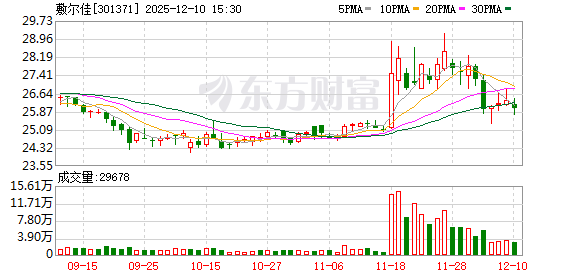
敷尔佳:截至2025年12月10日公司股东户数为16290户
Zheng Quan Ri Bao Wang· 2025-12-11 13:41
Core Insights - The company Fuhua Jia (301371) reported that as of December 10, 2025, the number of shareholders is 16,290 [1] Summary by Categories - **Company Information** - Fuhua Jia has a total of 16,290 shareholders as of the specified date [1]
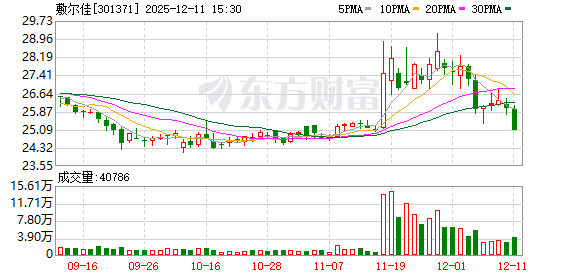
敷尔佳最新筹码趋于集中
Zheng Quan Shi Bao Wang· 2025-12-11 09:28
Core Viewpoint - The company, Fulejia, reported a decrease in shareholder accounts and a decline in stock price, indicating potential challenges in its financial performance and market perception [2]. Group 1: Shareholder and Stock Performance - As of December 10, the number of shareholders for Fulejia was 16,290, a decrease of 992 from the previous period (November 30), representing a decline of 5.74% [2]. - The closing price of Fulejia's stock was 25.08 yuan, down 3.54%, with a cumulative decline of 9.49% since the concentration of shares began [2]. - The stock experienced 4 days of increase and 5 days of decrease during the reporting period [2]. Group 2: Financial Performance - For the first three quarters, Fulejia achieved a total operating revenue of 1.297 billion yuan, a year-on-year decrease of 11.54% [2]. - The net profit for the same period was 325 million yuan, reflecting a year-on-year decline of 36.73% [2]. - The basic earnings per share were 0.6250 yuan, with a weighted average return on equity of 5.76% [2].
敷尔佳:公司每年定期进行商誉减值测试
Zheng Quan Ri Bao· 2025-12-10 11:38
Core Viewpoint - The company, Fuhua, conducts annual goodwill impairment tests and will disclose the results in its 2025 annual report scheduled for April 2026 [2] Group 1 - The company responds to investor inquiries regarding its goodwill impairment testing process [2] - The next disclosure of the annual report will take place in April 2026 [2]
化妆品板块12月9日跌0.37%,嘉亨家化领跌,主力资金净流出8817.78万元
Zheng Xing Xing Ye Ri Bao· 2025-12-09 09:11
Core Insights - The cosmetics sector experienced a decline of 0.37% on December 9, with Jiaheng Jiahua leading the drop [1] - The Shanghai Composite Index closed at 3909.52, down 0.37%, while the Shenzhen Component Index closed at 13277.36, down 0.39% [1] Company Performance - Qing Song Co. (300132) saw a closing price of 8.17, with an increase of 4.34% and a trading volume of 475,200 shares, amounting to a transaction value of 383 million [1] - Kesheng Co. (300856) closed at 15.70, up 3.36%, with a trading volume of 158,000 shares and a transaction value of 252 million [1] - Jiaheng Jiahua (300955) closed at 36.00, down 2.91%, with a trading volume of 64,600 shares and a transaction value of 23.4 million [2] Capital Flow - The cosmetics sector experienced a net outflow of 88.18 million from main funds, while retail investors saw a net inflow of 55.04 million [2] - Main funds showed a net inflow in Qing Song Co. of 20.05 million, while Jiaheng Jiahua experienced a net outflow of 2.01 million [3] - Retail investors contributed a net inflow of 804.95 million to Shuiyang Co. (300740), while Qingdao Jinwang (002094) saw a net outflow of 264.27 million [3]






研判2025!中国胶原蛋白面膜行业产业链全景、发展现状、企业布局及未来发展趋势分析:重组技术领航赛道,千亿市场潜力迸发[图]
Chan Ye Xin Xi Wang· 2025-12-09 01:09
Industry Overview - Collagen masks are mainstream skincare products focused on anti-aging and repair, utilizing collagen as the core ingredient along with auxiliary components to achieve hydration and skin barrier repair [1][2] - The Chinese mask industry is expected to reach a market size of 72.986 billion yuan in 2024, entering a period of adjustment and transformation, facing growth slowdown and intensified competition [1][6] - The collagen market is experiencing explosive growth, with a compound annual growth rate (CAGR) of 41.9% from 2020 to 2023, and retail scale expected to exceed 269.5 billion yuan by 2030 [1][7] Market Dynamics - The market structure in China shows that sheet masks remain dominant, while cream masks are rapidly growing, focusing on hydration and repair needs [1][7] - The competitive landscape features local leaders dominating, niche players breaking through, and international brands penetrating the market, with a clear price gradient and significant differentiation between high, medium, and low-end markets [1][8] Industry Chain - The upstream of the collagen mask industry primarily uses animal-derived collagen, while recombinant collagen is rapidly developing due to its high purity and compatibility with mask formulations [6][10] - The manufacturing process involves various technologies to convert raw materials into different forms and functions of mask products, with sales channels dominated by online e-commerce and deepening offline professional channels [6][10] Current Development - The Chinese mask industry is transitioning into a phase of deep integration after rapid growth, with three emerging drivers leading market changes: consumption upgrades, male skincare market expansion, and personalized demand fostering innovative scenarios [6][7] - The market size is projected to steadily grow to 76.79 billion yuan by 2025 and potentially exceed 146.42 billion yuan by 2030, indicating robust long-term growth prospects [6][7] Key Players - Major companies in the collagen mask industry include Juzi Biotechnology, Huaxi Biotechnology, and Marubi Biotechnology, leveraging differentiated technologies and channel advantages to lead the market [2][10] - The industry is characterized by a multi-faceted competitive ecosystem, with local leaders, niche players, and international brands all contributing to the market dynamics [10] Future Trends - The industry is expected to advance towards high-end technology, refined products, and standardized ecosystems, with a focus on cross-disciplinary technology integration and precise formulations [10][12] - Regulatory tightening is anticipated to accelerate the elimination of smaller brands, increasing market concentration, while leading companies will strengthen their market positions through R&D innovation and global expansion [10][14]


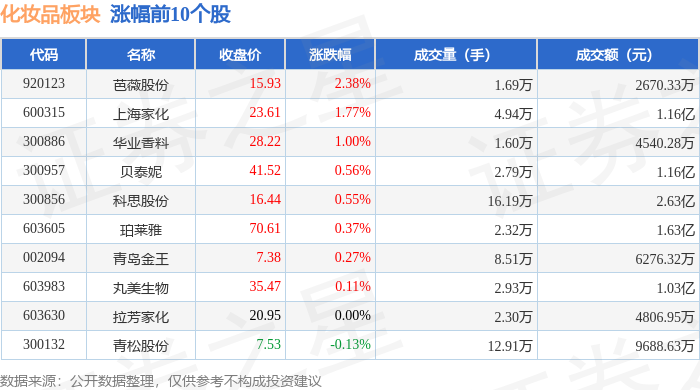
化妆品板块12月1日涨0.26%,芭薇股份领涨,主力资金净流出4951.61万元
Zheng Xing Xing Ye Ri Bao· 2025-12-01 09:16
Market Overview - On December 1, the cosmetics sector rose by 0.26% compared to the previous trading day, with BAWI leading the gains [1] - The Shanghai Composite Index closed at 3914.01, up 0.65%, while the Shenzhen Component Index closed at 13146.72, up 1.25% [1] Individual Stock Performance - BAWI shares closed at 15.93, up 2.38% with a trading volume of 16,900 lots and a transaction value of 26.70 million yuan [1] - Shanghai Jahwa closed at 23.61, up 1.77% with a trading volume of 49,400 lots and a transaction value of 116 million yuan [1] - Huachun Color closed at 28.22, up 1.00% with a trading volume of 16,000 lots and a transaction value of 45.40 million yuan [1] - Betaini closed at 41.52, up 0.56% with a trading volume of 27,900 lots and a transaction value of 116 million yuan [1] - Kohn shares closed at 16.44, up 0.55% with a trading volume of 161,900 lots and a transaction value of 263 million yuan [1] - Proya closed at 70.61, up 0.37% with a trading volume of 23,200 lots and a transaction value of 163 million yuan [1] - Qingdao King closed at 7.38, up 0.27% with a trading volume of 85,100 lots and a transaction value of 6.28 million yuan [1] - Marubi closed at 35.47, up 0.11% with a trading volume of 29,300 lots and a transaction value of 103 million yuan [1] - Lafang closed at 20.95, unchanged with a trading volume of 23,000 lots and a transaction value of 4.81 million yuan [1] - Qingsong shares closed at 7.53, down 0.13% with a trading volume of 129,100 lots and a transaction value of 96.89 million yuan [1] Fund Flow Analysis - The cosmetics sector experienced a net outflow of 49.52 million yuan from institutional funds, while retail investors saw a net inflow of 51.08 million yuan [2] - The overall fund flow indicates a mixed sentiment, with institutional investors pulling back while retail investors are increasing their positions [2] Detailed Fund Flow by Stock - Jiahen Home's main funds saw a net inflow of 7.25 million yuan, while retail funds had a net outflow of 19.70 million yuan [3] - Shanghai Jahwa experienced a net inflow of 3.64 million yuan from main funds, with retail investors contributing a net inflow of 348.90 million yuan [3] - Kohn shares had a net inflow of 3.35 million yuan from main funds, but retail investors saw a net outflow [3] - BAWI experienced a net outflow of 0.50 million yuan from main funds, while retail investors had a net inflow of 164.42 million yuan [3] - Qingdao King saw a net outflow of 0.83 million yuan from main funds, but retail investors contributed a net inflow of 238.25 million yuan [3]


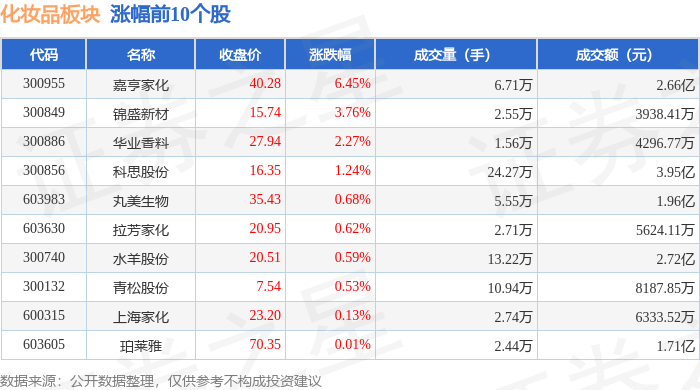
化妆品板块11月28日涨0.29%,嘉亨家化领涨,主力资金净流出6103.78万元
Zheng Xing Xing Ye Ri Bao· 2025-11-28 09:15
Group 1 - The cosmetics sector increased by 0.29% on November 28, with Jiaheng Jiahua leading the gains [1] - The Shanghai Composite Index closed at 3888.6, up 0.34%, while the Shenzhen Component Index closed at 12984.08, up 0.85% [1] - Jiaheng Jiahua's stock price rose by 6.45% to 40.28, with a trading volume of 67,100 shares and a transaction value of 266 million yuan [1] Group 2 - The cosmetics sector experienced a net outflow of 61.04 million yuan from institutional investors, while retail investors saw a net inflow of 76.64 million yuan [2] - Among individual stocks, Marubi Biological had a net outflow of 9.46 million yuan from institutional investors, while Shanghai Jahwa saw a net inflow of 5.63 million yuan [3] - The overall trading activity in the cosmetics sector indicates a mixed sentiment, with some stocks experiencing significant outflows while others attracted retail interest [2][3]