Adobe(ADBE)

Search documents
3000亿美元因Agent一夜蒸发,纳德拉、MongoDB CEO等宣告:传统SaaS已走到拐点
3 6 Ke· 2026-02-09 05:19
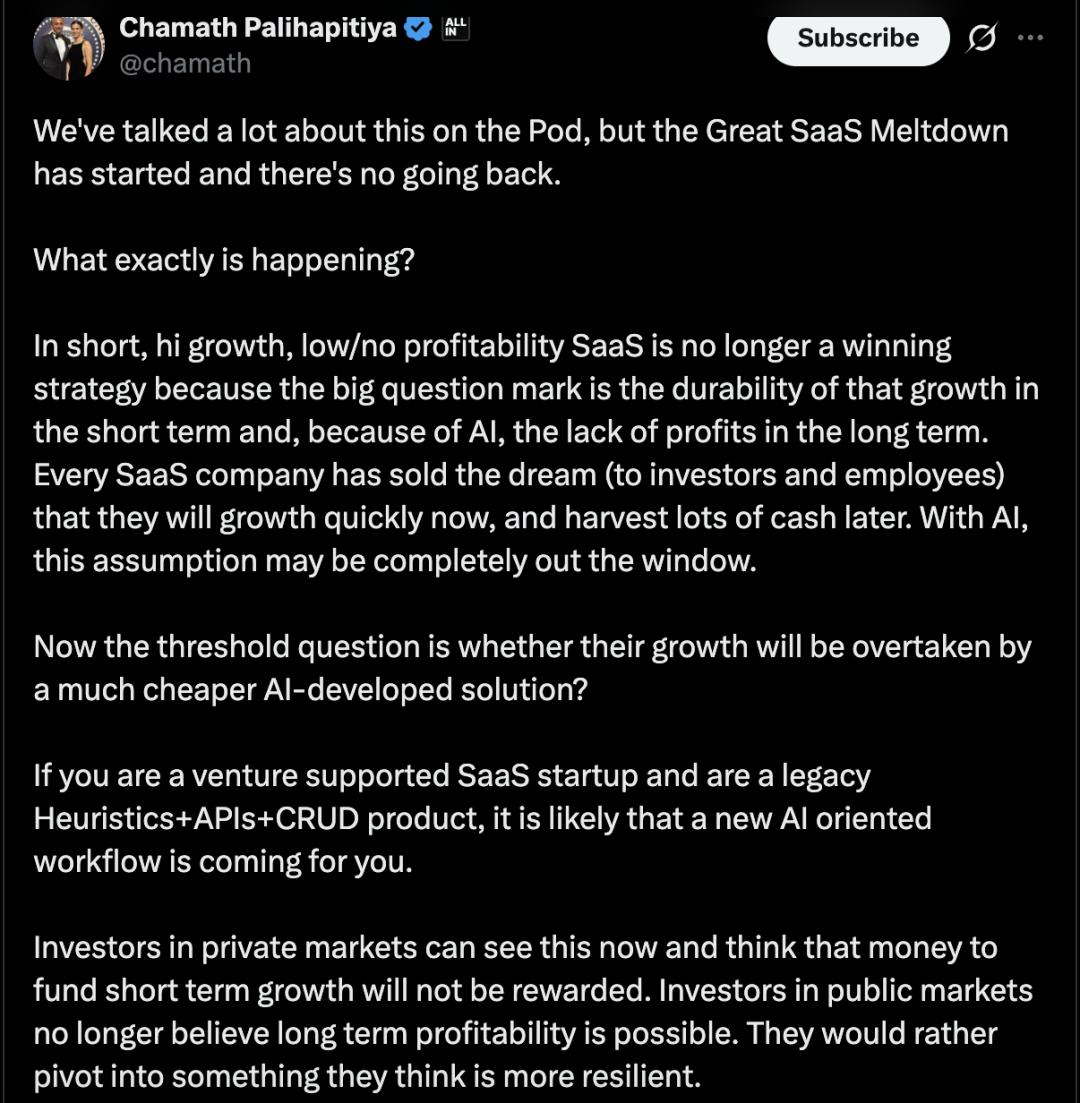
Core Insights - The market capitalization of SaaS, data, and software investment companies has evaporated by approximately $300 billion due to the release of an AI product, rather than disappointing earnings or macroeconomic shocks [1] - The IGV software index has dropped about 30% from its peak in late September, with significant declines in stock prices for major companies like Salesforce, ServiceNow, Adobe, and Workday, which fell around 7%, and Intuit, which plummeted nearly 11% [2] - The average expected price-to-earnings ratio for software companies has sharply decreased from about 39 times to approximately 21 times in just a few months [2] Group 1: Market Dynamics - The crisis in the SaaS sector has been ongoing for several months, with a recent acceleration in the speed of market reactions [2] - Short sellers have profited over $20 billion by betting against traditional SaaS businesses, indicating a significant loss of confidence in the sector [2] - The core assumption being challenged is the sustainability of traditional SaaS growth models, which have been supported by predictable recurring revenues and high switching costs [3][4] Group 2: AI Impact - AI is fundamentally testing the logic behind traditional SaaS models, as modern AI systems can replace many human workflows across various applications [6] - Investors are increasingly concerned that the growth of many SaaS companies may be rapidly supplanted by lower-cost, AI-driven solutions [8] - The emergence of AI-driven workflows is seen as a significant threat to the high-growth, low-profit SaaS development path, leading to a loss of market trust [7] Group 3: Future Outlook - High-profile figures like Chamath Palihapitiya and Microsoft CEO Satya Nadella have expressed that the SaaS model is becoming obsolete, predicting a shift towards AI-driven platforms [12][9] - Goldman Sachs predicts that by the end of the decade, AI agents will capture a disproportionate share of profits in the software market, with over 60% of software economic benefits potentially realized through agent systems rather than traditional SaaS services [15][18] - The transition from static applications to adaptive systems is expected to weaken the economic benefits of traditional software, although overall market growth is anticipated [18][19] Group 4: Investment Sentiment - The private equity and credit markets are reacting to the changing landscape, with investors recognizing that continued funding for short-term growth may not yield returns [8][20] - The prevailing investment logic in the software industry, based on predictable revenues and low customer churn, is being recalibrated in light of AI advancements [20] - MongoDB's CEO emphasizes that true platforms, rather than mere products, will endure in the evolving software landscape, highlighting the importance of adaptability and speed in technology transitions [21][26]




软件没有死,但“通用软件”已死
3 6 Ke· 2026-02-09 01:58
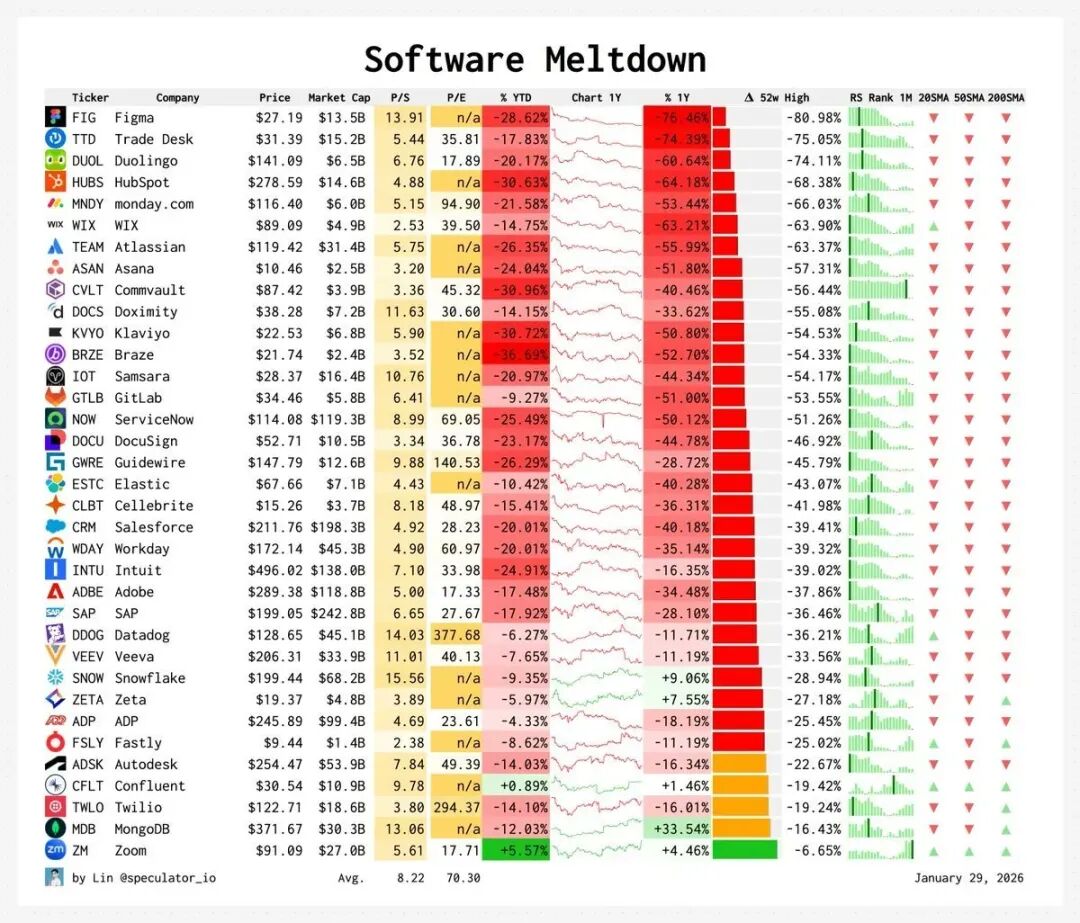
这不是板块轮动,这是在投降。 看来在投资领域,"硬件"已经成了新的"软件"。—— Paul Andreola 近期,软件股正在遭受重创! 这种下跌并非针对特定标的,也非战术性调整,几乎是无差别的打击。 观察当下的行业现状,与其说是板块轮动,不如说更像是一场大清算,甚至到了彻底投降的地步。无论是增长领头羊、赛道赢家、基础设施平台,还是通 用型 SaaS 或垂直型 SaaS,全都在同步跌落。 我今天在 X 上看到的一张图表,极其直观地展现了这种残酷现状。在数十家知名软件公司中,股价较近期高点的回撤幅度非常集中。这种跌幅通常只会 在企业面临生存危机时出现,而非仅仅源于周期性的不确定性 。 | | | | | | | | Software Meltdown | | | | | | | --- | --- | --- | --- | --- | --- | --- | --- | --- | --- | --- | --- | --- | | Ticker | Company | Price | | Market Cap | P/S | P/E | % YTD Chart 1Y | % 1Y | A 52w High ...
48小时万亿蒸发,高盛用Claude「杀死」人类会计,亲手埋葬软件帝国
3 6 Ke· 2026-02-09 01:08
Core Insights - The software industry is experiencing a significant downturn, with major companies facing massive sell-offs and a loss of nearly $300 billion in market value, approaching a trillion dollars when including losses in Europe and Asia [6][7][8] - The panic in the market is driven by the realization that traditional software may no longer be necessary, as AI technologies are emerging that can automate tasks previously performed by software [9][12][36] - Goldman Sachs is at the forefront of this shift, utilizing AI to automate accounting processes, which raises concerns about job losses in the finance sector [13][14] Group 1: Market Impact - Major software companies like Salesforce, Adobe, and Oracle are being heavily sold off, indicating a loss of confidence in their future profitability [6][7] - The term "SaaSpocalypse" has been coined to describe the potential collapse of the SaaS business model as AI agents can perform tasks without the need for traditional software [36][39] - The market is reacting to the fear that AI could replace many entry-level positions in accounting and compliance, leading to a significant restructuring in the workforce [14][36] Group 2: AI Integration - Goldman Sachs has developed AI systems that can handle complex tasks in accounting and compliance, which traditionally required significant human labor [13][14] - OpenAI is also rapidly advancing its AI capabilities, with tools like Codex taking over substantial coding responsibilities, indicating a shift in how software development is approached [17][20] - The integration of AI into business processes is expected to create a new paradigm where software is not just a tool but an integral part of operational workflows [39][41] Group 3: Future Outlook - Experts predict that while not all software will disappear, many superficial applications will lose their value as AI becomes capable of performing their functions [38][39] - The future of software may involve a combination of robust data systems and flexible AI agents, transforming the role of humans from operators to overseers [39][41] - The current upheaval in the software industry is seen as a necessary evolution rather than an end, with potential for new opportunities and innovations to emerge [41][45]



48小时万亿蒸发,高盛用Claude「杀死」人类会计
36氪· 2026-02-09 00:10
Core Viewpoint - The software industry is undergoing a significant upheaval, with AI technologies threatening traditional software roles and business models, leading to massive sell-offs in the market and a potential "SaaS apocalypse" [4][9][60]. Group 1: Market Impact - Nearly $300 billion in wealth has evaporated, with the total cost approaching $1 trillion when including losses in Europe and Asia [9]. - Major software companies like Salesforce, Adobe, and Oracle are experiencing drastic declines in stock prices due to fears of obsolescence [8][61]. - The market is reacting to the realization that AI could replace many software functions, leading to a reevaluation of the value of traditional software [10][60]. Group 2: AI's Role in the Transformation - Goldman Sachs has announced the automation of accounting tasks using AI, indicating a shift in how financial services operate [12][20]. - AI agents are being developed to handle complex tasks traditionally performed by humans, such as compliance and transaction processing, which could lead to significant job losses in these sectors [22][24][26]. - The emergence of AI tools like Claude and Codex is seen as a pivotal moment, with the potential to redefine software development and operational workflows [34][38][49]. Group 3: Future of Software - The traditional SaaS model, which relies on user licenses, is under threat as AI can perform tasks without the need for multiple software accounts [56][66]. - Not all software will disappear; however, those that are shallow and do not integrate deeply into workflows are at risk of being rendered obsolete [66][71]. - The future software landscape may consist of robust data systems supported by flexible AI agents, shifting the role of humans from operators to overseers [72][78]. Group 4: Industry Perspectives - Investors are cautioned that no competitive advantage is permanent, and companies that were once seen as cash cows may quickly lose value [89]. - Historical patterns suggest that while some companies may fail, new giants will emerge, and the software industry will continue to evolve rather than collapse [79][81].

Software stocks have been crushed. Here's how to play the sector as the dust settles.
MarketWatch· 2026-02-07 12:30
Core Viewpoint - Investors are encouraged to evaluate potential buying opportunities in undervalued software stocks following what analysts describe as "indiscriminate selling" [1] Group 1 - The recent market activity has led to a significant decline in software stock prices, prompting a reassessment of investment strategies [1] - Analysts suggest that the selling pressure may have been excessive, creating potential entry points for investors [1]
Wall Street Roundup: Risk Off
Seeking Alpha· 2026-02-06 18:25
Group 1: Bitcoin Market Dynamics - Bitcoin has experienced a significant decline, down 13% this week and 27% over the past month, with its value dropping from a peak of over $126,000 to below $63,000 [4][5] - The selling pressure was exacerbated by leveraged positions being forced to liquidate, indicating Bitcoin's status as a risk asset rather than a stable currency [6] - The volatility in Bitcoin reflects broader market concerns about overvaluation and risk allocation in investment portfolios [3][6] Group 2: Software Stocks and AI Impact - Software stocks have seen substantial declines, with major players like Microsoft down 7%, Adobe down 10%, and Oracle down 16%, driven by fears that AI advancements may render many companies obsolete [10][15] - New AI tools announced by companies like Anthropic and Google have contributed to market anxiety, leading to a sell-off in related stocks [7][10] - The market is grappling with the dual concerns of high capital expenditures on AI that may not yield expected returns and the potential for AI to disrupt entire industries [16][18] Group 3: Earnings Reports and Market Reactions - Alphabet reported an 18% revenue increase and a 48% growth in cloud revenue, but its stock fell due to high capital expenditure predictions for 2026, which could consume a significant portion of its profits [12][13] - Amazon's projected capital expenditures for 2026 are also high, at $200 billion, representing 28% of its revenue and 256% of its net income, raising concerns about sustainability [14][15] - Hershey's stock rose 9% after beating earnings expectations and raising guidance, reflecting a shift towards more resilient consumer staples amid economic uncertainty [27][28] Group 4: Economic Indicators and Job Market Concerns - Recent job market data indicates rising initial jobless claims and the lowest job openings since September 2020, suggesting a weakening labor market [31][32] - Layoffs announced by major companies like Amazon and UPS contribute to a pessimistic outlook for upcoming job reports [32][33] - The defensive rotation in the market is evident as investors seek stability in traditional sectors like consumer staples and healthcare, moving away from riskier tech assets [26][31]



两周搓出的Claude Cowork,让硅谷一夜蒸发2万亿,AI真要杀死软件?
虎嗅APP· 2026-02-06 14:10
Core Viewpoint - The article discusses a significant sell-off in the software sector, triggered by the introduction of AI capabilities by Anthropic, which threatens traditional software companies and their business models [4][6][19]. Group 1: Market Reaction - The global capital market has indiscriminately sold off software stocks, with major companies like Salesforce, Workday, and Intuit losing nearly $258 billion in market value in a single day [4]. - The North American software index experienced a 15% decline in January, marking the worst monthly performance since 2008 [4]. - The sell-off has spread to the Asia-Pacific market, leading to sharp declines in the stock prices of several industry leaders [4]. Group 2: AI's Impact on Software - Anthropic's AI application, Claude Cowork, has introduced capabilities that allow it to perform tasks traditionally done by humans, such as managing files and operating software [8][10]. - The release of specific plugins for various industries, including law and finance, indicates a shift where AI is not just a tool but a competitor to traditional software providers [11][13]. - Analysts predict that up to 50% of entry-level white-collar jobs may be impacted by AI within the next 1 to 5 years, posing a threat to companies that provide software tools for these roles [13]. Group 3: Software Industry Challenges - Software vendors are in a precarious position, needing to demonstrate revenue growth to alleviate concerns about AI's impact [15]. - Major companies are announcing layoffs, indicating a tightening of corporate budgets and a reluctance to invest in traditional software when AI can perform tasks at a lower cost [16]. - The trend of "downgrading" software is emerging, as companies reconsider the necessity of expensive SaaS solutions in light of AI capabilities [16]. Group 4: Future of Software Companies - The software industry is expected to split into two categories: "tool-based" software that will likely be eliminated and "system-based" software that must adapt to survive [24][25]. - Future software companies will need to shift from a per-user pricing model to a results-based pricing model, as AI agents reduce the need for human users [27]. - Gartner predicts that by the end of 2026, 40% of enterprise SaaS will incorporate outcome-based pricing elements, marking a significant shift in the industry [27].

Software Stocks Selloff: What's Behind the Rout?
Youtube· 2026-02-06 11:02
Group 1 - The recent selloff in the market is attributed to concerns over the impact of new technologies on traditional sectors such as legal, medical, and financial services, similar to the disruption caused by the Internet [1][2] - There has been a decline in stock values since their peak in summer 2025, indicating a prolonged downturn in certain sectors [1] - The software industry has seen many deals made at peak valuations during and after the COVID pandemic, followed by a sharp rise in interest rates, leading to concerns about overvaluation [5][6] Group 2 - Private equity firms are facing unexpected challenges, with a significant amount of financing for deals being sourced from private credit, raising concerns about the sustainability of these investments [4][6][7] - The market is experiencing a lack of clarity regarding which companies will emerge as winners or losers, leading to indiscriminate selling [9][10] - There is a growing anxiety among investors about the quality of stocks, as many companies are perceived to lack competitive advantages or "moats" [8][9] Group 3 - The current market environment is characterized by a momentum unwind, with significant declines across various asset classes, including Bitcoin and gold, indicating a broader risk-off sentiment [17][19] - The strength of the US dollar is impacting other assets negatively, suggesting a correlation between dollar strength and asset weakness [19][20] - There are concerns about systemic risks in the financial sector, particularly related to leveraged investments and margin calls, especially among retail investors in the US [16][11]

AI fears pummel software stocks: Is it 'illogical' panic or a SaaS apocalypse?
CNBC· 2026-02-06 04:21
Core Viewpoint - The release of new AI tools by Anthropic has raised concerns in the software sector, leading to a sell-off in software-as-a-service and data provider stocks [1][2]. Group 1: Market Reaction - The S&P 500 Software & Services Index, which includes 140 companies, fell over 4% on Thursday, marking an eight-session losing streak and a year-to-date decline of approximately 20% [2]. - Shares of major companies such as Thomson Reuters, Salesforce, and LegalZoom experienced significant declines during the sell-off, which also affected Asian IT firms like Tata Consultancy Services and Infosys [3]. Group 2: AI Tools Impact - Anthropic's new AI tools are designed to manage complex professional workflows, potentially undermining traditional software business models across various functions, including legal and technology research, customer relationship management, and analytics [2]. - There is a division among analysts and tech executives regarding the long-term impact of these AI tools on the software and data provider industries [3].



2025年中国营销智能体研究报告
艾瑞咨询· 2026-02-06 00:07
Core Insights - The article emphasizes the rapid evolution of marketing intelligence agents, which are transforming from auxiliary tools to autonomous decision-making systems in marketing, driven by advancements in AI technology [1][4][11]. Market Trends and Global Dynamics - Three major changes are identified: accelerated changes in platform advertising environments, rising privacy requirements, and increased digital marketing investments by companies [2]. Emergence of Global Marketing Intelligence Agents - The application of computer technology in marketing is undergoing a profound transformation, evolving from data analysis and decision support to full-chain marketing automation systems [4][11]. Challenges for Chinese Enterprises in Overseas Marketing - Chinese companies face significant challenges in overseas marketing, including cultural differences, complex channels, privacy and compliance issues, and cross-border payment difficulties [6]. Opportunities for Chinese Enterprises in Overseas Marketing - Marketing intelligence agents provide crucial support in content creation, compliance review, and localization for Chinese enterprises venturing abroad, leveraging the rapid iteration of open-source large language models [8]. Definition of Marketing Intelligence Agents - Marketing intelligence agents are defined as products based on generative AI or machine learning algorithms that can autonomously or semi-autonomously execute marketing-related tasks, assisting or replacing human marketing efforts [9]. Transition from Marketing Tools to Autonomous Agents - The development of marketing technology is transitioning from "tools" to "agents," with these agents now capable of real-time optimization across multiple channels [11][13]. Key Capabilities of Marketing Intelligence Agents - The four core capability areas of marketing intelligence agents include market insights, content generation, campaign optimization, and evaluation report generation, enabling full-chain automated marketing and continuous optimization [15]. Future Technology Trends - The collaboration of multiple agents forms a closed-loop system, combining creative, deployment, and analytical agents to achieve a cycle of creative generation, advertising deployment, data feedback, and strategy adjustment [17]. Challenges in AI + SaaS Models - The monetization of AI within SaaS models faces challenges, with companies adopting a consistent commercial approach but maintaining conservative expectations regarding AI's impact on financial reports [19]. Global and Chinese AI Marketing Market Environment - The AI + marketing market is rapidly evolving, driven by technological innovation, regulatory policies, and changes in business models, with both international and Chinese markets transitioning from "tool-based" to "intelligent" approaches [22]. Commercial Model Analysis of Marketing Intelligence Agents - The commercial model of marketing intelligence agents is evolving from a "single software subscription" to a "multi-dimensional revenue system," encompassing SaaS subscriptions, advertising revenue sharing, and value-added services [31]. Market Size and Forecast for China's Intelligent Marketing Agents - The market for intelligent marketing agents in China is expected to exceed 100 billion yuan by 2030, driven by the integration of AI technologies and the digital transformation of the advertising industry [34]. Digital Marketing Penetration in China - China's digital economy is growing rapidly, with a growth rate of 7.39%, and the digital marketing sector is entering a phase of accelerated penetration due to advancements in AI technologies [36]. Policy Framework for AI + Marketing in China - China has established a multi-layered policy framework to support and regulate the integration of AI and marketing, covering strategic guidance, technological research, industry applications, and compliance [38][41]. Global Opportunities for Chinese Enterprises - Chinese marketing intelligence products have a global opportunity to challenge existing giants by offering next-generation, AI-native automated infrastructure, leveraging unique business and talent structures [45][48].