Arm plc(ARM)

Search documents
1 Super Artificial Intelligence (AI) Stock to Buy Before It Skyrockets (Hint: It's Not Nvidia or Broadcom)
The Motley Fool· 2025-10-11 09:07
Core Insights - The demand for Arm Holdings' architecture is expected to significantly increase, potentially leading to substantial revenue and profit growth in the long run [1][5][10] Company Overview - Arm Holdings is a British company that provides intellectual property (IP), architecture, development tools, and software to chip designers, rather than manufacturing chips itself [3] - The company earns revenue through up-front licensing fees and royalties from each chip made using its IP, creating a strong revenue stream as adoption increases [4] Market Trends - IDC projects that sales of Arm-based AI accelerator chips in servers will grow from $32 billion in 2024 to $103 billion in 2029, while non-AI Arm-based chip sales are expected to rise from $14 billion to $31 billion in the same period [5] - The overall Arm-based server processor market is anticipated to nearly triple in size over the next five years [6] Competitive Landscape - Major companies like Nvidia and Broadcom are utilizing Arm's designs for their AI chips, contributing to the growth of the market [6][7] - Nvidia's Grace server CPU, built using Arm's IP, is in high demand for AI training and inference applications [7] Future Projections - The increasing deployment of AI infrastructure is projected to lead to an additional $3 trillion to $4 trillion in spending by 2030, further boosting Arm's royalty revenue [8] - The company is also positioned to benefit from the growing market for edge AI devices, where its processors are expected to gain market share [9] Financial Performance - Arm's earnings growth has outpaced revenue growth over the past year and a half, indicating strong financial health [11] - The AI-capable Armv9 architecture has a higher royalty rate compared to previous generations, which should enhance profitability [13] - Analysts forecast a 33% increase in Arm's earnings for the next fiscal year, significantly above the S&P 500's expected 14% growth [15]

软银要借50亿美元,以ARM股份抵押,投资OpenAI
Hua Er Jie Jian Wen· 2025-10-11 08:47
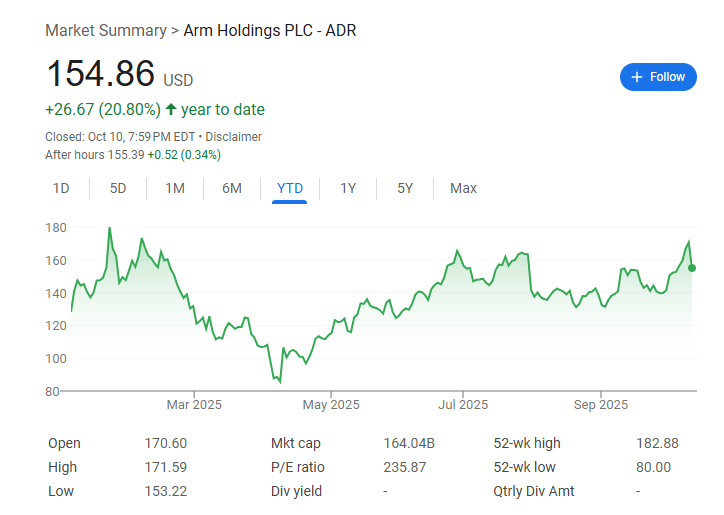
Group 1 - SoftBank is negotiating with multiple global banks to secure a new loan of $5 billion, using part of its ARM stock as collateral to fund investments in OpenAI [1][3] - ARM's strong performance in the capital market, with a stock price increase of over 20% this year, has bolstered SoftBank's confidence in this financing move [1][3] - Prior to this new loan, SoftBank had already secured a total of $13.5 billion in margin loans through ARM shares, with the new loan increasing this figure to $18.5 billion [3] Group 2 - Masayoshi Son is building a significant investment empire around AI technology, committing up to $30 billion to OpenAI and acquiring ABB's robotics division for $5.4 billion [4] - The aggressive strategy of SoftBank reflects a broader trend among global tech giants and investors pouring unprecedented capital into the AI sector, with AI-related debt reaching $1.2 trillion [5] - Future funding needs for SoftBank may exceed $30 billion, potentially requiring more asset sales and asset-backed financing to meet these demands [5] Group 3 - SoftBank is collaborating with OpenAI and Oracle Corp. on a "Stargate" initiative, aiming for a total investment of up to $500 billion to build data centers across the U.S. [7] - The company is also exploring the establishment of a large manufacturing center in the U.S. for AI industrial robots [7]


特朗普威胁100%新关税?美股遭遇“黑色星期五”
Guan Cha Zhe Wang· 2025-10-11 02:04
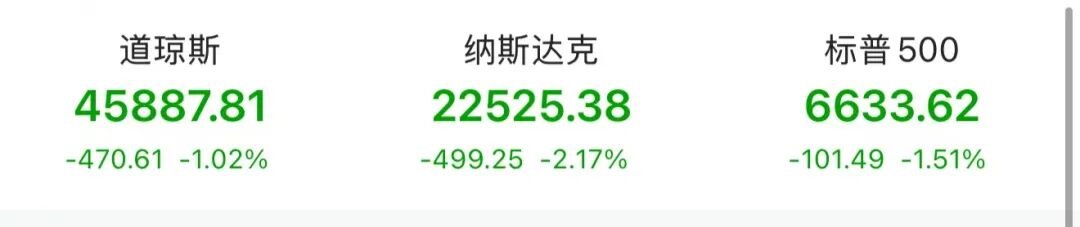
Core Viewpoint - The announcement by Trump regarding a 100% tariff on Chinese imports starting November 1 has triggered a significant sell-off in global capital markets, particularly affecting U.S. tech stocks and Chinese companies listed in the U.S. [1][10] Market Impact - U.S. stock markets faced their most severe challenge of the year, with the Dow Jones Industrial Average dropping 878.82 points (1.9%), the S&P 500 falling 182.6 points (2.71%), and the Nasdaq Composite plunging 3.56%, marking its largest single-day decline since April [2][4] - The Nasdaq Golden Dragon China Index fell by 6.1%, with a cumulative weekly decline of 8.37%, indicating a sharp downturn in Chinese stocks [1][8] Sector Performance - The technology sector was particularly hard hit, with major tech stocks experiencing significant declines: TSMC ADR down over 6%, Nvidia, Amazon down over 4%, and Apple, Meta down over 3% [4][7] - The Philadelphia Semiconductor Index saw a substantial drop of 6.32%, with ARM down over 9% and AMD, Qualcomm down over 7% [7] Chinese Stocks - Chinese companies listed in the U.S. faced a dual blow, with notable declines: NIO and Kingsoft Cloud down over 10%, Bilibili down over 9%, and Baidu, Alibaba, and XPeng down over 8% [1][9] - The FTSE A50 futures also suffered, dropping over 4%, suggesting potential pressure on A-shares at the upcoming opening [9] Broader Economic Context - The market turmoil is compounded by the ongoing U.S. government shutdown, which has entered its 10th day, leading to significant layoffs of federal employees, marking a departure from previous practices during government shutdowns [10]



美股正在跳水
Shang Hai Zheng Quan Bao· 2025-10-10 16:53
Market Overview - The U.S. stock market experienced a significant decline, with the Dow Jones index falling by 1.02%, the S&P 500 index dropping over 1%, and the Nasdaq Composite index decreasing by more than 2% [1] - The Nasdaq China Golden Dragon Index saw a decline of over 4%, marking its largest drop since August 27 [2] Sector Performance - The Philadelphia Semiconductor Index fell by 4.7%, with notable declines in major semiconductor stocks: AMD down over 8%, ARM down over 7%, Micron Technology down over 6%, Nvidia down over 2%, ASML down over 3%, Qualcomm down over 4%, and Matson down nearly 6% [6] Commodity Market - Gold prices experienced a short-term increase, with London spot gold reported at $4020.22 per ounce and COMEX gold at $4027.7 per ounce [2]


Top Stock Movers Now: AMD, Arm, Levi Strauss, and More
Yahoo Finance· 2025-10-10 16:46
Market Reaction - Major U.S. equities indexes experienced a sharp decline, erasing early gains after President Trump threatened "massive" tariffs on Chinese goods in response to China's rare earth export curbs [1][5] - The Dow, S&P 500, and Nasdaq all lost over 1% [1] Chip Industry Impact - Chip stocks, including Advanced Micro Devices (AMD) and Arm (ARM), were among the biggest decliners in the S&P 500 and Nasdaq [2] - Nvidia (NVDA) shares also fell after reaching a new intraday record, with the PHLX Semiconductor Index (SOX) down 4% [2] Company-Specific Developments - Qualcomm (QCOM) faced additional challenges as Chinese regulators investigated its acquisition of Autotalks for potential antitrust violations [3] - Mosaic (MOS) was the worst-performing stock in the S&P 500 due to production issues at two of its plants [3] - Levi Strauss (LEVI) shares dropped after the company indicated that tariffs would negatively impact current-quarter results [3] Other Notable Performances - PepsiCo (PEP) shares rose after reporting better-than-expected results driven by higher international demand and strong sales of healthier drinks in the U.S. [4][5] - Applied Digital (APLD) saw a significant increase in shares after beating earnings and revenue forecasts, aided by a new data center lease agreement with CoreWeave [4]


英特尔涨超4%,迈威尔科技涨超2%,高通、Arm跌超1%
Mei Ri Jing Ji Xin Wen· 2025-10-10 13:44
Group 1 - The Philadelphia Semiconductor Index opened slightly higher, up 0.2% [1] - Intel saw an increase of over 4% [1] - Marvell Technology rose by more than 2% [1] - Qualcomm and Arm experienced declines of over 1% [1]

抵押ARM股票投资OpenAI,软银欲全球贷款50亿美元
Feng Huang Wang· 2025-10-10 05:55
Core Insights - SoftBank Group is negotiating a $5 billion loan to bolster its capital reserves while accelerating investments in the AI sector [1][2] - The loan will be secured by pledging shares of its chip division, ARM, and is intended to fund further investments in OpenAI [1] - SoftBank's founder, Masayoshi Son, has committed up to $30 billion to OpenAI and recently acquired ABB's robotics division for $5.4 billion [1] Group 1 - SoftBank has initiated a significant investment push in AI, aiming to position itself as a key player in the ongoing AI boom [1] - The company's stock in ARM has risen by 38% this year, providing confidence and flexibility for expanding its investment pool [1] - The total amount of margin loans obtained through pledging ARM shares has reached $13.5 billion, with an additional $5 billion yet to be utilized [2] Group 2 - The latest loan will increase the total margin loan amount to $18.5 billion [2] - Son's ambitious plans include a $500 billion "Interstellar Gateway" project in collaboration with OpenAI and Oracle to build data centers in the U.S. [1] - SoftBank is also exploring the feasibility of establishing a large industrial manufacturing center in the U.S., potentially for AI industrial robot production lines [1]
SoftBank in talks for $5 billion margin loan backed by Arm stock, Bloomberg News reports
Reuters· 2025-10-10 04:55
Core Insights - SoftBank Group Corp is negotiating a $5 billion margin loan with global banks, using shares of its chip unit Arm Holdings as collateral [1] Group 1 - The loan amount being discussed is $5 billion [1] - The loan is secured by shares of Arm Holdings, which is a chip unit of SoftBank [1] - The news was reported by Bloomberg News [1]
Arm Holdings' Lofty Valuation Raises Short-Term Caution
ZACKS· 2025-10-09 18:15
Core Insights - ARM Holdings (ARM) has a high valuation with a P/E ratio of 173.72 and a forward P/E of 84.25, significantly above the semiconductor industry average of approximately 37.61, indicating strong investor confidence but limited margin for error [1][9] Financial Performance - ARM maintains a 99% market share in mobile chip design and is expanding its presence in AI data centers, which are critical for future growth [3] - The company has strong gross margins and a healthy cash position of $2.9 billion, providing a financial cushion for innovation and expansion [3] Competitive Landscape - Increased R&D spending and rising competition from China's focus on RISC-V chip architecture are putting pressure on ARM [2][9] - Potential friction with existing partners may arise if ARM expands into CPU manufacturing, traditionally served by its licensees [2] Analyst Sentiment - Analysts express caution regarding ARM's stock due to its high valuation, execution risks, and competitive uncertainties, making it less appealing for short-term investors [4] - For long-term investors, ARM's dominance in mobile and its growing role in AI infrastructure present a promising outlook, but a careful entry point is advised [4][5] Alternative Investment Options - Investors seeking semiconductor exposure may consider NVIDIA and Qualcomm, which are better valued compared to ARM [6][7] - NVIDIA has a forward P/E of 33.46 and leads in the AI accelerator space, while Qualcomm trades at 14.12x forward earnings and offers a diversified chip portfolio [6][7]

2 Monster Growth Stocks (1 Backed by Nvidia) to Buy Before They Soar 150% and 430%, According to a Wall Street Expert
The Motley Fool· 2025-10-02 08:12
Group 1: Arm Holdings - Arm is a British chipmaker that designs CPU architectures and licenses its intellectual property to other companies for custom chip development [3] - The company has gained market share in data centers, with over 70,000 enterprises using Arm server CPUs, a 14-fold increase in four years [4] - Nvidia owns a $178 million stake in Arm and has built its Grace CPU on Arm architecture, with other major companies like Amazon, Alphabet, and Microsoft also designing Arm-based server CPUs [5] - Arm reported a 12% increase in total sales to $1 billion, but missed expectations on the top line, with operating margin contracting by 8 percentage points due to increased R&D spending [6] - Wall Street estimates Arm's adjusted earnings will grow at 23% annually through March 2027, making its current valuation of 87 times earnings appear expensive [7] - Coatue estimates Arm will be worth $787 billion by 2030, implying a 430% upside from its current market value of $148 billion, equating to nearly 40% annual returns over the next five years [9] Group 2: MercadoLibre - MercadoLibre operates the largest online marketplace in Latin America, where e-commerce accounts for only 15% of total retail sales, compared to over 30% in the U.S. [8] - The company accounted for about 28% of retail e-commerce sales in Latin America last year, with projections to reach 30% market share by 2026 [8] - MercadoLibre has established its leadership by providing logistics, payments, and advertising services, creating a robust ecosystem for merchants [9] - The company reported a 34% increase in total revenue to $6.8 billion, with 29% growth in the commerce segment and 40% growth in the fintech segment [11] - Wall Street expects MercadoLibre's earnings to grow at 32% annually over the next three years, making its current valuation of 58 times earnings appear reasonable [12] - Coatue estimates MercadoLibre will be worth $300 billion by 2030, implying a 150% upside from its current market value of $120 billion, equating to 20% annual returns over the next five years [9]