Arm plc(ARM)

Search documents
Arm Holdings (ARM) Announces Arm Lumex Platform
Yahoo Finance· 2025-09-30 08:13
Core Insights - Arm Holdings plc (NASDAQ:ARM) is recognized as a promising technology stock, particularly following the announcement of its advanced compute subsystem platform, Arm Lumex, aimed at enhancing AI experiences on smartphones and PCs [1] Group 1: Arm Lumex Platform - The Arm Lumex platform integrates the latest Arm CPUs, Scalable Matrix Extension version 2, and powerful GPUs to achieve high AI performance, efficiency, and privacy [2] - By 2030, the SME and SME2 technologies are projected to contribute over 10 billion TOPS of AI compute across 3 billion devices [2] - The platform offers flexibility for partners, allowing them to use Lumex as-is or customize it for their system-on-chip designs, featuring key components like SME2-enabled Armv9.3 CPU clusters and the new Mali G1-Ultra GPU [3] Group 2: Company Overview - Arm Holdings designs and licenses high-performance, energy-efficient computing platforms, including CPUs, GPUs, and system intellectual property utilized by device manufacturers globally [4]

Semiconductor Stock Could Stage a Short-Term Breakout
Schaeffers Investment Research· 2025-09-29 18:08
Core Viewpoint - The current market conditions suggest it may be an opportune time to invest in ARM Holdings PLC, as the stock is testing a significant trendline and has shown resilience since its April lows, with a year-to-date increase of 13.7% [1] Group 1 - ARM's stock price has recently pulled back to $140, following volatile trading since a bear gap in late July, yet remains significantly above its April lows [1] - A historically bullish signal indicates a potential short-term bounce, with the stock having spent a considerable amount of time above its 200-day moving average [2] - The stock has shown a pattern where, after similar conditions in the past three years, it increased in value one month later three out of four times, averaging a gain of 9.8% [2] Group 2 - The 320-day trendline indicates potential support at the $140 level, suggesting a possible stabilization point for the stock [4] - There is significant short squeeze potential, with short interest accounting for 11.1% of the stock's available float, equating to three days' worth of buying power [4]
今夜!突发利空
Sou Hu Cai Jing· 2025-09-29 16:32
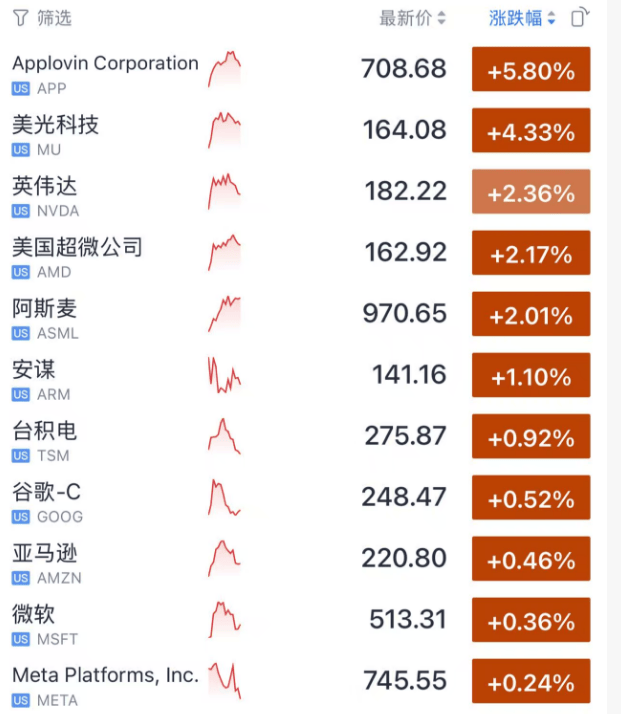
Group 1 - Technology stocks experienced a significant rise, with the Nasdaq 100 index increasing nearly 1% driven by strong performances from Nvidia, AppLovin, and Microsoft [2][3] - Gold prices reached a new high, pushing the market value of gold held by the U.S. Treasury to over $1 trillion [3] - Notable stock performances included AppLovin Corporation up by 5.80%, Micron Technology up by 4.33%, and Nvidia up by 2.36% [4] Group 2 - Market attention is focused on the upcoming non-farm payroll report to assess labor market resilience, which will influence the Federal Reserve's decisions on potential interest rate cuts [6] - There are concerns regarding a possible government shutdown, which could delay the release of important economic data, with a deadline for a spending bill approaching [6][9] - Analysts express skepticism about the impact of a government shutdown on the economy, suggesting that past shutdowns have not had lasting effects [6] Group 3 - The U.S. Labor Department announced that it will suspend all operations and economic data releases during a government shutdown, complicating the Federal Reserve's ability to justify further interest rate cuts [9] - The upcoming economic data releases, including the JOLTs report and other employment statistics, are critical as recent data has shown downward revisions and a declining job market [7]





今夜科技股上涨 但盘中有一大利空
Zhong Guo Ji Jin Bao· 2025-09-29 16:26
Group 1: Market Performance - The Nasdaq 100 index experienced a significant increase, rising nearly 1% at one point, driven by strong performances from Nvidia, AppLovin, and Microsoft [2][3] - Gold prices reached a new high, pushing the market value of gold held by the U.S. Treasury to exceed $1 trillion [3] Group 2: Company Stock Movements - AppLovin Corporation's stock rose by 5.80% to $708.68 [4] - Micron Technology's stock increased by 4.33% to $164.08 [4] - Nvidia's stock saw a rise of 2.36%, reaching $182.22 [4] - Other notable stock movements included AMD (+2.17%), ASML (+2.01%), and ARM (+1.10%) [4] Group 3: Economic Indicators and Government Actions - The market is focused on the upcoming non-farm payroll report to assess labor market resilience, with expectations of two more rate cuts by January [6][7] - Concerns about a potential government shutdown are rising, which could delay the release of important economic data [6] - The U.S. Bureau of Labor Statistics announced that it would suspend all operations and economic data releases during a government shutdown [8]

今夜!突发利空
中国基金报· 2025-09-29 16:23
Group 1 - The technology sector experienced a significant rise, with the Nasdaq 100 index increasing nearly 1% at one point, driven by strong performances from Nvidia, AppLovin, and Microsoft [2][3] - Gold prices reached a new high, pushing the market value of U.S. Treasury's gold holdings to over $1 trillion [3] - Major tech stocks such as Applovin, Micron Technology, Nvidia, and AMD saw notable gains, with Applovin up by 5.80% and Nvidia up by 2.36% [4] Group 2 - Market attention is focused on the upcoming non-farm payroll report to assess labor market resilience, which will influence the Federal Reserve's decisions on potential interest rate cuts [5] - There are concerns regarding a possible government shutdown, which could delay the release of important economic data, as Congress struggles to pass a short-term spending bill [5][6] - Analysts express uncertainty about the impact of a government shutdown on the market, noting that past shutdowns have not had lasting effects [7] Group 3 - The U.S. Bureau of Labor Statistics announced that it will suspend all operations and economic data releases during a government shutdown, complicating the Federal Reserve's ability to justify further rate cuts [9] - The upcoming Federal Reserve meeting is scheduled for October 28-29, and the lack of new government data may hinder decision-making [9]

Arm Holdings plc (ARM): A Bull Case Theory
Yahoo Finance· 2025-09-28 20:22
Core Thesis - Arm Holdings plc is positioned as a leading player in the semiconductor sector, benefiting from structural growth in AI, IoT, and 5G technologies [2][3] Company Overview - Arm Holdings operates a pure-play IP licensing model, designing chip architectures and collecting royalties, resulting in gross margins of 80–95% [2] - The company powers over 70% of the world's smartphones and billions of IoT devices, with increasing relevance in edge-AI and data-center GPU/CPU deployments [2] Financial Performance - Revenues are projected to grow from approximately $2.5 billion in 2021 to around $5 billion in 2024, reflecting a compound annual growth rate (CAGR) of about 35% [3] - Operating margins are between 30–35%, with free cash flow exceeding net income due to low capital expenditures [3] - Analysts anticipate annual EPS growth of 20–25% through FY2027, supporting a premium valuation around 50× forward EPS [3] Technical Analysis - The stock is currently consolidating within a strong uptrend, with key support in the $140–$145 range [4] - If the stock maintains this level, upside targets are projected between $168 and $220 over the next 12–24 months [4] - The high-margin licensing model and robust free cash flow contribute to a favorable risk/reward profile for medium- to long-term investors [4] Market Sentiment - The stock has appreciated approximately 10.93% since previous bullish coverage, with the thesis on Arm's high-margin licensing and growth potential remaining intact [5] - The current analysis emphasizes technical consolidation and disciplined entry points around $140–$145 for potential upside [5]
Is Arm Holdings One of the Best Artificial Intelligence (AI) Stocks for Long-Term Investors?
The Motley Fool· 2025-09-27 12:30
Core Viewpoint - The company is well-positioned for long-term growth in the AI sector, emphasizing the importance of a strong business model and competitive advantages over daily market fluctuations [1][2]. Group 1: Business Model - Arm Holdings operates a unique business model in the semiconductor industry by licensing its CPU designs rather than manufacturing chips, generating revenue through licensing fees and royalties [4]. - This high-margin business model allows Arm to maintain profitability despite lower revenue compared to companies that design and manufacture their own chips [4]. Group 2: Market Position - Arm holds over 99% market share in the smartphone market, attributed to its CPU architecture's superior battery conservation compared to Intel and AMD's x86 platform [5]. - The company's market share is also expanding in data centers, where energy efficiency is increasingly critical [5]. Group 3: Revenue Streams - A significant portion of Arm's royalties, approximately 50%, comes from designs that are over 10 years old, indicating the longevity of its revenue streams [6]. - The company is innovating further by entering chip design and offering more complex products like system-on-chip (SoC) licenses [6]. Group 4: Competitive Advantage - Arm's technological edge in CPU architecture and its robust royalty model position the company for continued growth, particularly benefiting from the ongoing AI boom [7]. - The company's advantages provide resilience compared to many peers in the semiconductor industry [7].
美股异动|费城半导体指数跌超2%,半导体股多数走低
Ge Long Hui· 2025-09-25 14:00
Group 1 - The Philadelphia Semiconductor Index fell over 2%, indicating a general decline in the semiconductor sector [1] - Most semiconductor stocks experienced losses, with Wolfspeed dropping over 9% and NXP Semiconductors declining over 6% [1] - Other notable declines included Arm down over 4%, and companies like Marvell Technology, TSMC, and Micron Technology each falling over 3% [1] Group 2 - Broadcom, AMD, and Qualcomm also saw declines, each dropping over 2.5% [1]




Cramer Gushes Over ARM—Is It The Next Must-Own AI Stock?
Benzinga· 2025-09-24 19:12
Group 1 - ARM Holdings PLC is positioned as a strong player in the AI boom, with its energy-efficient designs making it essential for chipmakers and hyperscalers [1][2][3] - The company operates a capital-light, margin-rich business model by licensing designs rather than selling chips directly, which could lead to significant growth as the industry shifts towards AI accelerators and edge computing [2][3] - ARM's potential to break out of its "smartphone IP" narrative and reprice towards the AI infrastructure tier is highlighted, similar to Nvidia's success in the GPU market [3][4] Group 2 - Retail investors are increasingly interested in ARM as a middle ground investment, offering global brand recognition and the potential for explosive upside with AI adoption [4] - The company must demonstrate that its AI revenue streams can surpass its traditional mobile business, which is a critical factor for its future valuation [5]
COHR vs. ARM: Which Tech Growth Stock Offers More Upside Now?
ZACKS· 2025-09-24 18:26
Core Insights - Coherent Corp. (COHR) and Arm Holdings plc (ARM) are both technology companies focused on advanced hardware and innovation, playing crucial roles in modern computing [1][3] - COHR specializes in photonics and optical components, while ARM is known for its semiconductor IP that powers a significant share of smartphones and AI processors [2] Coherent Corp. (COHR) Summary - COHR experienced a remarkable 51% increase in fiscal 2025 revenue, driven by a 61% surge in its data center business, indicating strong demand in high-growth technology sectors [4] - The company is advancing its product offerings with the introduction of 1.6T transceivers and is developing next-generation 3.2T transceivers to meet the needs of hyperscale data centers [5] - COHR has tripled its indium phosphide production capacity year over year and launched the world's first 6-inch indium phosphide production line, enhancing cost efficiency and product volume [6] - The company is also entering the optical circuit switch (OCS) market, which is expected to accelerate growth as demand for higher bandwidth and faster data transmission increases [7] - COHR faces competition in the Silicon Carbide (SiC) market from companies like Wolfspeed and ON Semiconductor, which are pushing technological boundaries [8][10] - The Zacks Consensus Estimate for COHR indicates a 9% growth in sales and a 29% increase in EPS for fiscal 2026 [16] Arm Holdings plc (ARM) Summary - ARM's chip architectures are essential for mobile computing, powering devices from major companies like Apple, Qualcomm, and Samsung, and maintaining a competitive edge through efficiency and performance [11] - The company is becoming increasingly relevant in the AI and IoT sectors, with its architecture supporting the growing demand for embedded AI models [12] - ARM faces challenges in China due to the rising adoption of RISC-V, which could limit its growth in this key market [13] - The potential move into producing its own CPUs presents both opportunities for market expansion and risks of straining relationships with existing customers [14][15] - The Zacks Consensus Estimate for ARM suggests an 18% year-over-year growth in sales, with EPS expected to grow by 3% [19] Valuation and Investment Case - COHR is attractively valued with a forward P/E of 22.26X, while ARM's higher forward P/E of 72.07X reflects investor confidence in its growth potential [23] - COHR is viewed as the stronger investment case due to its execution in data center optics and expansion into Silicon Carbide, while ARM faces risks related to its dependence on China and potential channel conflicts [24] - Current Zacks Ranks indicate COHR as a Hold (3) and ARM as a Sell (4) [25]