
AstraZeneca(AZN)

Search documents
AstraZeneca names Rick Suarez head of US biopharmaceuticals unit
Reuters· 2026-01-08 12:12
Core Viewpoint - AstraZeneca has appointed Rick Suarez as the head of its U.S. biopharmaceuticals unit to lead a significant $50 billion initiative in research, development, and manufacturing [1] Group 1 - The appointment of Rick Suarez is part of AstraZeneca's strategy to enhance its biopharmaceuticals operations in the U.S. [1] - The $50 billion investment indicates AstraZeneca's commitment to expanding its research and development capabilities [1] - This move is expected to strengthen AstraZeneca's position in the competitive biopharmaceutical market [1]



“扎根中国的信心更足了”
Ren Min Ri Bao· 2026-01-07 22:17
Core Insights - The article highlights Beijing's efforts to enhance high-level openness to the outside world, exemplified by AstraZeneca's successful approval for data export compliance in December 2025 [1] - AstraZeneca's commitment to China is reinforced by a favorable policy environment, making Beijing a key strategic location for the company [1] Company Developments - AstraZeneca has received approval for two innovative drugs for rare diseases in the first half of 2025, facilitating temporary importation of urgently needed clinical drugs [1] - Since entering China in 1993, AstraZeneca has invested over $5 billion, with China becoming its second-largest market globally [1] - The workforce in Beijing is expected to grow to over 1,700 employees in the near future [1] Industry Context - Beijing is actively promoting a more open ecosystem for global resources, focusing on data flow, drug clearance, institutional innovation, and ecological cultivation [1] - Over the past five years, Beijing has implemented more than 400 reform and opening-up tasks approved by the State Council, resulting in the establishment of over 9,000 foreign-funded enterprises [1]
昨夜,全线收涨!涉及美联储降息!
Xin Lang Cai Jing· 2026-01-07 00:29
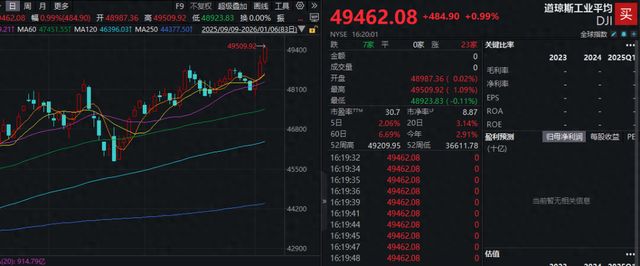
Group 1: Market Performance - The U.S. stock market saw all three major indices rise, with the Dow Jones Industrial Average reaching a new historical high, approaching the 50,000 mark, closing at 49,462.08 points, up 0.99% [3] - The Philadelphia Semiconductor Index increased by 2.75%, setting a new historical high, with notable gains in chip stocks such as Microchip Technology up over 11%, Micron Technology up over 10%, and NXP Semiconductors up over 9% [5][6] Group 2: Federal Reserve Insights - Federal Reserve Governor Milan stated that the Fed should lower interest rates by more than 100 basis points this year, as economic data trends may support further rate cuts [5] - Milan noted that core inflation has returned to around the Fed's 2% target, and he expects strong economic growth in the U.S. this year [5] Group 3: Commodity Prices - Silver prices surged again, with COMEX silver futures breaking the $80 per ounce mark, reflecting a rise of approximately 6% [8] - Gold prices also saw a slight increase, with COMEX gold futures surpassing $4,500 per ounce, up over 1% [8]


JNJ vs. AZN: Which Drug Stock Comes Out on Top for Investors?
ZACKS· 2026-01-06 17:55
Core Insights - Johnson & Johnson (JNJ) and AstraZeneca (AZN) are among the largest pharmaceutical companies globally, with diverse healthcare portfolios and strong oncology segments [1][2] - JNJ's diversified business model includes pharmaceuticals and medical devices, while AZN focuses heavily on oncology sales, which account for approximately 43% of its total revenues [2][12] - Both companies face challenges such as patent expirations and the redesign of Medicare Part D, impacting their growth prospects [2][10] Johnson & Johnson (JNJ) - JNJ's strength lies in its diversified business model, operating through over 275 subsidiaries, which reduces reliance on any single drug [3] - The Innovative Medicine unit reported a 3.4% organic sales growth in the first nine months of 2025, driven by key drugs like Darzalex and new launches [4] - JNJ's MedTech business has shown improvement, particularly from acquired cardiovascular businesses and advancements in electrophysiology [5] - The potential separation of its Orthopaedics franchise into a standalone company, DePuy Synthes, is expected to enhance growth and margins in the MedTech unit [6] - JNJ anticipates accelerated growth in both Innovative Medicine and MedTech segments in 2026 [8] - The company has made significant advancements in its pipeline, gaining approvals for new products that could drive future growth [9] - JNJ's diversified model supports steady growth, with 2025 gains attributed to Innovative Medicine and improving MedTech performance [10] - JNJ estimates that 10 new products could achieve peak sales of $5 billion, despite facing challenges like the Stelara patent cliff and ongoing talc lawsuits [11] AstraZeneca (AZN) - AZN has several blockbuster drugs exceeding $1 billion in sales, contributing to its revenue growth, with new products offsetting losses from mature brands [12][13] - The company aims for industry-leading top-line growth, projecting total revenues of $80 billion by 2030, with plans to launch 20 new medicines [14] - AZN faces challenges from the redesign of Medicare Part D affecting U.S. oncology sales and competition from generics and biosimilars [15] - The company expects fourth-quarter revenues to be impacted by VBP-related costs and budget constraints in China [16] Financial Estimates and Performance - The Zacks Consensus Estimate for JNJ's 2026 sales and EPS indicates year-over-year increases of 4.97% and 5.74%, respectively [17] - In contrast, AZN's 2026 sales and EPS estimates imply increases of 6.02% and 12.23% [19] - JNJ's stock has risen 39.8% over the past year, while AZN's stock has increased by 36.9%, outperforming the industry average of 18.8% [21] - JNJ's current price/earnings ratio is 17.76, slightly higher than AZN's 17.65, with both companies trading above industry averages [23] - JNJ offers a dividend yield of 2.6%, compared to AZN's 1.1% [25] Investment Considerations - Both JNJ and AZN have shown strong performance in 2025 and are optimistic about growth in 2026, with both stocks rated as Zacks Rank 3 (Hold) [26] - JNJ's consistent revenue and EPS growth, along with strong cash flows and a history of dividend increases, positions it favorably despite facing headwinds [27][28]


FTSE hits new record as global markets edge higher
Yahoo Finance· 2026-01-06 17:44
Market Performance - The Dow Jones Industrial Average reached a new record high of 49,221.13 points, driven by gains in companies like Chevron and Amazon [5][7][62] - The FTSE 100 closed at a fresh high of 10,122 points, supported by strong performances from pharmaceutical companies such as AstraZeneca and GSK [4][6][46] - Global stock markets are experiencing a rally following the political changes in Venezuela, with significant optimism among investors [5][6][55] Sector Trends - Classic sectors such as finance, pharmaceuticals, and energy are regaining popularity among investors, contrasting with the tech sector that dominated in previous years [2][3] - Oil companies saw a temporary surge in stock prices after discussions about potential US subsidies for private sector exploration in Venezuela [3][46] - The price of copper hit a new high of $13,387 per tonne, influenced by supply concerns due to potential tariffs on imports [4][14][49] Investment Opportunities - Hedge funds and asset managers are preparing to invest in Venezuelan assets, including debt and stocks, following the political upheaval [58] - There is a potential for US oil companies to significantly increase production in Venezuela, with projections suggesting a rise from 800,000 barrels per day to 2.5 million within a decade [27][51] - Venezuelan government bonds have stabilized after a sharp rally, indicating improved market sentiment regarding potential debt restructuring [32][34]


BostonGene and AstraZeneca Announce Strategic Collaboration to Advance Foundation Model-Driven Oncology Development
Businesswire· 2026-01-06 12:44
Core Insights - BostonGene has announced a strategic collaboration with AstraZeneca to enhance oncology drug development using its multimodal AI platform [1] Group 1: Company Overview - BostonGene is recognized for developing a leading AI foundation model focused on tumor and immune biology [1] - AstraZeneca is a global biopharmaceutical company that emphasizes the discovery, development, and commercialization of prescription medicines in Oncology, Rare Diseases, and BioPharmaceuticals [1] Group 2: Collaboration Details - The collaboration aims to leverage BostonGene's AI capabilities to advance drug development in oncology [1]

MFN谈判接近尾声,14家药企达成协议
Haitong Securities International· 2026-01-06 05:46
Investment Rating - The report assigns an "Outperform" rating for the pharmaceutical industry [1]. Core Insights - On December 19, the U.S. government announced agreements with 14 pharmaceutical companies, including major players like Amgen, Gilead, and Novartis, to implement Most-Favored-Nation (MFN) pricing, which includes price reductions for certain medications and increased domestic investment [6][17]. - The agreements entail a commitment of at least $150 billion in domestic production investments from the participating companies [18]. - Price reductions are primarily focused on Medicaid and direct sales channels, which are expected to have a limited impact on overall revenue for the companies involved [19]. Summary by Sections MFN Negotiations - The MFN negotiations are nearing completion, with 14 pharmaceutical companies reaching agreements with the government, covering aspects such as Medicaid price reductions and international pricing alignment for new drugs [6][17]. - The agreements include provisions for lowering costs of chronic disease medications and implementing MFN pricing for all listed innovative drugs [18]. Impact on Tariffs and Market Reaction - The MFN agreements provide a three-year exemption from tariffs, alleviating previous uncertainties regarding trade policies affecting the pharmaceutical industry [14][19]. - Following the announcement, the XBI index rose by 2.85%, indicating a neutral to optimistic market reaction to the agreements [11]. Specific Measures and Commitments - Companies are required to lower costs for chronic disease medications, including those for type 2 diabetes and rheumatoid arthritis, through direct sales channels [6][18]. - The agreements also stipulate that companies will donate active pharmaceutical ingredients to a strategic reserve to reduce reliance on foreign sources [7][18].


美国 MFN 协议点评:MFN 谈判接近尾声,14 家药企达成协议
GUOTAI HAITONG SECURITIES· 2026-01-05 14:07
Investment Rating - The report assigns an "Overweight" rating for the pharmaceutical industry, indicating a projected performance that exceeds the Shanghai and Shenzhen 300 Index by more than 15% [6][23]. Core Insights - The U.S. government has reached a Most Favored Nation (MFN) price agreement with 14 pharmaceutical companies, which includes provisions for price reductions and a three-year tariff exemption, resulting in a limited overall impact on revenue [2][10]. - The agreement involves nine major pharmaceutical companies committing to invest at least $150 billion in domestic production in the U.S. and implementing MFN pricing for all listed innovative drugs [9][10]. - The MFN agreement primarily affects Medicaid and direct-to-patient sales channels, which represent a small portion of the companies' overall revenue [16][17]. Summary by Sections MFN Negotiations - As of December 19, 14 pharmaceutical companies have reached agreements with the U.S. government, with nine major firms including Amgen, Bristol-Myers Squibb, and Gilead participating [8][10]. - The agreements include measures to lower costs for chronic disease medications and increase domestic investment [9][10]. Price Reduction Measures - The agreement mandates price reductions for chronic disease medications, including those for diabetes and rheumatoid arthritis, through the TrumpRx platform, which offers discounts of 50%-85% [8][9]. - The MFN pricing requirement applies to all innovative drugs, affecting not only Medicaid but also commercial insurance and cash-paying patients [9][10]. Market Reaction - Following the announcement of the MFN agreement, the XBI index rose by 2.85%, indicating a neutral to optimistic sentiment among investors regarding the policy's implications [13][16]. - Stock price changes for the involved companies showed mixed reactions, with some experiencing slight increases on the announcement day [14][15].

PDX: An 8.6% Yield, 12% Discount, And Potential Recovery In 2026
Seeking Alpha· 2026-01-04 13:30
Group 1 - The primary goal of the "High Income DIY Portfolios" service is to provide high income with low risk and capital preservation for DIY investors [1] - The service offers seven portfolios, including three buy-and-hold, three rotational portfolios, and a conservative NPP strategy portfolio [1] - The portfolios are specifically designed for income investors, including retirees or near-retirees, focusing on creating stable, long-term passive income with sustainable yields [1] Group 2 - The "Financially Free Investor" emphasizes a unique 3-basket investment approach aimed at achieving 30% lower drawdowns and 6% current income [2] - The investing group "High Income DIY Portfolios" includes a total of 10 model portfolios with varying income targets and risk levels, along with buy and sell alerts and live chat support [2] - The focus is on investing in dividend-growing stocks with a long-term horizon to achieve market-beating growth [2]



专家电话会_CRO的责任与创新-没有简单答案,因此需金融服务伙伴-Expert Call_ CRO Accountability and Innovation—No Easy Answers, So FSP
2026-01-04 11:34
Summary of the Call on CRO Accountability and Innovation Industry Overview - The discussion centers around the **pharmaceutical services industry**, specifically focusing on **clinical research organizations (CROs)** and their operational models, including **Functional Service Provider (FSP)** and **Full-Service Outsourcing (FSO)** models [1][6][32]. Key Points and Arguments 1. **Successful Pharma Outsourcing**: - Successful outsourcing relies on achieving competitive cost, quality, speed, and accountability. Accountability is emphasized as a critical factor in project success [6][15]. - Internalizing capabilities at AskBio, as done previously at AstraZeneca, improved control, reduced delays, and enhanced cost and quality outcomes compared to FSO experiences [6][16]. 2. **Popularity of FSP Models**: - FSP models are gaining traction as they allow sponsors to flexibly manage resources and maintain greater control over processes. For FSO to regain popularity, conditions such as sustained biotech funding or CROs improving their cost and quality must be met [6][31]. 3. **Automation and AI in Clinical Development**: - The next wave of improvement in clinical development is expected to come from automation and AI, particularly in areas like medical writing and data collection. However, the adoption of these technologies will be gradual due to validation and regulatory requirements [6][64][71]. 4. **Performance of Smaller CROs**: - Smaller, specialized CROs often outperform larger CROs for biotech sponsors due to better understanding of unique client needs and integration [6][6]. 5. **Integrated Technology Platforms**: - Sponsors are increasingly seeking integrated technology platforms to drive innovation. Veeva is highlighted as a leading solution that offers efficiency and cost savings [6][6]. 6. **Challenges in the CRO Industry**: - The CRO industry faces challenges such as high turnover rates among study coordinators and a crowded market for clinical trial sites, particularly in oncology [56][60]. 7. **Impact of COVID-19**: - The pandemic has led to a slowdown in study starts and decision cycles, with ongoing challenges in patient recruitment and site activation [54][56]. 8. **Accountability in CRO Partnerships**: - Accountability is crucial in CRO partnerships, especially for smaller companies where project-level oversight is more detailed. The governance structures are similar across large companies, but smaller companies require more granular accountability [48][51]. 9. **Future of CROs**: - The role of CROs may evolve as automation increases, potentially leading to a reduction in the need for traditional monitoring roles. Smaller companies may still rely on CROs, but there is a trend towards bringing more functions in-house as automation capabilities grow [90][91]. 10. **Vendor Landscape**: - The vendor landscape is crowded, making it difficult to identify true innovation. Companies are exploring various AI applications to improve clinical development processes [65][66]. Additional Important Insights - **CRO Quality Variability**: The quality of CRO services can vary significantly based on the specific team assigned to a project, highlighting the importance of team selection [6][6]. - **Integration with Bayer**: AskBio's operational model benefits from Bayer's resources, allowing for a unique blend of internal capabilities and external support, which is not common in most acquisitions [41][44]. - **Regulatory Challenges**: Regulatory environments, particularly in China and Europe, continue to pose challenges for study activation and patient recruitment [60][62]. This summary encapsulates the key discussions and insights from the call, providing a comprehensive overview of the current state and future trends in the pharmaceutical services industry.
