salesforce(CRM)

Search documents
Salesforce Earnings Preview: What to Expect
Yahoo Finance· 2026-01-21 14:10
Company Overview - Salesforce, Inc. (CRM) has a market cap of $206.2 billion and is a leader in customer relationship management technology, offering AI-powered solutions such as Agentforce, Data Cloud, Slack, Tableau, and industry-specific applications [1] Financial Performance - Analysts expect Salesforce to report an EPS of $2.14 for fiscal Q4 2026, reflecting a 3.6% decline from $2.22 in the same quarter last year, although the company has exceeded earnings expectations in the past four quarters [2] - For fiscal 2026, analysts predict an EPS of $8.92, which represents a 13.1% increase from $7.89 in fiscal 2025 [3] Stock Performance - Salesforce shares have decreased by 32.2% over the past 52 weeks, underperforming the S&P 500 Index, which gained 13.3%, and the State Street Technology Select Sector SPDR ETF, which returned 21.2% during the same period [4] - Following strong Q3 2026 results, Salesforce shares rose by 3.7%, with reported revenue of $10.26 billion and adjusted EPS of $3.25. The company also raised its full-year 2026 revenue guidance to between $41.45 billion and $41.55 billion, with significant growth in Agentforce and Data 360 ARR, which reached nearly $1.4 billion, up 114% year-over-year [5] Analyst Ratings - The consensus view among analysts on CRM stock remains bullish, with a "Strong Buy" rating overall. Out of 51 analysts, 36 recommend a "Strong Buy," 2 suggest "Moderate Buys," 12 recommend "Holds," and 1 advises a "Strong Sell." The average analyst price target for Salesforce is $331.25, indicating a potential upside of 50.5% from current levels [6]

North Atlantic Titanium Closes Final Tranche of $1.25 Million Private Placement Financing to Advance the Everett Titanium Project in Quebec
Thenewswire· 2026-01-21 14:00
Core Viewpoint - North Atlantic Titanium Corp. has successfully closed the final tranche of its upsized and oversubscribed non-brokered offering, raising a total of $1,250,000 to advance its Everett titanium project in Quebec and for general corporate purposes [1][2][4]. Fundraising Details - The offering consisted of 12,500,000 units at $0.06 per unit and 6,250,000 flow-through units at $0.08 per unit, with each unit including one common share and one warrant [2]. - The total gross proceeds from the offering are $1,250,000, which will be allocated for initial option payments, working capital, and exploration activities [2][4]. Use of Proceeds - Net proceeds from the sale of units will fund the initial option payment for the Everett titanium property, while proceeds from flow-through units will be used for surface exploration and metallurgical testing [4]. - The company plans to conduct diamond drilling at selected locations in the Everett oxide body upon permitting [4]. Insider Participation - Insiders subscribed for a total of 783,317 units, which is considered a related party transaction under Multilateral Instrument 61-101 [6]. - The company is relying on exemptions from certain requirements of MI 61-101 due to the participation not exceeding 25% of the market capitalization [6]. Finder's Fees and Advisory Fees - The company paid $24,963.20 in finder's fees and issued 416,053 finder's warrants as part of the final tranche [7]. - An advisory fee of $100,000 was paid to Research Capital Corp. through the issuance of 1,666,666 units on the same terms as the offering [8]. Company Overview - North Atlantic Titanium is focused on advancing the Everett titanium deposit in Quebec and holds interests in other projects, including the Sleeping Giant South project and potential agreements in China [13].


What Is Spooking CRM Stock Investors?
Forbes· 2026-01-21 14:00
Core Viewpoint - Salesforce has experienced an 8-day decline, resulting in a total loss of -17% and a market capitalization decrease of approximately $44 billion, now standing at $209 billion [2]. Group 1: Stock Performance - The year-to-date (YTD) return for Salesforce is -13%, significantly underperforming compared to the S&P 500, which has a return of -0.9% [3]. - The current losing streak of Salesforce stock raises concerns among investors, contrasting with the performance of the Trefis High Quality Portfolio, which has shown strong performance relative to various indices [9][10]. Group 2: Causes of Decline - Concerns regarding the impact of AI on Software as a Service (SaaS) revenue have contributed to the stock's decline [4]. - An unusual spike in put option purchases indicates a bearish sentiment in the market, leading to continued institutional selling and a pessimistic outlook [9]. Group 3: Insider Activity - Director Neelie Kroes sold 3,893 shares of Salesforce, valued at approximately $929,259, which has diminished investor confidence [9]. Group 4: Valuation Perspective - Despite the recent decline, the stock's strong operating performance and financial health suggest it is fairly priced, warranting a reassessment of its valuation to identify potential investment opportunities or risks [5].
全球软件 2026 年初步展望及重点标的-Global Software Initial thoughts for 2026 and our software names
2026-01-21 02:58
Summary of Global Software Conference Call Industry Overview - The software industry is experiencing a significant shift in focus from macroeconomic concerns to the disruptive rise of AI, with investor discussions centered around whether an AI bubble exists and the potential impact of AI on enterprise software [1][11][15]. Key Themes for 2026 - **Valuation Reset**: Software valuations have halved over the past year, creating opportunities for investors to acquire high-quality stocks at discounted prices [14][31]. - **IT Spending Outlook**: Recent CIO surveys indicate one of the strongest IT spending outlooks since 2018, with expectations for a stable macro environment and lower interest rates supporting demand, particularly among small and medium-sized businesses (SMBs) [3][13][23]. - **Generative AI Impact**: While Generative AI is a major topic, its actual revenue impact on software companies is still limited. Most companies are not yet seeing significant revenue from AI, and the focus is shifting towards company-specific opportunities [6][15][19]. Company Recommendations - **Buy Recommendations**: - **Oracle (ORCL)**: Strong core business with significant cloud transition and market share gains in IaaS/PaaS, driven by unique offerings [4][27]. - **Microsoft (MSFT)**: Durable business with multiple growth levers and a reset valuation, positioned well for AI monetization [4][27]. - **SAP (SAP)**: Consistent double-digit revenue growth and margin improvement, despite AI cycle noise [4][27]. - **HubSpot (HUBS)**: Attractive entry point with strong SMB market positioning and potential benefits from AI adoption [4][27]. - **Cautionary Recommendations**: - **Salesforce (CRM)**: Concerns over underperformance and potential reliance on acquisitions to drive growth [4][29]. - **Snowflake (SNOW)**: Long-term growth concerns due to market saturation and competitive pressures [4][30]. - **Workday (WDAY)**: Growth deceleration and investor skepticism regarding AI's impact on its business model [4][28]. Financial Metrics - **Valuation Comparisons**: - Adobe (ADBE): Adjusted P/E ratios have decreased significantly, with a current valuation of 12.0x for 2026E [5][32]. - Microsoft (MSFT): Current P/E at 27.5x for 2026E, reflecting a reset from previous highs [5][32]. - Oracle (ORCL): Trading at a 0.9x PEG ratio, down from 1.4x a year ago, indicating a significant valuation adjustment [32]. Macro Considerations - **Economic Environment**: The macroeconomic landscape is expected to stabilize, with potential benefits from deregulation and tax cuts in the U.S. impacting SMB spending positively [6][23]. - **AI Adoption Timeline**: Enterprise adoption of AI is anticipated to take longer than expected, with significant visibility likely not occurring until 2027 or 2028 [22][23]. Conclusion - The software sector is at a pivotal moment, with significant valuation resets providing investment opportunities. However, the actual impact of AI on revenue generation remains uncertain, necessitating a cautious approach to investment in this space. The focus should be on companies with strong fundamentals and clear growth trajectories amidst the evolving landscape of AI and macroeconomic conditions [1][14][19].




Salesforce's Benioff calls for AI regulation, says models have become 'suicide coaches'
CNBC· 2026-01-20 17:14
Core Viewpoint - Salesforce CEO Marc Benioff emphasizes the need for regulation of artificial intelligence, citing alarming instances where AI has been linked to suicide coaching [1] Group 1: Regulation of AI - Benioff advocates for regulatory measures for AI, similar to past calls for social media regulation [1] - He highlights the serious implications of unregulated AI, referencing documented cases of suicide associated with AI technologies [1] Group 2: Historical Context - In 2018, Benioff compared social media to a health issue, suggesting it should be regulated like cigarettes due to its addictive nature [2] - He notes that the negative consequences of unregulated social media are now being mirrored in the realm of artificial intelligence [2]

Stock Of The Day: Is This The Bottom For Salesforce?
Benzinga· 2026-01-20 16:52
Core Viewpoint - Salesforce, Inc. shares have experienced a decline of over 15% in value over the past two weeks, but the stock may be poised for a rebound as it approaches a historical support level of $225 [1]. Price Movement - Salesforce shares have dropped to approximately $225, a price that previously served as support in August and November [2]. Support Levels - Historical support levels often attract remorseful sellers who regret their previous sales, leading to increased buying interest when the stock returns to these levels [4]. - When Salesforce fell back to around $225 in November, many remorseful sellers placed buy orders, creating significant support at this price point [5]. Potential for Rebound - As the stock returns to $225, disappointed traders who sold at this level in November are likely to place buy orders, which could establish support once again [6]. - The last two instances when Salesforce found support at $225 resulted in subsequent rallies, indicating a potential for upward movement if buying pressure increases [6][7]. Market Dynamics - The dynamics of anxious buyers and sellers can lead to a bidding war, potentially driving the stock into an uptrend, similar to previous occurrences when the stock hit the $225 mark [7].
Claude抢生意,美国软件股暴跌
3 6 Ke· 2026-01-20 07:22
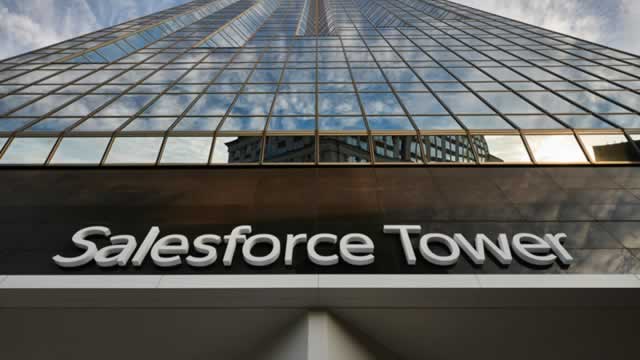
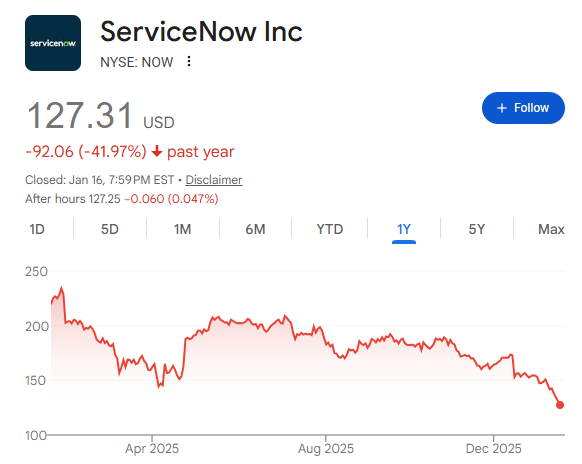
Core Viewpoint - The software sector is experiencing its worst start to the year since 2022, with a 15% decline following an 11% drop last year, raising concerns about future growth prospects due to emerging AI competition [1][3]. Group 1: Market Performance - A group of Software as a Service (SaaS) stocks tracked by Morgan Stanley has seen a significant downturn, marking the worst annual opening since 2022 [1]. - Intuit Inc., the parent company of TurboTax, experienced a 16% drop, while Adobe and Salesforce saw declines exceeding 11% [3]. - The Nasdaq 100 index is nearing historical highs, yet companies like ServiceNow Inc. are at multi-year lows, highlighting a widening gap in performance within the tech sector [9]. Group 2: AI Competition - The launch of Anthropic's AI collaboration tool "Claude Cowork" has intensified fears of disruptive competition in the software market, reminiscent of concerns from 2025 [3][8]. - Claude Cowork allows users to automate tasks such as creating spreadsheets and generating reports, significantly enhancing productivity for both programmers and non-programmers [4][6]. - The tool's rapid adoption has led to a notable increase in its user base, with a 12% rise in global daily active users since last month [7]. Group 3: Investor Sentiment - Many investors are losing confidence in holding software stocks, believing there are no catalysts for valuation recovery despite lower price multiples [8]. - Concerns about the attractiveness of AI products from established software companies are growing, as many have not demonstrated significant revenue impact from their AI offerings [9]. - The expected profit growth for software and services companies in the S&P 500 is projected to slow to 14% in 2026, down from an estimated 19% in 2025 [9]. Group 4: Valuation Trends - Software companies are seeing their valuations decline, with a forward price-to-earnings ratio of 18 times, the lowest in history compared to an average of over 55 times in the past decade [10]. - The traditional high valuation of software companies, based on subscription models and recurring revenue, is being challenged by the emergence of AI agents capable of performing tasks more efficiently [13].

开年最惨!美国软件股崩了,因为Claude Code太火了
华尔街见闻· 2026-01-19 09:46
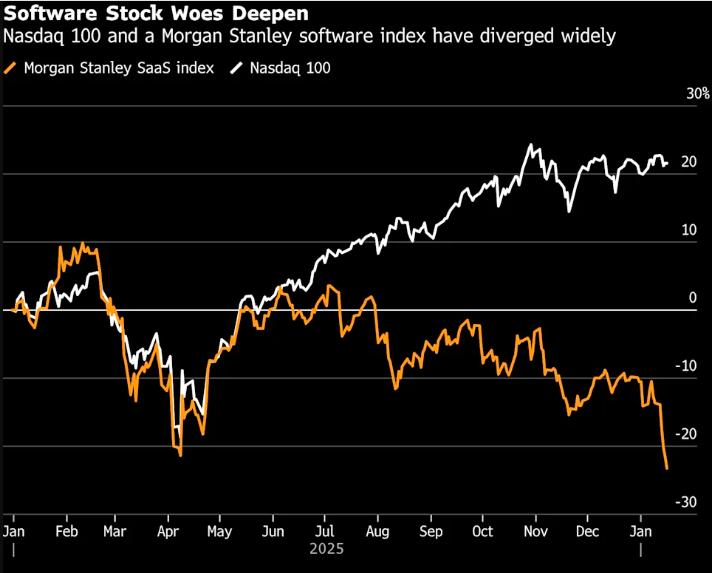
Core Viewpoint - The release of Claude Code has reignited concerns about the disruption of the software industry by AI, leading to the worst annual start for U.S. software stocks in years, with a 15% decline in a basket of SaaS stocks tracked by Morgan Stanley since the beginning of the year [1][4]. Group 1: Market Performance - Software stocks have experienced a significant downturn, with a 15% drop since the start of the year, following an 11% decline in 2025, marking the worst opening performance since 2022 [1]. - Current valuations for software stocks are at a record low, trading at 18 times expected earnings for the next 12 months, significantly below the average of over 55 times in the past decade [1]. Group 2: Impact of AI Developments - The panic in the market was triggered by Anthropic's release of "Claude Cowork," which showcased capabilities that alarmed investors about the future of software companies [5][6]. - Users reported completing complex projects in a week that would typically take a year, highlighting the disruptive potential of AI tools [2]. Group 3: Analyst Perspectives - Many buy-side institutions believe there is currently "no reason to hold" software stocks due to the uncertainty brought by AI, with no catalysts for valuation recovery in the short term [4][6]. - Analysts note that existing software companies have not demonstrated significant appeal in their AI products, with Salesforce and Adobe showing limited revenue impact from their AI initiatives [8]. Group 4: Comparative Sector Performance - The earnings growth forecast for software and services companies in the S&P 500 is expected to slow from approximately 19% in 2025 to 14% in 2026, contrasting with the semiconductor sector, which is projected to see profit growth of nearly 45% in 2025 and accelerate to 59% in 2026 [8][9]. - Major tech companies like Microsoft, Amazon, Alphabet, and Meta Platforms are expected to invest heavily in AI infrastructure, providing clearer visibility for revenue growth compared to software firms [8]. Group 5: Valuation Discrepancies - Despite low valuations, there is a divide in market sentiment regarding the future of software stocks, with some analysts optimistic about a rebound by 2026 due to stable customer spending and attractive valuations [10][11]. - Concerns remain about how software companies will compete against AI agents capable of completing tasks rapidly, complicating the assessment of appropriate valuation multiples [11].

开年最惨!美国软件股崩了,因为Claude Code太火了
Hua Er Jie Jian Wen· 2026-01-19 00:23
Core Viewpoint - The release of Claude Code has reignited concerns about the disruption of the software industry by AI, leading to a significant decline in U.S. software stocks, marking one of the worst starts to the year in recent history [1][5]. Group 1: Market Performance - Since the beginning of the year, a basket of SaaS stocks tracked by Morgan Stanley has dropped by 15%, following an 11% decline in 2025, marking the worst opening performance since 2022 [1]. - Software stocks are currently trading at a record low valuation of 18 times expected earnings for the next 12 months, significantly below the past decade's average of over 55 times [1]. - Companies like ServiceNow Inc. have seen their stock prices fall to multi-year lows, while Intuit Inc. experienced a 16% drop, the largest weekly decline since 2022 [2]. Group 2: Investor Sentiment - Many buy-side institutions believe there is "no reason to hold" software stocks amid the disruptive uncertainty brought by AI, with no visible catalysts for valuation recovery in the short term [4][6]. - The release of the "Claude Cowork" service by Anthropic has intensified fears among investors regarding the future growth prospects of software companies [5][6]. Group 3: AI Integration Challenges - Most software manufacturers have not demonstrated significant appeal in their AI products, with Salesforce and Adobe struggling to show revenue impact from their AI initiatives [7]. - Existing software companies need to exhibit accelerated growth to drive stock price rebounds, which appears unlikely in the short term [7]. - In contrast, other tech sectors, particularly semiconductor companies, are expected to see substantial profit growth, with projections of nearly 45% profit growth in 2025 and 59% in 2026 [7][8]. Group 4: Valuation Discrepancies - Despite low valuations, there remains a divide in market sentiment regarding the future of software stocks, with some analysts optimistic about a rebound by 2026 due to stable customer spending and attractive valuations [8]. - Barclays and Goldman Sachs predict that rising AI adoption will expand the total addressable market for software companies, potentially benefiting them in the long run [8]. - Wealthspire's chief market strategist notes that while the sector is not yet a clear buy opportunity, it is approaching a more attractive point for investment [9].
机构称“没有理由持有”!美股软件股陷入“AI焦虑”,板块估值跌至多年低位
智通财经网· 2026-01-19 00:04
Core Viewpoint - The software sector in the U.S. stock market is experiencing its worst start in years, with a 15% decline in software-as-a-service stocks tracked by Morgan Stanley, contrary to earlier expectations of a 11% drop by 2025 [1][4]. Group 1: Market Performance - The stock prices of major software companies like Intuit, Adobe, and Salesforce have seen significant declines, with Intuit dropping 16%, Adobe and Salesforce both falling over 11% [1]. - Despite the Nasdaq 100 index nearing historical highs, companies like ServiceNow have reached multi-year lows, indicating a disconnect between overall market performance and software stock valuations [5]. Group 2: AI Innovations and Concerns - Anthropic's launch of the Claude Cowork service has raised concerns about disruptive innovations in AI, which could further impact software manufacturers' growth prospects [4]. - The rapid development of AI tools has created unprecedented uncertainty regarding future growth, as highlighted by investment managers [4]. Group 3: Earnings and Valuation Trends - Earnings growth for software and service companies in the S&P 500 is expected to slow to 14% in 2026, down from an anticipated 19% in 2025, contrasting with more optimistic fundamentals in other tech sectors [6]. - The price-to-earnings ratio for Morgan Stanley's software company portfolio has dropped to 18 times expected earnings, a historical low compared to an average of over 55 times in the past decade [6][7]. Group 4: Future Outlook - Some analysts believe that the current low valuations of software stocks could lead to a rebound by 2026, driven by stable customer spending and the potential benefits of AI [7][8]. - There is a cautious optimism about the software sector's attractiveness, although it is not yet deemed a definitive buy opportunity [8].