Kraft Heinz(KHC)

Search documents
Jim Cramer Highlights The Change of Management in Kraft Heinz
Yahoo Finance· 2026-01-09 08:17
Group 1 - The Kraft Heinz Company (NASDAQ:KHC) has a new CEO, Steve Cahillane, who previously led Kellogg's and is expected to manage the company's upcoming split into two entities in the second half of the year [1] - The market has historically undervalued Kraft Heinz, with many investors having written off the company despite its potential for recovery under new leadership [1] - Jim Cramer expressed skepticism about the company's split but acknowledged that Cahillane has a track record of creating value through corporate restructuring [1] Group 2 - Kraft Heinz produces a variety of food and beverage products, including condiments, dairy, meals, meats, beverages, and snacks under well-known brands such as Kraft, Heinz, Oscar Mayer, and Philadelphia [2]

Why Kraft Heinz (KHC) Outpaced the Stock Market Today
ZACKS· 2026-01-09 00:02
Company Performance - Kraft Heinz (KHC) closed at $23.43, with a +1.83% increase from the previous day, outperforming the S&P 500 which gained 0.01% [1] - Over the last month, Kraft Heinz shares have decreased by 5.5%, underperforming the Consumer Staples sector's loss of 2.96% and the S&P 500's gain of 0.86% [2] Earnings Expectations - The upcoming earnings report is expected to show an EPS of $0.61, reflecting a 27.38% decline compared to the same quarter last year [3] - The Zacks Consensus Estimate for revenue is projected at $6.39 billion, down 2.8% from the previous year [3] - For the entire fiscal year, earnings are estimated at $2.53 per share, indicating a -17.32% change, while revenue is expected to remain flat at $24.98 billion [4] Analyst Sentiment - Recent estimate revisions are crucial for investors, as they reflect near-term business trends, with positive changes indicating analyst optimism [4] - The Zacks Rank system currently rates Kraft Heinz at 4 (Sell), with a recent downward shift of 0.5% in the EPS estimate [6] Valuation Metrics - Kraft Heinz is trading at a Forward P/E ratio of 9.2, which is lower than the industry average of 12.6 [7] - The Food - Miscellaneous industry, part of the Consumer Staples sector, has a Zacks Industry Rank of 193, placing it in the bottom 22% of over 250 industries [7] Industry Insights - The Zacks Industry Rank measures the strength of individual industry groups, with top-rated industries outperforming the bottom half by a factor of 2 to 1 [8]

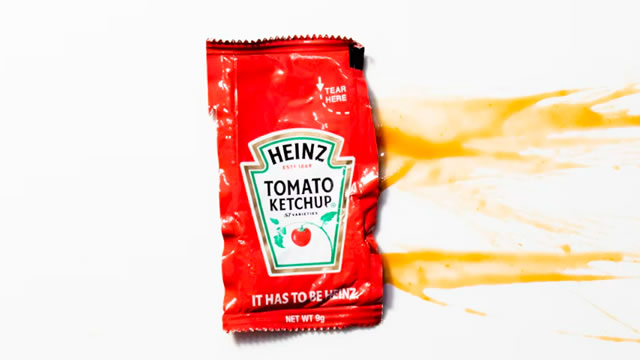
Kraft Heinz and Mondelez shares drop as Trump officials blast ultraprocessed foods and unveil new food pyramid
MarketWatch· 2026-01-07 18:16
Core Viewpoint - Shares in major food companies like Kraft Heinz and PepsiCo declined as officials from the Trump administration criticized ultraprocessed foods and sugary drinks while announcing new initiatives [1] Group 1: Company Impact - Kraft Heinz and PepsiCo experienced a drop in share prices due to negative comments from government officials regarding their product categories [1] - The criticism from the Trump administration may lead to increased scrutiny and potential regulatory changes affecting these companies [1] Group 2: Industry Trends - The focus on ultraprocessed foods and sugary drinks indicates a growing trend towards health-conscious consumer preferences and potential shifts in market demand [1] - Companies in the food industry may need to adapt their product offerings in response to changing public perceptions and regulatory pressures [1]

3 Warren Buffett Stocks to Buy Hand Over Fist in January 2026
The Motley Fool· 2026-01-06 11:15
Core Viewpoint - Warren Buffett has officially stepped down as CEO of Berkshire Hathaway, but the company is expected to maintain its investment strategy under Greg Abel's leadership, focusing on high-quality businesses with competitive advantages [1][2]. Group 1: Ally Financial - Ally Financial is a significant holding for Berkshire Hathaway, with 29 million shares representing a 9.4% stake valued at approximately $1.3 billion [4]. - The company has shown resilience, recovering from previous challenges, with shares rising nearly 30% in 2025, outperforming the S&P 500's 16.4% gain [6]. - Analysts forecast earnings of $5.38 per share for 2026, a 44% increase from the 2025 forecast of $3.75, suggesting potential for share price recovery to previous highs [7]. Group 2: Chevron - Chevron appears overvalued at about 20 times forward P/E, compared to competitors like ExxonMobil at 16.9 times [9]. - Despite current pressures from low oil prices, investor optimism remains due to Chevron's cost-cutting plans and potential growth in natural gas power generation for AI data centers [11]. - A rebound in oil prices is anticipated in 2027 and 2028, which could lead to a significant increase in Chevron's stock performance [12]. Group 3: Kraft Heinz - Kraft Heinz represents a 27.5% stake in Berkshire's portfolio, valued at about $7.9 billion, but has faced challenges, including a $5 billion impairment loss [13][14]. - The company plans to split into two entities, separating its slower-growing staple foods business from its faster-growing sauces and seasonings business, which could unlock significant value [15]. - Current trading at 9.5 times forward earnings is low compared to peers in the packaged foods sector, which typically trade at mid-teens P/E ratios, indicating potential for investment [16].



How Kraft Heinz Lost Its Lock on Mac and Cheese—and American Shoppers
WSJ· 2026-01-02 02:00
Core Insights - The leading brand is experiencing a decline in market share due to competition from emerging brands and supermarket imitations [1] - The company has faced years of cost-cutting measures, underinvestment, and internal turmoil leading up to a planned split [1] Market Dynamics - Buzzy upstarts and supermarket knockoffs are significantly impacting the market position of the leading brand [1] - The competitive landscape is shifting as new entrants gain traction and consumer preferences evolve [1] Corporate Strategy - The company is planning a split as a response to ongoing challenges, indicating a strategic shift to address operational inefficiencies [1] - Historical issues such as underinvestment and corporate chaos have contributed to the current state of the company [1]
Is It Finally Time to Buy This Dividend Stock Now That It Has a 6.6% Dividend Yield?
Yahoo Finance· 2025-12-30 14:17
Core Viewpoint - Kraft Heinz's high dividend yield of 6.6% may attract dividend investors, but the stock has faced significant pressure, with shares down over 20% year to date and over 30% in the last five years due to declining sales trends [1] Group 1: Financial Performance - Kraft Heinz's free cash flow for the year to date is $2.5 billion, representing a 23.3% increase year over year, which comfortably covers the $1.4 billion in total dividend payments [4][5] - Despite a 2.3% year-over-year decline in sales, the company's ability to generate substantial cash flow is noteworthy, indicating it remains a strong cash-generating entity [6] Group 2: Valuation - The stock is currently trading at a low valuation of eight times trailing-12-month free cash flow, suggesting that investors have minimal growth expectations for the company [7][8] Group 3: Shareholder Returns - In addition to dividends, Kraft Heinz is actively returning cash to shareholders through share repurchases, having repurchased $988 million in 2024 and an additional $435 million in the first nine months of 2025, with $1.5 billion remaining under its repurchase authorization [9]
The Dividend Aristocrat With 53% Margins Just Widened the Gap on the Frozen Dividend Competitor
247Wallst· 2025-12-30 14:12
Core Insights - Kraft Heinz and PepsiCo both reported better-than-expected earnings for Q3 2025, indicating strong performance in the packaged food sector [1] Group 1: Company Performance - Kraft Heinz and PepsiCo are on contrasting paths despite both beating earnings expectations, suggesting differing strategies and market conditions [1]


3 Hot Consumer Stocks to Leave Behind in 2026
The Motley Fool· 2025-12-29 01:00
Core Viewpoint - The article discusses three well-known consumer stocks that are struggling and suggests that investors may want to consider divesting from them as they reevaluate their portfolios for 2026. Group 1: Nike - Nike has faced challenges due to changing consumer tastes and macroeconomic conditions, leading to increased competition from brands like Adidas and Under Armour [4][5] - In Q2 of fiscal 2026, Nike's revenue increased by only 1%, following a 10% decline in fiscal 2025, while net income fell 32% to $792 million due to rising expenses [6] - Despite a current price of $60.83 and a market cap of $90 billion, Nike's P/E ratio of 34 indicates it remains relatively expensive, suggesting potential reconsideration for investors [8] Group 2: Starbucks - Starbucks has struggled post-CEO Howard Schultz, facing complaints about high prices, slow service, and poor in-store experiences, which have affected its business and reputation [9][10] - In Q4 of fiscal 2025, revenue grew by 6% year-over-year, but net income plummeted 85% to $133 million due to faster expense growth and one-time restructuring charges [11][12] - With a current price of $85.07 and a market cap of $97 billion, Starbucks has a forward P/E ratio of 37, indicating it trades at a premium despite ongoing struggles [14] Group 3: Kraft Heinz - Kraft Heinz has been criticized for the failure of its merger, with Warren Buffett acknowledging its shortcomings, and the planned split of the company is unlikely to resolve core issues [15][17] - In Q3 of 2025, net sales dropped 3% annually, continuing a trend since 2023, although the company reported earnings of $615 million due to the absence of impairment losses [18] - With a current price of $24.13 and a market cap of $29 billion, Kraft Heinz's P/E ratio of 12 may attract some investors, but ongoing challenges suggest it may be best to avoid this stock [16][19]

市值腰斩!巴菲特“踩雷”,给我们敲响什么警钟?
券商中国· 2025-12-28 01:06
Core Viewpoint - The article discusses the shrinking economic moat of traditional consumer goods companies like Kraft Heinz due to the rise of new retail channels such as Amazon and Costco, which offer lower-priced, high-quality private label products, thereby eroding brand loyalty and market share [2][4]. Group 1: Market Dynamics - Kraft Heinz's market capitalization has decreased from $80 billion at its 2015 merger to approximately $30 billion today, indicating a significant decline in its market position [2]. - The emergence of retail giants has led to a shift in consumer preferences, with customers increasingly opting for cost-effective alternatives over established brands [4]. - The term "retail apocalypse" is used to describe the fate of companies unable to compete with the likes of Amazon and Walmart, leading to numerous bankruptcies in the sector [4]. Group 2: Investment Strategy - Warren Buffett emphasizes that selling stocks should not be based solely on price appreciation or the duration of ownership but rather on the deterioration of a company's fundamentals [7]. - Buffett's investment philosophy includes holding stocks indefinitely as long as the expected return remains satisfactory and the management is competent and trustworthy [7]. - He has demonstrated this approach by selling IBM shares to invest in Apple, highlighting the importance of adapting to changes in a company's economic moat [7]. Group 3: Resilience of Certain Companies - Companies with unique competitive advantages, such as Coca-Cola, are less susceptible to disruption from new retail channels, as their proprietary products maintain strong market positions [10]. - Buffett's long-term investments in companies like Moody's, which has a strong reputation in the credit rating industry, showcase the benefits of investing in firms that are difficult to replace [10][11]. - Industries such as oil, railroads, and utilities are characterized by high barriers to entry and stable profit margins, making them less vulnerable to market fluctuations [11].

Kraft Heinz: A Deep Value Play With Catalysts (NASDAQ:KHC)
Seeking Alpha· 2025-12-23 13:07
Core Viewpoint - The Kraft Heinz Company (KHC) has shown disappointing results for shareholders, with a total return of -11% over the past five years, contrasting with the performance of the S&P 500 [1] Company Performance - KHC's stock performance has resulted in a negative total return of -11% over the last five years [1]