Coca-Cola(KO)

Search documents
Coca-Cola(KO) - 2025 Q4 - Earnings Call Transcript
2026-02-10 14:30
Financial Data and Key Metrics Changes - The company achieved a comparable earnings per share (EPS) of $3 in 2025, reflecting a significant increase from approximately $2 in previous years, marking a 50% growth [6][19] - Organic revenue growth was reported at 5% for the fourth quarter, with unit case growth at 1% [18][19] - Comparable gross margin and operating margin both increased by approximately 50 basis points, driven by underlying expansion despite currency headwinds [19] Business Line Data and Key Metrics Changes - The company added 12 billion-dollar brands to its portfolio, totaling 32, with 75% of these brands outside the sparkling soft drinks category [5] - Trademark Coca-Cola retail sales grew by over $60 billion, reinforcing its position as the highest valued food and beverage brand globally [5] - North America saw strong results with broad-based strength across its beverage portfolio, including growth in Coca-Cola, Sprite Zero, and BODYARMOR [10] Market Data and Key Metrics Changes - In North America, the company gained both volume and value share, with strong performance across its total beverage portfolio [10] - Latin America experienced challenges but managed to grow volume and revenue, with Coca-Cola Zero Sugar and Sprite Zero Sugar performing well [11] - In EMEA, volume declined initially but recovered, with successful marketing campaigns linked to the holiday season and the Winter Olympics [12] Company Strategy and Development Direction - The company aims to continue expanding its billion-dollar brands and enhance its digital engagement with consumers [15][16] - Future strategies will focus on improving speed to market, better integrating marketing campaigns, and enhancing innovation capabilities [15][16] - The leadership transition to Enrique Braun is expected to bring new energy and focus on brand management and digital engagement [7][8] Management's Comments on Operating Environment and Future Outlook - Management acknowledged a complex external environment in 2025 but expressed confidence in delivering on guidance and maintaining market share [8][9] - The company anticipates organic revenue growth of 4%-5% for 2026, with a balanced mix of volume and price expected as market conditions stabilize [20][21] - Management emphasized the importance of adapting to local market dynamics and leveraging the strength of its brand portfolio for future growth [14][49] Other Important Information - The company generated approximately $11.4 billion in free cash flow in 2025, an increase of about $600 million from the previous year [19][20] - The balance sheet remains strong with a net debt leverage of 1.6 times EBITDA, below the targeted range of 2-2.5 times [20] - The company plans to continue its dividend growth, maintaining a long-standing commitment to returning value to shareholders [24][80] Q&A Session Summary Question: Insights on 2026 organic sales growth outlook - Management indicated that the 4%-5% organic sales growth outlook for 2026 reflects a balance between price, mix, and volume, with expectations for improvement in key markets like India and China [28][36] Question: Impact of macroeconomic conditions on growth - Management acknowledged ongoing macroeconomic pressures but expressed confidence in the company's strategies to navigate these challenges and achieve growth [35][36] Question: North America operating margin sustainability - Management noted that North America has seen structural changes leading to higher operating margins, with expectations for continued improvement and investment in the region [39][41] Question: Currency impact on financial performance - Management explained that the guidance includes a 1% tailwind to net sales and a 3% tailwind to net income due to favorable currency conditions, particularly in emerging markets [60][61] Question: Strategies to address challenges in specific markets - Management highlighted the importance of leveraging successful strategies in stronger markets to offset challenges in regions like China and Mexico, where tax headwinds are anticipated [46][48]
[Earnings]Upcoming Earnings: AstraZeneca, Coca-Cola, Cisco, and More


Stock Market News· 2026-02-10 14:13
Tuesday features AstraZeneca PLC and Coca-Cola Company (The) pre-market, with numerous healthcare and financials reports. Wednesday highlights McDonald's Corporation, T-Mobile US Inc., and Cisco Systems Inc. for technology earnings. Thursday brings Applied Materials Inc. after market. Energy majors lead a lighter Friday, while Next Tuesday concludes with Medtronic plc. and Palo Alto Networks Inc.. Disclaimer: This article is for informational purposes only and does not constitute financial advice. We are no ...

Coca-Cola stock sinks on disappointing outlook as Coke Zero, water power surprise sales increase
Yahoo Finance· 2026-02-10 14:11
Core Insights - Coca-Cola's stock experienced a decline of up to 4% following a cautious outlook for 2026, as CEO James Quincey highlighted the need for improvement in several international markets [1] - The company reported a 5% organic revenue growth in the fourth quarter, surpassing Wall Street's expectation of 4.8%, but anticipates organic sales growth of 4%-5% for 2026, which is below the 5% forecasted by analysts [2] - Adjusted earnings are projected to grow by 7%-8% this year, following a 9% increase in 2025 [2] Regional Performance - Coca-Cola is facing challenges in markets such as China, India, and Mexico, particularly due to the implementation of a soft drink tax, with flat sales reported in the Asia Pacific region during the fourth quarter [3] - In North America, the company saw a 1% increase in volumes and a 4% rise in prices in the fourth quarter, as consumers shifted towards less sugary options [3] Product Performance - Coca-Cola Zero Sugar volumes increased by 13% in the fourth quarter and 14% for the full year, while Diet Coke and Coca-Cola Light saw a 2% volume increase for the quarter and remained flat for the year [4] - The company is also experiencing growth in its protein products, such as Fairlife and Core Power, as well as hydration products like BodyArmor [4] Consumer Trends - The company is testing a new Simply Pop prebiotic soda to compete with PepsiCo's Poppi acquisition, although progress has been slow [5] - Quincey noted that while total consumer spending remains stable, purchasing habits are changing, with lower-income consumers engaging in value-based shopping [6] - Coca-Cola has implemented an affordability strategy over the past few years, which the company believes is effective in addressing these changing consumer behaviors [6]
Coca-Cola (KO) Q4 Earnings Top Estimates
ZACKS· 2026-02-10 14:06
Coca-Cola (KO) came out with quarterly earnings of $0.58 per share, beating the Zacks Consensus Estimate of $0.57 per share. This compares to earnings of $0.55 per share a year ago. These figures are adjusted for non-recurring items.This quarterly report represents an earnings surprise of +2.66%. A quarter ago, it was expected that this world's largest beverage maker would post earnings of $0.78 per share when it actually produced earnings of $0.82, delivering a surprise of +5.13%.Over the last four quarter ...

Coca-Cola stock slumps as Q4 revenue misses estimates
Invezz· 2026-02-10 13:44
Core Viewpoint - Coca-Cola's Q4 revenue fell short of analysts' expectations, leading to a decline in stock price despite a modest earnings beat and signs of stabilizing demand in key markets [1] Financial Performance - Adjusted earnings for Q4 were reported at 58 cents per share, exceeding Wall Street estimates of 56 cents [1] - Net revenue increased by 2% year-over-year to $11.8 billion, missing the consensus forecast of $12.05 billion [1] - Coca-Cola's stock dropped nearly 4% in premarket trading following the earnings report [1] Pricing and Demand Dynamics - The company raised prices by 4% in North America and 1% globally during the quarter, which helped boost revenue despite mixed volume trends [1] - Unit case volume rose by 1%, driven by growth in Brazil, the United States, and Japan, although this was partially offset by an unfavorable product mix [1] - Coca-Cola Zero Sugar saw a notable sales increase of 13% during the October-December period [1] Consumer Behavior - Consumers are exhibiting caution and selective spending, impacting overall volume growth, which remained unchanged from the previous year [1] - Coca-Cola has introduced smaller packaging and more affordable options to cater to price-sensitive consumers [1] - Premium brands like Smartwater and Fairlife continue to attract consumers willing to pay more, highlighting a divide between value-driven and premium demand [1] Future Outlook - Coca-Cola forecasts organic revenue growth of 4% to 5% and comparable earnings growth of 7% to 8% for 2026, indicating confidence in navigating a challenging consumer environment [1] - The company expects core earnings per share to grow by 7% to 8% in 2026 from approximately $3 in 2025, with FactSet estimates suggesting growth of around 7.3% [1] - Coca-Cola's stock had previously risen 20.8% over the past 12 months, outperforming competitors like PepsiCo and the S&P 500 [1] Leadership Transition - Coca-Cola is preparing for a leadership transition, with Henrique Braun set to take over as CEO on March 31, while current CEO James Quincey will become executive chairman [1]
可口可乐 2025 年为 BodyArmor 商标计入9.6 亿美元减值支出。
Xin Lang Cai Jing· 2026-02-10 13:33
可口可乐 2025 年为 BodyArmor 商标计入9.6 亿美元减值支出。 来源:滚动播报 ...
Coca-Cola(KO) - 2025 Q4 - Earnings Call Presentation
2026-02-10 13:30
Q4 & FY 2025 MARGIN ANALYSIS February 10, 2026 RECONCILIATION TO U.S. GAAP FINANCIAL INFORMATION FY 2025 MARGIN ANALYSIS The following presentation includes certain "non-GAAP financial measures" as defined in Regulation G under the Securities Exchange Act of 1934. A schedule which reconciles our results as reported under Generally Accepted Accounting Principles and the non-GAAP financial measures included in the following presentation is attached as an appendix hereto. Q4 2025 MARGIN ANALYSIS CONSOLIDATED G ...
The Hidden Number in Coca-Cola's Earnings That Could Change Everything for Dividend Investors in 2026
247Wallst· 2026-02-10 13:20
Coca-Cola (NYSE: KO) reported fourth-quarter results that met EPS expectations but fell short on revenue, with the headline dominated by a $960 million non-cash impairment charge on its BODYARMOR trademark. ...
The Hidden Number in Coca-Cola’s Earnings That Could Change Everything for Dividend Investors in 2026
Yahoo Finance· 2026-02-10 13:20
Core Insights - Coca-Cola reported fourth-quarter results that met EPS expectations but fell short on revenue, primarily due to a $960 million non-cash impairment charge on its BODYARMOR trademark, reflecting slowing growth in the sports drink category and increased competitive pressure [3][8] Financial Performance - Revenue for the quarter was $11.82 billion, missing estimates by 4.6% compared to the expected $12.39 billion [8] - Operating income decreased by 32% year-over-year to $1.84 billion [8] - Net income for the quarter was reported at $2.27 billion [8] - Comparable currency neutral operating income grew by 13%, and global unit case volume increased by 1%, driven by strong performance in Brazil, the United States, and Japan [4] Strategic Outlook - Management provided guidance for 2026, projecting organic revenue growth of 4% to 5% and comparable EPS growth of 7% to 8%, with an anticipated 3% currency tailwind [5] - Free cash flow is expected to be approximately $12.2 billion [5] - The company announced the creation of a chief digital officer position to enhance digital transformation efforts [6] - Coca-Cola plans to close the sale of Coca-Cola Beverages Africa in the second half of 2026 [6] Dividend Information - Coca-Cola increased its dividends for the 63rd consecutive year, paying out $8.78 billion in dividends during 2025 [6][8]
BodyArmor减值拖累,可口可乐Q4 GAAP营业利润同比下滑32%,全年指引不及预期|财报见闻
Sou Hu Cai Jing· 2026-02-10 13:10
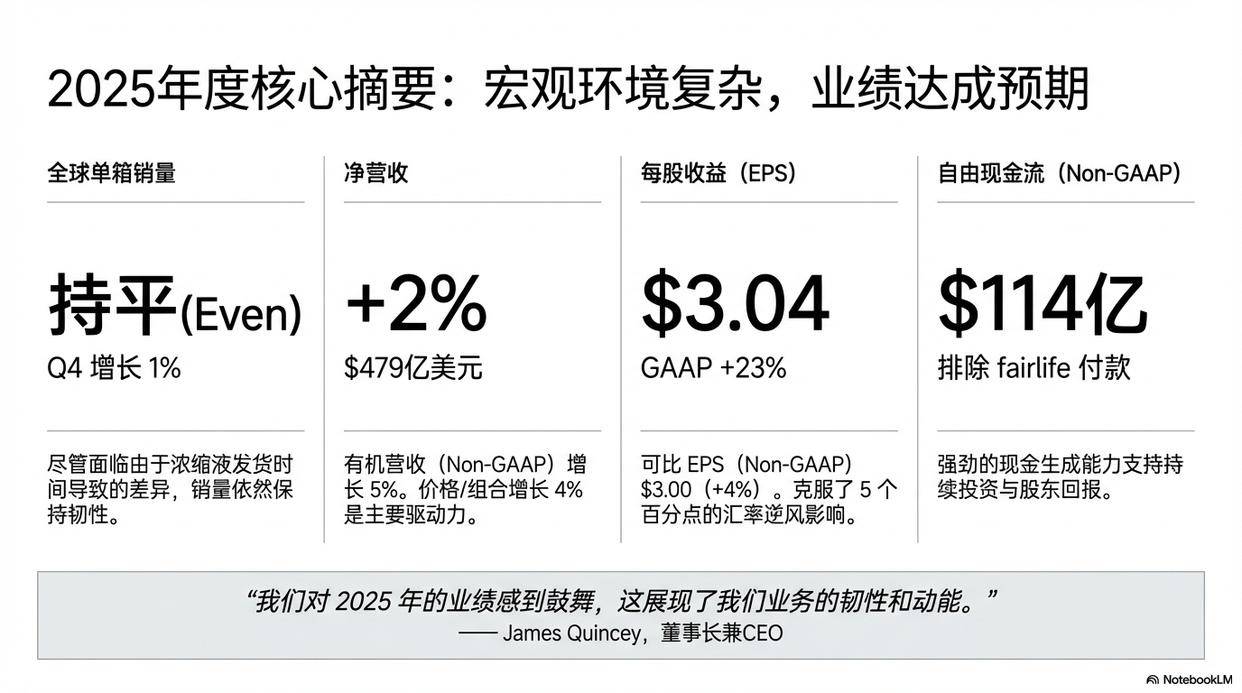
尽管零糖系列表现依旧亮眼,且四季度业绩略超预期,但在通胀降温、定价权红利消退的背景下,可口可乐给出的2026年增长指引略显疲态,令市场感到失 望。 2月10日,全球饮料巨头可口可乐发布了2025年第四季度及全年财报。财报显示,公司四季度营收118.2亿美元,同比增长2%,有机收入增长5%;可比每股 收益(EPS)为0.58美元,同比增长6%,略高于分析师平均预期的水平。 | 每股收益(EPS) | 全球单箱销量 | 净营收 | | 自由现金流(Nol | | --- | --- | --- | --- | --- | | +2% | 持平(Even) | | $3.04 | $1141 | | $479亿美元 | Q4 增长 1% | | GAAP +23% | 排除 fairlife · | | 有机营收(Non-GAAP) 增 | 尽管面临由于浓缩液发货时 | | 可比 EPS (Non-GAAP) | 强劲的现金生成能 | | 长 5%。价格/组合增长 4% | 间导致的差异,销量依然保 | | $3.00 (+4%)。克服了5个 | 续投资与股东回报 | | 是主要驱动力。 | 持韧性。 | | 百分 ...