
裁员潮

Search documents
丹麦大规模裁员潮蔓延,丹斯克银行裁员数百人
Xin Lang Cai Jing· 2026-02-26 13:32
Group 1 - Danske Bank has cut 420 jobs across its regional business units due to increased automation reducing the need for business support staff [1] - Most layoffs will occur in Denmark and Lithuania, with smaller reductions in other Nordic offices, Poland, and Northern Ireland [1] - Affected positions are primarily in support roles that do not involve direct customer interaction [1] Group 2 - The bank has emphasized its efforts to enhance automation and streamline operations, leading to the replacement of many manual processes with automated solutions or more powerful tools [1] - These layoffs contribute to a broader trend of job cuts among major companies in Denmark, raising concerns that these reductions may not be temporary but rather a necessary outcome following a period of expansion [1]
解读2025年全球裁员潮:AI还不是关键因素
经济观察报· 2026-01-27 10:42
Core Viewpoint - AI is transforming the way companies employ labor, but it is not necessarily the main driver behind the current wave of layoffs. Instead, AI serves as a narrative framework for structural adjustments within companies while also being a significant force in productivity transformation [1][6]. Group 1: Layoff Trends - A massive layoff wave is expected globally by 2025, affecting various sectors from tech giants to traditional manufacturing and finance. The true drivers behind these layoffs include economic slowdown and strategic restructuring rather than solely AI [2][4]. - In the U.S., approximately 153,074 layoffs were announced in October 2025, marking one of the worst months in over 20 years. By the end of November 2025, total layoffs reached around 1.17 million, the highest since the COVID-19 pandemic [2]. - AI-related layoffs accounted for only about 4% to 5% of total layoffs in the U.S., indicating that economic pressures and strategic realignments are more significant factors [3][6]. Group 2: Regional Differences - In Europe, layoffs are primarily attributed to cost control, profit pressure, and business restructuring, particularly in the automotive and manufacturing sectors [4]. - In China, layoffs are closely linked to macroeconomic adjustments and structural changes, with youth unemployment rates remaining high. The layoffs are driven by economic slowdown and industry cycles rather than a clear AI factor [5]. Group 3: AI's Role in Employment - AI is reshaping job structures, particularly affecting roles in customer service and support. However, the broader causes of layoffs remain economic conditions and strategic business decisions [6][10]. - AI is expected to create new talent demands, with job postings related to AI increasing by approximately 78% in 2025, while the talent pool only grew by 24% [11]. Group 4: Skills and Training - The future workforce will require a combination of skills, including the ability to learn continuously, understand business deeply, and collaborate effectively. These meta-skills will be crucial in the AI era [14][15]. - Companies that invest in employee reskilling and development tend to perform better in terms of innovation and long-term competitiveness compared to those that focus solely on layoffs [19][20]. Group 5: Organizational Change - Successful companies are not just reducing headcount but are also investing in employee skill upgrades and organizational restructuring to adapt to technological changes [20][21]. - The focus should be on optimizing processes and reallocating talent to higher-value roles rather than merely cutting jobs, as this approach supports long-term growth and productivity [21].


美企靠关税抗裁员潮纸黄金微调整
Jin Tou Wang· 2025-12-25 03:06
Group 1 - The current U.S. job market is facing challenges, with concerns about potential layoffs in 2026, but Morgan Stanley believes many companies can avoid large-scale layoffs [2] - The two major macro themes for the U.S. in 2025 are increasing layoffs and persistent inflation, influenced by tariff pressures that led companies to reduce hiring earlier this year [2] - Morgan Stanley's chief U.S. economist Michael Gapen's team suggests that companies need to continue raising prices in 2026 after raising them throughout 2025 to stabilize employment [2] Group 2 - The paper gold price is currently experiencing a downward trend, influenced by expectations of Federal Reserve policies and fluctuations in the U.S. dollar, facing short-term adjustment pressure [3] - Despite the short-term challenges, the medium to long-term outlook for paper gold remains supported by safe-haven demand, with the potential for upward movement if prices stabilize above key support levels [3] - The MACD indicator suggests caution regarding the strengthening of bearish forces in the paper gold market [3]

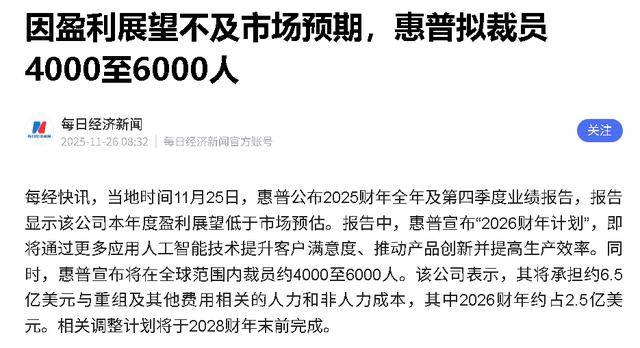
惠普盈利却裁员,6000人被淘汰,机器人上岗潮来临,员工前路难测
Sou Hu Cai Jing· 2025-11-29 23:16
Core Insights - HP announced significant layoffs of 4,000 to 6,000 employees despite reporting increased revenue and strong sales in personal computers, highlighting a disconnect between profitability and workforce stability [1][4] - The trend of layoffs is not isolated to HP; other tech giants like Amazon, Microsoft, and Intel are also reducing their workforce despite good financial performance, indicating a broader industry shift [4][5] - The drive for efficiency and cost-cutting is being fueled by investor pressure, leading companies to prioritize productivity over headcount [7][9] Group 1: Layoff Trends - HP's decision to cut jobs comes after previous layoffs, reflecting a growing trend in the tech industry where companies are downsizing even when they are financially healthy [1][4] - The layoffs are particularly affecting older employees who may find it challenging to adapt to the changing job market [1][2] Group 2: Impact of Technology - The rise of AI and automation is replacing many traditional roles, allowing companies to operate with fewer employees while maintaining or increasing efficiency [9][11] - Companies are increasingly relying on technology to handle tasks that previously required human labor, leading to a significant reduction in the workforce [9][11] Group 3: Employment Landscape - The job market is becoming increasingly competitive, with many individuals forced into freelance work as traditional job security diminishes [11][13] - There is a growing need for workers to acquire new skills to remain employable, as the demand for high-skilled positions rises [11][13] Group 4: Societal Implications - The rapid changes in the job market due to technological advancements are creating significant pressure on individuals and families, necessitating a collective response from government and businesses to support workforce retraining [13][16] - The challenge lies in ensuring that technology serves to enhance human capabilities rather than replace them, which is crucial for future employment stability [16]


泡沫、壁垒、裁员
Xin Hua She· 2025-11-25 00:25
Group 1: AI Bubble Concerns - The performance of major companies in the AI sector has been robust, with firms like Nvidia exceeding revenue and profit expectations, yet concerns about an AI bubble are growing among analysts [2][3] - Major tech companies, including Amazon, Alphabet, and Microsoft, have raised their capital expenditure forecasts, collectively expecting to exceed $380 billion in investments this year, but market reactions to these investments have varied [2] - A survey by Bank of America indicates that over half of fund managers believe there is a bubble in AI stocks, particularly among the "Tech Giants," suggesting an over-concentration of market funds [3] Group 2: Impact of Tariff Barriers - The impact of U.S. tariff policies has become more pronounced in Q3, negatively affecting the earnings and forecasts of export-oriented companies in Europe and Japan [4][5] - European luxury goods companies have reported significant revenue declines, with LVMH's fashion and leather goods division seeing a roughly 8% drop and Kering's Gucci brand experiencing a 22% decline in revenue [4] - Japanese automakers have collectively faced a 2.5% drop in net profits, with estimates suggesting that U.S. tariffs on imported vehicles could lead to losses of approximately 1.5 trillion yen for major Japanese car manufacturers [4] Group 3: Consumer Sentiment and Layoffs - U.S. consumer sentiment is notably low, with major companies announcing significant layoffs, contributing to a bleak economic outlook [7] - The disparity in consumer spending is evident, as affluent consumers maintain or increase their spending while lower-income consumers are forced to cut back [7] - The number of layoffs in the U.S. has reached nearly 1 million in the first nine months of the year, the highest since 2020, raising concerns about potential economic recession [7]


【环球财经】泡沫、壁垒、裁员——从跨国企业季报看世界经济风险与挑战
Xin Hua She· 2025-11-24 06:37
Group 1: Core Insights - The earnings reports from major companies in developed economies show mixed results, with rising concerns over the AI bubble and tariff barriers impacting profitability [1][2][4] - Major tech companies like Nvidia, Amazon, Alphabet, and Microsoft reported strong third-quarter earnings, but there are growing worries about the sustainability of AI investments [2][3] Group 2: AI Bubble Concerns - Over half of fund managers surveyed believe that AI stocks are in a bubble, with excessive investment in major tech firms leading to concentrated market risks [3] - The S&P 500's cyclically adjusted price-to-earnings ratio has reached its highest level since the dot-com bubble, raising fears of a potential economic downturn if the AI bubble bursts [3] Group 3: Impact of Tariff Barriers - U.S. tariff policies have significantly affected the earnings of export-oriented companies in Europe and Japan, with many firms facing increased costs [4][5] - European luxury brands like LVMH and Kering reported substantial revenue declines due to high tariffs, with LVMH's fashion and leather goods revenue down approximately 8% and Kering's Gucci brand down about 22% [4] Group 4: Consumer Sentiment and Layoffs - U.S. consumer sentiment is notably low, with significant layoffs occurring across various sectors, contributing to economic uncertainty [7] - Major companies, including Amazon and Target, have announced layoffs totaling around 80,000 employees, reflecting a stagnating job market and potential recession risks [7]
泡沫、壁垒、裁员——从跨国企业季报看世界经济风险与挑战
Xin Hua Wang· 2025-11-24 03:40
Group 1: AI Bubble Concerns - The performance of major companies in the AI sector has been strong, with firms like Nvidia exceeding revenue and profit expectations, but concerns about an AI bubble are growing [2][3] - Major tech companies, including Amazon, Alphabet, and Microsoft, are increasing capital expenditures in AI infrastructure, with a total expected to exceed $380 billion this year, yet market reactions to these investments vary [2] - A survey by Bank of America indicates that over half of fund managers believe AI stocks are in a bubble, with high valuations raising concerns about potential market impacts if AI development underperforms [3] Group 2: Impact of Tariff Barriers - The impact of U.S. tariff policies has become more pronounced, negatively affecting the earnings of export-oriented companies in Europe and Japan, as well as U.S. firms facing additional costs [4][5] - European luxury goods companies are experiencing significant revenue declines, with LVMH's fashion and leather goods revenue down approximately 8% and Kering's Gucci brand down about 22% year-over-year [4] - Japanese automakers are also suffering, with estimates suggesting that U.S. tariffs could lead to losses of approximately 1.5 trillion yen for seven major car manufacturers [4] Group 3: Consumer Sentiment and Layoffs - U.S. consumer sentiment is notably low, with major companies announcing significant layoffs, contributing to economic uncertainty [7] - The disparity in consumer spending is evident, as affluent consumers maintain or increase spending while lower-income consumers are forced to cut back [7] - Layoffs in the U.S. have reached nearly 1 million in the first nine months of the year, the highest for that period since 2020, raising concerns about future consumer spending [7]
国际观察丨泡沫、壁垒、裁员——从跨国企业季报看世界经济风险与挑战
Xin Hua Wang· 2025-11-24 03:28
Group 1: AI Bubble Concerns - Concerns about an AI bubble are rising as the enthusiasm for investment in AI infrastructure has cooled despite strong performances from companies like Nvidia, Amazon, Alphabet, and Microsoft [2][3] - Nvidia's third-quarter revenue and profit exceeded expectations, but analysts believe its results do not fully alleviate market concerns about an AI bubble [2] - A survey by Bank of America indicates that over half of fund managers believe AI stocks are in a bubble, with high valuations posing risks to financial markets [3] Group 2: High Tariff Barriers Impacting Performance - The impact of U.S. tariff policies has become more pronounced, negatively affecting the quarterly performance and annual forecasts of many export-oriented companies in Europe and Japan [4][5] - European luxury goods companies are facing significant revenue declines, with LVMH's fashion and leather goods revenue down approximately 8% and Kering's Gucci brand down about 22% year-over-year [4] - German automakers are also suffering, with Porsche's automotive business profit plummeting nearly 99% and Volkswagen's operating profit down 58% due to high tariffs [4] Group 3: Consumer Slowdown and Layoff Trends - U.S. consumer sentiment is notably low, with major companies announcing significant layoffs, contributing to economic uncertainty [6][7] - Kraft Heinz's CEO noted that consumer sentiment is at one of its lowest points in decades, indicating a split in consumer spending behavior [6] - Layoffs have reached nearly 1 million in the U.S. in the first nine months of the year, the highest since 2020, with major companies like Amazon and Target laying off approximately 80,000 employees [7]
我,国资投资人,今年绩效停发
母基金研究中心· 2025-11-12 08:51
Core Insights - The article highlights a significant trend of salary reductions and layoffs within state-owned investment institutions, reflecting broader challenges in the equity investment industry due to poor market conditions and unmet performance targets [2][3][6][7]. Group 1: Salary Reductions and Performance Issues - State-owned investment institutions are experiencing salary cuts, with some reporting a reduction of around 25% compared to the previous year, primarily due to unmet performance targets and a challenging investment environment [2][3][4]. - The performance evaluation for fund managers is shifting towards a more lenient approach, emphasizing the need for flexibility in performance assessments [2][3]. - The implementation of a "salary cap order" by the Ministry of Finance has led to stricter salary management, with some institutions actively recovering previously paid salaries [6][7]. Group 2: Industry-Wide Impact - The equity investment industry is facing a continuous "salary reduction wave," with the median annual salary for front-line investment managers dropping to 300,000 yuan in 2024 [7]. - There is a widening salary gap among different types of institutions, with state-owned enterprises experiencing the most significant declines in overall salary levels [7][8]. - Many investment professionals are transitioning to other roles or industries due to the inability to secure new funding or make investments, with some taking on side jobs or shifting to post-investment management [10][11]. Group 3: Organizational Changes and Adaptations - Some state-owned investment institutions are implementing "last-place elimination" policies, where employees with poor performance ratings face termination [5]. - The restructuring within investment firms includes not only salary cuts but also layoffs and demotions, reflecting a broader trend of cost optimization [9]. - Investment professionals are increasingly focusing on post-investment management as a way to adapt to the current market conditions, recognizing the importance of supporting portfolio companies [10][11].

贵金属日评:美国就业表现趋弱支撑贵金属价格-20251107
Hong Yuan Qi Huo· 2025-11-07 03:15
Report Summary 1. Report Industry Investment Rating - Not provided in the report. 2. Core Viewpoints - The weak employment performance in the US supports the prices of precious metals. The high number of corporate lay - offs in the US in October has increased the probability of a Fed rate cut in December. Along with factors such as the Fed providing liquidity, geopolitical risks, and central banks' gold - buying, precious metal prices may be supported [1]. 3. Summary by Related Catalogs Precious Metal Market Data - **Gold**: - Shanghai Gold futures' closing price was 917.80 yuan/g, with a change of 5.54 yuan compared to the previous day and - 4.12 yuan compared to the previous week. The trading volume was 238,433.00, a decrease of 157,531.00 from the previous day. The inventory remained at 87,816.00 (in ten - gram units) [1]. - COMEX gold futures' closing price was 3941.70 dollars/ounce, with a change of 43.10 dollars compared to the previous day and - 5.60 dollars compared to the previous week. The trading volume was 281,102.00, a decrease of 97,457.00 from the previous week [1]. - London gold spot price was 3968.20 dollars/ounce, with a change of - 20.20 dollars compared to the previous week [1]. - **Silver**: - Shanghai Silver futures' closing price was 11427.00 yuan/ten - gram, with a change of 151.00 yuan compared to the previous day and - 14.00 yuan compared to the previous week. The trading volume was 571,201.00, a decrease of 306,143.00 from the previous week [1]. - COMEX silver futures' closing price was 47.85 dollars/ounce, with a change of - 0.02 dollars compared to the previous day and 0.57 dollars compared to the previous week. The trading volume was 74,607.00, a decrease of 24,464.00 from the previous week [1]. - London silver spot price was 47.61 dollars/ounce, with a change of 0.51 dollars compared to the previous week [1]. Important Information - The direction of the Fed's December rate cut is unclear. This year's voting members are hesitant due to the government shutdown, and next year's members are more concerned about inflation. The Bank of England kept the interest rate at 4%, and the expectation of a December rate cut is rising [1]. - The AI revolution has accelerated the lay - off wave. In October, the number of Challenger corporate lay - offs in the US increased by 175.3% year - on - year, reaching the highest level in the same period in twenty years. The private data provider Revelio Labs reported a decrease of 9100 in non - farm employment in October [1]. Investment Strategy - Temporarily stay on the sidelines. For London gold, pay attention to the support level around 3580 - 3860 and the resistance level around 4180 - 4384; for Shanghai gold, focus on the support level around 830 - 860 and the resistance level around 950 - 1000. For London silver, pay attention to the support level around 39 - 42 and the resistance level around 50 - 55; for Shanghai silver, focus on the support level around 9400 - 10000 and the resistance level around 11600 - 12400 [1].