Nokia(NOK)

Search documents
6G时代,要来了
半导体行业观察· 2026-01-04 01:48
Core Insights - The discussion on 6G standards officially commenced in early 2025, with a series of research and seminars aimed at reaching industry consensus on the next generation of mobile communication technology. By the end of this year, the blueprint for 6G is expected to become clearer, with the first commercial 6G services anticipated to launch around 2030 [1][2] - The United States plans to showcase 6G technology during the 2028 Summer Olympics in Los Angeles, with demonstrations organized by the National Telecommunications and Information Administration (NTIA) [1] - The initial 6G specifications will be included in the 21st release of 3GPP, with a timeline for this work to be established by June 2026. The full-scale work is expected to begin in March 2027, with a typical release cycle lasting about 18 months [1] Group 1 - The ongoing phase of research and discussions regarding 6G will continue until the end of this year and early 2027, amidst geopolitical factors that may introduce friction in global efforts [2] - 3GPP has initiated research on 6G technology alongside the development of 5G Advanced specifications, emphasizing the need for continuity between the two technologies [4] - Major equipment suppliers like Ericsson, Huawei, and Nokia view 5G Advanced as foundational for 6G, with expected advancements in machine learning integration, energy efficiency, latency reduction, advanced MIMO technology, and satellite integration [4] Group 2 - Collaboration among standard organizations is expected to intensify this year, with ETSI hosting a workshop in April 2025 to explore synergies in open RAN efforts with O-RAN Alliance and 3GPP [6] - Artificial intelligence is anticipated to permeate various aspects of 6G, influencing standardization processes related to interfaces, protocols, and algorithms, as well as playing a crucial role in network security discussions [6]


英国《金融时报》:诺基亚如何从iPhone受害者变成10亿美元的英伟达交易对象
美股IPO· 2026-01-02 16:04
Core Viewpoint - Nokia has undergone a significant transformation to embrace the artificial intelligence revolution, shifting its focus from mobile phones to providing hardware necessary for cloud services and data centers, supported by a $1 billion investment from Nvidia [1][3][15]. Group 1: Historical Context - Nokia was a dominant player in the mobile phone industry, with its iconic ringtone played 1.8 billion times daily by 2009, and held a 26.4% market share in 2000 [3][11]. - The company's market value peaked at approximately €286 billion during the internet bubble, contributing about 4% to Finland's GDP [11]. - Nokia sold 126 million units of its popular 3310 model, which featured the famous Snake game [11]. Group 2: Strategic Shifts - The rise of smartphones, particularly the iPhone in 2007, led to a dramatic decline in Nokia's sales, resulting in a loss of market share from nearly 40% in 2008 to a significant drop by 2014 [12][14]. - Nokia's decision to adopt Microsoft's Windows Phone in 2011 was a critical misstep, leading to poor sales of the Lumia brand and ultimately the sale of its devices and services division to Microsoft for €5.4 billion [12][13]. - Under CEO Rajeev Suri, Nokia shifted focus to network services, acquiring Alcatel-Lucent for €15.6 billion, which was a controversial but pivotal move for the company [13]. Group 3: Current Developments - Nokia is now focusing on emerging technologies such as cloud services and optical networks, with a recent acquisition of Infinera for $2.3 billion [15]. - The company aims to capitalize on the "AI supercycle," which is expected to drive significant spending in data centers, with its fiber technology facilitating information transfer [15]. - Following Nvidia's investment, Nokia's stock rose by 25%, although its current market value of approximately €32 billion is still far from its historical highs [15]. Group 4: Challenges Ahead - Analysts express concerns about Nokia's new strategy, highlighting the volatile nature of AI investments and the presence of competitors like Ciena and Cisco [16]. - There are significant worries among network operators regarding the future returns on AI investments, as they prefer not to rely heavily on a single supplier [16]. - Despite these challenges, Nokia's CEO remains optimistic about the company's ability to adapt and navigate the evolving landscape [16].

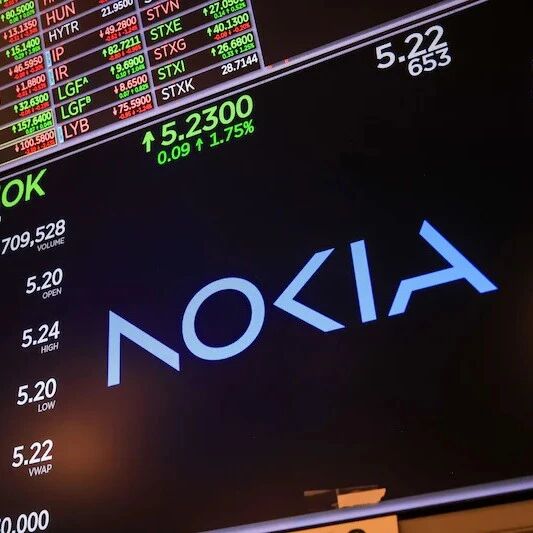
Here’s What Wall Street Thinks About Nokia Oyj (NOK)
Yahoo Finance· 2025-12-31 16:42
Core Viewpoint - Nokia Oyj is recognized as one of the best-performing quantum computing stocks in 2025, with positive ratings from analysts and growth projections in sales and key segments [1][2]. Group 1: Analyst Ratings and Price Targets - J.P. Morgan analyst Sandeep Deshpande maintained a Buy rating on Nokia with a price target of €6.90 [1]. - Raymond James also reiterated a Buy rating and raised the price target from $6.50 to $7 [1][2]. Group 2: Sales Growth Projections - Analysts at Raymond James project mid-single-digit sales growth for Nokia in 2026 and 2027, with one-third of this growth expected from the company's IP and Optical segments, which are currently growing by mid-teen percentages [2]. Group 3: Strategic Partnerships and Initiatives - Nokia announced a partnership with Bharti Airtel to make its network available to third-party developers through the Network as Code platform, which functions like an app store for networks [3]. - The company is focused on building infrastructure for mobile and fixed networks, including 5G, fiber, cloud, and data center solutions [4]. Group 4: Quantum Initiatives - Nokia's quantum initiatives encompass four key areas: Quantum Security, Computing, Networks, and Sensing [4].
3 Must-Watch 5G Stocks Poised for the Next Growth Wave in 2026
ZACKS· 2025-12-22 18:01
Industry Overview - The 5G rollout has entered a new phase in 2025, driven by enterprise deployments and next-generation technologies like private wireless, IoT, and edge computing [1] - The U.S. 5G market is highly saturated, with major telecom providers covering over 300 million people [1] - North America has the highest 5G adoption rates, while South East Asia and Oceania are emerging markets for 5G, with subscriptions projected to reach around 680 million by 2031 [2] Market Dynamics - The 5G infrastructure market is expected to grow at a 13.1% compound annual growth rate (CAGR) from 2026 to 2033, while the 5G services market is projected to grow at a 62.2% CAGR from 2025 to 2030 [4] - Digital transformation across industries is driving demand for 5G, as organizations seek automation and secure connectivity for remote and hybrid work models [5] - The rise in high data-intensive applications, such as streaming services and multiplayer gaming, is increasing data traffic and pressuring existing telecom infrastructure [7][8] Company Highlights - Ericsson is a leading provider of communication networks and has secured a historic five-year contract with AT&T worth $14 billion to accelerate the deployment of an open and interoperable Radio Access Network [10][11] - Nokia has made significant progress in its 5G portfolio and has secured multiple customer wins, including partnerships with Vodafone Three and Bharati Airtel [14][16] - CommScope is focused on providing infrastructure solutions that support the convergence of wireline and wireless networks, essential for 5G technology [18][19] Financial Performance - Ericsson's stock has gained 19.4% over the past year, with earnings estimates improving to 5.63% for 2025 [12] - Nokia's stock has increased by 46.1% over the past year, with earnings estimates improving to 6.67% for 2025 [17] - CommScope's stock has surged by 232.5% over the past year, with earnings estimates improving to 27.91% for 2025 [20]


Network API Market to Surpass USD 27.01 Billion by 2033, Driven by 5G Expansion and Demand for Real-Time Connectivity | Report by SNS Insider
Globenewswire· 2025-12-20 08:00
Core Insights - The Network API Market is projected to grow from USD 2.15 billion in 2025 to USD 27.01 billion by 2033, with a CAGR of 37.32% from 2026 to 2033 [1][2] Market Drivers - The demand for seamless integration, real-time data exchange, and enhanced connectivity across cloud services, corporate applications, and IoT ecosystems is driving the growth of the Network API market [2] - The adoption of digital transformation projects, 5G networks, and AI-based services is increasing the need for reliable, scalable, and secure APIs [2] Regional Insights - North America holds a dominant share of 42.00% in the Network API Market in 2025, attributed to advanced digital infrastructure and strong enterprise integration of API-driven solutions [10] - The Asia Pacific region is expected to experience the fastest growth with a CAGR of approximately 40.25% from 2026 to 2033, driven by rapid digital transformation and increasing smartphone penetration [10] Market Segmentation By Type - Communication & Messaging APIs lead with a 29.4% market share, essential for real-time interactions and enterprise messaging workflows [5] - Device & IoT Connectivity APIs are the fastest-growing segment, with a CAGR of 28.6%, driven by the rapid expansion of IoT across various industries [5] By Network Type - 3G/4G/LTE Networks account for 41.7% of the market share, serving as the foundation for API-driven telecom services [6] - 5G Networks are the fastest-growing segment, with a CAGR of 30.3%, due to their ultra-low latency and high bandwidth capabilities [6] By Application - IT & Telecom sectors lead with a 33.8% share, relying heavily on APIs for network optimization and operational automation [8] - BFSI is the fastest-growing segment, with a CAGR of 27.4%, driven by the demand for secure financial APIs [8] By End-User - Enterprises hold a 36.2% share, integrating APIs to streamline workflows and enhance connectivity [9] - Developers represent the fastest-growing segment, with a CAGR of 26.1%, due to the increasing availability of open APIs [9] Recent Developments - In 2024, Ericsson launched its Network API Platform, providing enterprises and developers access to real-time 5G network capabilities [14] - In 2025, Nokia introduced Network as Code (NaC), a cloud-native platform offering self-service access to 5G and fixed network APIs [14] Key Players - Major companies in the Network API market include Ericsson, Nokia, Cisco, Microsoft, AT&T, and others [13]





Is Nokia a Must-Own Stock for 2026?
The Motley Fool· 2025-12-19 20:30
Core Viewpoint - Nokia's partnership with Nvidia significantly enhances its artificial intelligence (AI) strategy, positioning the company as a key player in the AI era, with stock surging over 40% in 2025 [2][4]. Company Overview - Nokia has transitioned from a mobile phone leader to focusing on networking infrastructure and wireless network solutions [1]. - The company experienced a 9% revenue decline in 2024, totaling 19.2 billion euros, but is seeing transformative changes in 2025 [4][11]. Partnership with Nvidia - Nokia announced a partnership with Nvidia to develop a wireless network that supports AI applications at the edge, marking a strategic shift towards AI emphasis [5][6]. - The collaboration aims to create a 6G wireless system utilizing AI radio access network (AI-RAN) technology, which enhances network management for improved performance [6][8]. - Nvidia will invest $1 billion in Nokia by purchasing shares at $6.01 each, further solidifying the partnership [7]. Financial Performance - In Q3 2025, Nokia reported a revenue increase of 12% year-over-year, reaching 4.8 billion euros, aided by the acquisition of Infinera [11]. - Despite revenue growth, Q3 operating profit fell 14% to 239 million euros, and diluted earnings per share (EPS) dropped 67% to 0.01 euros due to rising costs [12]. - The company is targeting cost savings of 1.2 billion euros by the end of 2026, having already achieved 0.8 billion euros in savings [12]. Market Outlook - The AI market is projected to grow to $4.8 trillion by 2033, representing a 25-fold increase from 2023's $189 billion, which bodes well for Nokia's AI initiatives [13]. - The demand for AI-driven wireless solutions is expected to rise, driven by advancements in self-driving cars, drones, and robotics [10]. Competitive Landscape - Nokia's focus on AI-RAN technology is seen as a strong strategy, but it faces competition from companies like Ericsson and Cisco Systems [14]. - The company's forward price-to-earnings (P/E) ratio is comparable to Cisco's, but it must demonstrate long-term financial success to be considered a strong buy [15][17].

Acer, Asus and Hisense win UK court ruling in video streaming patent dispute with Nokia
Reuters· 2025-12-18 14:54
Core Point - Taiwanese tech companies Acer and Asus, along with China-based Hisense, achieved a favorable ruling from London's High Court in their global patent dispute with Nokia regarding video coding technology [1] Company Summary - Acer, Asus, and Hisense are involved in a legal battle with Nokia over video coding technology patents [1] - The ruling from the High Court in London is a significant development for these companies in the context of their ongoing patent disputes [1]


4 Tech Stocks Under $10 With Strong Growth Potential for 2026
ZACKS· 2025-12-18 14:41
Industry Overview - The technology sector is experiencing strong growth in 2025, driven by cloud computing, artificial intelligence (AI), cybersecurity, data-center expansion, and digital transformation [2] - The sector has gained 25.3% year to date, outperforming the S&P 500's growth of 19.2% [3] - Approximately 61% of investors believe the technology sector will attract the most investment over the next three years, surpassing all other sectors [3] Future Outlook - The outlook for the technology sector in 2026 appears positive, supported by ongoing enterprise investment in AI, software automation, and digital engagement tools [4] - Demand for specialized technologies is expected to accelerate as organizations seek to extract more value from data and improve operational agility [4] Investment Opportunities - Investing in low-priced tech stocks can provide attractive upside potential, especially when these companies show improving fundamentals and clear growth drivers [5] - Nokia (NOK) is well-positioned in the technology cycle, with a strong 5G portfolio and a stable balance sheet, holding €4.89 billion ($5.74 billion) in cash as of September 30, 2025 [6][7] - Lantronix, Inc. (LTRX) is gaining traction in Edge AI and drones, with a significant increase in drone OEM engagements from 10 to 17 [12][13] - Taboola.com Ltd. (TBLA) is expanding its performance advertising platform, Realize, and reported adjusted EBITDA of about $48 million with margins exceeding 27% in Q3 2025 [19][20] - TransAct Technologies (TACT) is experiencing strong momentum in its Foodservice Technology business, with expected net sales between $50 million and $53 million for full-year 2025 [23][24] Company Performance - Nokia targets an annual comparable operating profit of €2.7–€3.2 billion by 2028 and has a Zacks Rank 2 (Buy) [10] - Lantronix has a Growth Score of A, with a stock surge of 48.8% over the past year and earnings estimates for the current and next fiscal year increasing by 42.9% and 90%, respectively [16] - Taboola has a Growth Score of A, with a stock gain of 11.4% over the past three months and earnings estimates moving up by 2.2% and 4.3% for the current and next fiscal year [22] - TransAct has a Growth Score of A, with a stock increase of 15.8% over the past six months and earnings estimates rising by 18.4% and 6.9% for the current and next fiscal year [26]




French telecom operator Free joins Nokia’s Network as Code API ecosystem
Globenewswire· 2025-12-18 14:12
Core Insights - French telecommunications operator Free has joined Nokia's Network as Code API ecosystem, facilitating developers and enterprises to utilize Free's advanced network capabilities [2][3] Group 1: Collaboration and Vision - The collaboration aligns with Free's vision to provide equal access to telecommunications services while creating new revenue opportunities through network APIs [3] - Nokia's Network as Code platform now includes over 60 global partners, with diverse use cases across industries such as banking, healthcare, automotive, and entertainment [3] Group 2: Platform Benefits - The addition of Free to Nokia's Network as Code ecosystem highlights the trend towards API-driven network monetization, providing developers with standardized access to network functions [4] - The platform offers a unified interface for accessing network capabilities across multiple operators, reducing complexity and accelerating time-to-market for new applications and services [4] Group 3: Statements from Leadership - Free's CEO, Nicolas Thomas, emphasized the value of providing developers with a standardized method to leverage the network's power, aiming to create new APIs and services for partners, customers, and society [5]

诺基亚完成对诺基亚贝尔股权收购
Ju Chao Zi Xun· 2025-12-17 03:42
诺基亚强调,此次收购旨在"优化其在中国的所有权结构"并"简化其在中国的所有权结构"。完成全资控股后,诺基亚贝尔将完全 并入诺基亚的全球运营体系,与其全球战略和管理模式保持一致。这意味着诺基亚在华业务的决策链条将更为顺畅,有利于资源 整合与效率提升。 诺基亚贝尔的前身上海贝尔股份有限公司成立于1984年,是中国第一家中外合资通信企业,股权结构长期为中外各持50%左右 (诺基亚方多1股)。2017年,诺基亚完成对阿尔卡特朗讯的收购后,将其在华业务与上海贝尔整合,成立了上海诺基亚贝尔股份 有限公司,作为其在华的独家运营平台。 根据股权转让时披露的财务信息,诺基亚贝尔2024年实现营收83.91亿元,净利润4209.29万元;2025年前三季度营收46.06亿元, 净利润显著增长至9046万元。截至2025年9月30日,公司总资产达115.69亿元,净资产69.51亿元,为此次股权交易提供了明确的估 值基础。 在全球5G网络建设高峰期渐过、地缘政治环境复杂的背景下,诺基亚此番全资控股在华核心运营实体,被业界视为对中国市场的 长期信心和战略加码。 近日,诺基亚宣布,已于2025年12月12日完成收购中国华信邮电科技有限 ...