
电信设备

Search documents
美国被爆警告叙利亚别用中国电信技术,叙通信部回应
Huan Qiu Shi Bao· 2026-02-27 22:45
Core Viewpoint - The United States has warned Syria against relying on Chinese technology in the telecommunications sector, claiming it contradicts U.S. interests and poses a threat to national security [1][2] Group 1: U.S. Warnings and Diplomatic Engagement - The warning was issued during a private meeting between a U.S. State Department delegation and Syrian Communications Minister Abdul Salam Haykal in San Francisco [1] - The U.S. has urged Syria to use American or allied technologies in telecommunications [2] - The U.S. has expressed concerns regarding Chinese intelligence and security practices, alleging that they could compel Chinese citizens and companies to provide sensitive data [2] Group 2: Syria's Response and Infrastructure Development - The Syrian Communications Ministry stated that decisions regarding equipment and infrastructure will be made based on national technical and security standards [2] - Syria is actively pursuing telecommunications infrastructure development and is exploring the procurement of Chinese technology for building telecom base stations and local internet service provider infrastructure [1] - Syrian officials indicated a need for supplier diversification due to the urgency of infrastructure projects [1]

美股异动|爱立信盘前涨约2% 预计2026年继续裁员5000人削减成本
Ge Long Hui· 2026-02-27 09:46
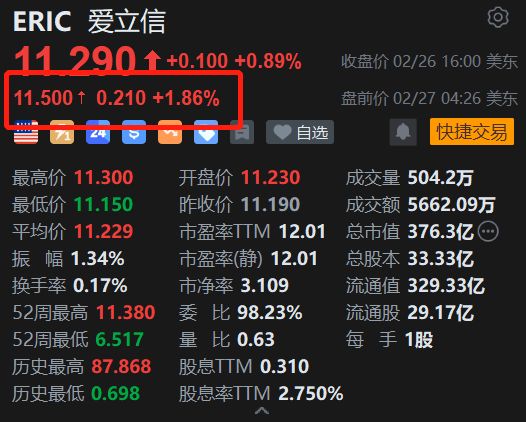
Core Viewpoint - Ericsson's CEO Börje Ekholm announced plans for continued layoffs, with approximately 5,000 jobs to be cut globally by 2025, and further cost reductions expected in 2026. This move is seen as a financial "painkiller" for the company, optimizing costs and supporting profits and stock prices, while also indicating a challenging adjustment period for the telecom equipment industry [1]. Group 1 - Ericsson's stock rose about 2% in pre-market trading following the announcement [1]. - The company is expected to implement layoffs at a consistent pace, indicating a long-term strategy for cost management [1]. - The layoffs are viewed as a necessary measure to navigate the difficult conditions currently faced by the telecom equipment sector [1]. Group 2 - As of the latest trading data, Ericsson's closing price was $11.290, with a pre-market price of $11.500, reflecting a 1.86% increase [1]. - The company's market capitalization stands at $37.63 billion, with a total share count of 3.333 billion [1]. - The stock has experienced a 52-week high of $11.380 and a low of $6.517, indicating significant volatility in its price [1].


美国贸易代表:有些国家要加15%关税,中国不加
Guan Cha Zhe Wang· 2026-02-26 03:00
Core Viewpoint - The U.S. government, following a Supreme Court ruling against "equivalent tariffs," has implemented a 10% global tariff on goods, with plans to increase rates for certain countries to 15% or higher, while not imposing new tariffs on China [2][6][18]. Group 1: Tariff Implementation and Adjustments - The initial 10% tariff on global goods took effect on Tuesday, with plans to raise rates for some countries to 15% or more [2][6]. - U.S. Trade Representative Jamison Greer indicated that the government intends to adhere to agreements made with China and will not raise tariffs on Chinese goods beyond current levels [2][6][18]. - The government is replacing the emergency tariffs that were struck down by the Supreme Court with new tariffs under the Trade Act of 1974, specifically Section 122 for temporary tariffs and Section 301 for investigations into unfair trade practices [4][16]. Group 2: Trade Investigations and Targets - The investigations will focus on countries accused of overcapacity, forced labor in supply chains, discrimination against U.S. tech companies, and subsidies for products like rice and seafood [5][17]. - Greer has claimed that China has not adequately addressed the issue of overcapacity, which serves as a justification for potential tariffs on China and Vietnam [5][17]. Group 3: Future Trade Agreements and Policies - The U.S. plans to utilize the time following the Supreme Court ruling to conduct trade investigations that could lead to more permanent tariffs on specific countries and industries [6][18]. - The U.S. has reached a reciprocal trade agreement with Indonesia, which includes a 19% tariff, and will investigate Indonesia's trade practices under Section 301 [19][20]. - Greer emphasized the importance of maintaining policy continuity in trade agreements while ensuring that any tariff increases comply with legal procedures [20][21]. Group 4: Concerns from Trade Partners - European and other trade partners are concerned that new tariffs may exceed agreed-upon limits in existing trade agreements, prompting the European Parliament to pause legislative work on a trade framework with the U.S. [21]. - President Trump has warned that countries failing to adhere to agreements could face significantly higher tariffs, indicating a potential for new licensing fees as well [21][22]. Group 5: Additional Tariff Considerations - The administration is considering new tariffs on industries such as large batteries, cast iron, plastic pipes, and telecommunications equipment under the Trade Expansion Act of 1962, citing national security risks [22]. - Ongoing investigations may lead to tariffs on additional sectors, including semiconductors and pharmaceuticals, as the government accelerates its review process following the Supreme Court's decision [22].
不是15%?特朗普10%全球关税生效,还有六个行业关税或在路上
Di Yi Cai Jing· 2026-02-24 09:40
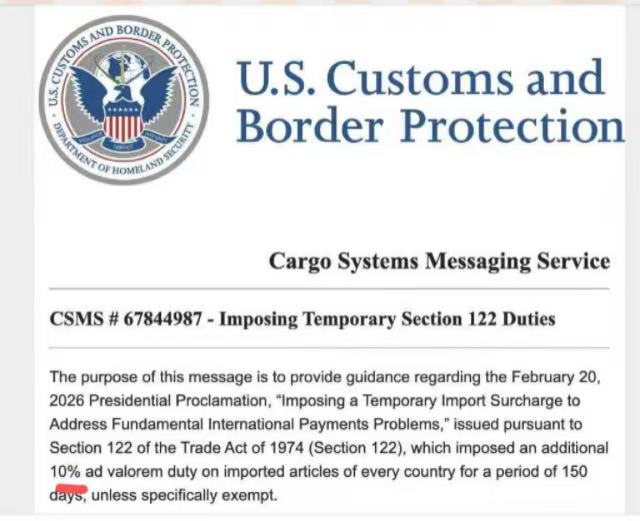
Group 1 - The Trump administration is set to impose a temporary 10% tariff on imports from all countries for 150 days, starting from February 24, 2026, unless explicitly exempted [1][3] - The 10% tariff is a result of the "temporary Section 122 tariff" and is intended to provide guidance on a presidential order issued on February 20, 2026 [4][5] - There is ongoing uncertainty regarding the potential increase of the tariff to 15%, as no official presidential executive order has been issued to implement this change [4][5] Group 2 - The U.S. government is planning to investigate six industries under Section 232 for national security reasons, which may include batteries, cast iron and iron fittings, plastics, industrial chemicals, grid equipment, and telecommunications equipment [1][7] - The Section 232 investigations can lead to indefinite tariffs based on national security assessments, with the process taking approximately nine months [7][8] - The current Section 122 tariff is seen as a transitional measure, allowing the administration time to develop more legally robust tariff measures [7]
美拟对铸铁等六个行业加征新一轮关税
Yang Shi Xin Wen Ke Hu Duan· 2026-02-24 08:03
Core Viewpoint - The U.S. government is considering imposing new tariffs on approximately six industries under the justification of "national security" [1] Group 1: Proposed Tariffs - The proposed tariffs may cover large batteries, cast iron and iron fittings, plastic pipes, industrial chemicals, and equipment for power grids and telecommunications [1] - These new tariffs will be implemented separately from the recently announced global 15% tariff measures [1] Group 2: Legal Framework - The measures will be introduced under Section 232 of the Trade Expansion Act of 1962, which grants the president broad authority to impose tariffs if certain imports are deemed a threat to national security [1] Group 3: Recent Developments - On February 21, former President Trump announced an increase in tariffs on imported goods to the U.S. from 10% to 15%, effective immediately [1] - The U.S. government will determine and announce new "legitimate tariffs" in the coming months [1]
美国考虑对约六个行业加征新一轮关税,可能涵盖大型电池等
Hua Er Jie Jian Wen· 2026-02-24 01:17
Core Viewpoint - The U.S. government is considering imposing a new round of tariffs on approximately six industries under the justification of "national security" [1] Group 1: Proposed Tariffs - The proposed tariffs may cover large batteries, cast iron and iron fittings, plastic pipes, industrial chemicals, as well as grid and telecommunications equipment [1] - These new tariffs will be implemented separately from the recently announced global 15% tariff measures [1]
增持诺基亚,黄仁勋到底想干啥?
Xin Lang Cai Jing· 2026-02-21 00:41
Core Insights - Nvidia's recent investment adjustments, particularly the increase in stake in Nokia, highlight a strategic shift towards enhancing its "physical AI" strategy, focusing on the synergy between computing power and network infrastructure [1][10][12] - The decision to divest from ARM and Applied Digital while increasing holdings in Intel and Synopsys indicates a move towards consolidating efforts in AI infrastructure [3][12][7] Company Overview - Nokia has transitioned from a consumer electronics giant to a leading telecommunications equipment supplier, currently experiencing a recovery with a stock price of $7.77, a 27.59% increase over the past three months, and a market capitalization of $44.617 billion [8][1] - The company has strong capabilities in 5G access, base station software, and optical communication, and is set to enhance its core competencies with the acquisition of Infinera in 2024 [8][1] Strategic Intent - Nvidia's increase in Nokia shares is not a random financial investment but a calculated move to integrate Nokia's network capabilities with Nvidia's AI computing strengths, facilitating the deployment of AI technologies in telecommunications [10][12] - The strategic focus is on creating a closed-loop ecosystem that combines computing power, network infrastructure, and chip design, which is essential for the development of physical AI applications [12][6] Investment Adjustments - Nvidia's divestment from ARM and Applied Digital reflects a strategic realignment to focus on core areas that support the "compute + network" model, avoiding distractions from non-core investments [12][3] - The investments in Intel and Synopsys are aimed at addressing AI chip production bottlenecks and enhancing collaboration in chip design, which are critical for the overall AI infrastructure [12][6]


爱立信和诺基亚在中国,销售额断崖式下跌
半导体芯闻· 2026-02-06 10:12
Core Viewpoint - The article discusses the significant decline in sales and market share of Ericsson and Nokia in the Chinese 5G market due to geopolitical tensions and shifts in customer spending patterns, highlighting the challenges faced by Western telecom suppliers in China [3][5][7]. Group 1: 5G Infrastructure in China - China has built 4.83 million 5G base stations by the end of November, with an increase of 579,000 from the previous year, surpassing the total number installed in Europe since the technology's inception [2]. - The expected explosive growth in 5G spending in China makes it an attractive market for companies like Ericsson and Nokia, especially compared to the more regulated European market [2]. Group 2: Sales Decline of Ericsson - Ericsson's revenue from Chinese customers fell sharply from nearly $1.8 billion in 2019 to approximately $0.798 billion in 2025, representing a decline of over 40% [3]. - The company's market share in China has significantly decreased, with its revenue from the region accounting for only 3% of total sales in the latest quarterly report [3]. - In 2021, Ericsson's sales in China nearly halved to about $1.1 billion, attributed to geopolitical actions against Huawei and ZTE [3]. Group 3: Nokia's Market Challenges - Nokia's market share in China is reported to be only 3% as of 2025, with a significant drop in revenue from nearly €2.2 billion ($2.6 billion) in 2019 to about €1.1 billion ($1.3 billion) in 2025 [4][5]. - The company has hinted at a complete exit from the Chinese mobile communications market, citing national security concerns [5]. - Nokia's revenue in the Greater China region is projected to decline by 19% to €913 million ($1.08 billion) by 2025, which is only 42% of the revenue from seven years ago [5]. Group 4: Strategic Moves and Workforce Reduction - Nokia's acquisition of its subsidiary Nokia Shanghai Bell for €501 million ($592 million) aims to simplify its operations in China while potentially reducing expenditures [6]. - Both Ericsson and Nokia have significantly reduced their workforce in China, with Ericsson's employee count dropping from approximately 14,000 in mid-2021 to about 9,500 by the end of the previous year [7]. - The anticipated exit of both companies from the Chinese market raises concerns about their future in the global 6G market, as Chinese operators invest rapidly in mobile network technology [7].

市场热门的出海公司有哪些
Sou Hu Cai Jing· 2026-02-03 19:31
Group 1: Technology and Internet - Huawei is a global leader in telecommunications equipment and smartphone manufacturing, with products and services available in multiple countries and regions [3] - Xiaomi started with high-cost performance smartphones and has expanded into smart home devices and TVs, holding a strong market share in India and Southeast Asia [3] - ByteDance owns popular applications like TikTok (international version of Douyin) and Helo, which are widely popular globally [4] Group 2: E-commerce - Alibaba operates AliExpress, conducting e-commerce business globally, with notable performance in markets like Russia and Brazil [5] - JD.com expands overseas through its JD Worldwide platform, providing cross-border e-commerce services [6] - SHEIN is a fast-fashion e-commerce platform that has rapidly risen in the European and American markets due to its quick-response supply chain and low-price strategy [7] Group 3: Gaming - Tencent has secured a significant position in the global gaming market through acquisitions of companies like Supercell and Riot Games, and by launching self-developed games such as Arena of Valor [8] - NetEase has achieved success in overseas markets with self-developed games like Onmyoji and is expanding its influence through investments and partnerships [8] - miHoYo has gained immense success in overseas markets with high-quality games like Genshin Impact, becoming one of the most successful Chinese gaming companies in recent years [9] Group 4: Consumer Brands - Anker focuses on the research and sales of smart charging and peripheral products, with strong sales across multiple countries and regions [10] - Haier, a home appliance giant, has established a strong market network globally through acquisitions and localization strategies [11] - Midea has become a globally recognized home appliance brand through technological innovation and international expansion [12] Group 5: Emerging Brands - Perfect Diary, a beauty brand, has rapidly risen in overseas markets through social media marketing and high-quality products [13] - Pop Mart, a trendy toy brand, attracts a large number of young consumers in overseas markets through innovative formats like blind boxes [14]
印度官方证实:已同意从美国采购石油、国防物资及飞机等产品
Xin Lang Cai Jing· 2026-02-03 09:33
Core Viewpoint - India has agreed to purchase a range of goods from the United States, including oil, defense materials, electronics, pharmaceuticals, telecommunications equipment, and aircraft, as part of a trade agreement aimed at reducing the trade deficit with the U.S. [1][2][6] Group 1: Trade Agreement Details - The U.S. will reduce tariffs on Indian goods from 50% to 18% in exchange for India stopping oil imports from Russia and lowering trade barriers [1][6] - India is expected to significantly increase its procurement of U.S. goods, potentially reaching a value of $500 billion, covering energy, coal products, technology, agricultural products, and more [1][6] - The agreement is described as a first-phase trade deal, with plans for a more comprehensive agreement to be negotiated in the coming months [3][9] Group 2: Economic Impact - The trade agreement has positively influenced market sentiment, with India's Nifty 50 index rising nearly 3% and the Indian Rupee appreciating over 1% to 90.40 against the U.S. dollar [5][9] - Data from the Indian Ministry of Commerce indicates that from January to November 2025, India's exports to the U.S. increased by 15.88% to $85.5 billion, while imports from the U.S. totaled $46.08 billion [3][8]